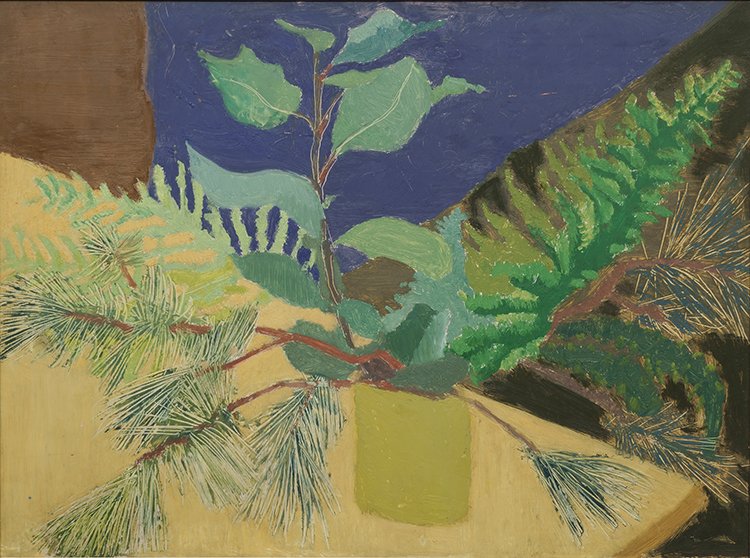
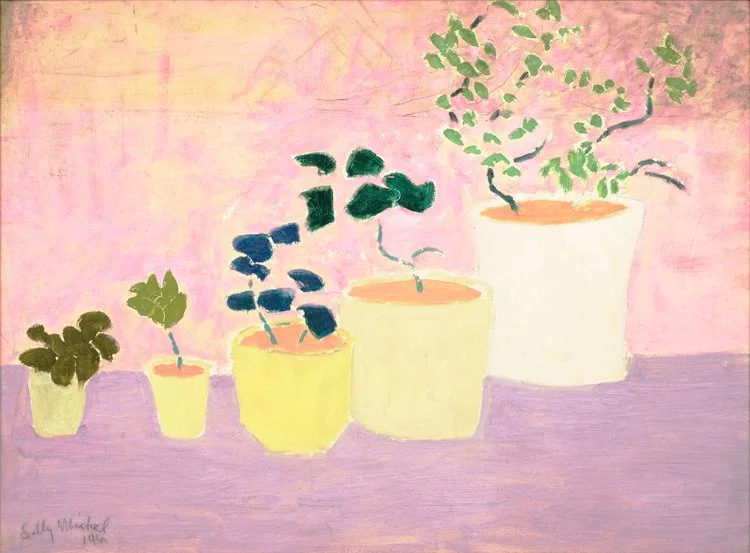
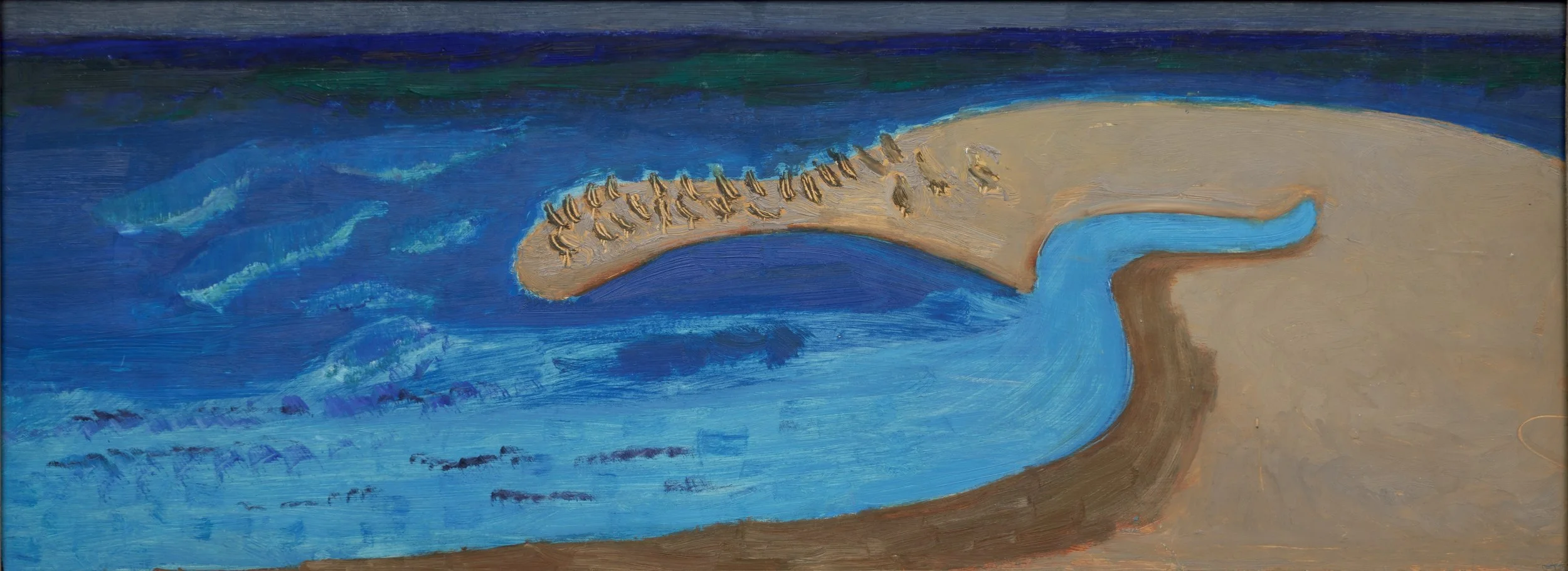
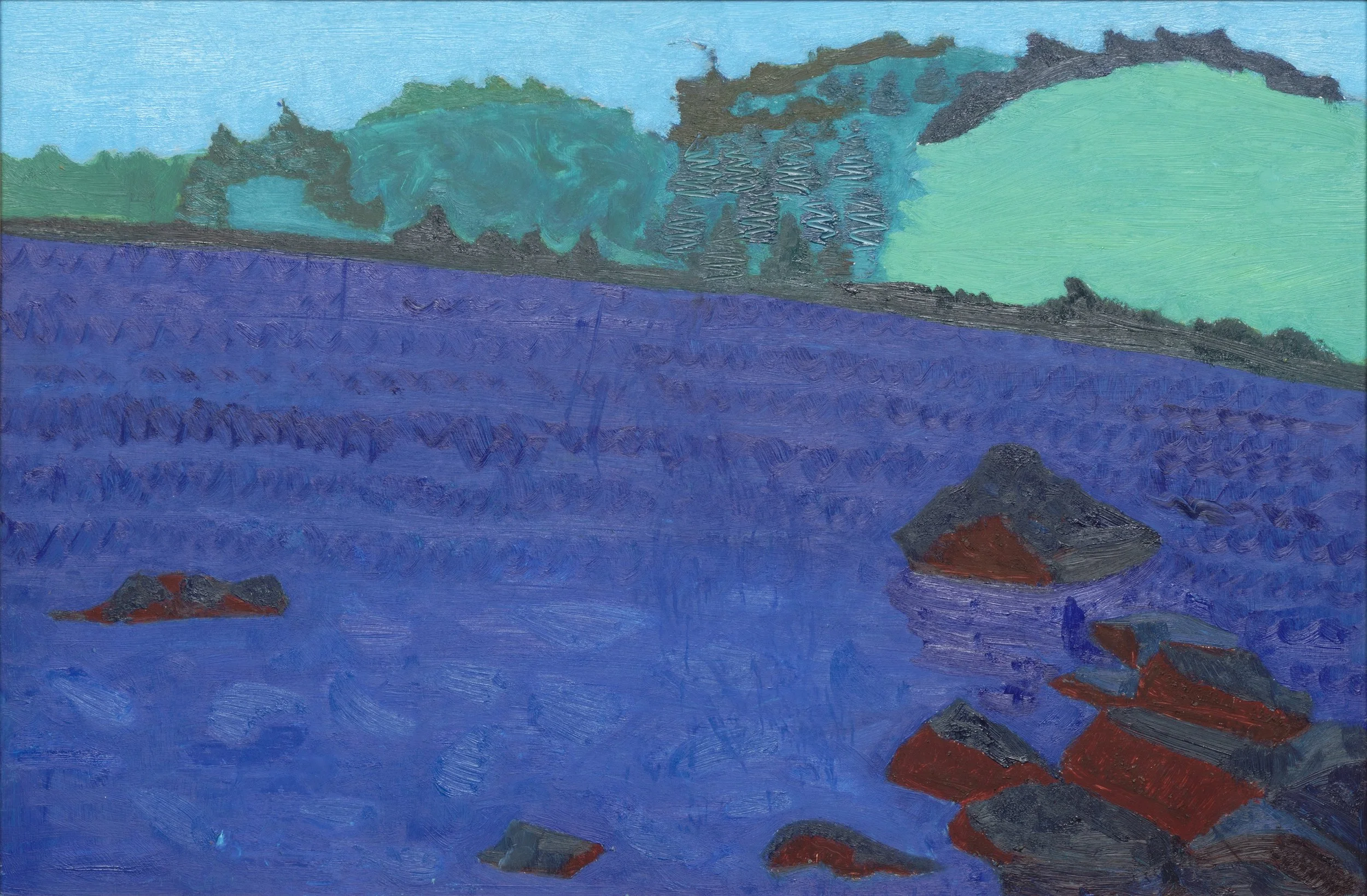
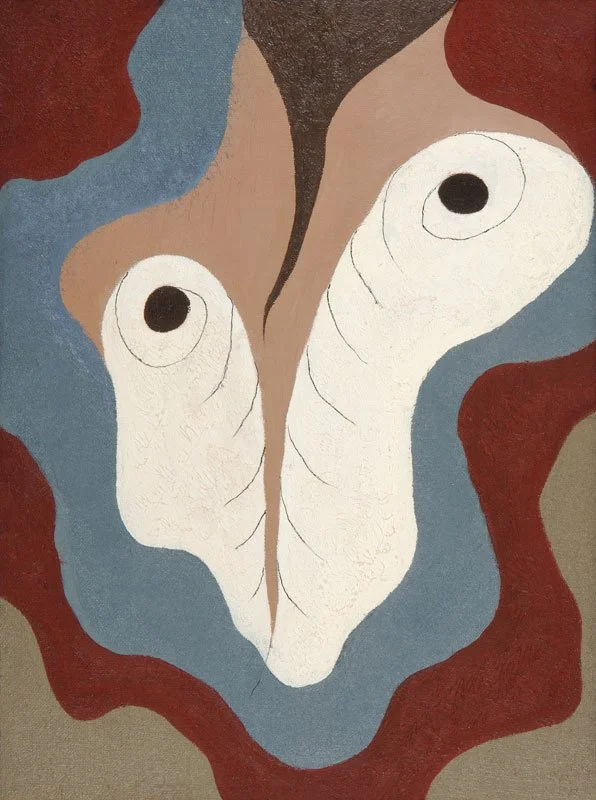
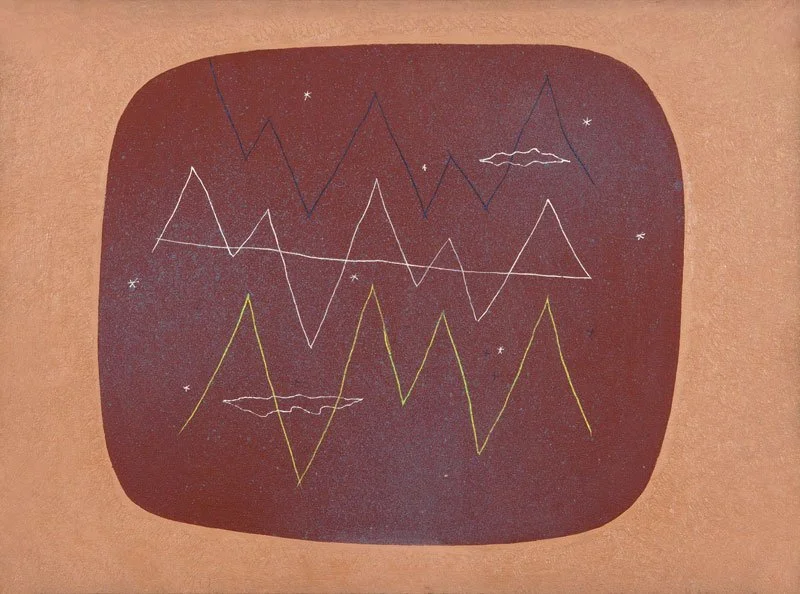
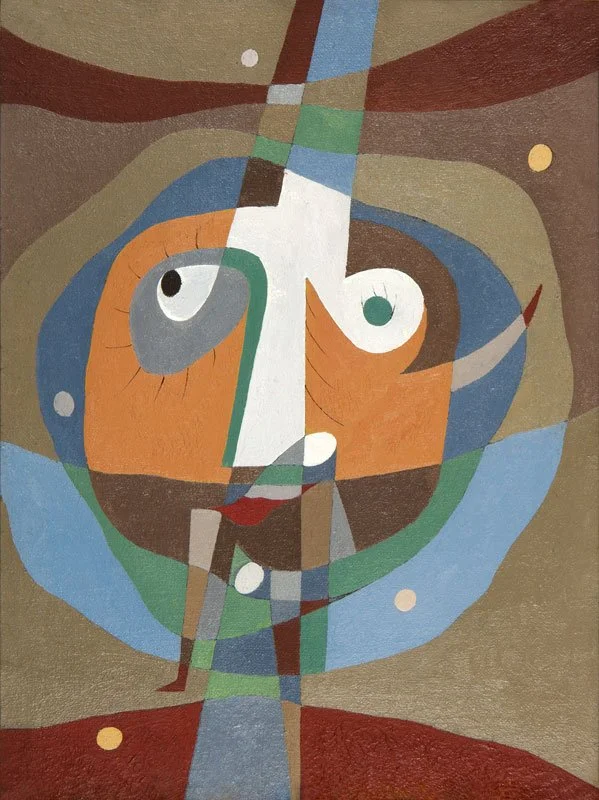
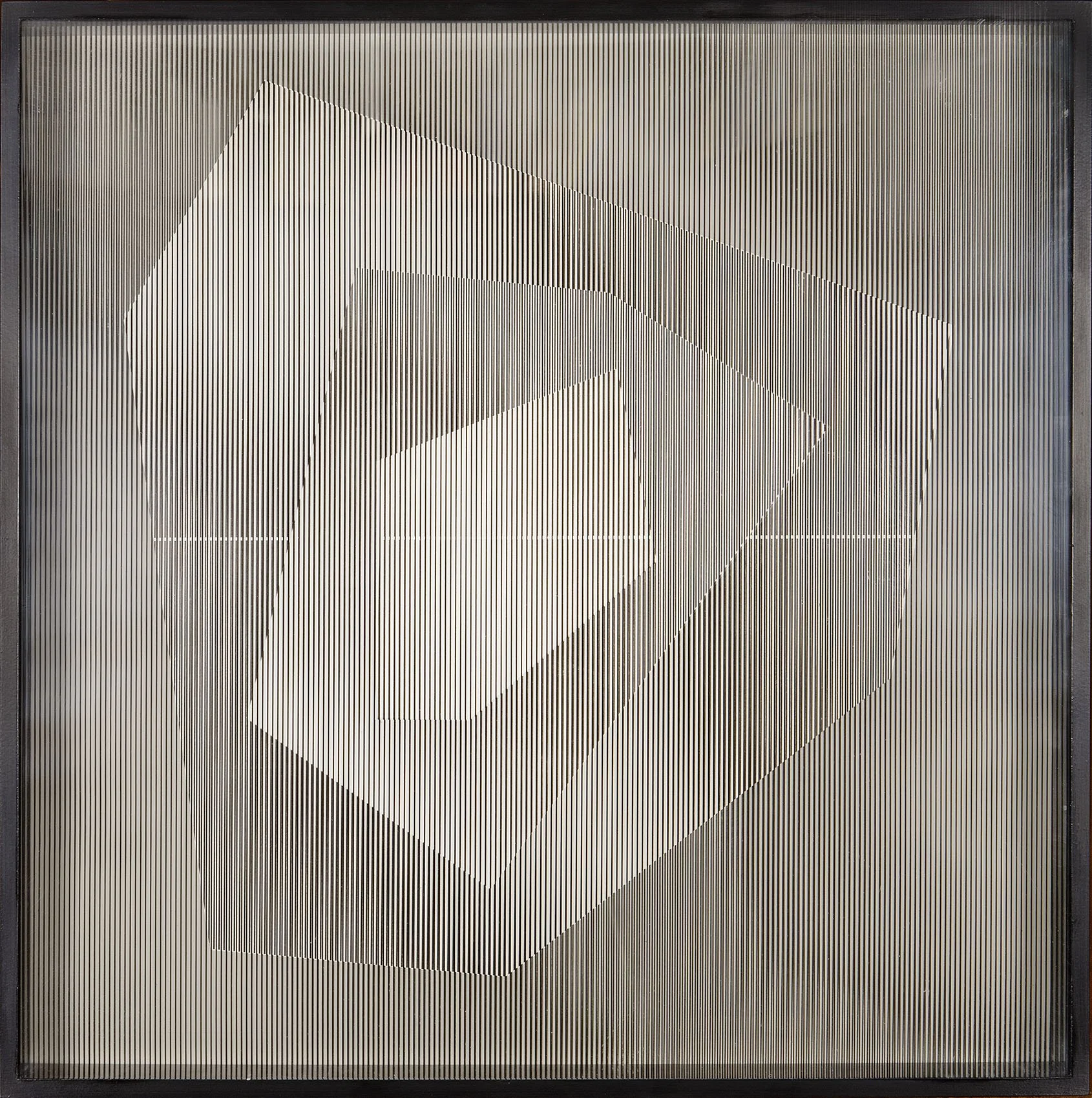
SALLY MICHEL: FIELDS OF COLOR


Essay by Tom Wolf, Professor of Art History, Bard College

When asked, two years after the death of her husband, whether she should be referred to as “Sally Michel or Mrs. Milton Avery”, she replied, “They’re both one and the same.”* Sally Michel married the painter Milton Avery, seventeen years older than she, in 1926 and thereafter her life was intertwined with his. She was a young artist, totally dedicated to painting. In him she found someone equally committed to making art, her life companion until his death in 1965. He had an approach to painting that she found valid and would practice for the rest of her career: “We actually had a lot of the same ideas about art even before we met.…” What attracted him when they met in Gloucester was that, like him, she was up early each morning, going outside with her art materials to make oil paintings.

Art historian Robert Hobbs described the Avery marriage as “a relationship with few parallels in the history of art.” While her commitment to making her own art never wavered, Michel had no problem putting him in the foreground, working to support him financially and promoting his art, while steadily practicing her own painting, usually side by side with him. “I wanted all the spotlight to be on Milton.” “And I really thought Milton’s work was really so much more important than mine.” She did commercial artwork for twenty years so he could devote all his time to painting. In large part the uniqueness of their relationship lay in the fact that she was genuinely happy helping him to be a full-time artist while she made her art in his shadow. She worked on commercial illustration jobs at home, so they were almost constantly together. The day before their daughter was born she made a drawing for Bamberger’s department store that was picked up from the hospital. Avery was not a prima donna—he helped around the house, washing diapers and doing dishes and some of the cooking. She wrote his letters; “and... all those statements that were made for magazines and when they asked for credos, I just wrote up something. . . But actually, I was saying what I knew he thought.” As artist and writer Frederick Wight observed, “Sally Avery speaks for her husband, bridging over his shyness; or rather he speaks through her, since it is obvious that she says what he needs said.” They fit together like two interlocking color areas in one of their paintings, complementing and strengthening each other.

Their art developed together. Curator Barbara Haskell has pointed out that when Avery moved to New York to pursue Michel he had not yet experienced the modernist art that had burst out in Europe and was making an impact in the New York art world. His style had developed out of late 19th century American prototypes. After he relocated and they were married (as Michel said, “He chased me until I caught him”) he started painting with flatter, more simplified shapes. When Avery and Michel met in Gloucester they were painting outside, but once they settled in New York they preferred to sketch on paper outdoors and then develop their sketches into oil paintings on canvas at home.

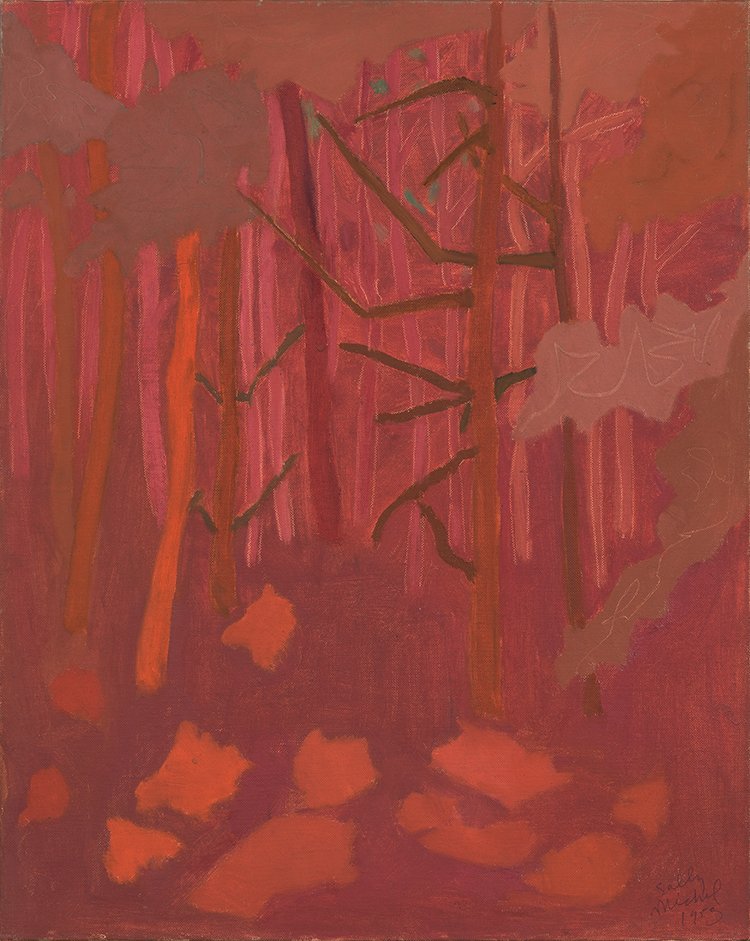
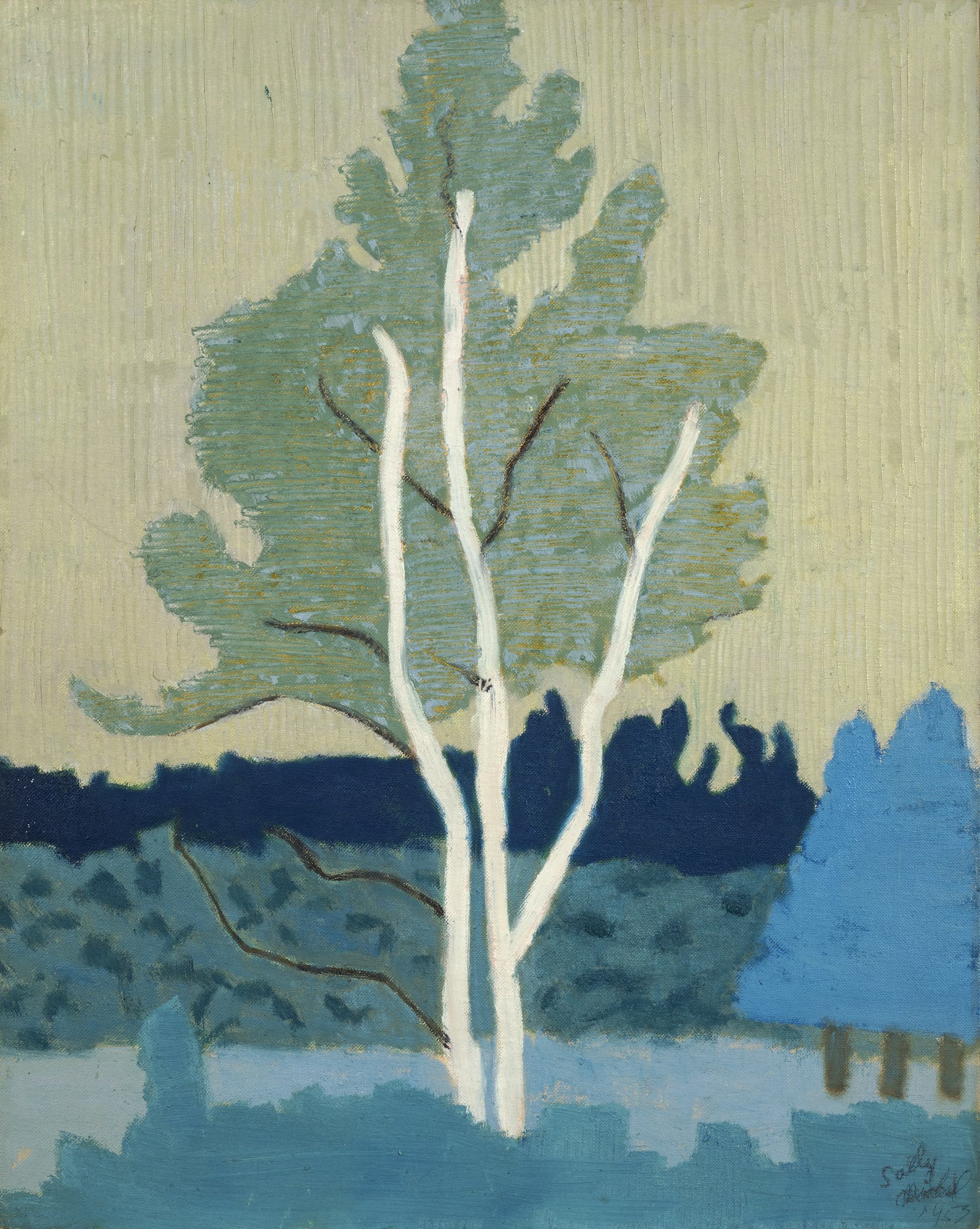
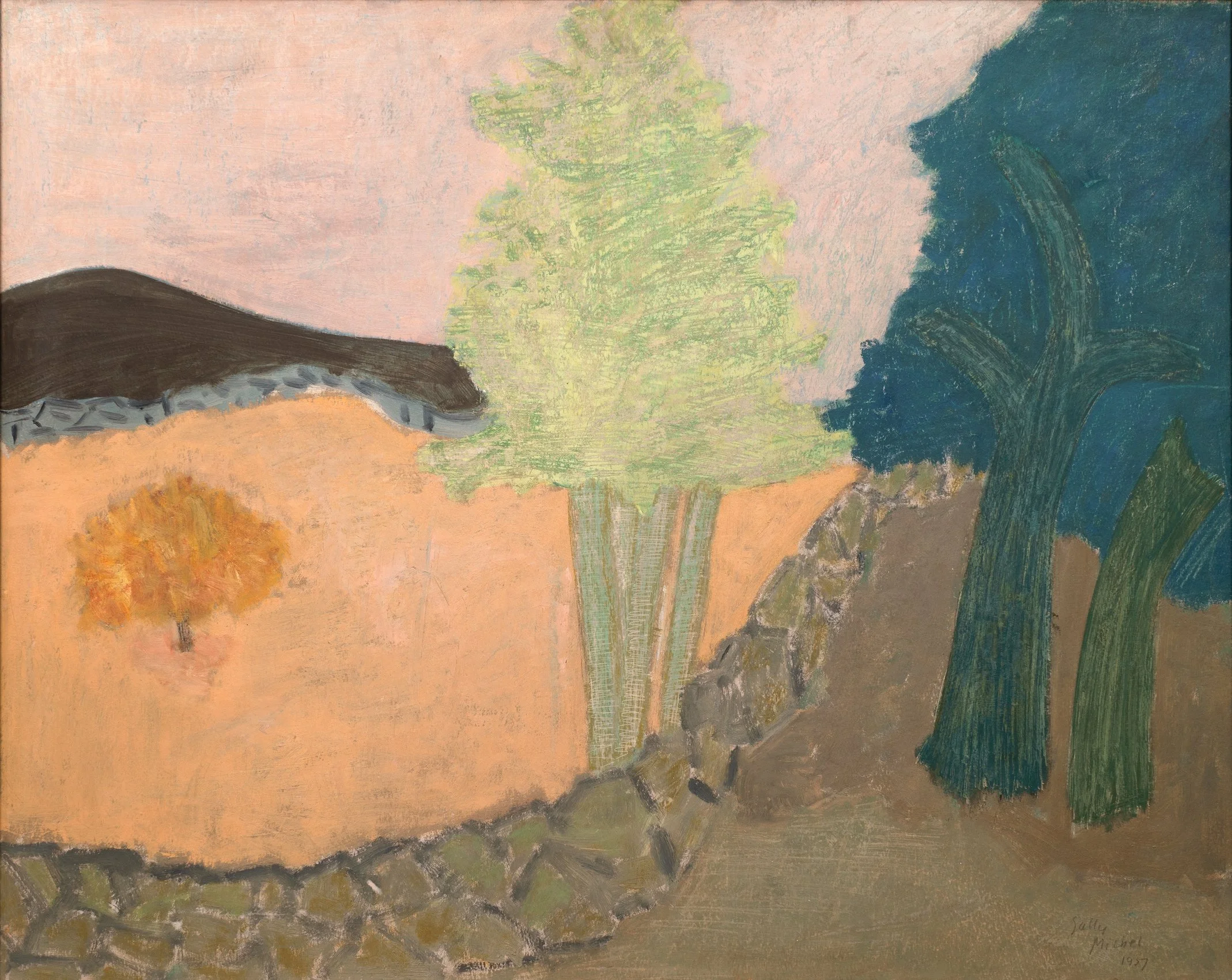
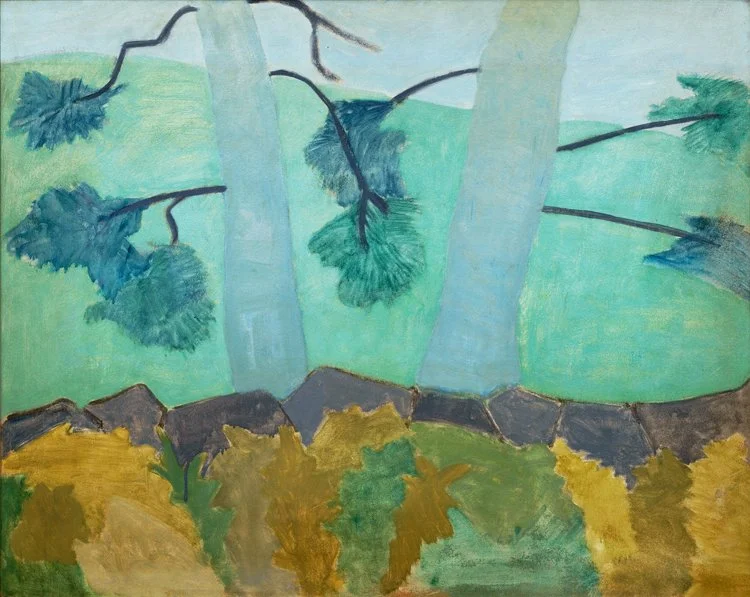
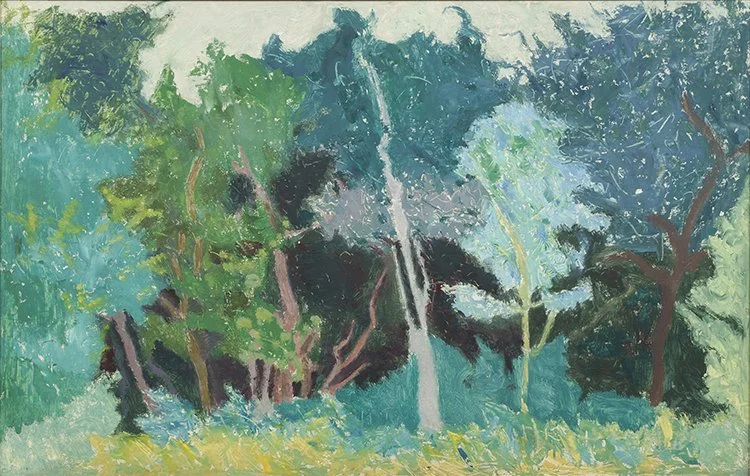
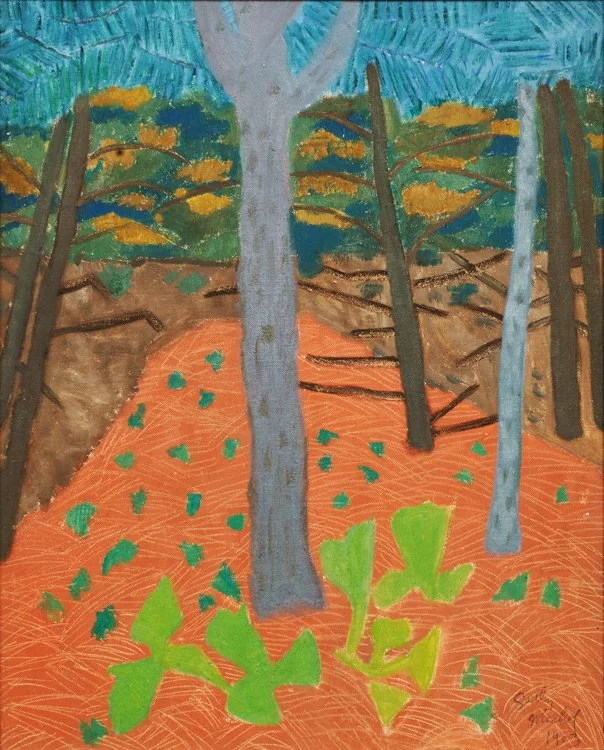
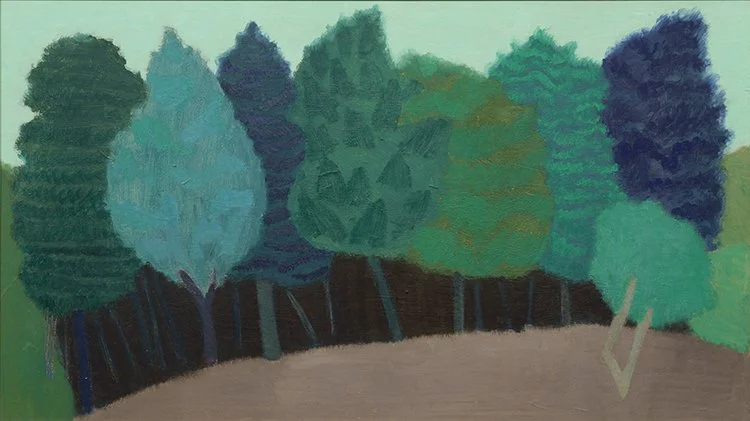
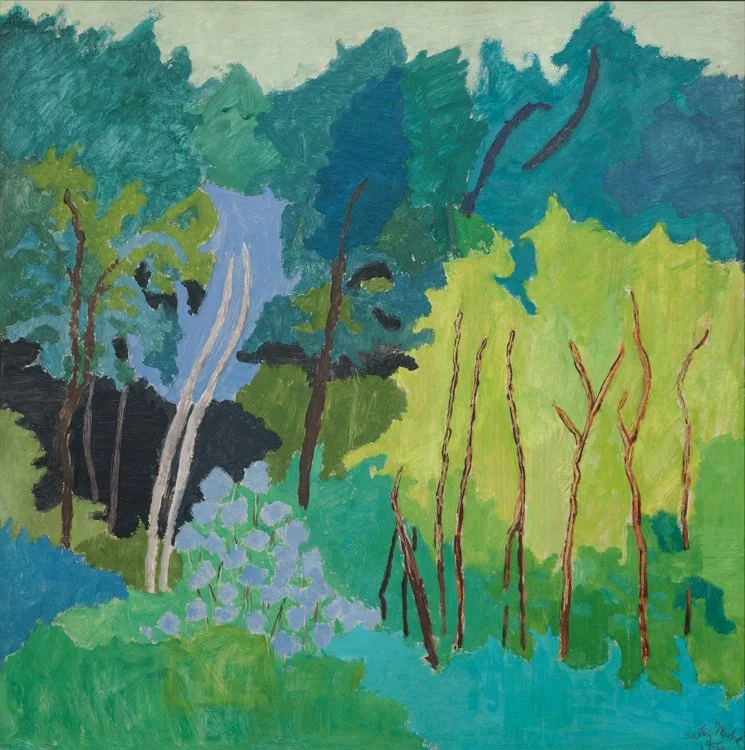
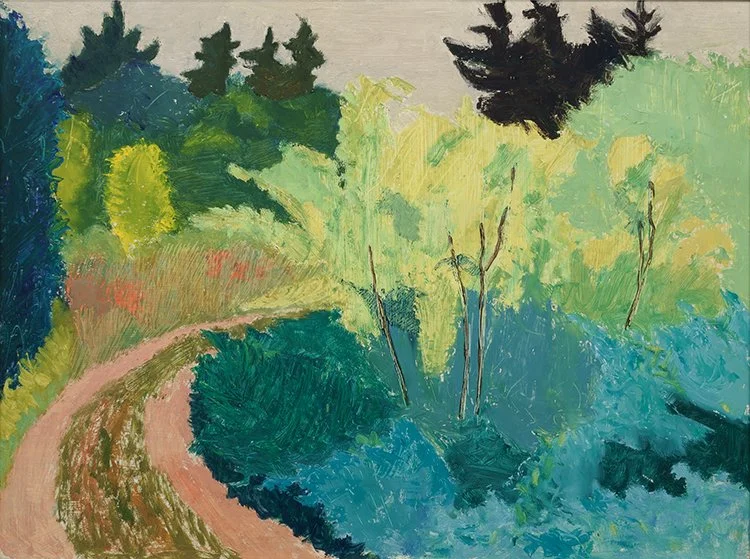
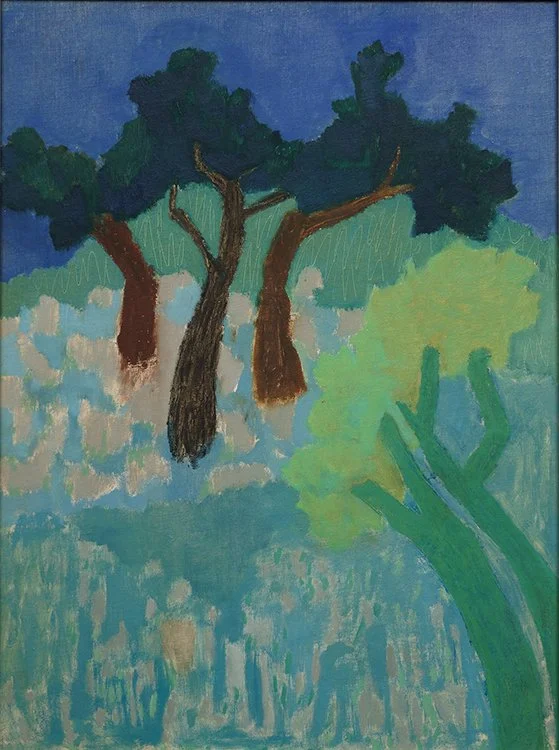
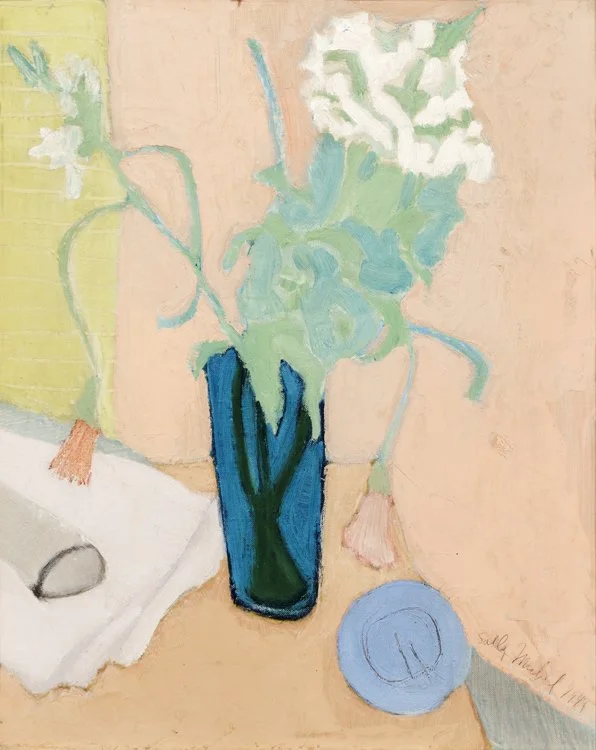
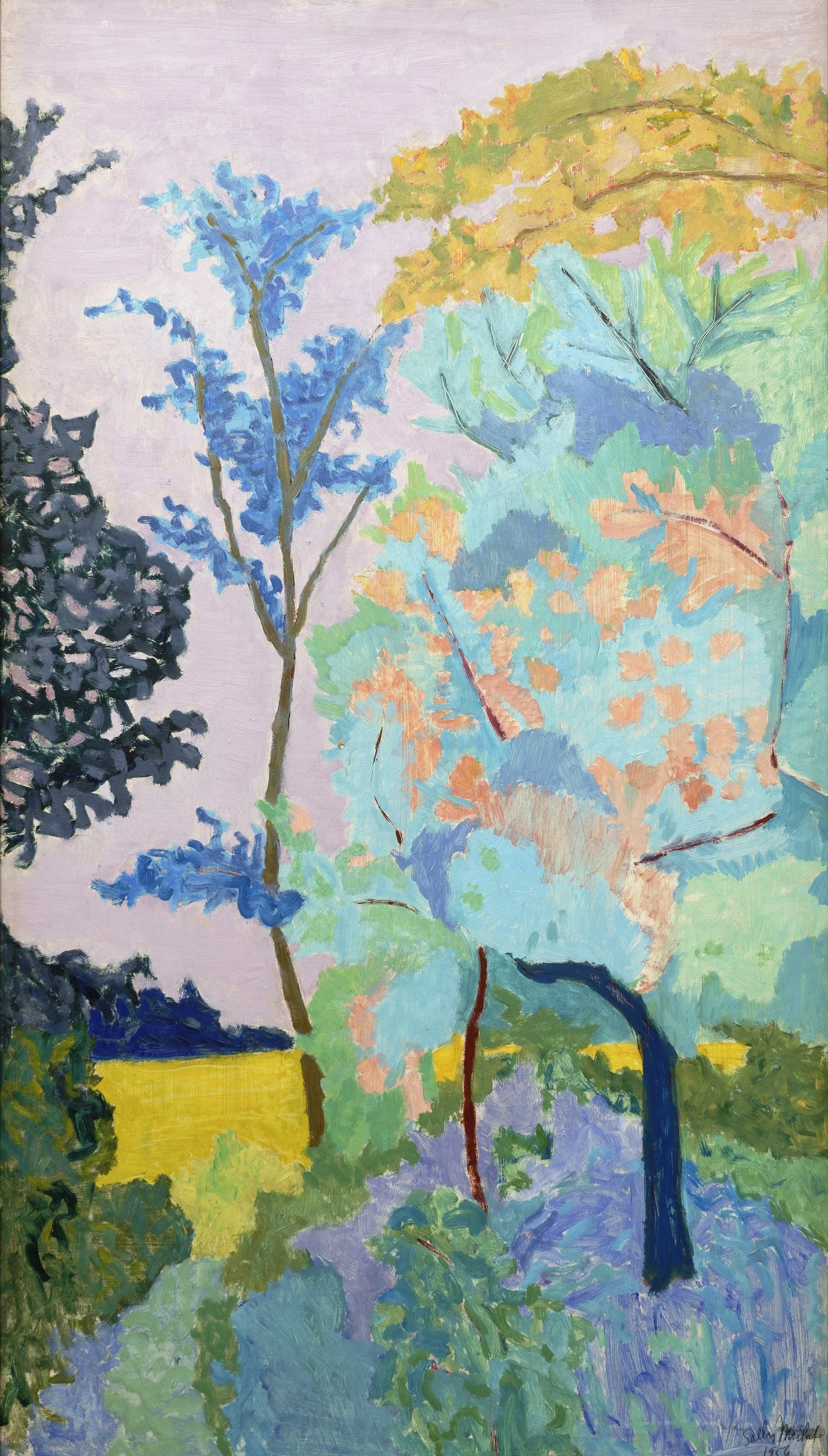
Most of Michel’s paintings in this exhibition are landscapes, a traditional genre both Avery and Michel often practiced, especially during their summer travels. The earliest here date from 1953, when Avery’s art was gradually selling better and the couple was beginning to see the end of two decades of living frugally. Red Landscape and Birch, both from 1953, modest sized, vertical paintings centered on trees, typify Michel’s style at this point. The two paintings share an avoidance of realist detail, and a flattening out of landscape space, but they are distinctly different in color, with Birch featuring tans and a rich range of cool blues and blue greys, while Red Landscape ranges from muted reds to hotter oranges with only a few dots of green to ignite the scene through contrast. The emphasis on radiant color parallels the Averys’ friend, Mark Rothko’s paintings from the same years, with the difference that the Averys always kept a connection to the real world in their imagery and never ventured into total abstraction.

When she painted these two tree paintings Michel was supporting her husband with commercial jobs. Her mainstay was illustrating a weekly parenting column for the New York Times. She did this for twenty years; once she retired in 1960 the column was cancelled. These black and white illustrations demonstrate another side of her talent, the drawing skill that drew her to being an artist when she was a child. A scene of a youthful party features eighteen figures, a crowd never seen in her paintings, where broad, flat forms that are vehicles for color are the rule. The people are economically characterized and each individual activity is precisely captured. In the bottom left corner a girl draws the lettering for a party announcement, the one person involved in drawing—an alter-ego common in these drawings, which often feature images of girls making art (and often, as here, resembling her daughter, March). The Averys were aloof from politics, interested only in their painting. Milton never voted, and although they lived through the Depression and World War II there are few traces of these historic events in their painting. There are a few exceptions in Michel’s drawings for the Times, when the text in the article called for it—for example a drawing from 1941 where a boy plays with toy soldiers on the floor while his parents both anxiously read newspapers and the radio blares, “Battles, Italy, Greece, WAR.” In these drawings, Michel masterfully captured psychological and narrative moments, which makes clear that she deliberately rejected these qualities in her paintings for the sake of form and color.

It is well known that in the 1930s and 1940s Avery was an inspiring figure for a group of ambitious younger artists who would become famous as Abstract Expressionist painters: Rothko, Adolph Gottlieb, and Barnett Newman. They admired his dedication to his art and his individualistic style, which built on developments of European modernism against the prevailing trends in American painting. They visited constantly and took vacations together. Like Michel, the wives of the younger artists supported their husbands, though they did not share her absolute commitment to painting at the same time. “No, I don’t think any of the women were as dedicated as I was to art. I was really dedicated to art and they were dedicated to their men, and if they painted, okay, but art was really like the Holy Grail.” Unlike Avery, who came from a Protestant family, the younger artists were Jewish, as was Michel. Her family was observant and not pleased that she married a non-Jew. Once she married she was no longer invited to their Sabbath meals, though they gradually came to accept Avery. After he died in 1965 Michel began to travel internationally, not only to Europe but also twice to Africa, and she also made five trips to Jerusalem, suggesting that she had an identification with her Jewish background despite her nonobservant lifestyle.

“I tell you, when I think of the fate of women it just wrings my heart. . . . It’s terrible,” Michel said in an interview with Nancy Acord where she told the story of her parents. Her father came to the United States from Poland; after some years he decided he wanted to marry and returned to Poland to find a wife. He settled on Michel’s mother who agreed to marry him on the condition that they remain in Poland. He assented, they married, and the next day he put her on the boat to the United States. Several years later, after they had two of their eventual five surviving children and his finances were bad, he sent her back to Poland to live with his family for a year and a half before calling her back to the U.S. Michel concluded this part of the interview stating, “I’m not a feminist but I’m a humanist.” Like some other women artists of the time, such as Helen Frankenthaler, she claimed, “Personally, I wish there wasn’t so much emphasis on women. I think there should be more emphasis on good work and bad work. To be judged not by whether you’re a woman or not but by whether you’re a good artist or not.” She also felt, “I think my work right now is naturally influenced by Milton. I couldn’t help it having lived with him so long. I hope it’s more feminine because I’m a female.” Today “feminine” is a loaded term, but perhaps she was referring to the delicacy plus the sophisticated use of pattern found in her commercial drawings and made blunter in some of her paintings, such as Ida, a portrait of family friend Ida Baumbach (the grandmother of film director Noah Baumbach). Lost in thought or sleeping, Ida is surrounded by dazzling colors while the grid of the table plays a visual game, making a pattern of multicolored diamonds from the orange of her dress, grey from the background, and a sly bit of pink from her leg.

Michel’s practice of travelling extensively began two months after Avery passed away, when he had an exhibition in London and the dealers persuaded her to come. She was economically independent, thanks to Avery’s success in the art market in his last years, and free to pursue her own art full time. She bought a house in Bearsville, outside of Woodstock, and its serene surroundings became the subject of many of her works. A photo documents her practice of sketching outdoors, the subject her grandson and friends relaxing on the lawn in Bearsville, a casual gathering of the sort that inspired paintings like Bill and Friends. Her paintings became larger now that she had more space to paint and was not doing commercial work any more, and they are thinly and quickly painted, giving a sense of watercolor-like luminosity and a casual spontaneity. She had a horror of paintings that looked labored: “I think it just ruins it. I have worked on paintings like that for a long time but I usually throw them away in the end. I mean all the life and all the joy goes out of them.”

It would seem that the grace that characterized Michel’s art and her life had its source in her positive and upbeat personality: “I was always an optimist.” “Have you ever been sad a day in your life, Sally?” interviewer Acord asked her somewhat incredulously. Of course she had been but her overall affirmative attitude was manifested in her art, like Studio View (1977), a rare urban scene, gridded like a Mondrian, but with an array of thinly brushed pastel colors.

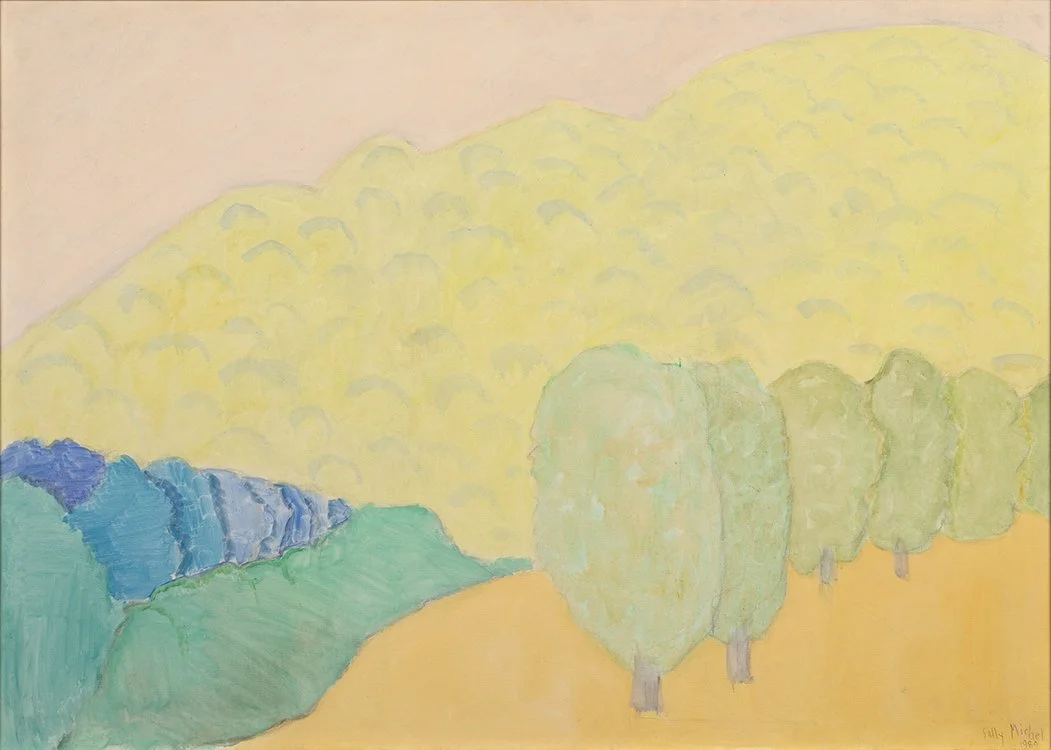
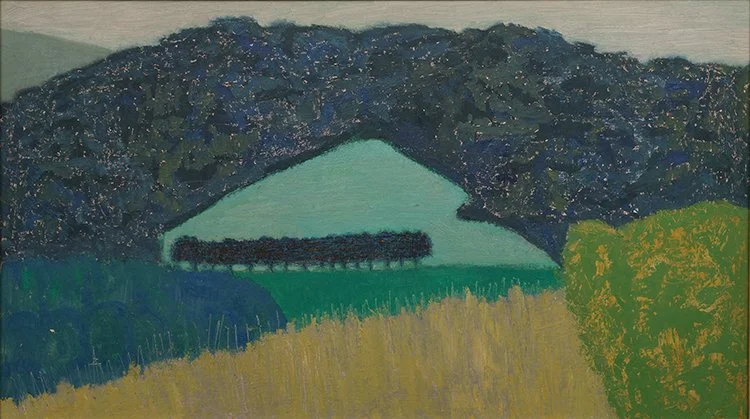
Her Bearsville house afforded Michel a variety of landscape subjects: it is on a hill, surrounded by trees, above a pasture where cows often grazed before distant mountains. In Last Snow (1984), one of her late landscapes, she transformed the geography before her into areas of radiant, unrealistic color. A sketch for the painting exists, where she roughed out the basic composition and included some color notes. The notes indicate a yellow ground plane with tan accents; these she brightened into pink in the actual painting. She added a pale brown sky, a duller version of the bright yellow below, to create a field of warm yellows punctuated by darker hues representing trees and a mountain.

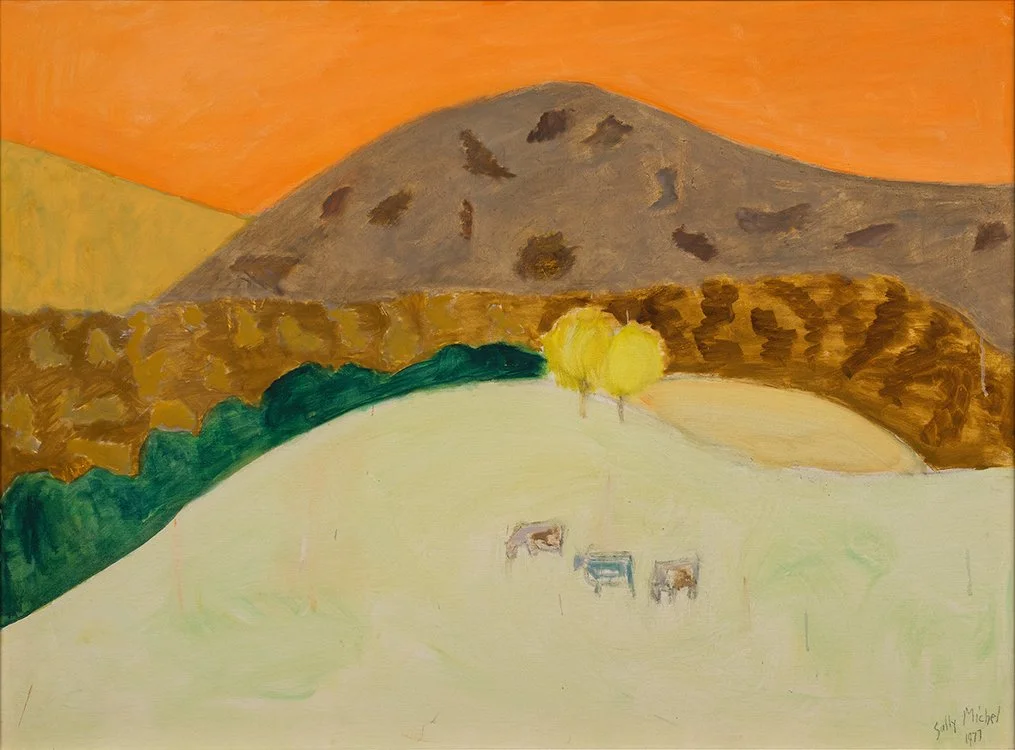
While Michel often denied any narrative interpretations of paintings, saying of Avery’s “they have no literary content,” on another occasion she said, “Every painting is an adventure. . . .You’re really delving into all your memories and things that have happened to you.” A Bearsville painting, Orange Sky (1977), where three cows hit individual color notes against a pale green pasture, evokes the summer of 1930 with her husband in Collinsville, Connecticut: “That whole summer we spent wandering after cows and making sketches. One farmer had these cows that used to travel about a mile for pasture, so we’d walk in back of them sketching, picking up apples and pears to eat.” The mountains and bands of foliage undulate peacefully under the livid orange sky, in a painting that affirms the present while also recalling an idyllic past.

“I think a painting should look as if it just happened. It should be a miracle.” “I really feel sorry for people that can’t paint because it’s so much fun to paint and it makes every day an adventure.”

NOTES

*This essay follows “Sally Michel: Working Artist” which I wrote for the Sally Michel: Rhythms of Light and Color catalogue of Michel’s November 2015 exhibition at D. Wigmore Fine Art. There is necessarily some repetition but I have tried to cover new ground. Instead of footnoting my sources I will cite them below. Because she lived to age 100 and was an open person she gave several lengthy interviews which have been among my main sources: interview with Dorothy Gees Seckler, November 3, 1967, Archives of American Art; four-part interview with Louis Sheaffer, December 1978-February 1979, Columbia Center for Oral History; interview with Tom Wolf, February 19 and March 19, 1982, Archives of American Art; and interview with Nancy Acord, Fresno Art Museum, December 2 and 3, 1989. All the quotations from Sally Michel in my text come from these interviews. Other sources cited are: Robert Hobbs, “Sally Michel: The Other Avery,” Woman’s Art Journal, Fall 1987/Winter 1988, 5; Frederick S. Wight, Milton Avery, Baltimore Museum of Art, 1952, 9; Barbara Haskell, Milton Avery, Whitney Museum of American Art, 1982, 40f. Michel’s “WAR” drawing illustrates the “Parent and Child” column, “Mental Hygiene” by Catherine MacKenzie, The New York Times (magazine section), Sunday, February 9, 1941, 22. In writing this essay I am grateful for the encouragement and assistance of Deedee Wigmore, Emily Lenz, March Avery Cavanaugh, Sean A. Cavanaugh and Melissa De Medeiros at The Milton and Sally Avery Arts Foundation, and at Bard College, Jeanette McDonald.

[ TOP ]

CHARLES GREEN SHAW: PAINTING IN AN AMERICAN RHYTHM

November 2016 - February 2017

Essay | Biography


Essay by Emily Lenz

Charles Green Shaw (1892-1974) contributed to the development of American abstraction in the 1930s and 1940s through his own work and his involvement in three important New York art circles. He is most associated with the Park Avenue Cubists, a group of wealthy artists who provided connections between New York and Paris during the Great Depression. Shaw was in fact not as wealthy as his fellow Park Avenue Cubists A.E. Gallatin (1881-1952), George L.K. Morris (1905-1975), and Suzy Frelinghuysen (1911-1988). This freed him from social and family responsibilities, allowing Shaw to spend more time in his studio and develop friendships with a broad group of abstract artists. Shaw was a founding member of the American Abstract Artists (AAA) group, established in 1936 when forty artists banded together to promote abstraction through annual exhibitions open to the public. In the AAA’s early years, Shaw worked to find gallery space and sponsors for their exhibitions. Shaw was also part of the circle around Hilla Rebay, curator of the Museum of Non-Objective Painting (now the Solomon R. Guggenheim Museum). When the museum opened in 1939, Rebay included Shaw in a number of group exhibitions and gave Shaw solo exhibitions in 1940 and 1941. Additionally Shaw advanced abstraction through his advisory board position at the Museum of Modern Art (1936-1941) and his illustrated children’s books intended to introduce abstraction to younger generations.

Many of Charles Green Shaw’s choices in early life laid the foundation for his later interest in abstraction. He took a general science degree at Yale University that mixed science, math, and the liberal arts, graduating in 1914. He began a graduate degree in Architecture at Columbia University that was cut short when Shaw enlisted in World War I, serving in the Army’s Air Service. His keen sense of observation was first applied to journalism, writing for The New Yorker, Smart Set, and Vanity Fair through the 1920s. Shaw began art lessons in 1926, studying briefly with Thomas Hart Benton (1889-1975) at the Art Students League then more extensively with George Luks (1867-1933). Shaw set out for Paris in 1929 and stayed in Europe through 1933. There, Shaw’s eyes were opened to abstraction through the Cubist work of Pablo Picasso (1881-1973), Georges Braque (1882-1963), and Juan Gris (1887-1927). From 1930 to 1935, Shaw worked through Cubism to find an American version that was simplified and more geometric. This is seen in Three Pear Composition, 1935 which has a Cubist still life composition and faux bois elements, but Shaw treats the pears as biomorphic forms and replaces the tabletop with a mass of projecting geometric shapes.

In the early 1930s, Shaw worked alone developing his abstract vocabulary. When he returned to New York in 1933, he knew no other abstract artists working in the city. That changed in the spring of 1935 when Shaw met A. E. Gallatin (1881-1952), a wealthy collector who opened his collection of European Modernism to the public as The Gallery of Living Art on NYU campus. The gallery was the earliest public institution to show abstraction. After Gallatin’s first visit to Shaw’s studio, he returned with George L.K. Morris (1905-1975), who acted as curator for the Gallery of Living Art. The two purchased a painting for the gallery’s collection and selected eight of Shaw’s paintings for a solo exhibition, breaking the museum’s protocol of group exhibitions only. In the summer of 1935, Shaw traveled to Paris with Gallatin and Morris who provided introductions to many great painters. Conversant in both French and German, Shaw had no problem communicating with the array of European artists working in Paris at the time. In 1936 in response to Alfred Barr excluding Americans from his two major exhibition Cubism and Abstract Art and Fantastic Art, Dada, and Surrealism, Gallatin, Morris, and Shaw organized an exhibition called Five Contemporary American Concretionists at the Reinhardt Gallery that included Shaw, Morris, John Ferren (1905-1970), Alexander Calder (1898-1976), and Charles Biederman (1906-2004). The exhibition traveled to Paris at the Galerie Pierre and to London at the Mayor Gallery with Gallatin replacing Calder as the fifth artist.

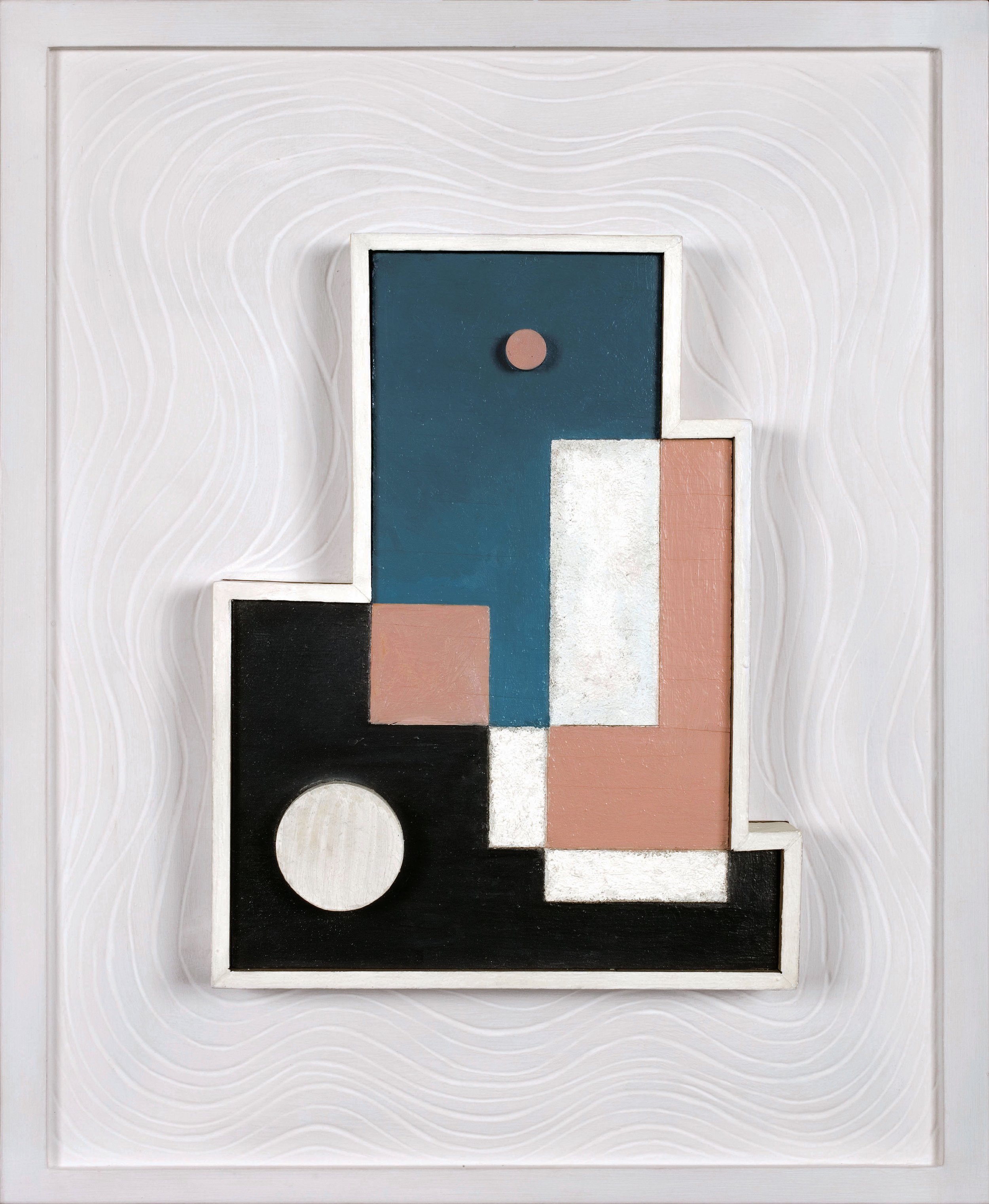
The exhibition at D. Wigmore considers the evolution of Charles Green Shaw’s style from the early 1930s through the mid-1940s as Shaw works his way through Cubism and Surrealism to find his own American voice. The dynamic energy of New York became Shaw’s source for an American abstraction. Shaw noted the broken patterns of the modern city where rhythmic movement was seen in every direction, from the geometry of sidewalks repaired and repaved to an ever changing skyline as more skyscrapers were built. Shaw created abstractions based on his observations of the city. Shaw first evokes the city’s sky line with his Plastic Polygons constructions as seen in Day and Night Polygon, 1936 then in more nuanced ways in paintings of pure geometry. Shaw’s evolution from the 1930s to the 1940s can be demonstrated with comparisons of paintings from the D. Wigmore exhibition.

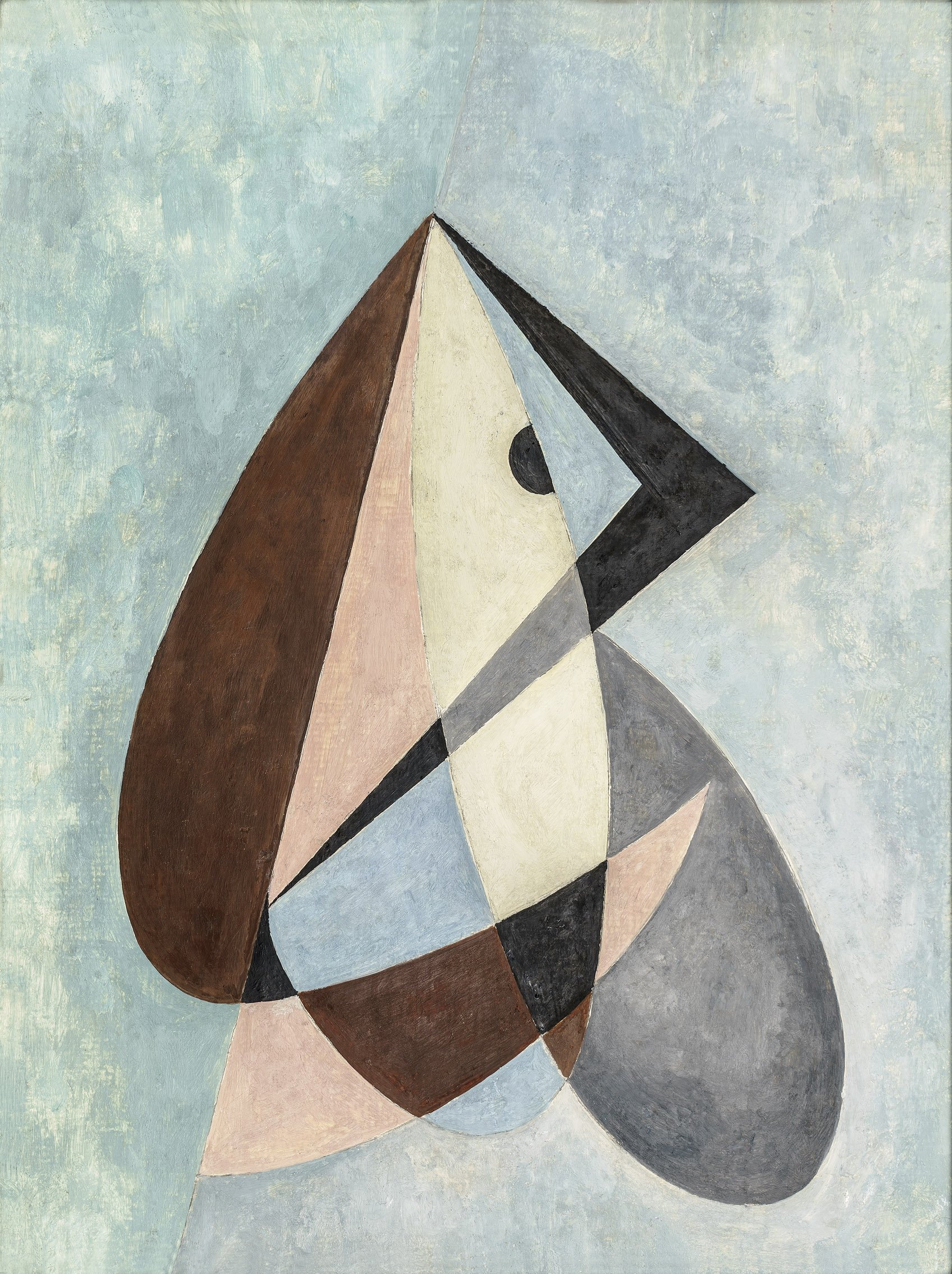
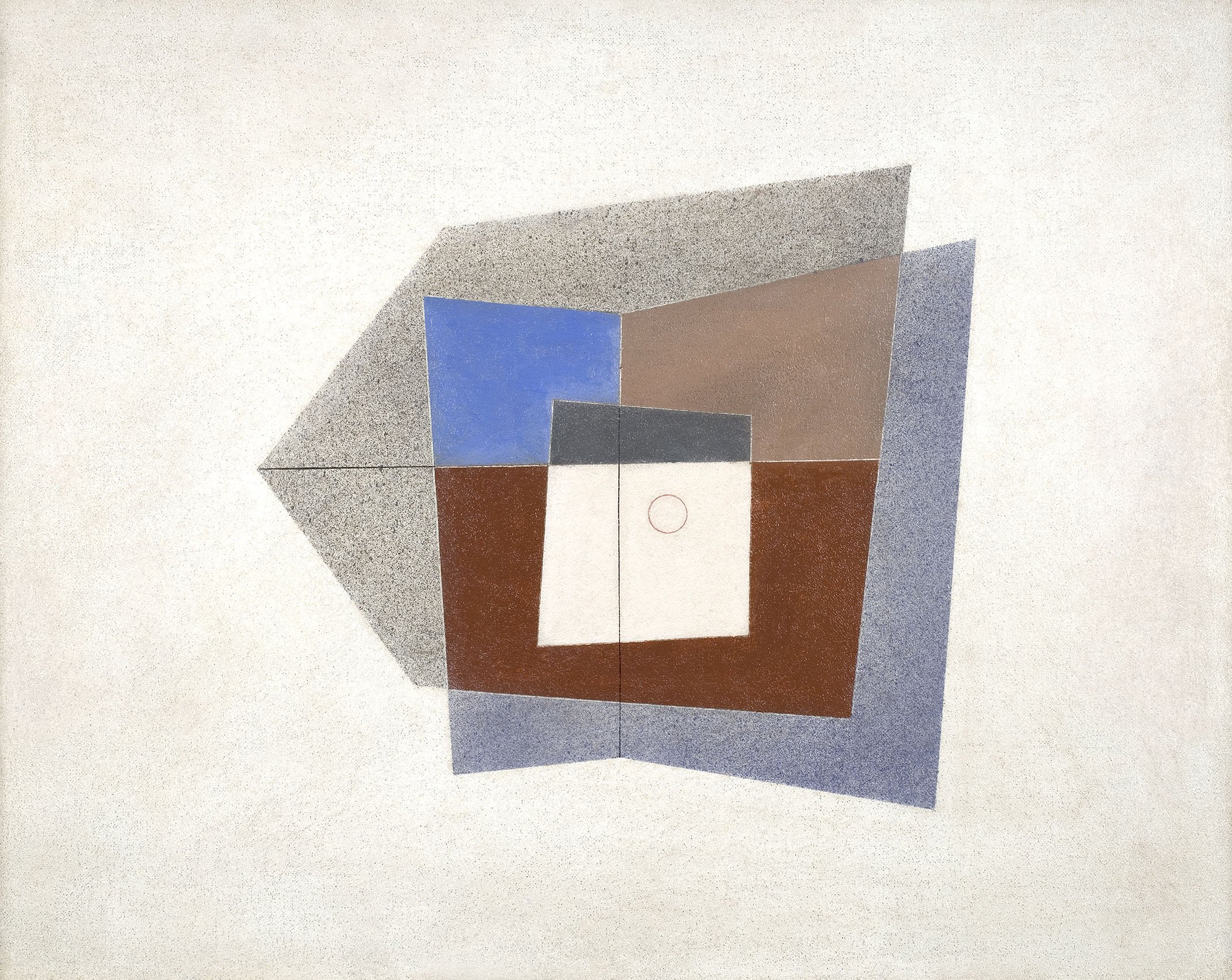
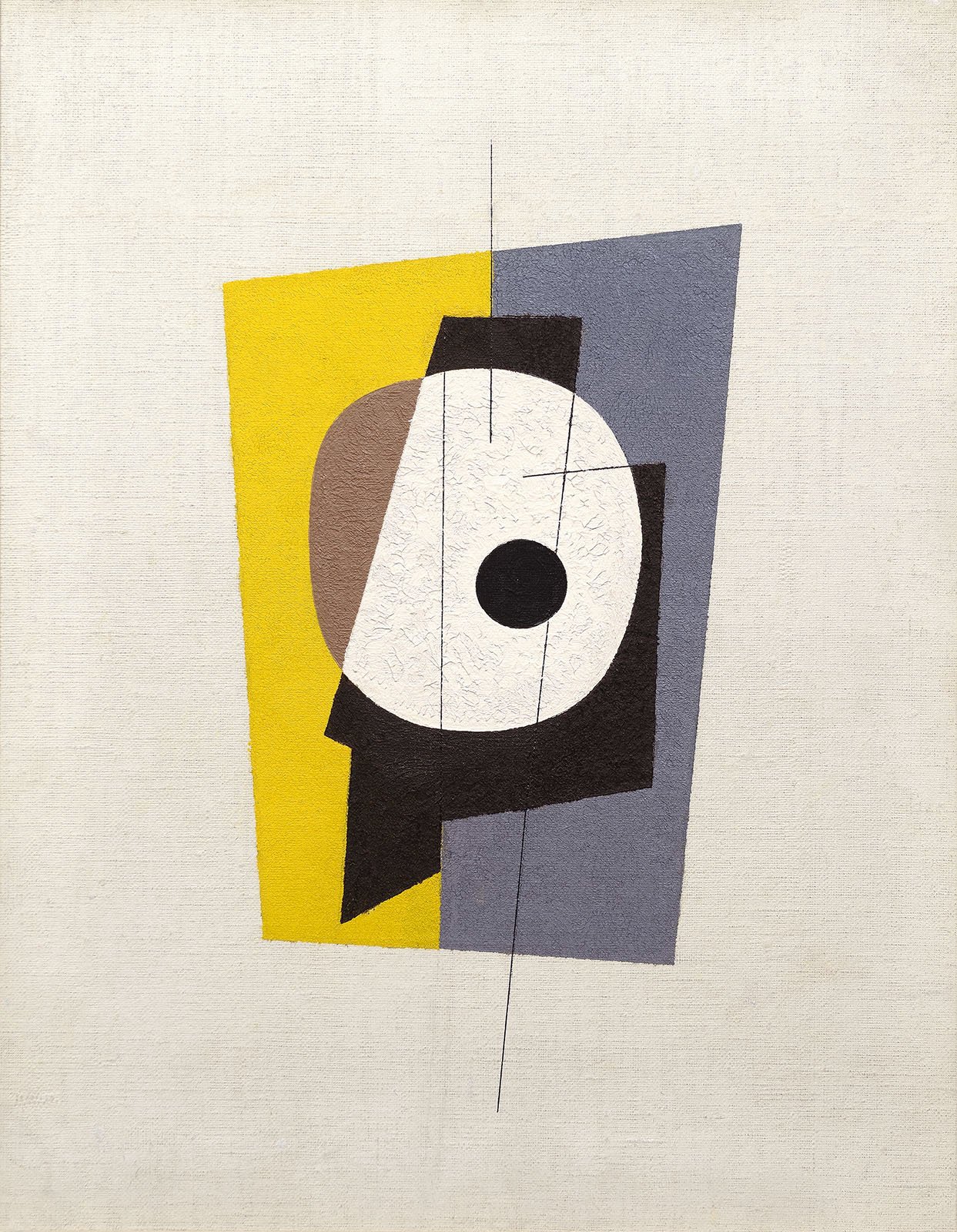
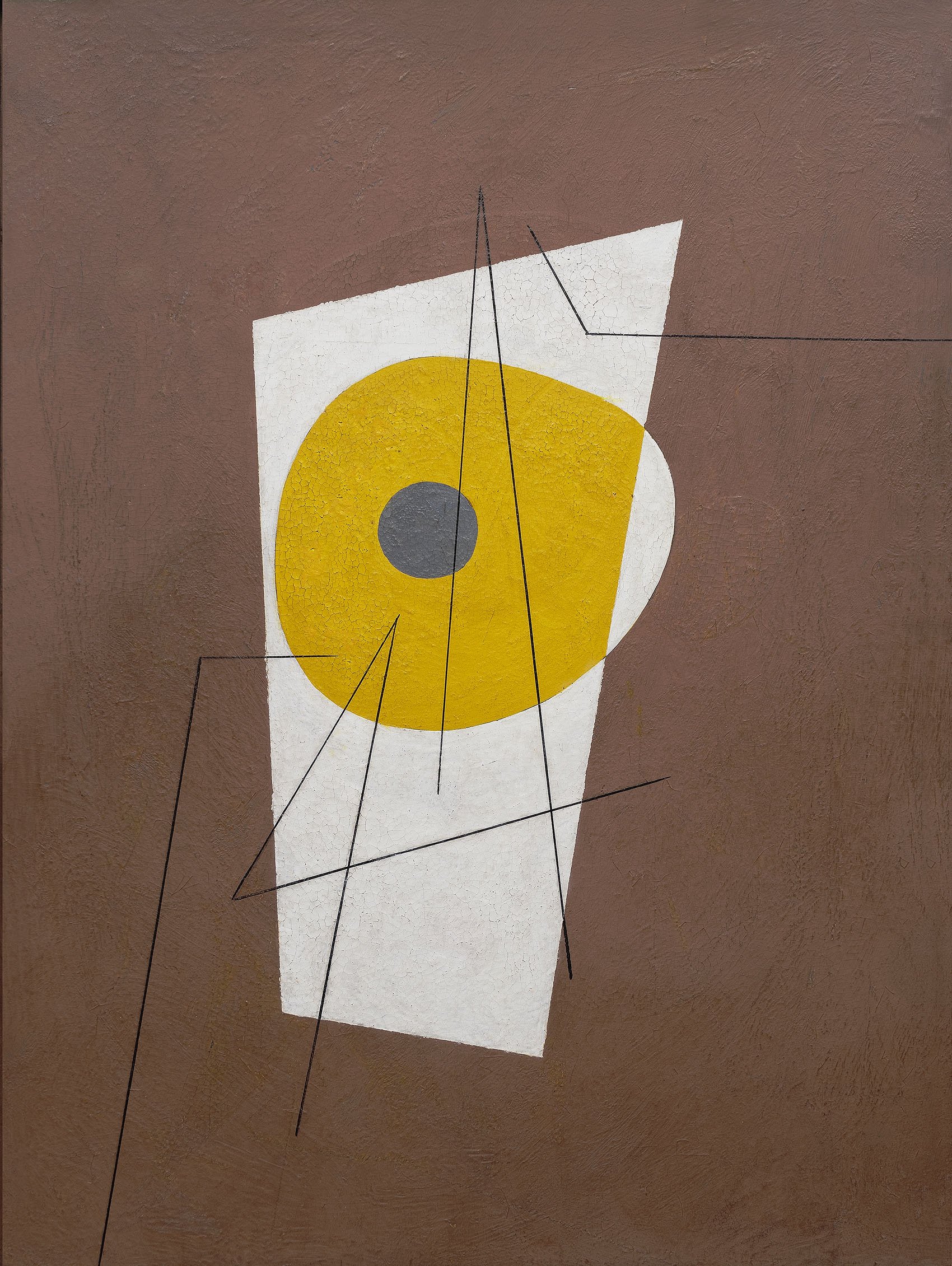
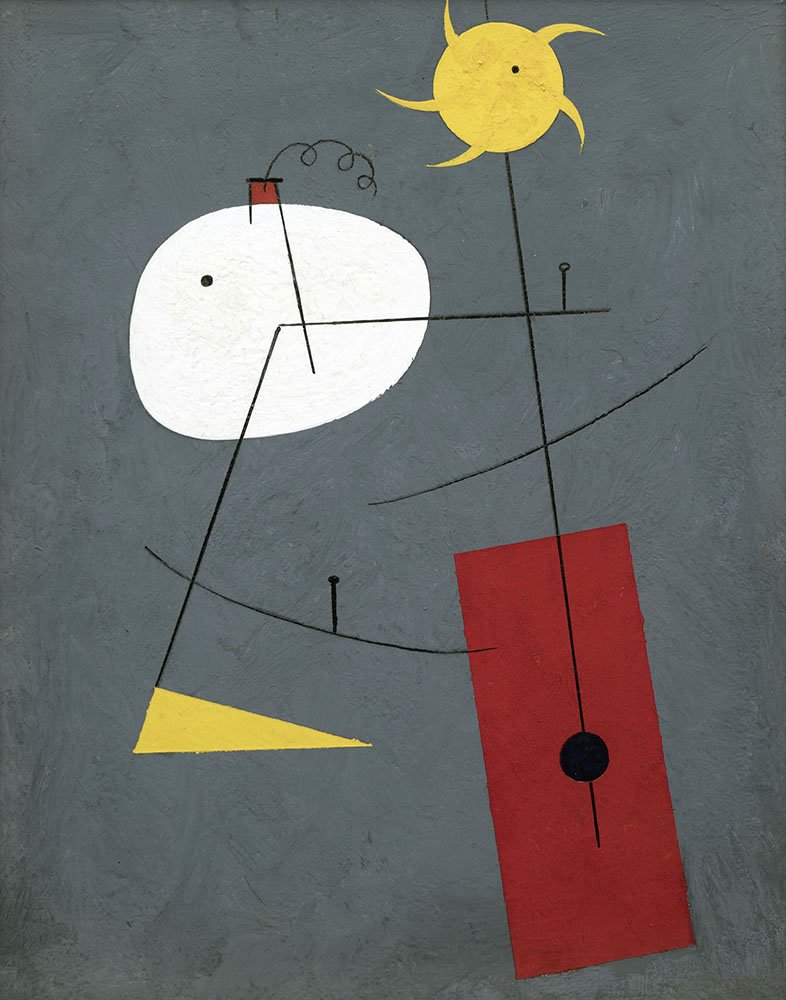
Shaw’s use of Cubism and his evolution towards pure geometry is shown when Chrysalis, 1935 and Divided Planes, 1943 are placed side-by-side. In Chrysalis, one sees Shaw’s debt to Picasso as a teacher. The sculptural form suggests a Picasso-like bust floating against a blue ground. Shaw rounds the forms with modeling to convey depth and volume. A black semi-circle stands in for an eye, suggesting both a woman’s profile and a point of access into the overall form. With Chrysalis next to Divided Planes, one sees not only a shared palette but also how Shaw flattened the biomorphic forms from Chrysalis into pure geometry in Divided Planes. Shaw creates depth in Divided Planes through layering of planes, achieved through a mix of stippling to imply transparency and overlapping of single colors. In place of an eye, Shaw uses a three-sided line to imply an opening into the composition of Divided Planes. The comparison of the two demonstrates how Shaw moved away from French abstraction into a streamlined geometry that may suggest horizons and vistas but is strictly non-objective.

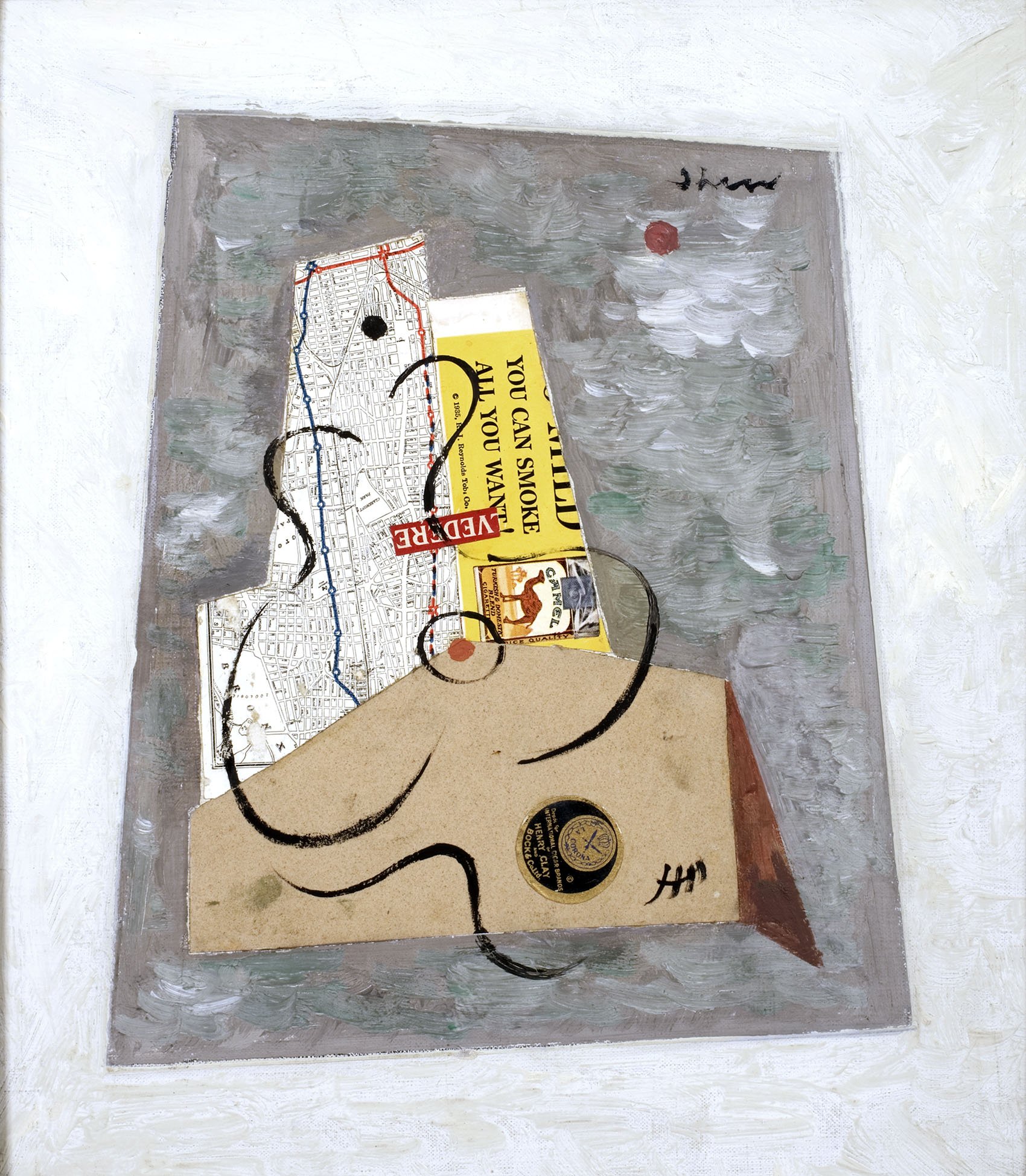
Shaw’s distinct abstract voice has a playful side and an interest in breaking forms down into geometric shapes. This can been seen in a comparison of the drawing Self-Portrait, 1935 and the painting Refraction, 1940. In the 1935 drawing, Shaw depicts himself in hat, glasses, and tie with a spare use of line and shapes. The verticality of the portrait connects to his first Manhattan skyline paintings. The thick black band on his hat gives solidity to the composition and the elegant arrangement of circles and triangles in place of his eyes and nose its focal point. Already we see Shaw’s economy of line and paring down of the human figure into an arrangement of geometric shapes. Refraction, 1940 is a different type of portrait with the letters of Shaw’s last name appearing in the composition. The coiled black lines convey the springing motion that seems to have circulated the artist’s name around the canvas. In Refraction, Shaw has found a personal American abstraction- direct, streamlined, and witty. Refraction is forward looking with a proto-Pop sensibility. Its mixture of punchy design, self-reference, and primary colors are all elements that appear in Jasper Johns’s work two decades later.

In a 1968 oral history for the Archives of American Art, Shaw spoke of solidity, impact, balance, and tension as defining principles of his abstractions. Throughout his career, Shaw’s paintings reflect modern awareness of space, speed, and a shift from classic symmetry to dynamic movement in order to capture the energy of Twentieth Century life. As a result, Shaw achieved a distinctly American abstraction.

[Top]

Modernism 1913-1950 | Realism of the 1930s and 1940s | Abstraction of the 1930s and 1940s | Post-War | Selected Biographies

1960s AMERICAN OP ART

September - November 2016

Essay | Biographies


Essay by Emily Lenz

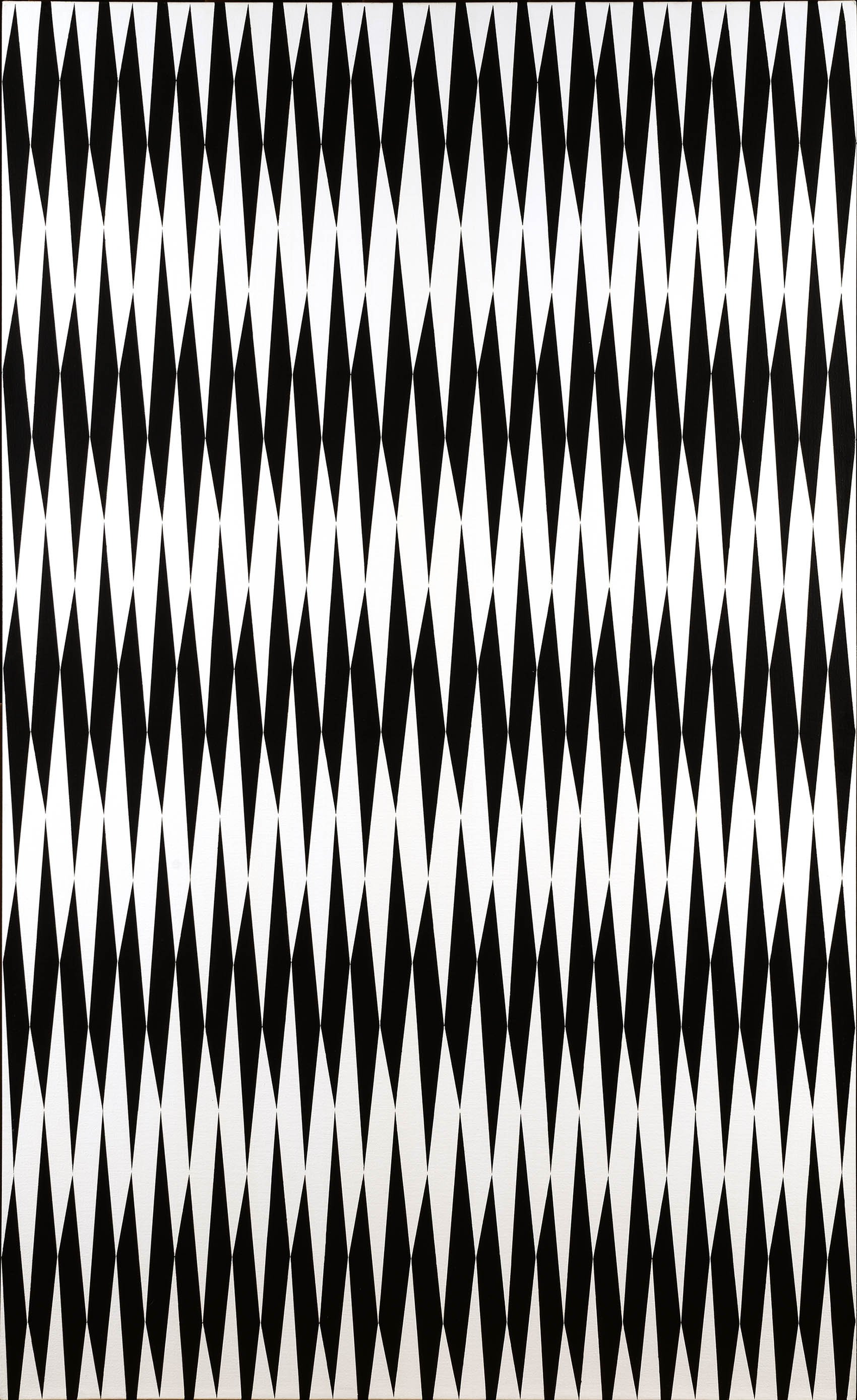
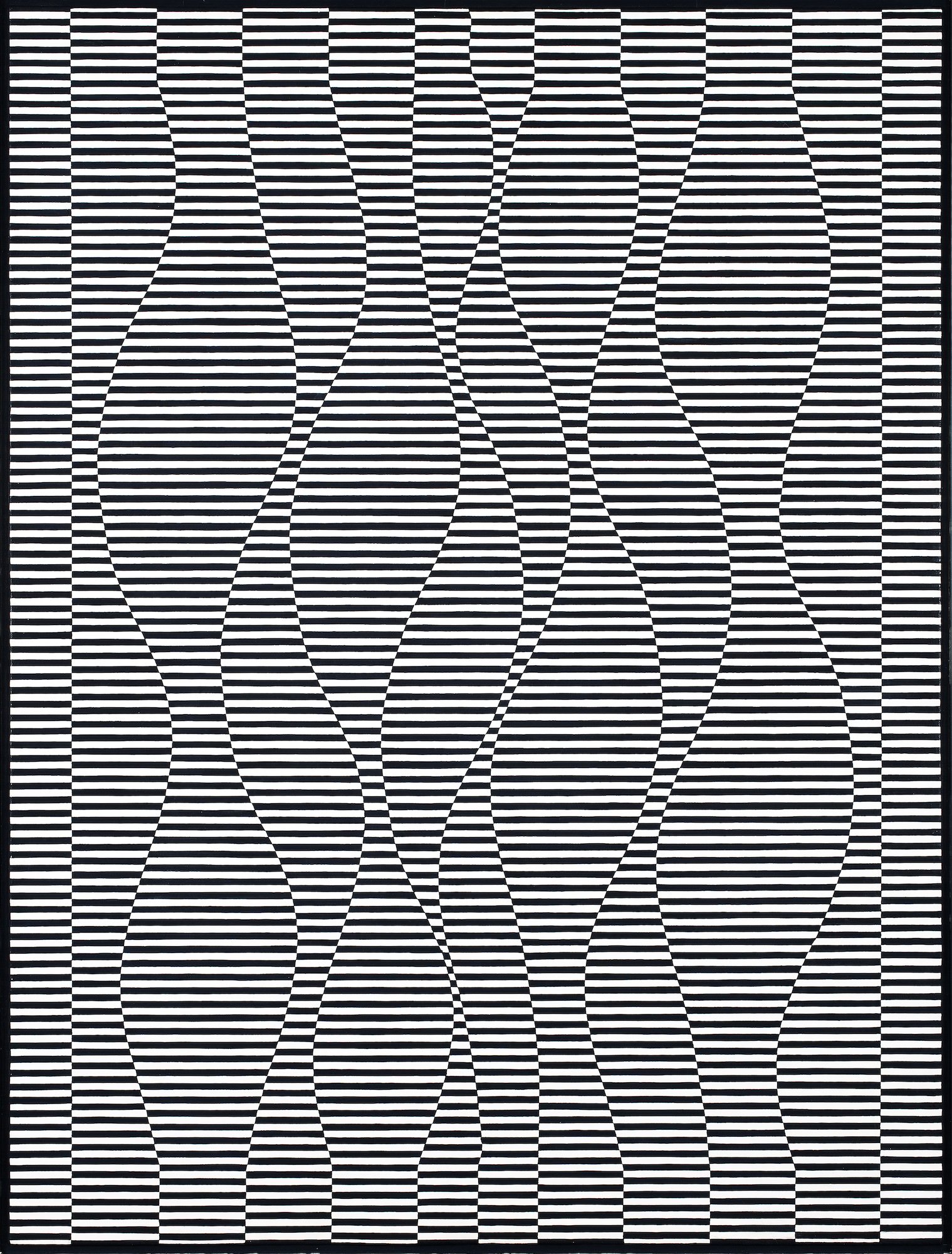
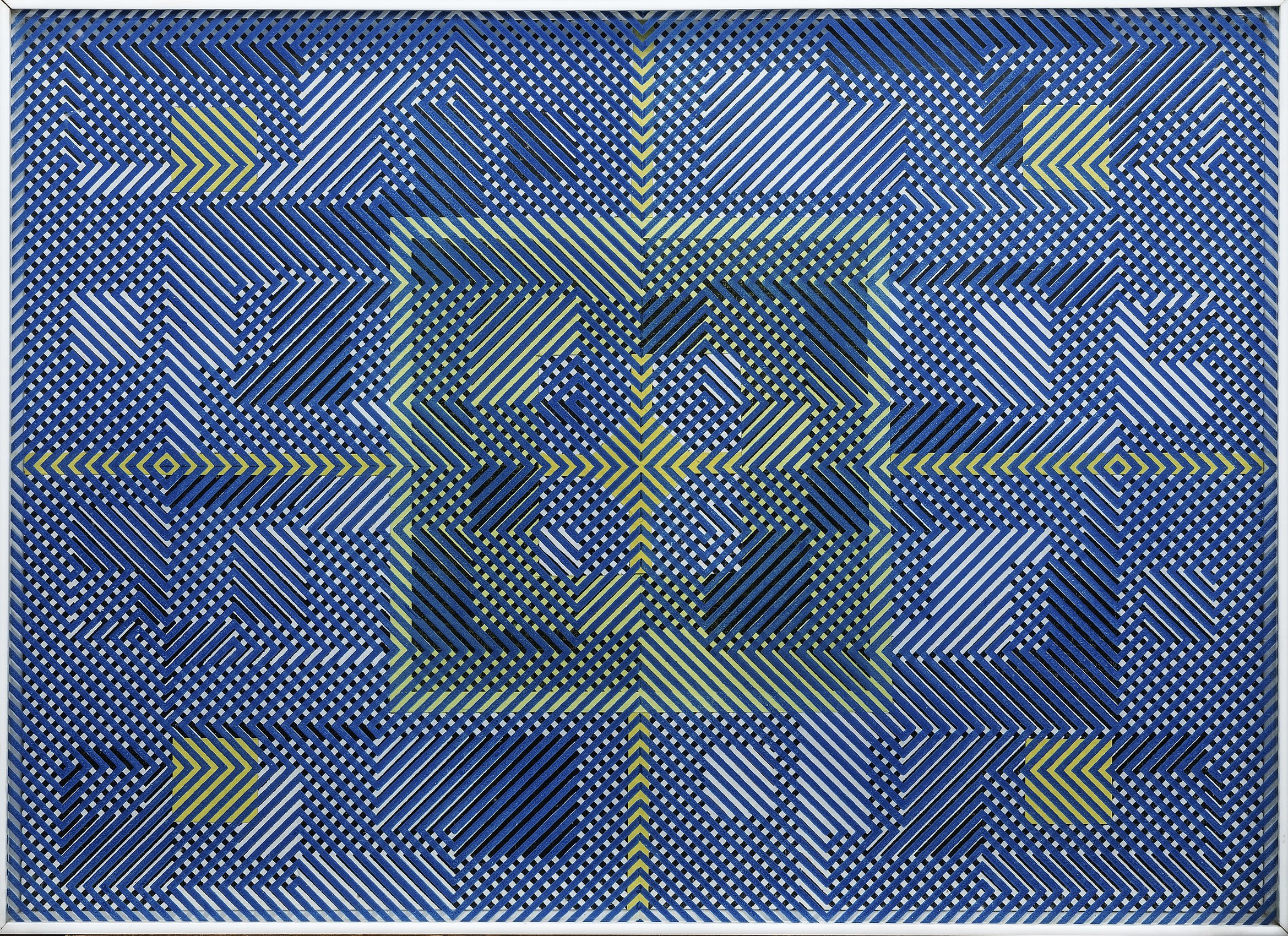
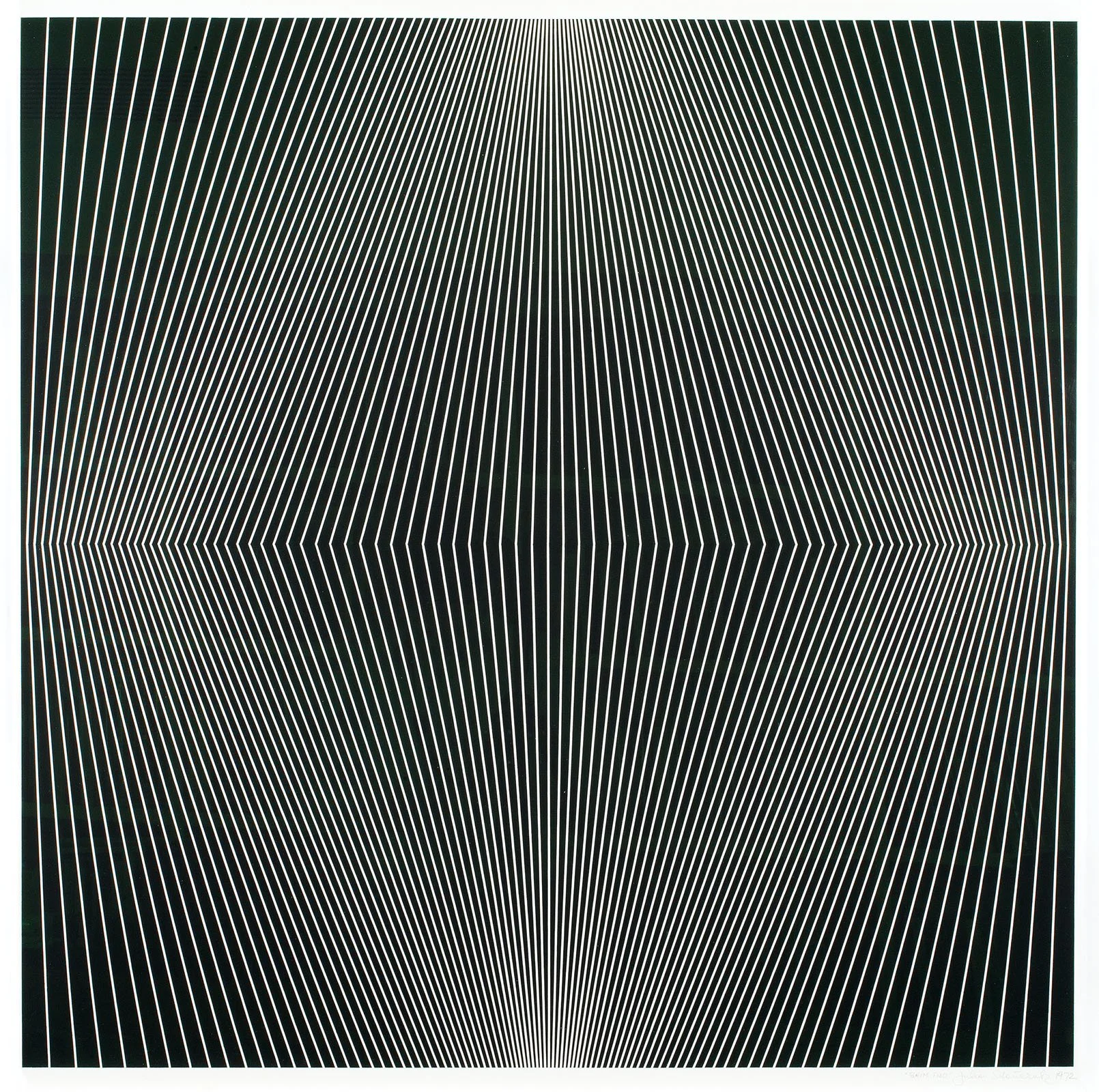
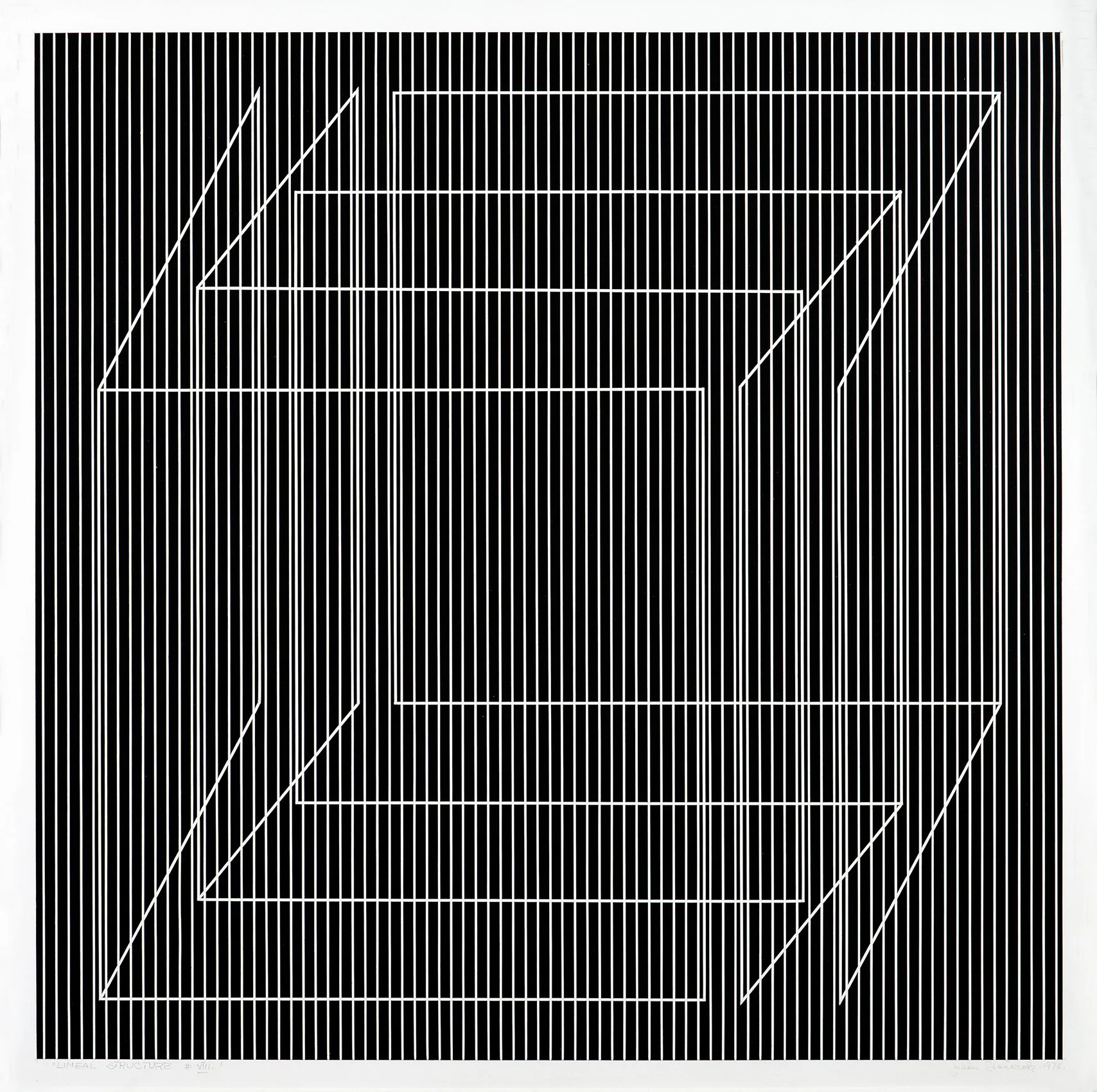
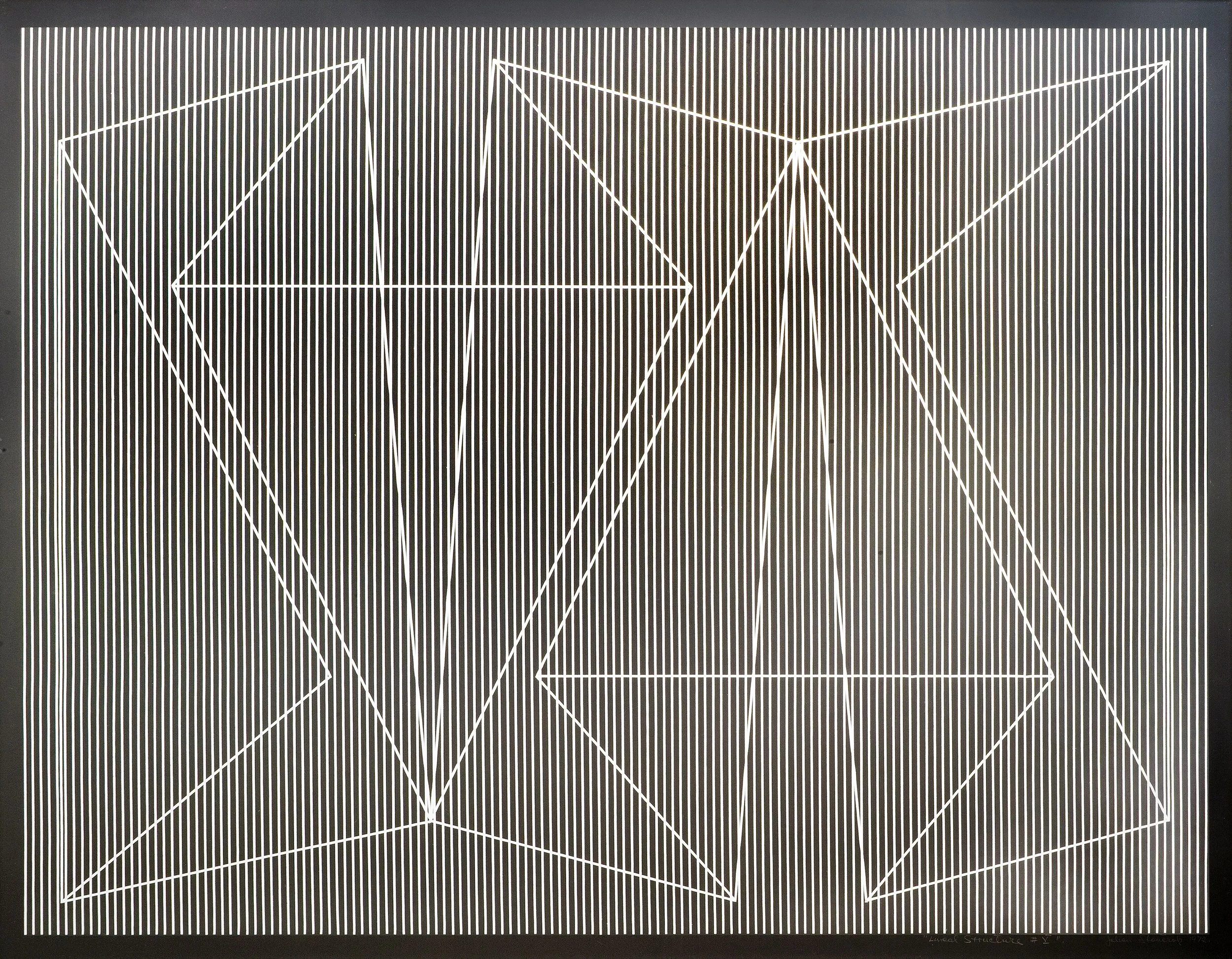
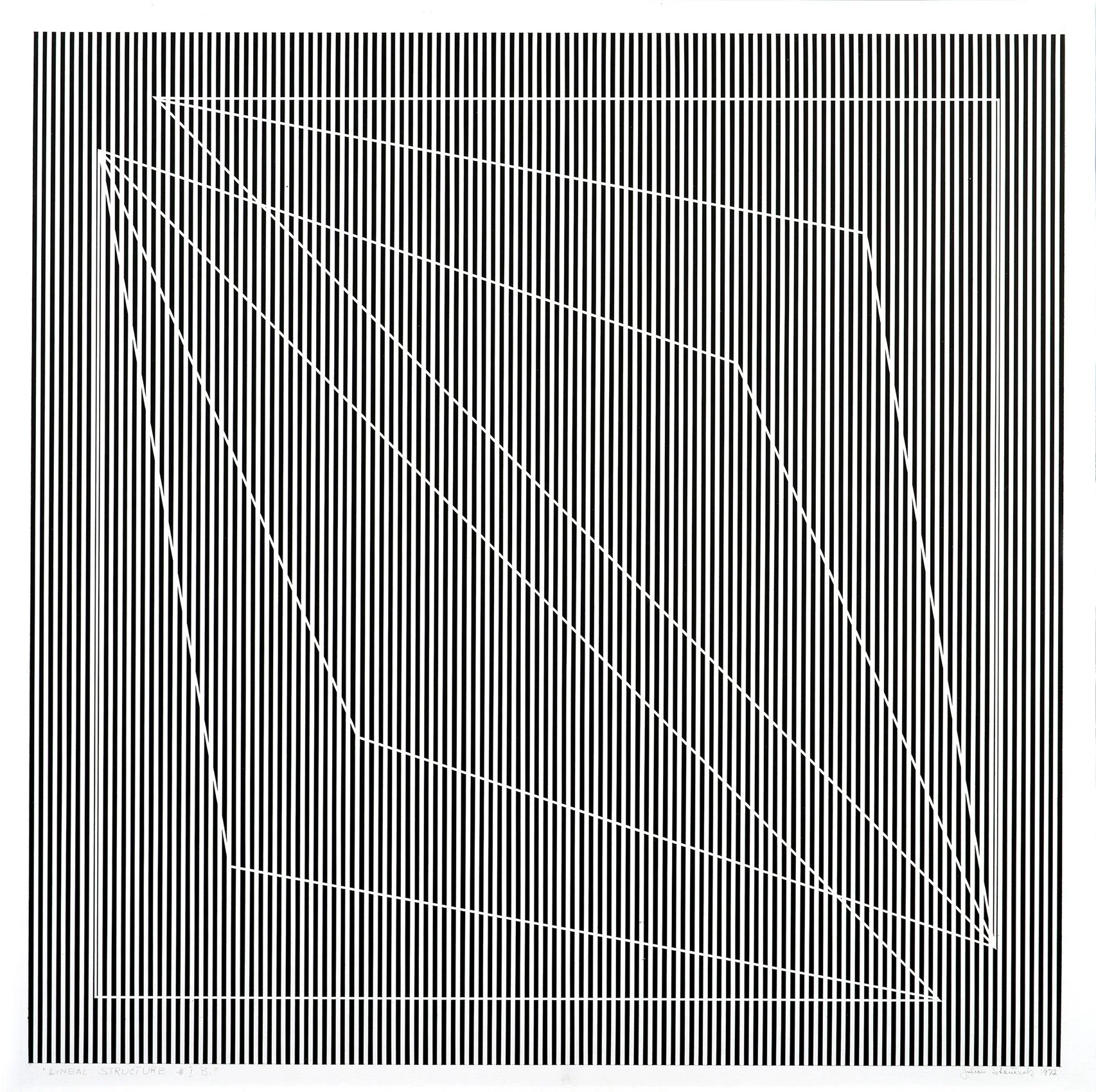
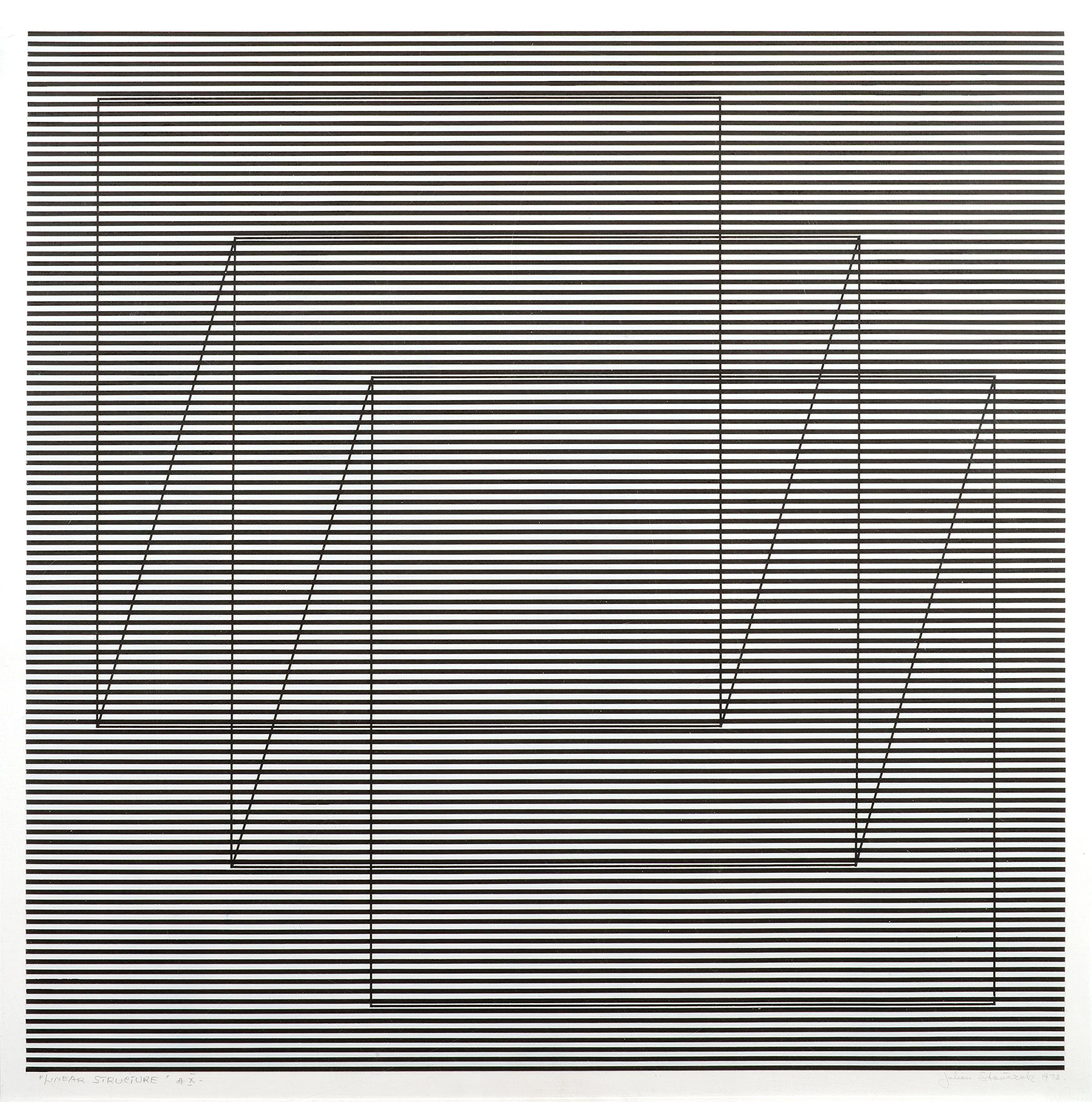
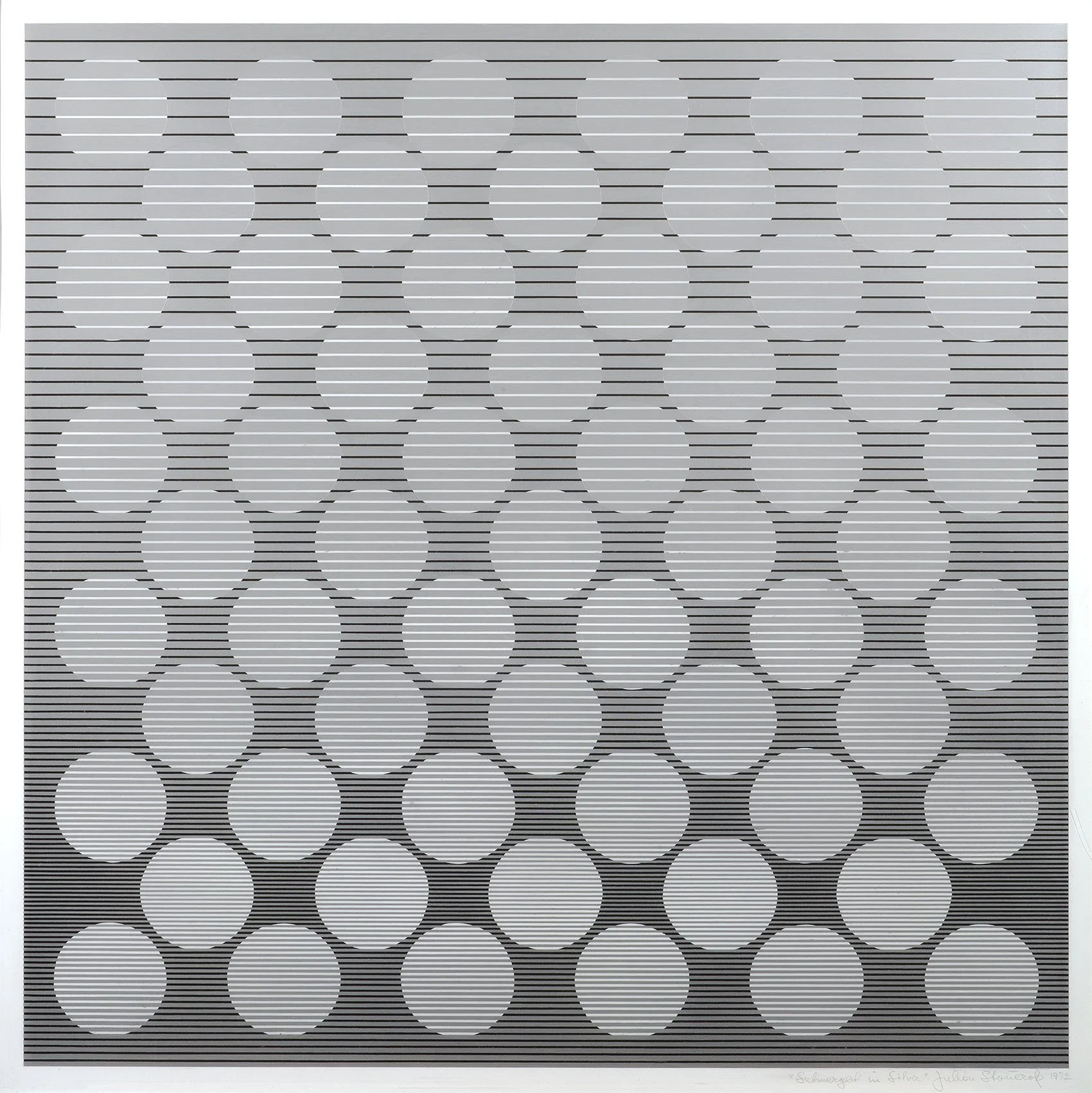
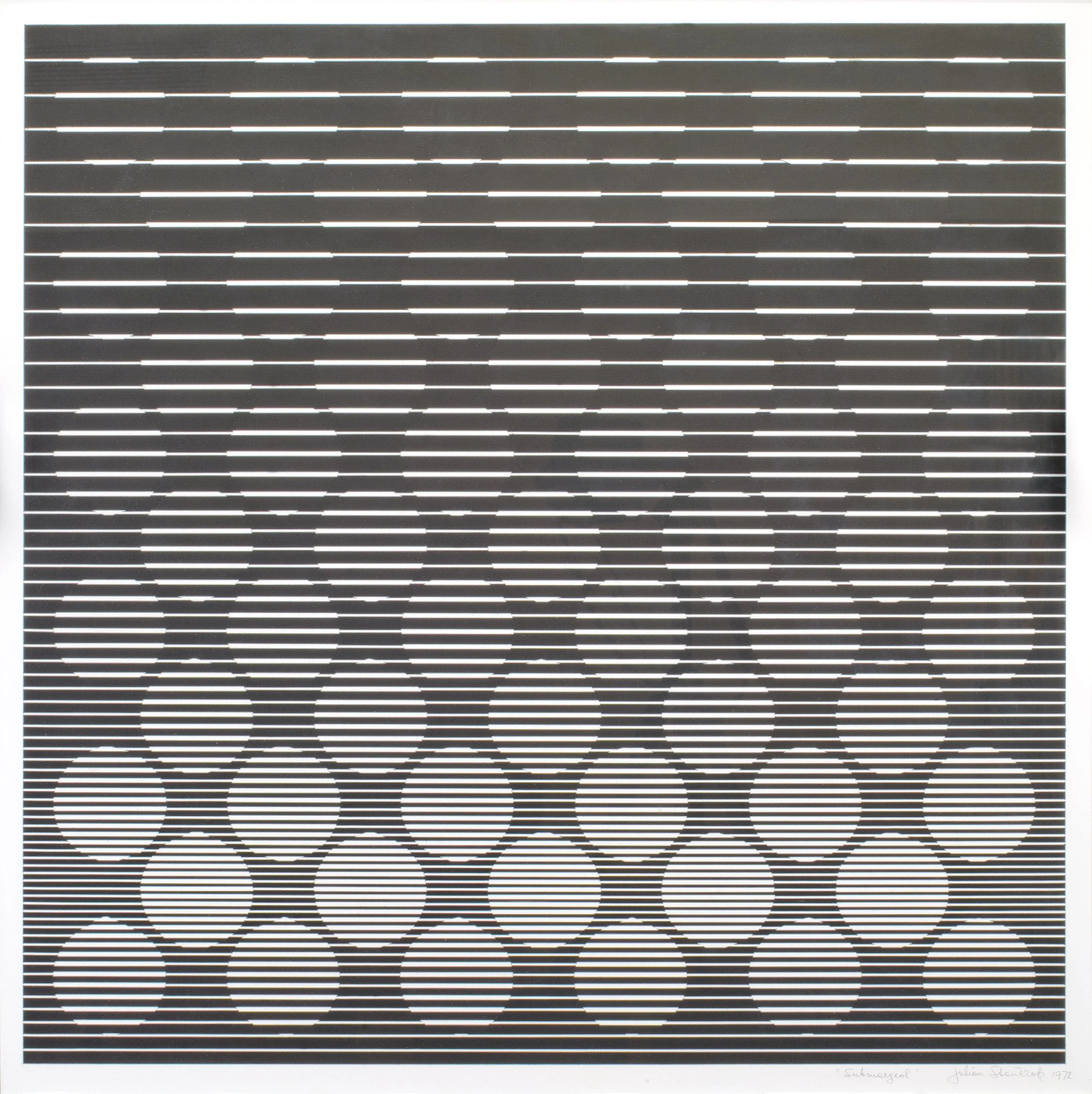
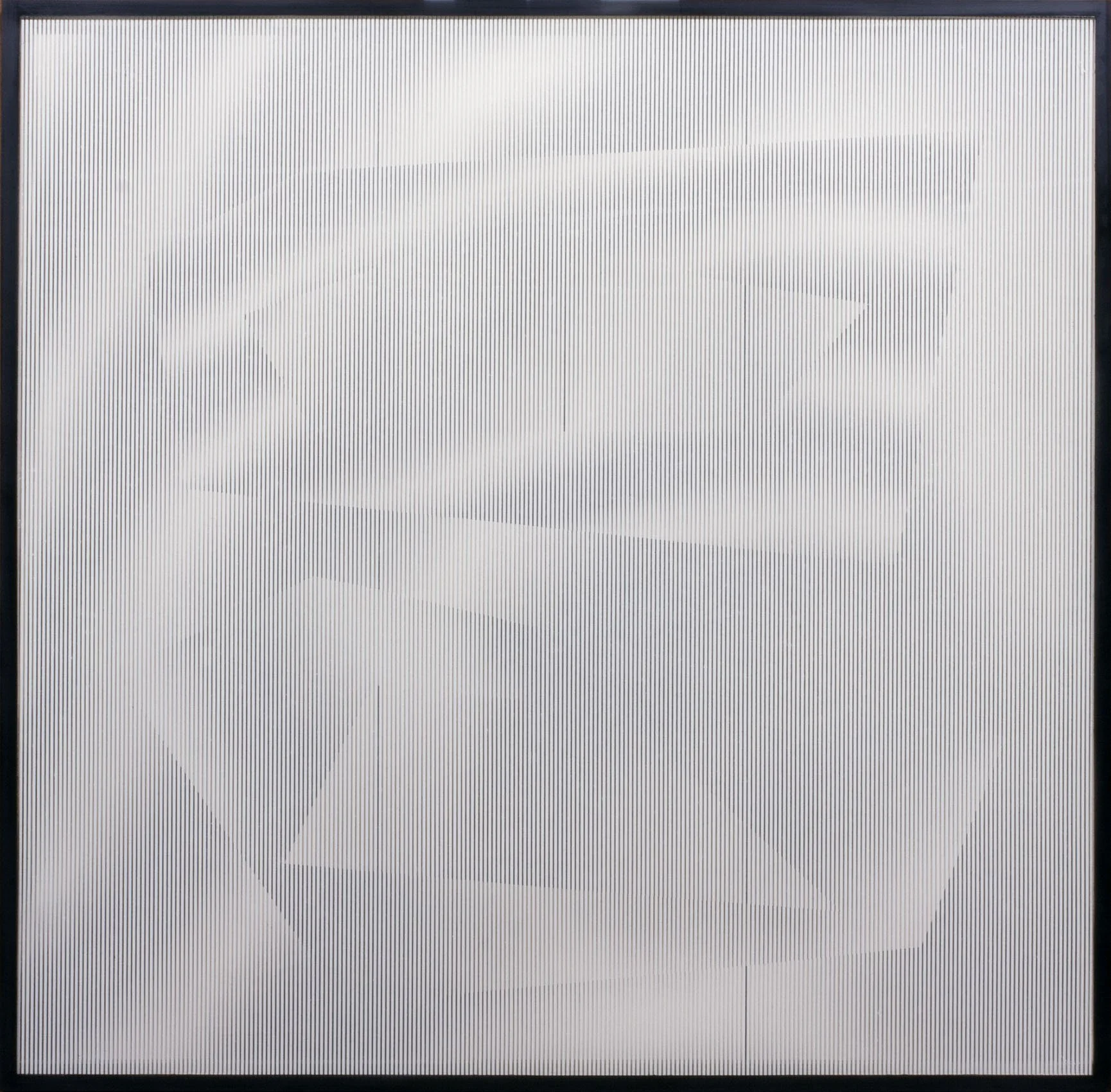
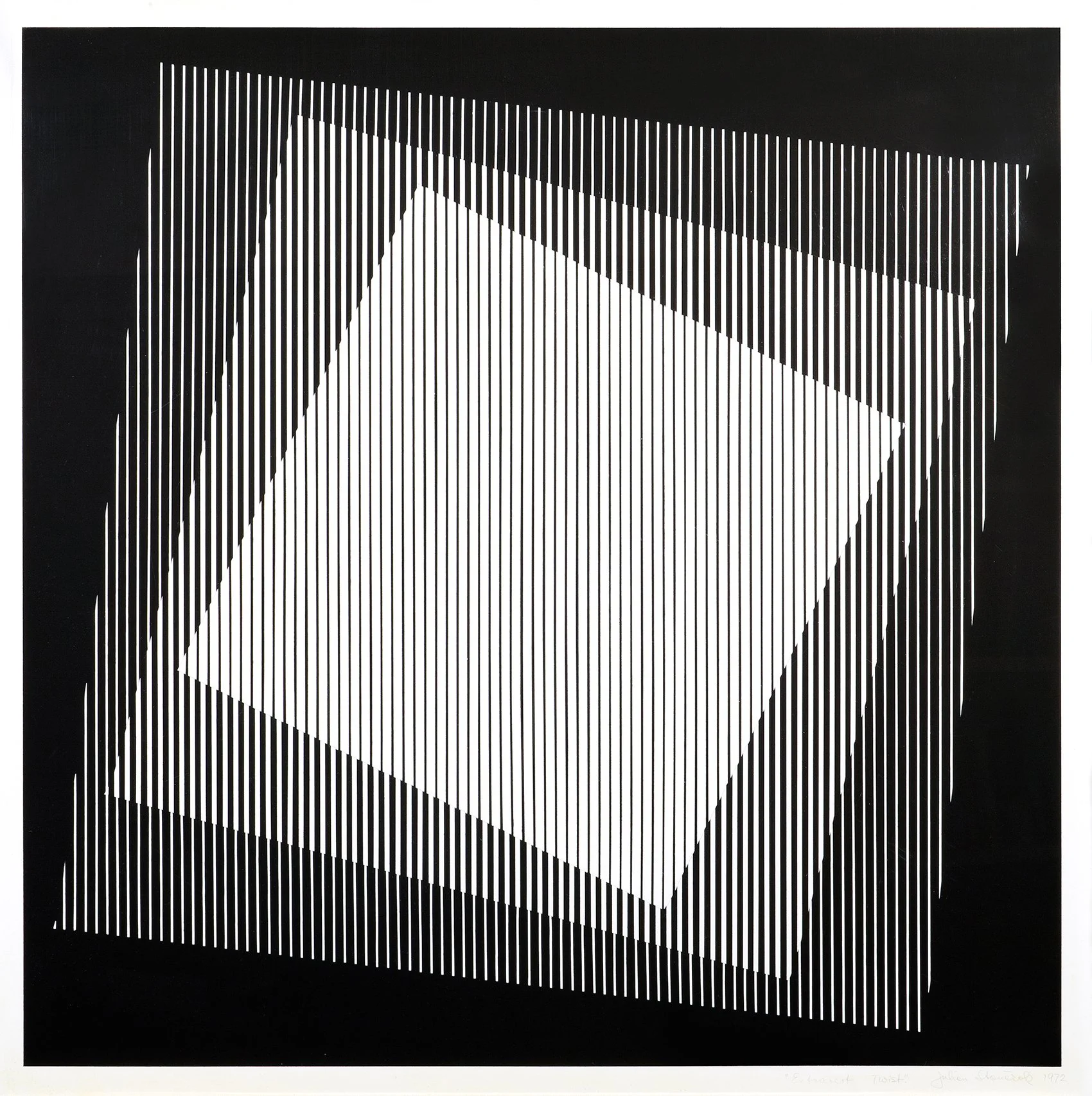
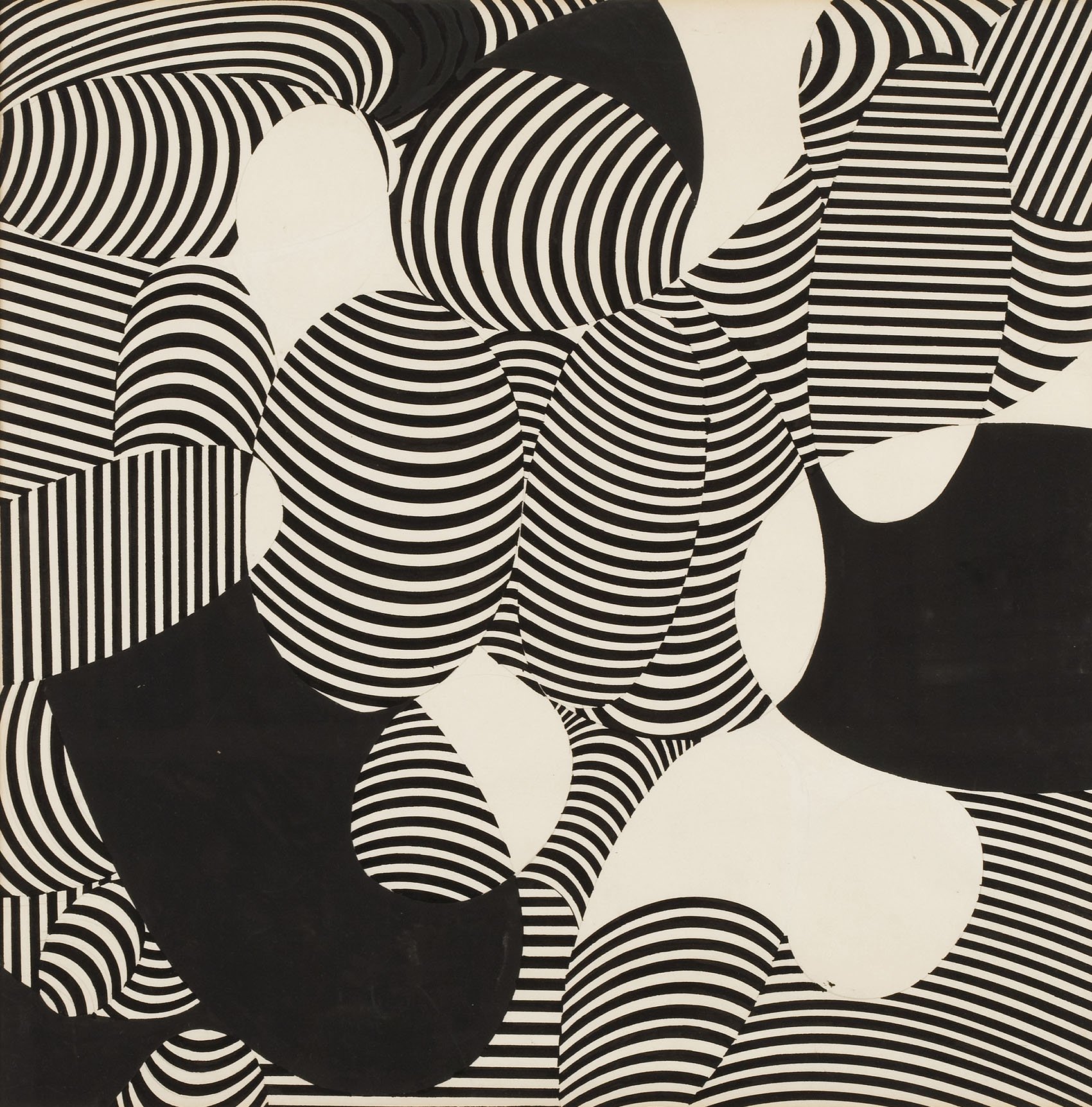
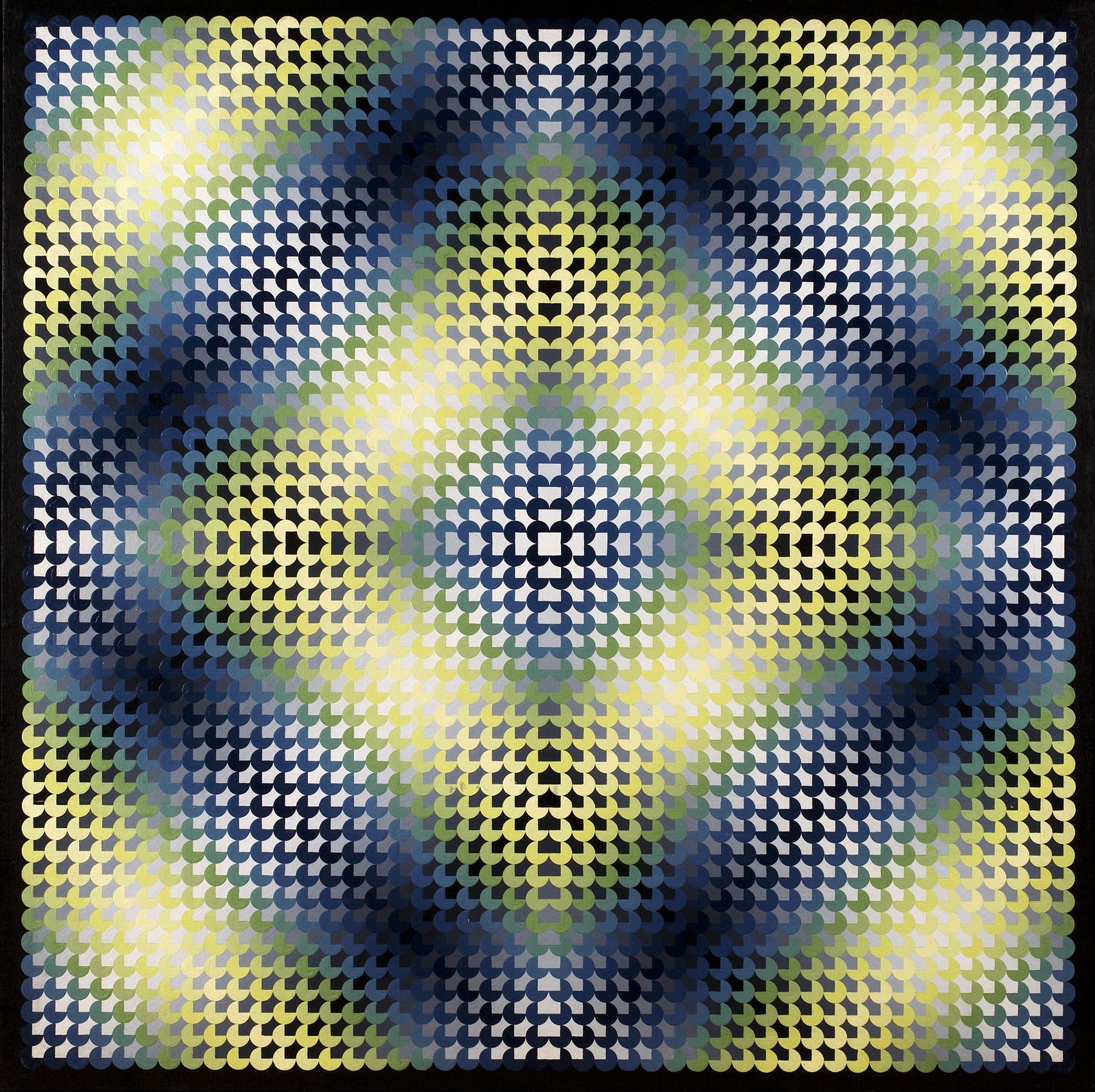
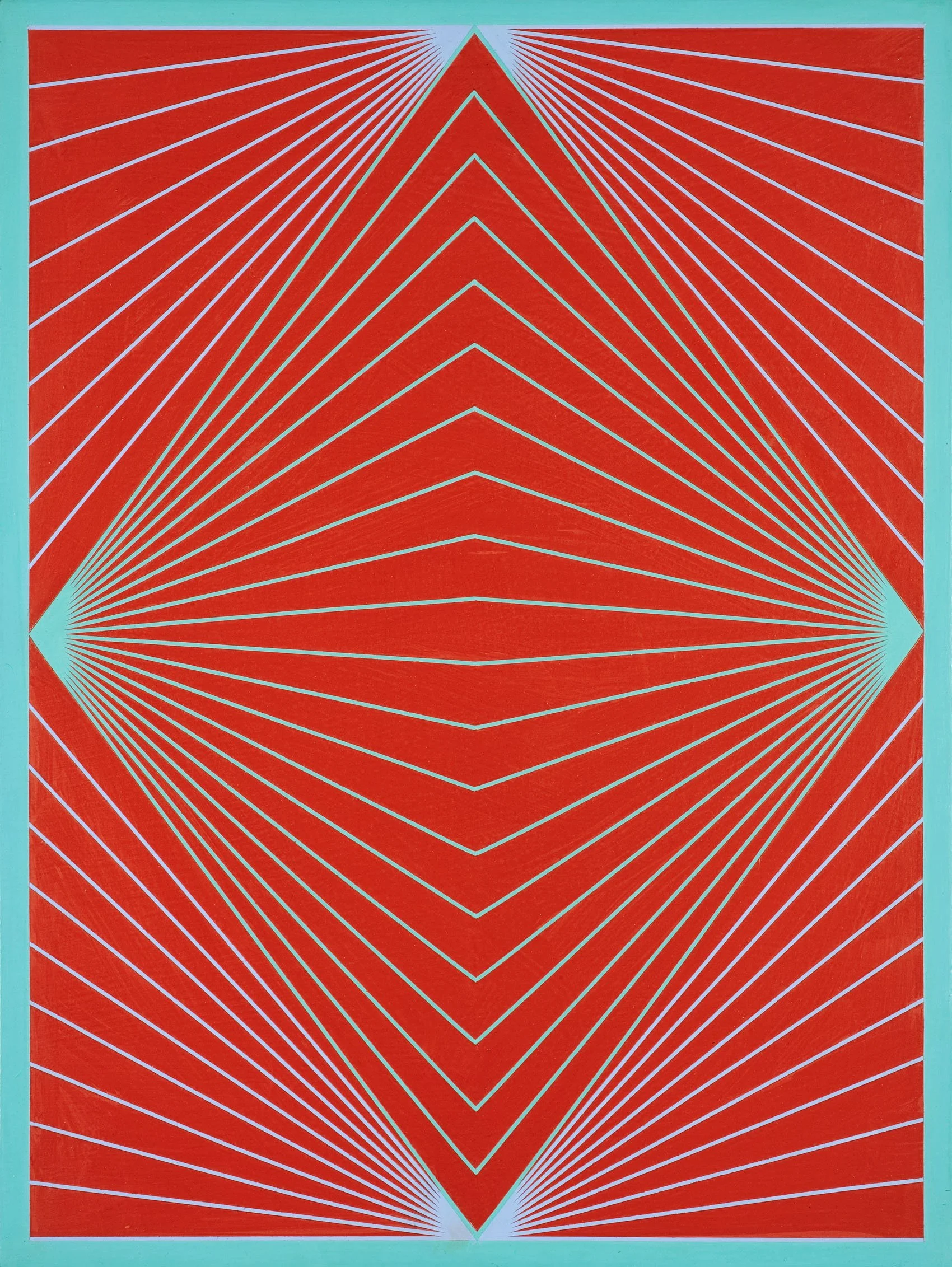
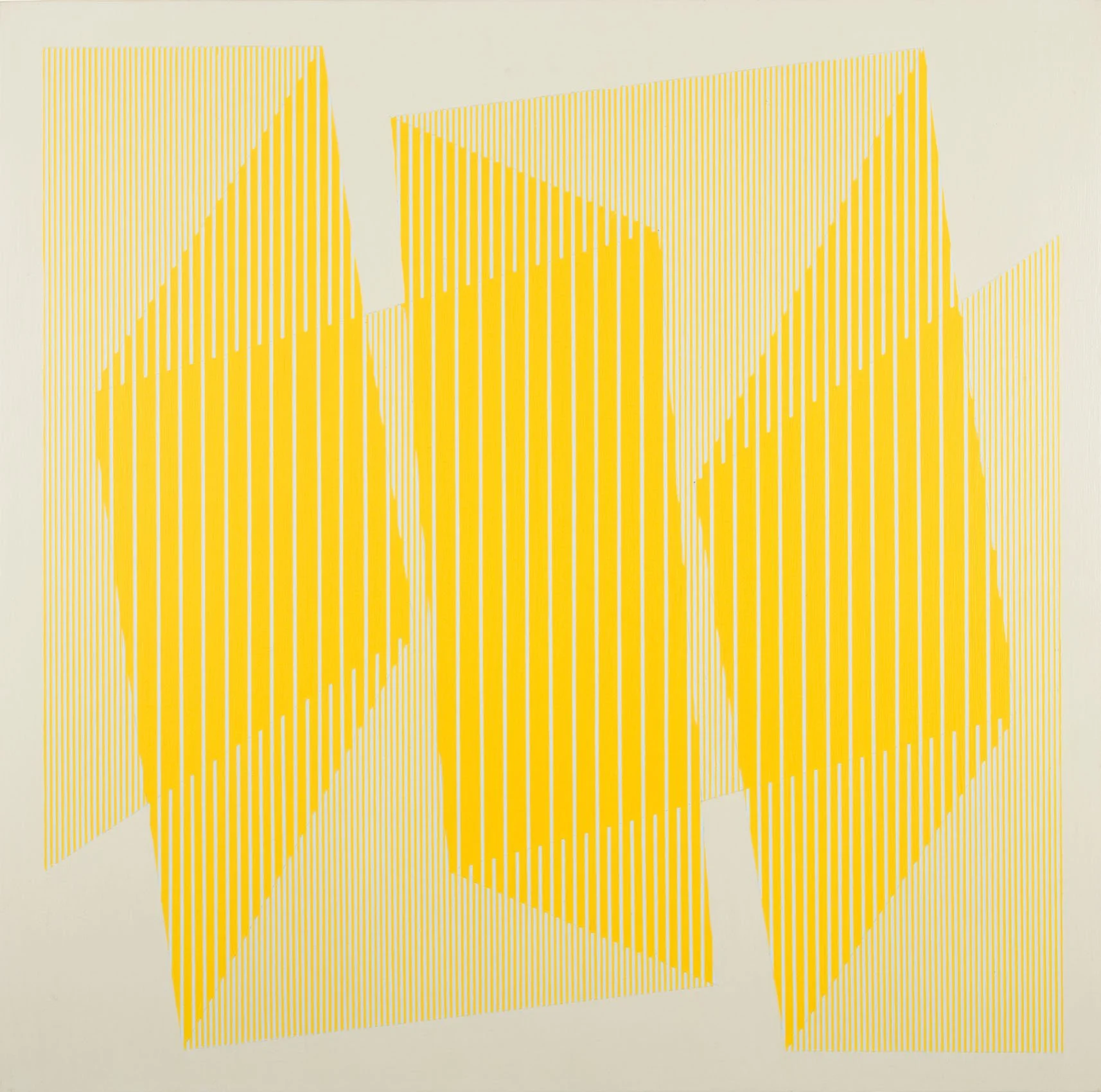
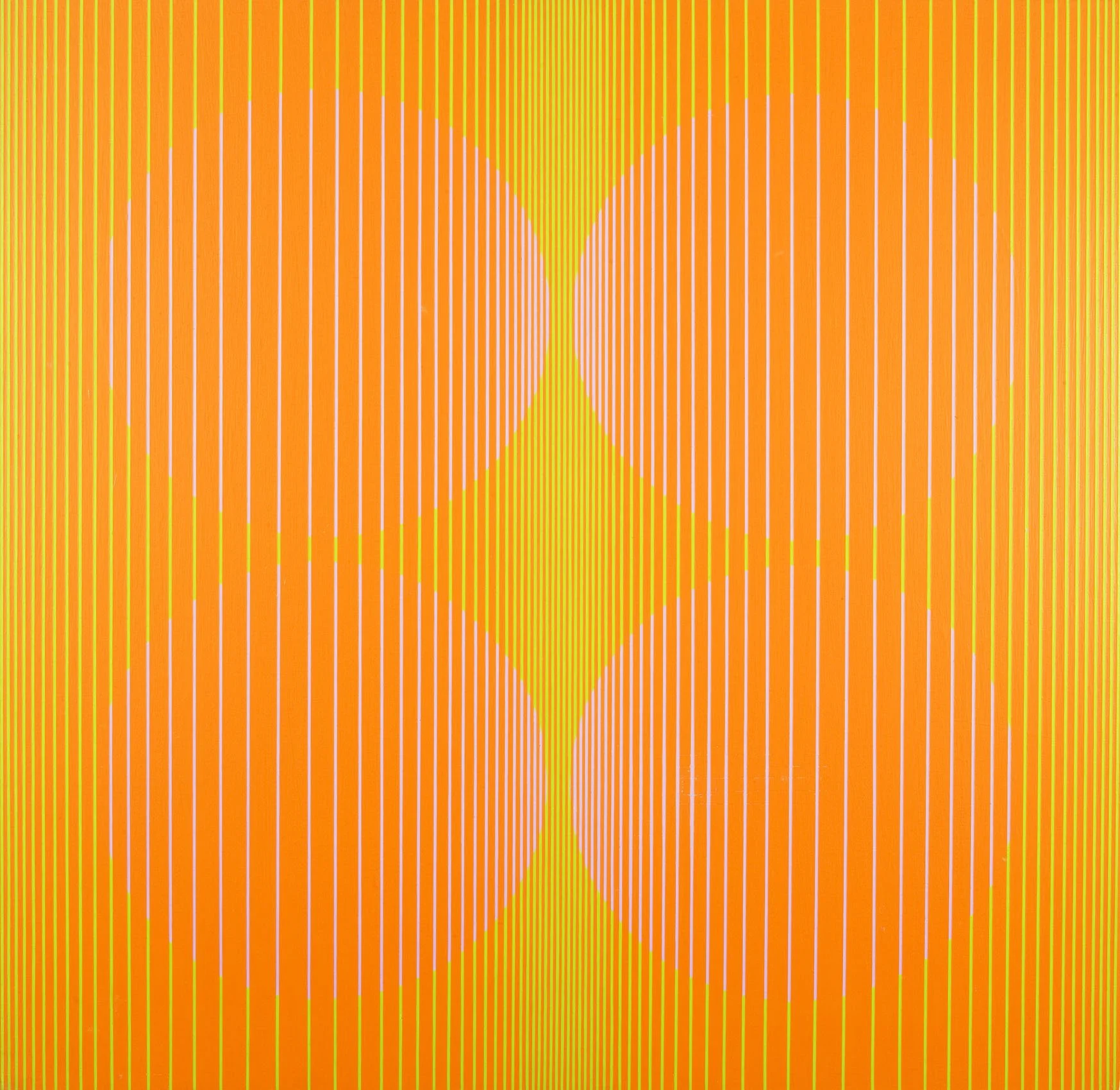
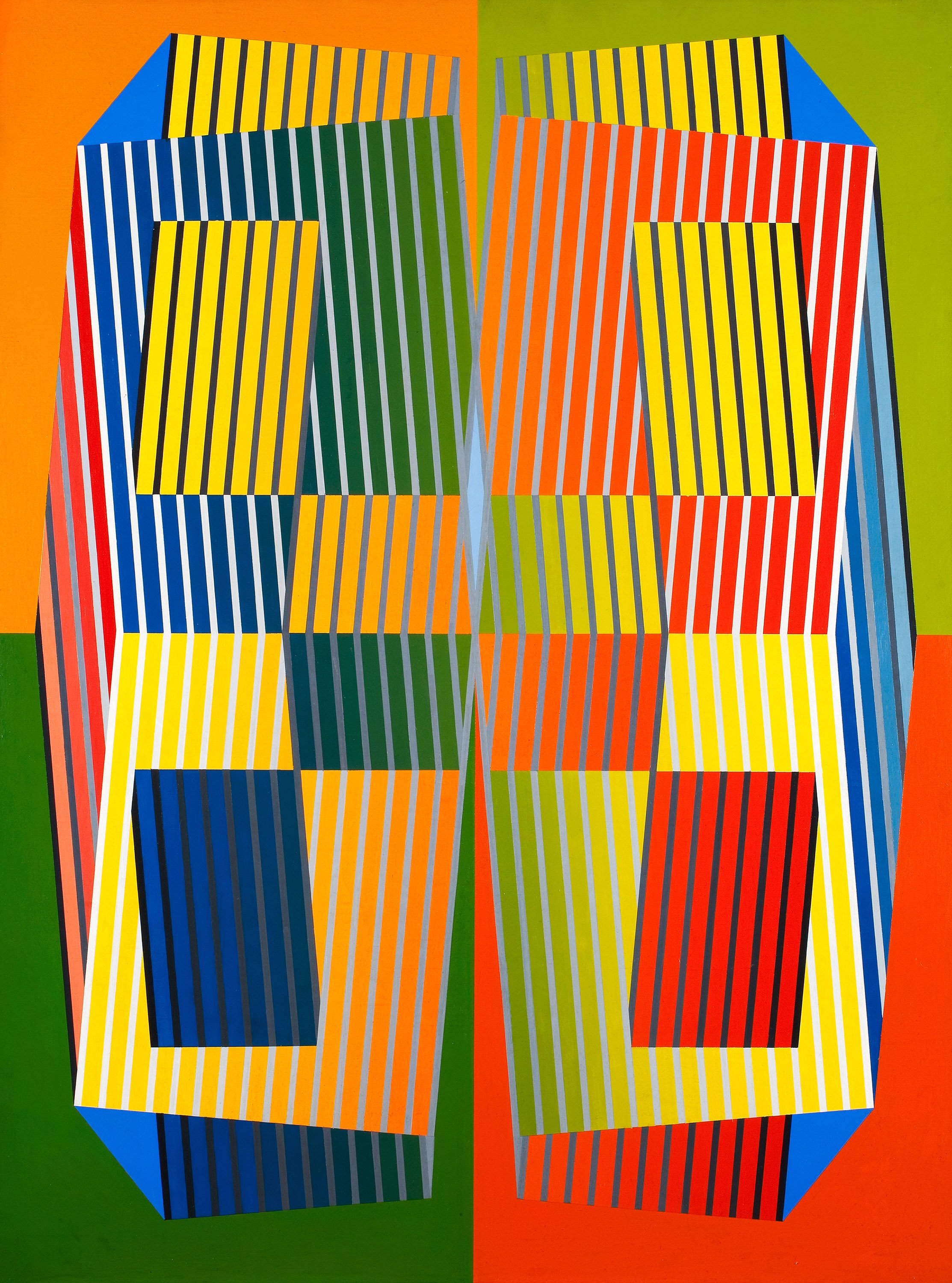
The 1960s was a rich period for geometric art in America. The presence of Bauhaus trained teachers in American art schools, new understanding of how the brain perceives color, and post-war advancements in plastics and paint lay the foundation for Op art, which questioned how we perceive space and movement. Op artists used an investigative approach to create new models for depicting space using only color and line to achieve movement that projects and recedes. The viewer’s participation in an active visual dialogue with a painting was fundamental; the ultimate goal being heightened awareness of what it means to see. The Museum of Modern Art’s 1965 exhibition The Responsive Eye identified Op as an international style. Our exhibition focuses on the Americans in The Responsive Eye, including six painters and two sculptors: Richard Anuszkiewicz (b.1930), Francis Celentano (1928-2016), Francis Hewitt (1936-1992); Bill Komodore (1932-2012), Mon Levinson (1926-2014), Reginald Neal (1909-1992), Julian Stanczak (b.1928), and Tadasky (b.1935). Celentano, Komodore, and Neal are newly represented by D. Wigmore Fine Art, Inc and featured in the exhibition. Works in black and white are emphasized in the exhibition to show the diverse ways Op artist created movement through compositions focused on positive and negative space, without color adding another element of push-pull. In today’s computer age, the artworks in our exhibition appear calculated and mapped out, but all these composition resulted from experimentation and intuition in the artists’ studios.

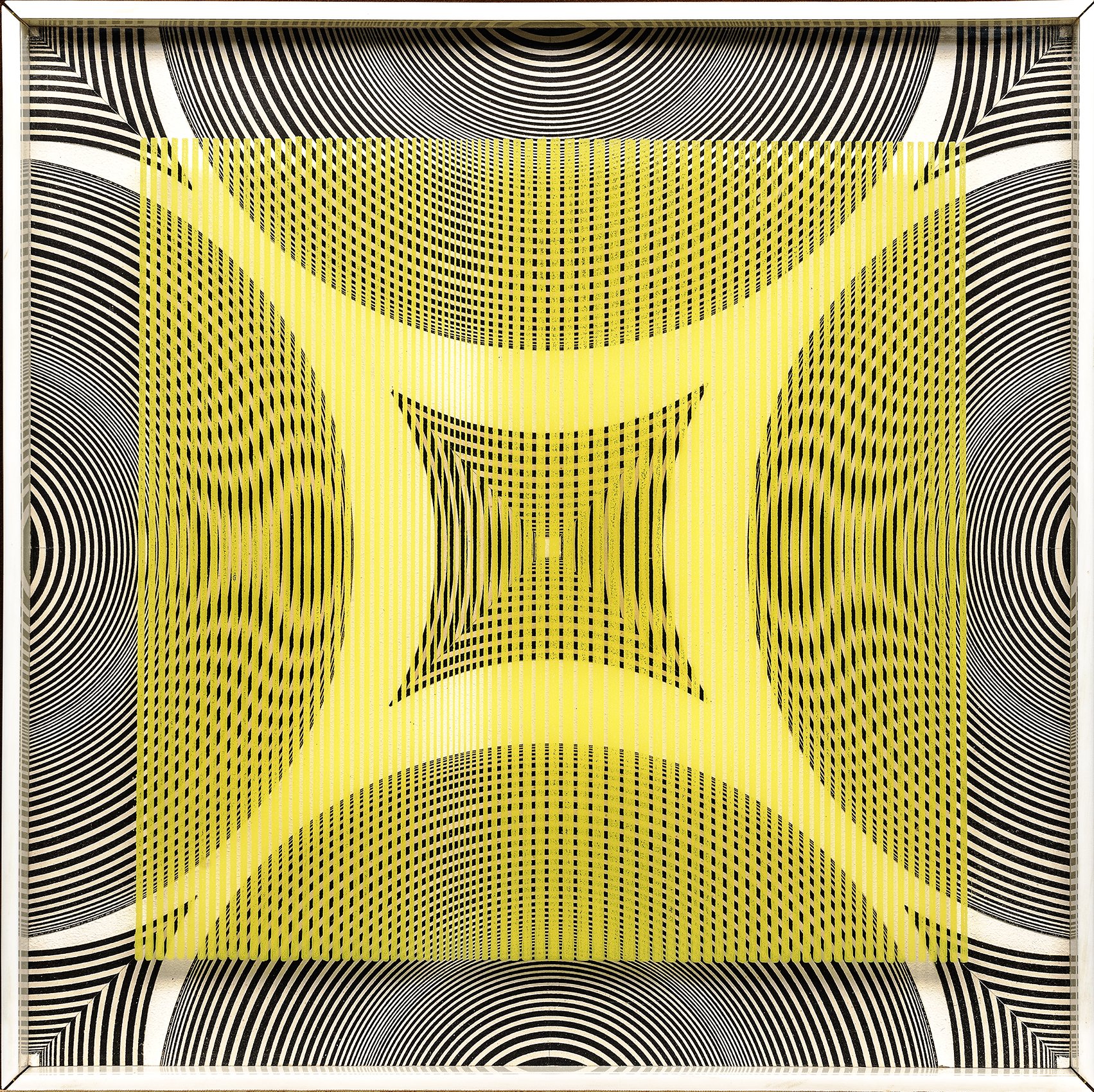
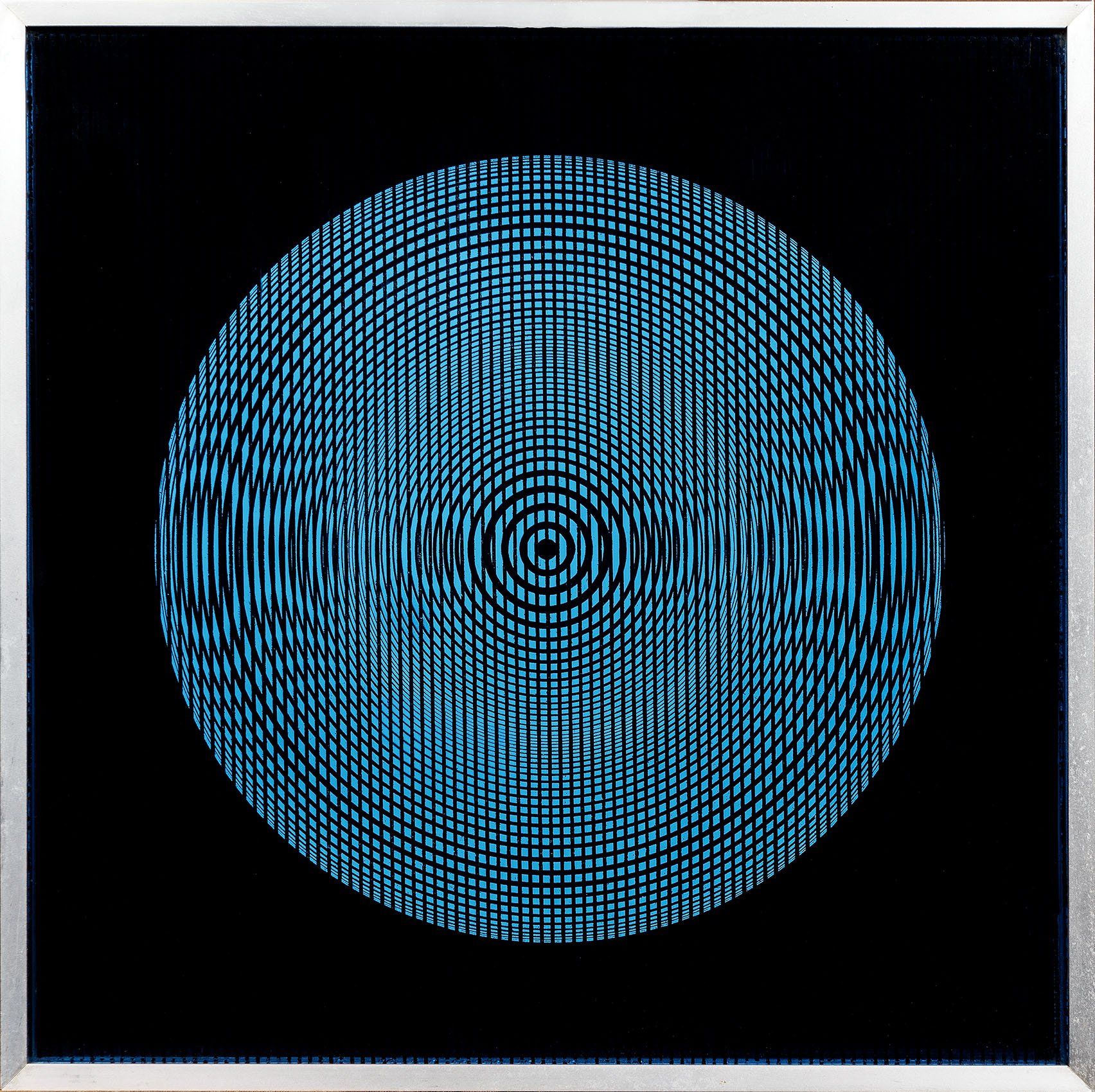
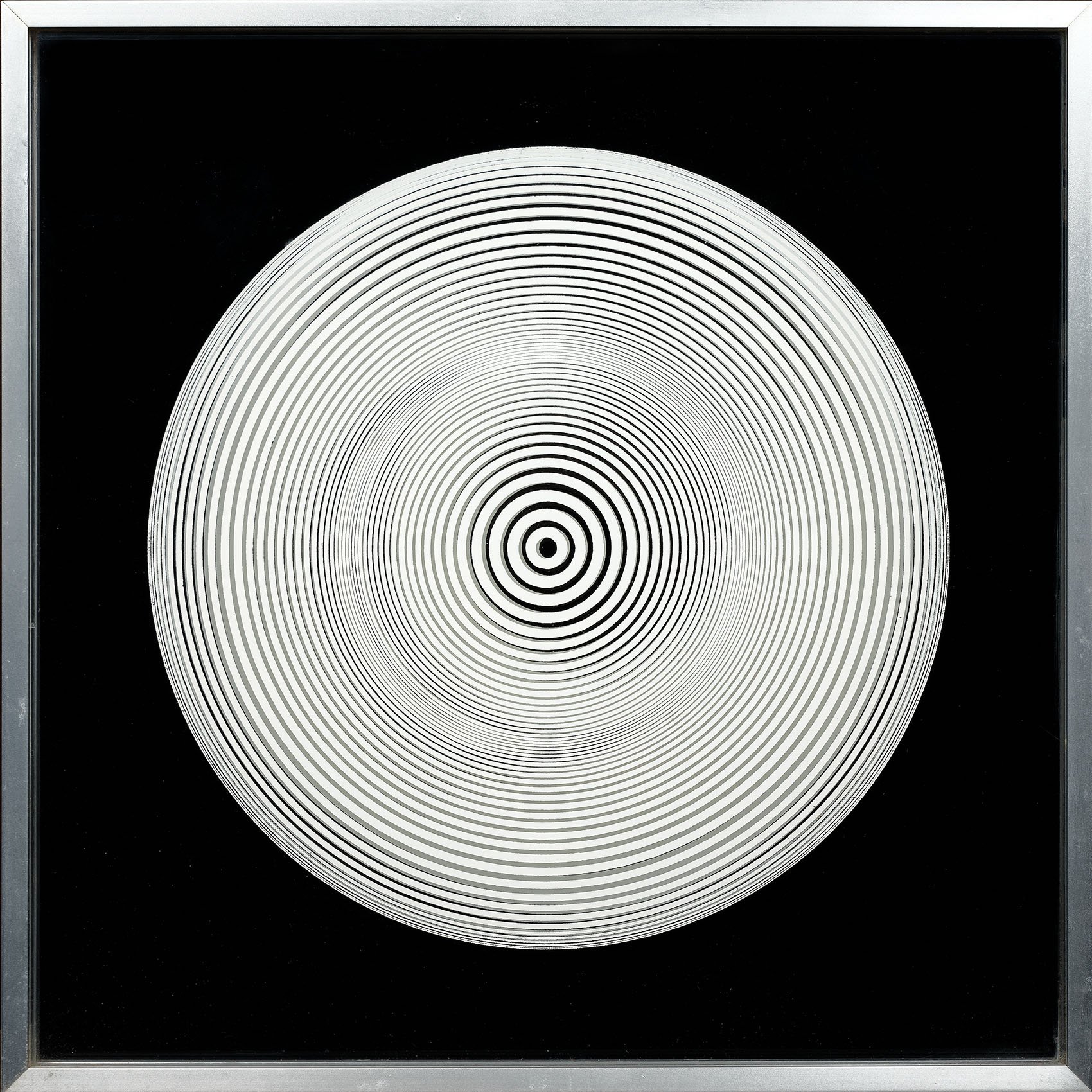
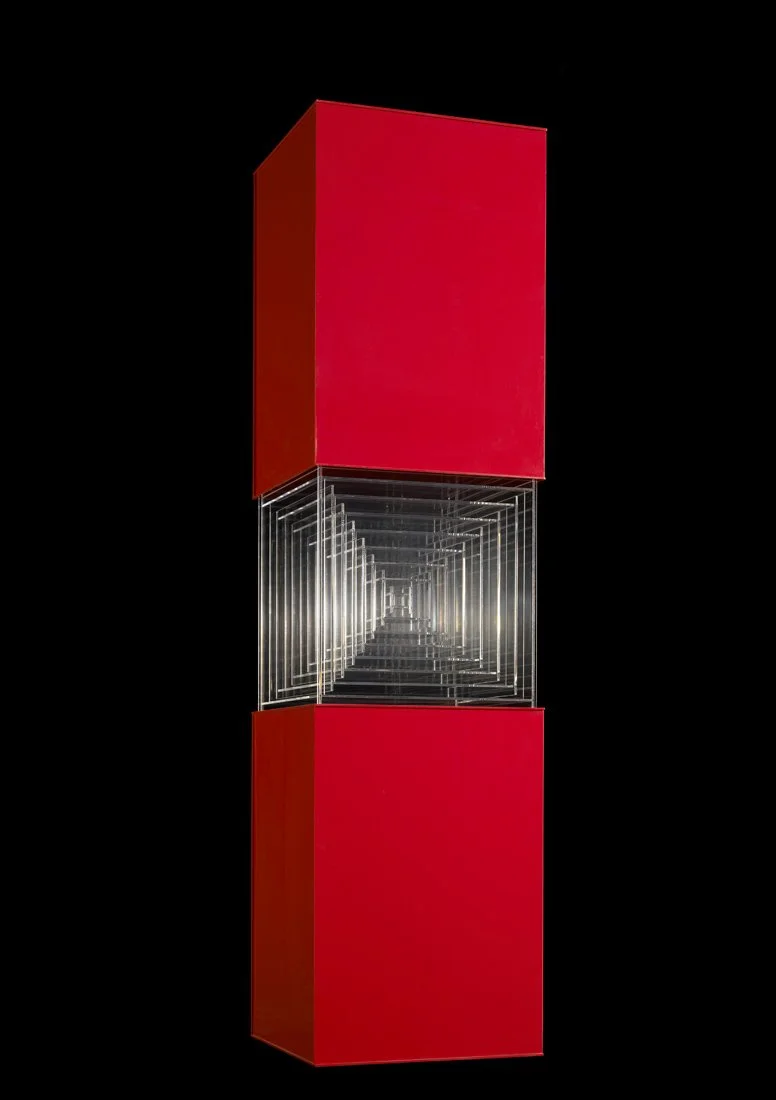
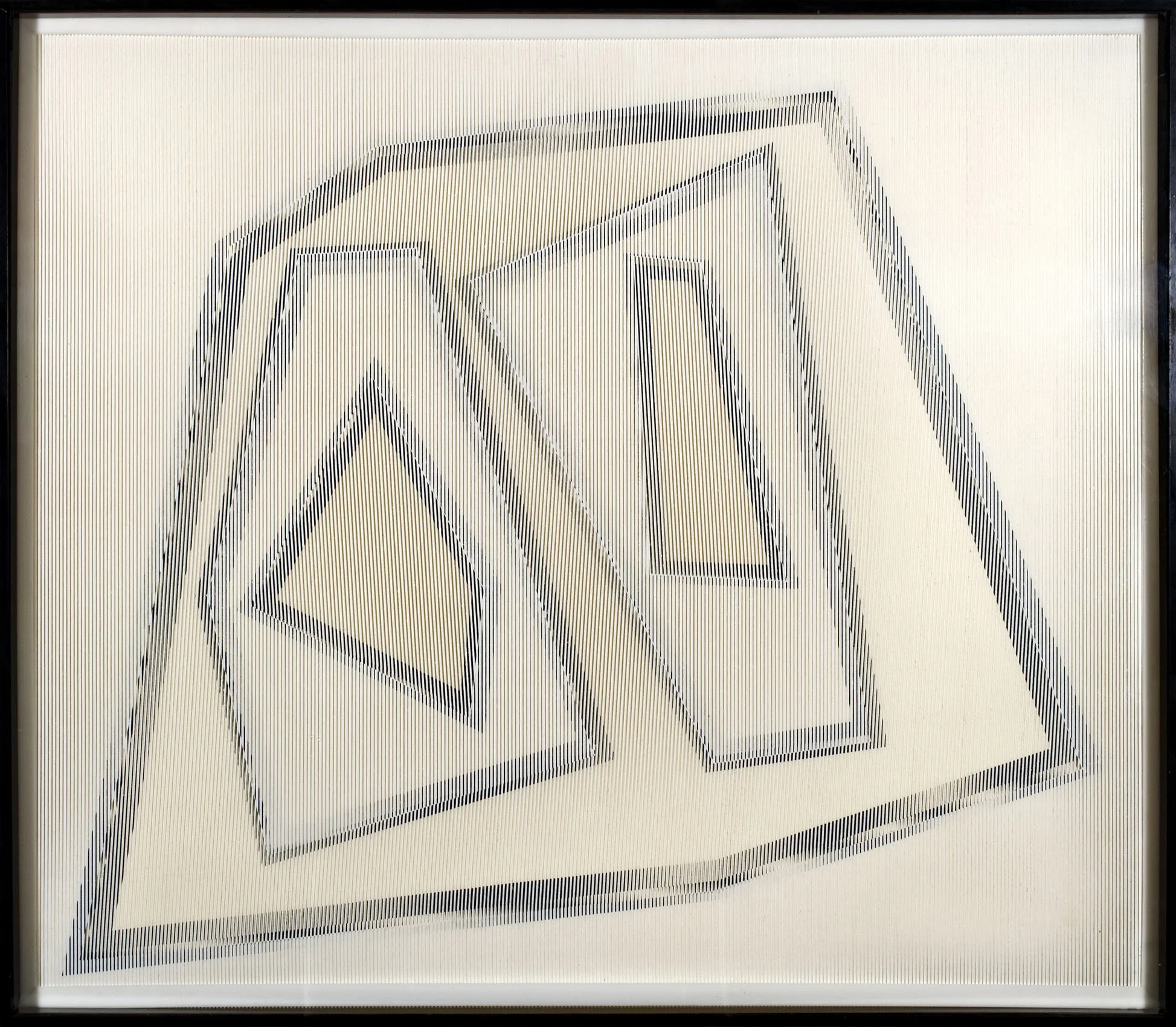
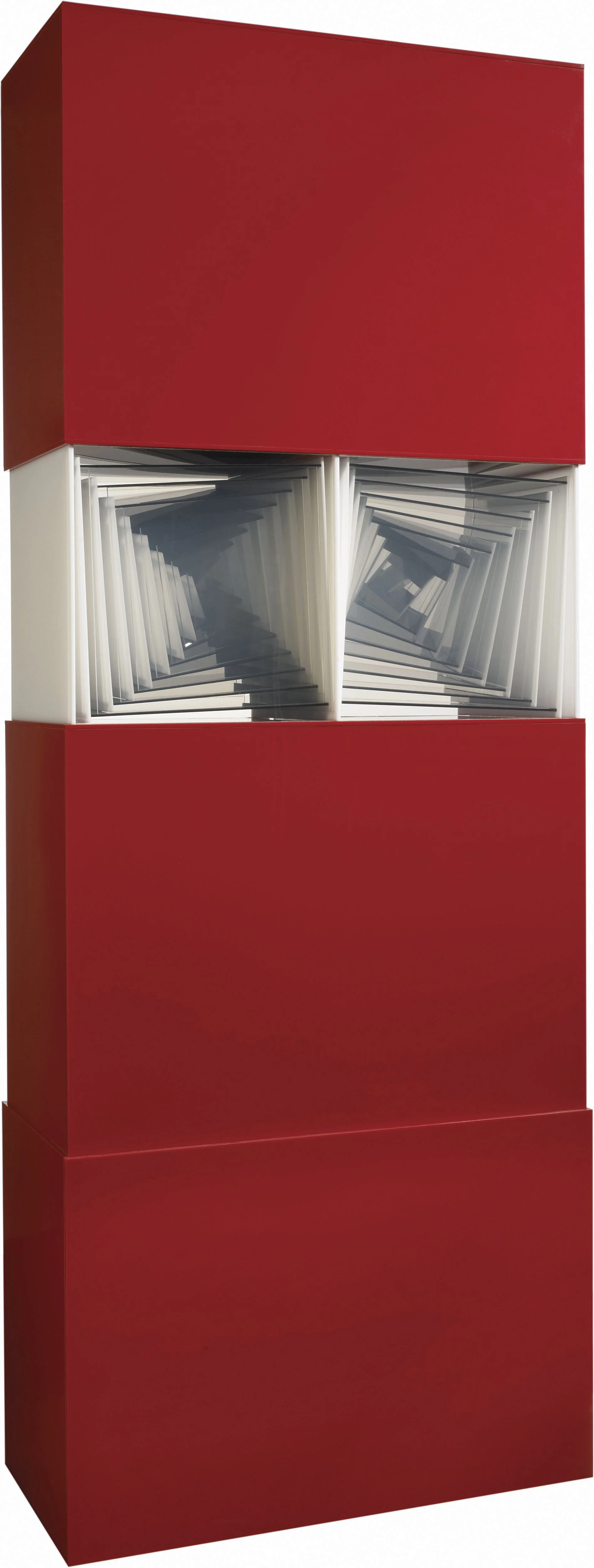
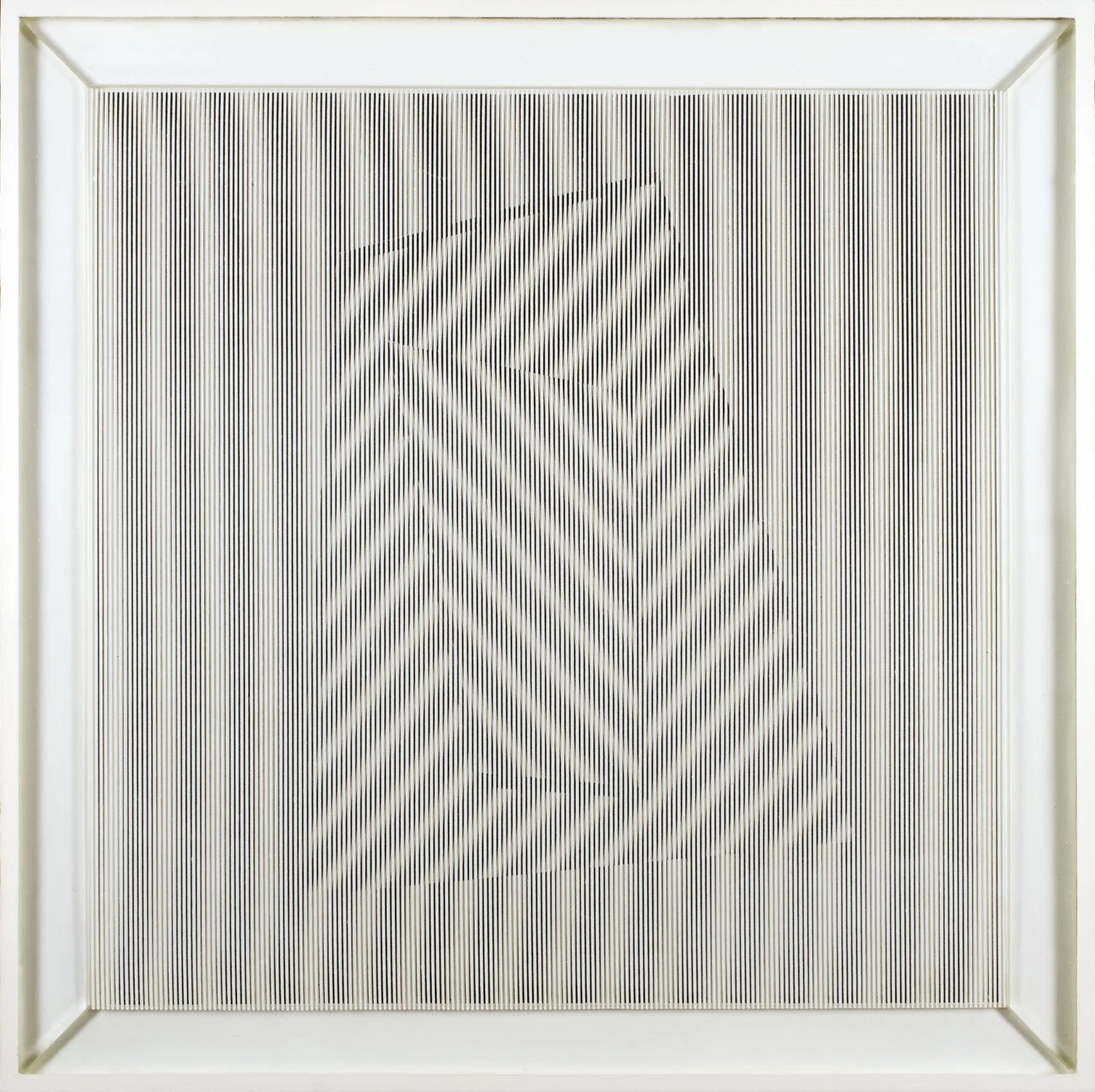
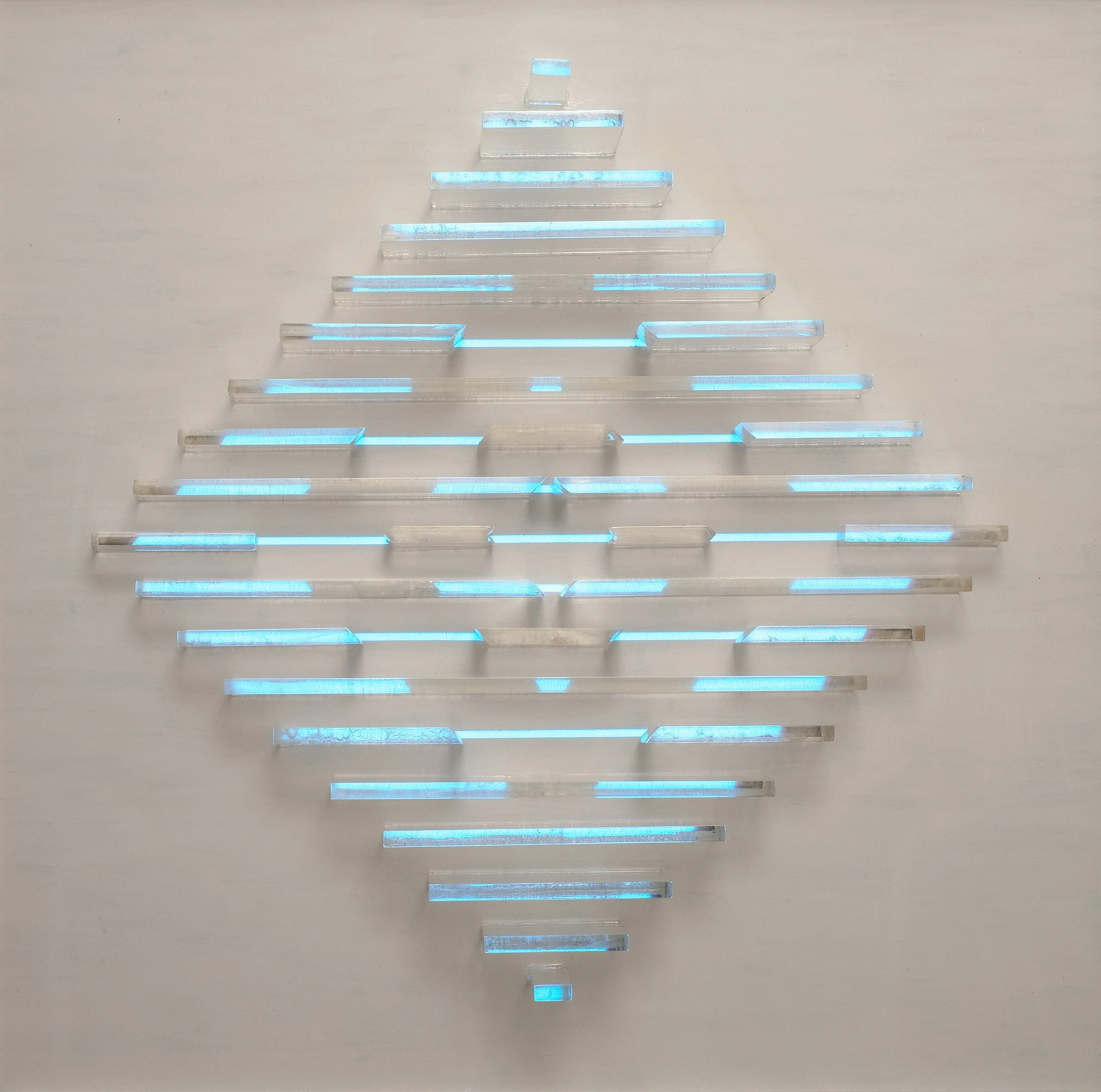
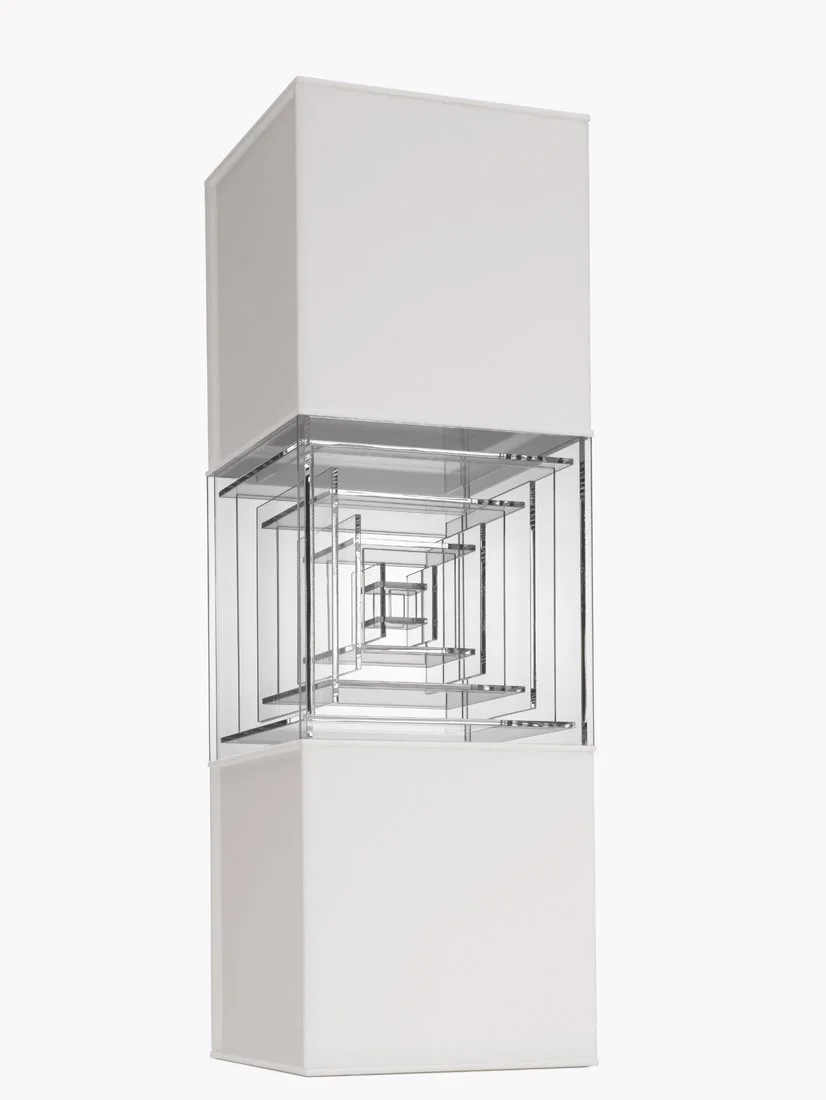
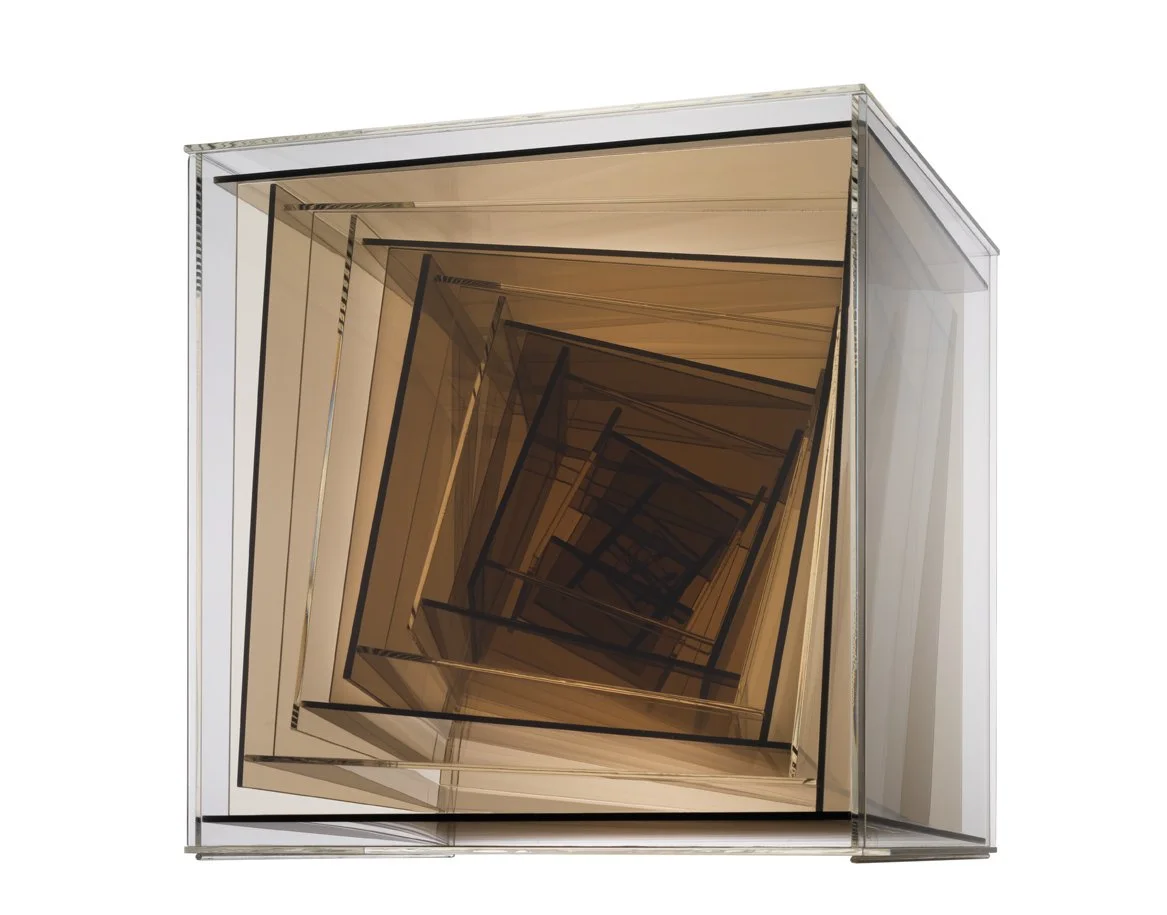
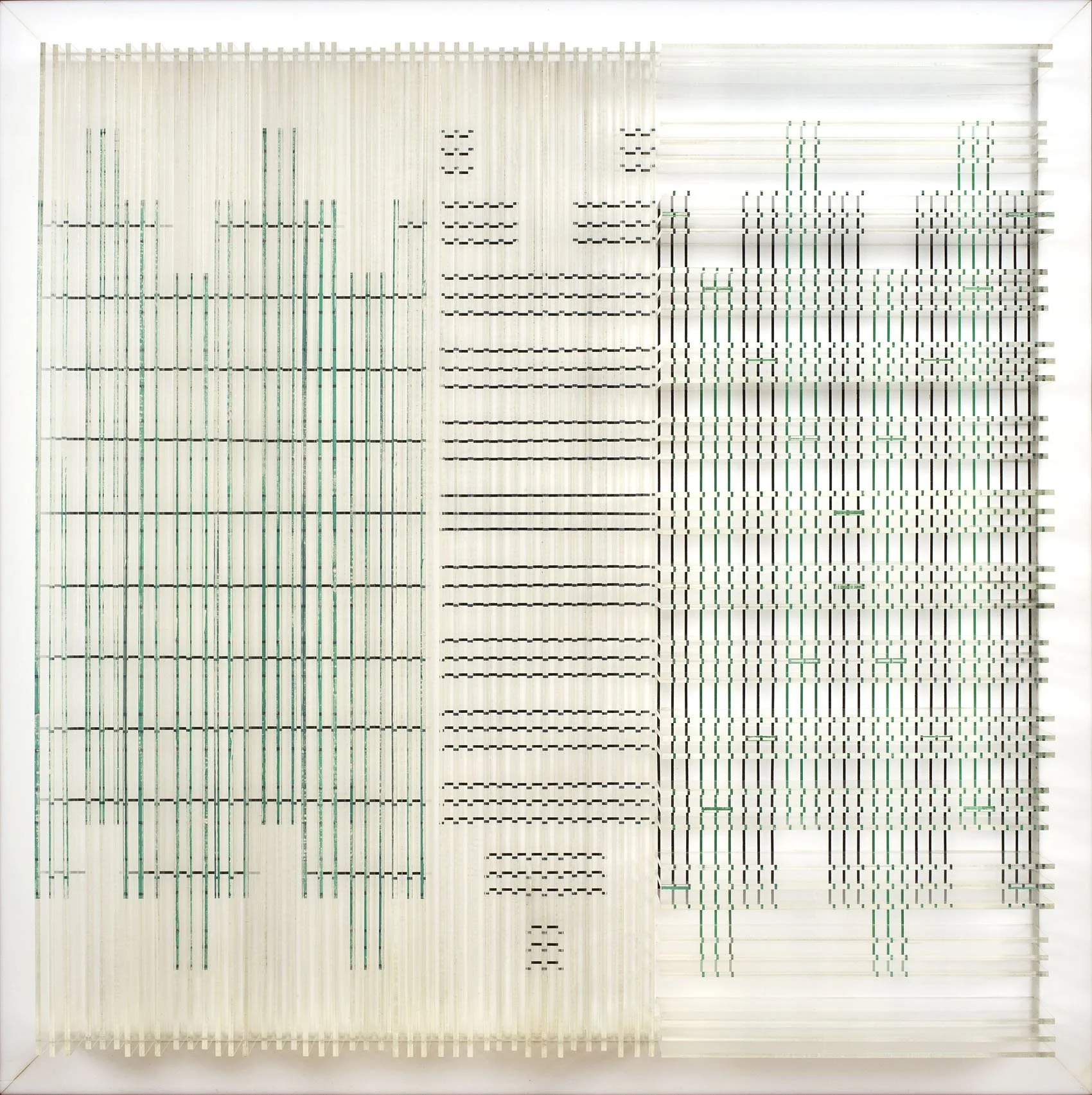
Constructivist and Bauhaus attitudes to art and industry freed 1960s artists to explore new materials and plastics suited the enthusiasm for technology brought on by the Space Race. The plastic quality of new fast-drying acrylic paints allowed painters using tape to execute fine lines for complex compositions and color interactions with an oil-like richness. The two sculptors in our exhibition, Reginald Neal and Mon Levinson, used plastic in sheet form in their wall-mounted constructions because of its transparency and luminosity. Neal and Levinson both became interested in the moiré effect that occurs when two sets of parallel lines overlap for the effect’s simulation of movement as each change in the viewer’s sightline generates new patterns as the eye unconsciously ties together new points of intersection. In the 1950s Reginald Neal was an established artist and printmaker credited with advancing the development of color lithography. In the 1960s Neal’s work became more abstract as he considered the concept of time. In 1964 he merged lithography and sculpture by cutting his prints into symmetrical patterns faced with a layer of printed lines on Plexiglas, which he placed in plastic boxes to create spatial separation. In Hexagon Moiré, c.1966, a clear sheet of Plexiglas with printed white lines in a hexagon shape is mounted about an inch from a blue Plexiglas backboard with white concentric circles printed over black parallel lines. The effect is mesmerizing with new patterns of circles and shading created with the viewer’s movement. While Neal came to his constructions through printmaking, Levinson developed his constructions out of an interest in plastics. In 1964 Levinson started to make Plexiglas construction in black and white to examine how the intensity of the moiré effect could be controlled by the width, tone, and distance between the sets of lines, which he investigated with a series of construction between 1964 and 1967, as seen in Lateral Flow, 1966. In 1968 Levinson simplified his compositions to focus on the reflective properties of plastic using formal geometry to consider light as a raw material in his work.

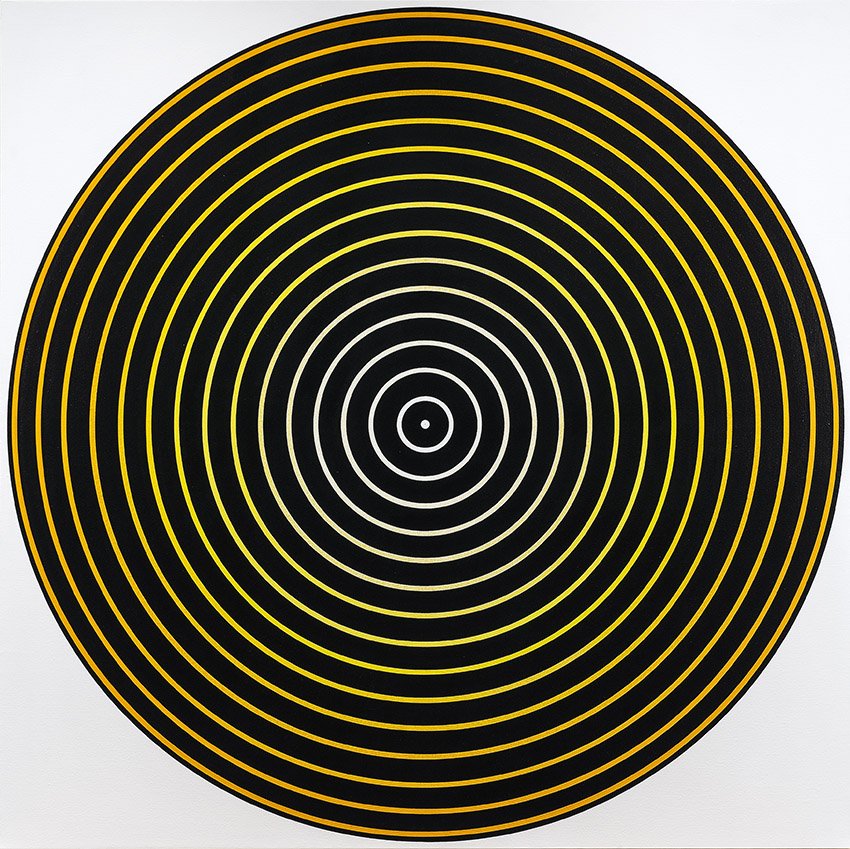
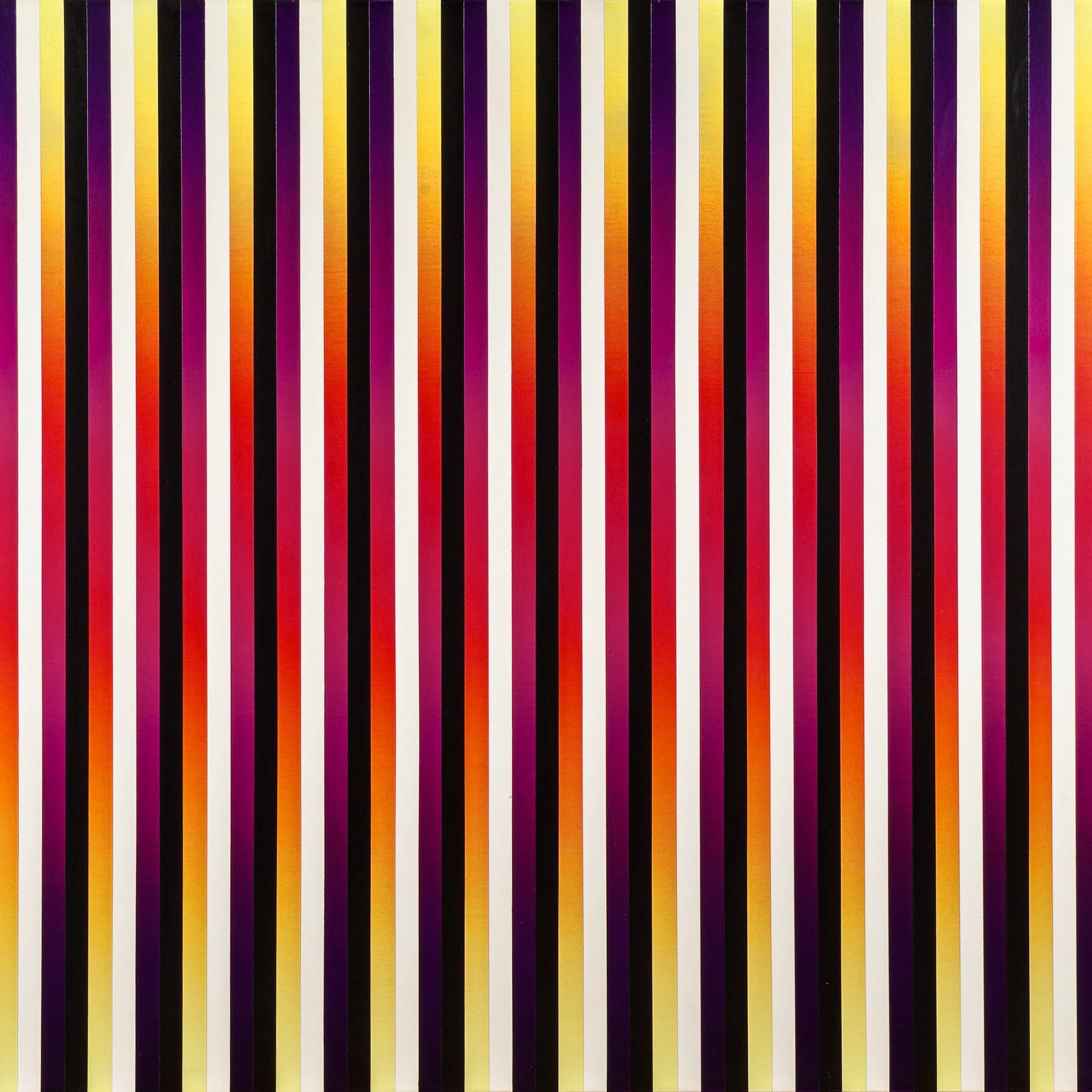
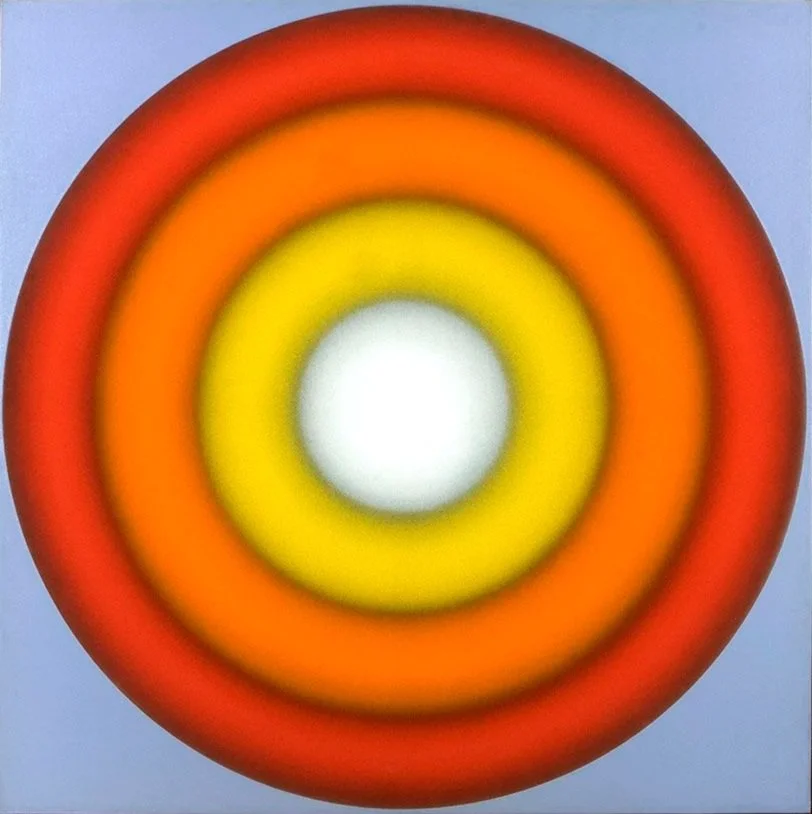
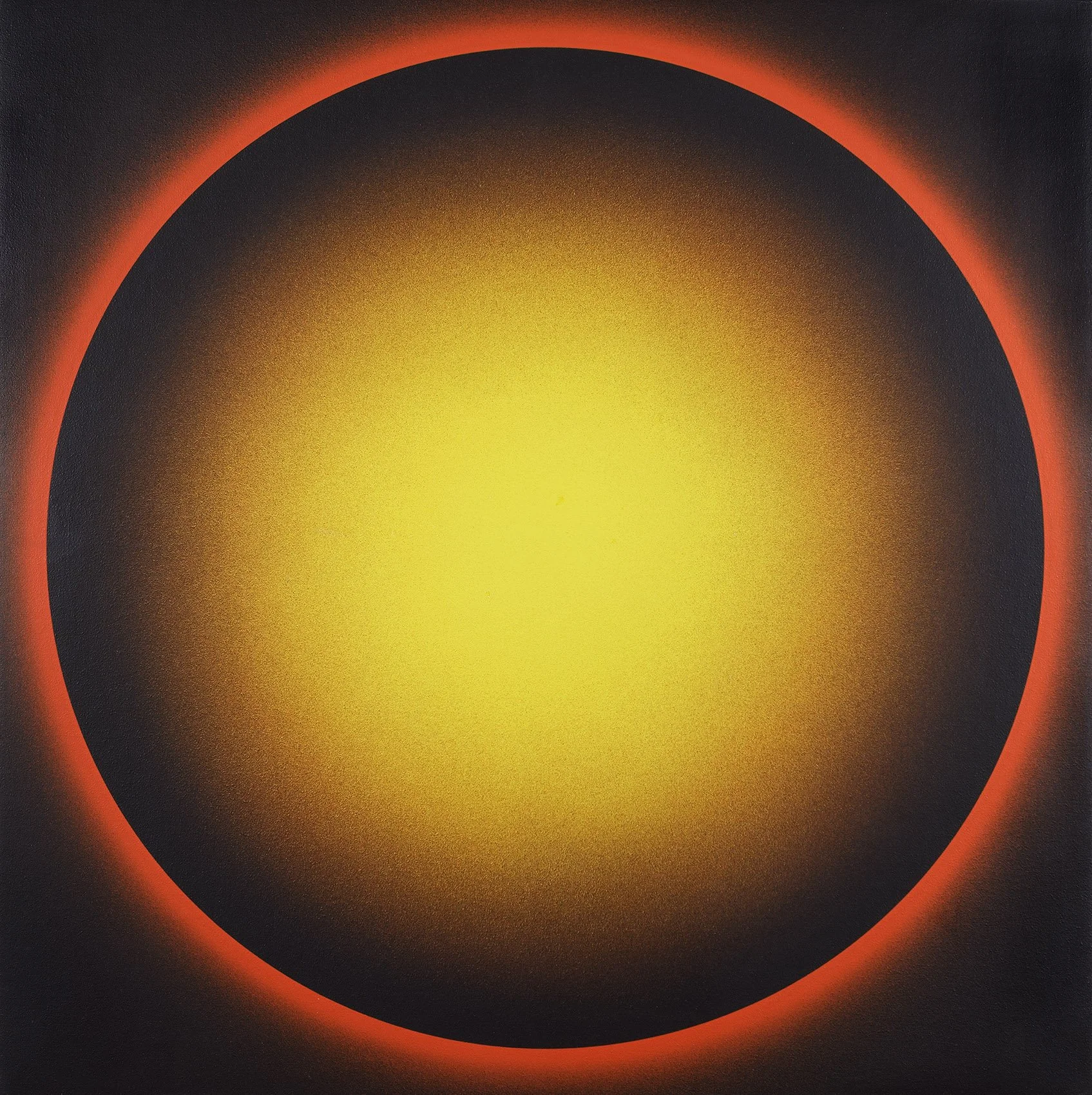
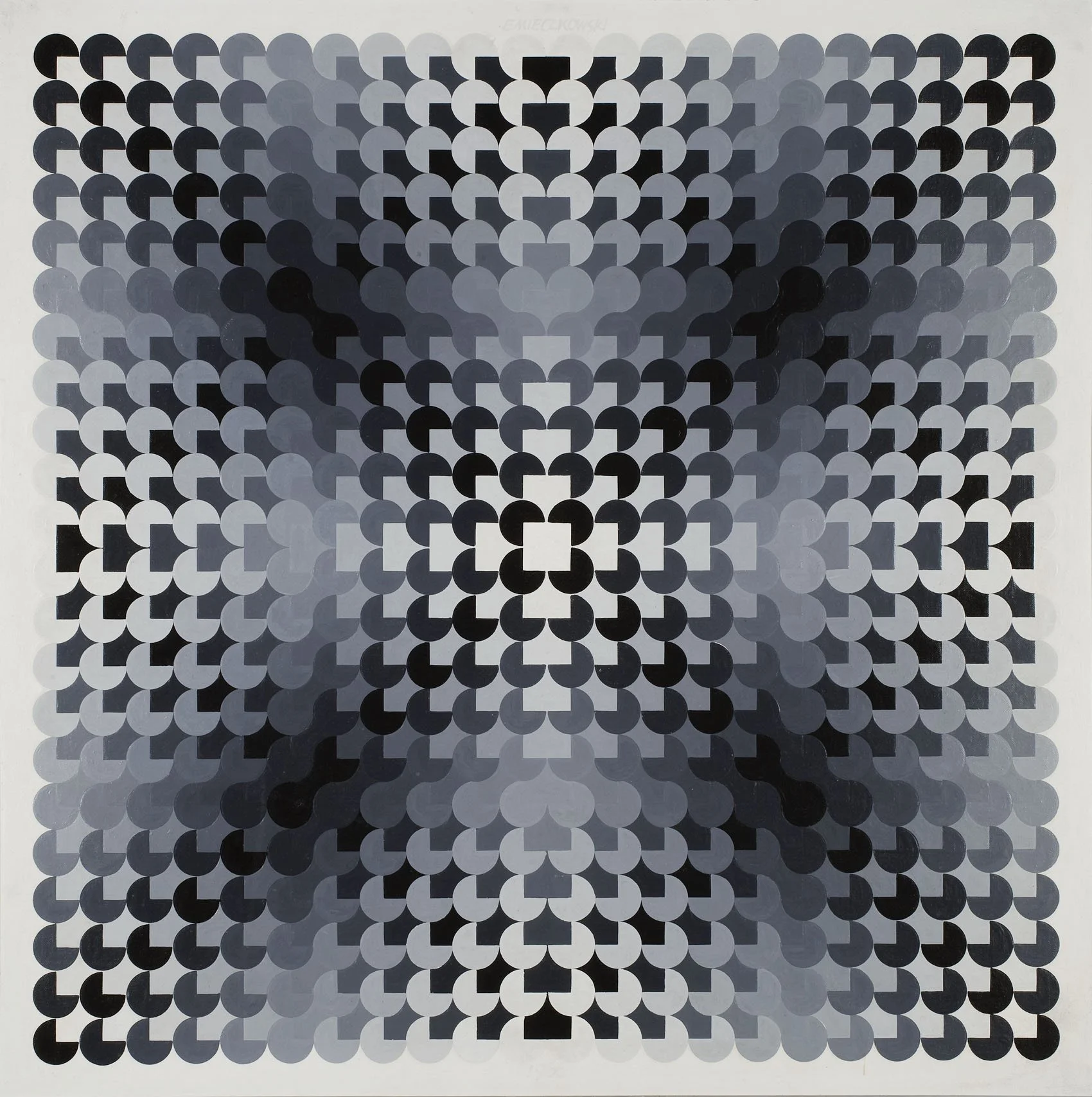
Celentano, Hewitt, and Tadasky used optical blending to create a blur effect that suggests speed as colors meet and melt into one another. In Celentano’s work from 1965 to 1968, he repeated, rotated, and mirrored patterns in black and white to dizzying effect as seen in Zilos, 1966. In 1968 Celentano formulated a strategy for color and began his first color series titled Alpha using an airbrush to soften color transitions within ruled lines. In Alpha Reverse in Black and White, 1970, bands of gradient colors alternate with bands of constant color, giving the impression of pistons in motion. Celentano aimed to create visual instruments of dramatic tension by orchestrating color interactions within the confines of patterns and structures that control the perception of these forms. After spending four years developing his technique to execute perfect circles within a square canvas, Tadasky had mastered his craft by 1965. In C-182, 1965, Tadasky used optical blending to create a color shift from orange to white across a black circle that suggests the sun’s heat and light. He achieved this fading effect by applying an additional layer of yellow and then white as he worked his way to the center. Frank Hewitt was one of three artists who formed The Anonima Group in Cleveland in the early 1960s. Along with Ernst Benkert and Ed Mieczkowski, the group investigated the psychology of perception by setting a program of limits each artist would explore separately. In 1965 Anonima’s project was titled Black/White and Gray 24” Square with each artist contributing ten paintings for a New York exhibition that traveled to the Institute of Contemporary Arts, London and Galeria Foksal in Warsaw in 1966. Hewitt was the most painterly of the group with beautiful transitions from light to dark in his compositions. Though he set the program for the group, he broke the rules to incorporate touches of color like the maroon edges in Munchin’ Henries at Shaky Heights, 1965 to make the black and white composition pop.

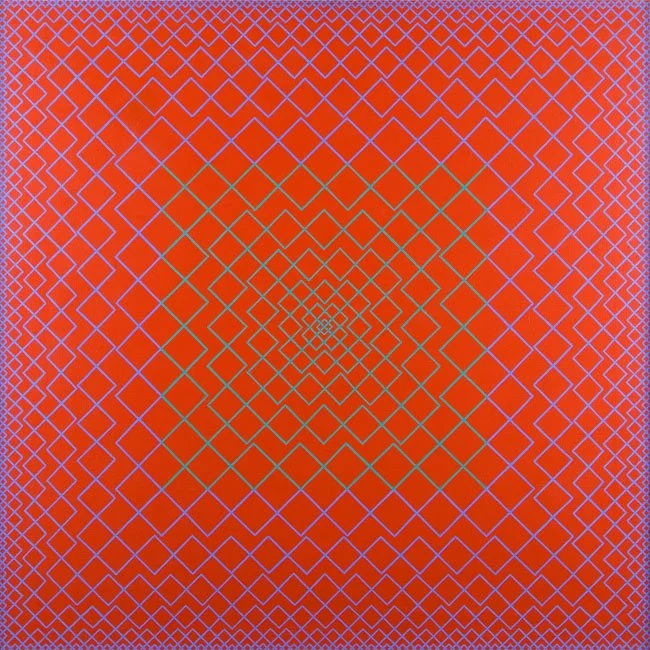
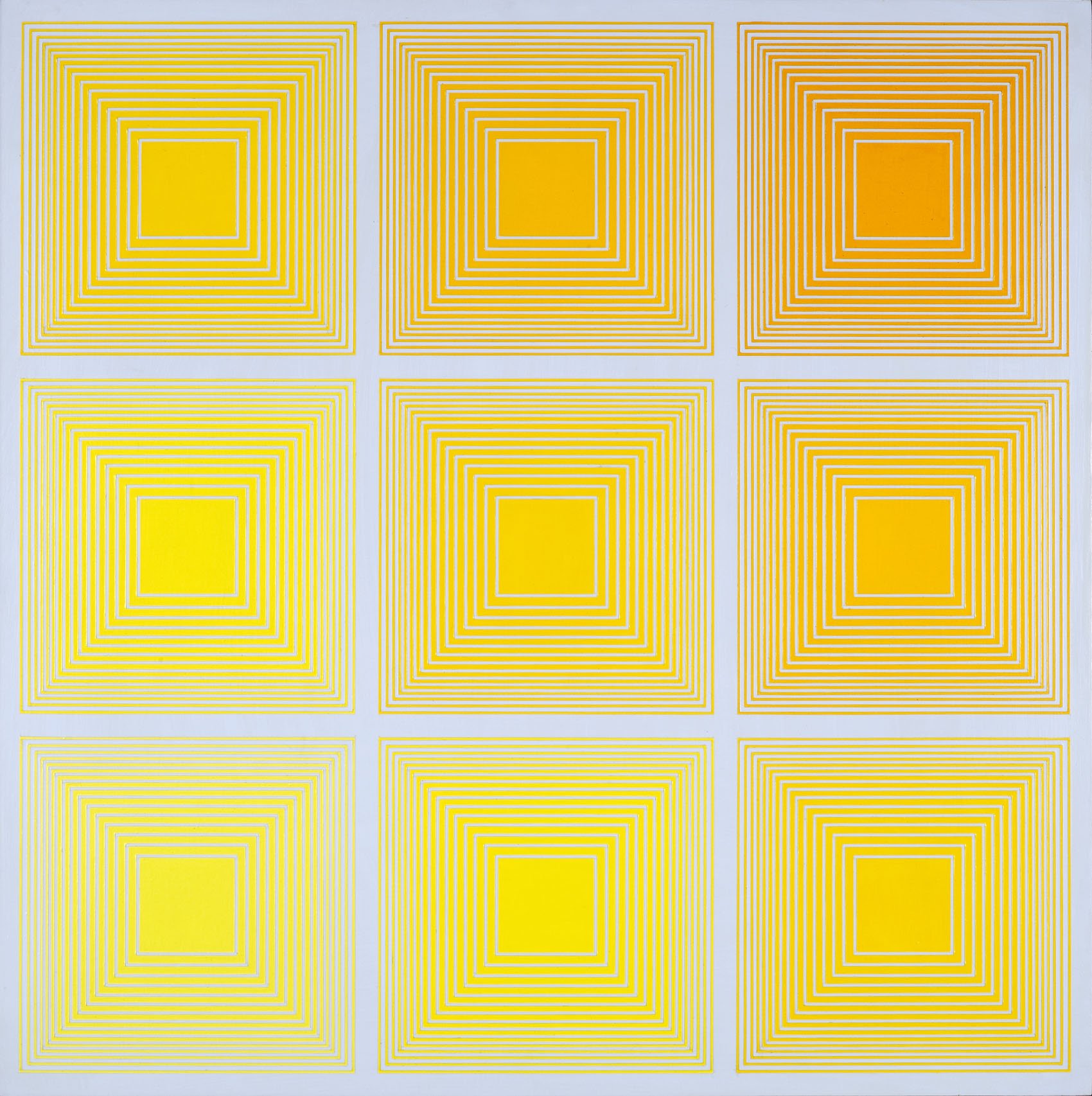
In different ways, Anuszkiewicz and Komodore explore the tension between the center and edges of a canvas to address the ambiguous sense of space that results from an abstract painting no longer having the traditional figure-ground relationship of representational painting. With the rise of abstraction, the canvas’s surface became a dynamic space of indeterminate depth. Komodore addressed this by creating a single central field activated by the contrast of light and dark along the canvas edge as seen in Meander, 1967. All four 1967 paintings by Komodore in our exhibition explore the ambiguity between movement and stillness and closed and open spaces in an overall minimal composition. Richard Anuszkiewicz considered the edge’s ability to define an infinite center depth or projection, pinching and expanding the space by changing the density of the lines as seen in Unit, 1966. Anuszkiewicz embraced his teacher Josef Albers’s theories on color interaction and applied that understanding to measured, geometric compositions of precise linear patterns within gridded or square formats.

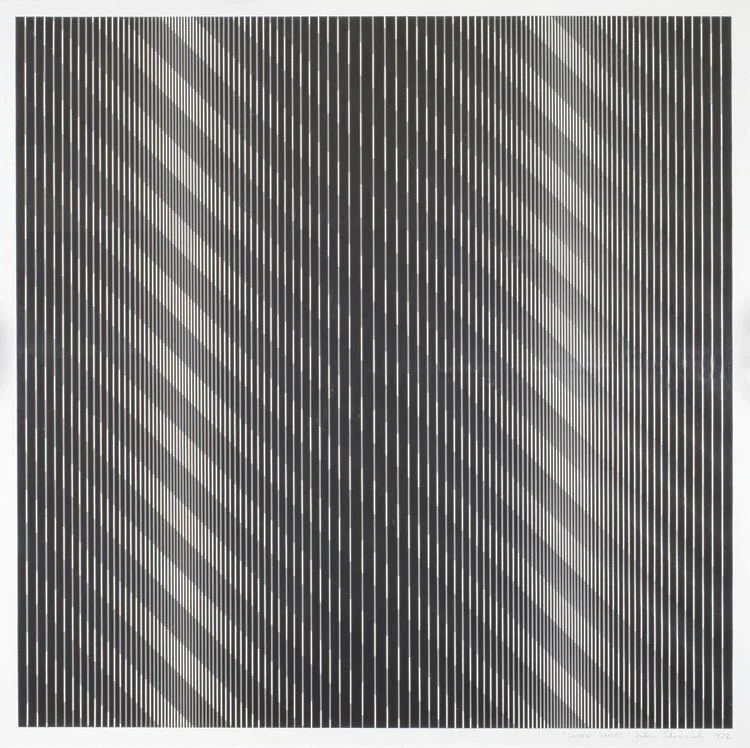
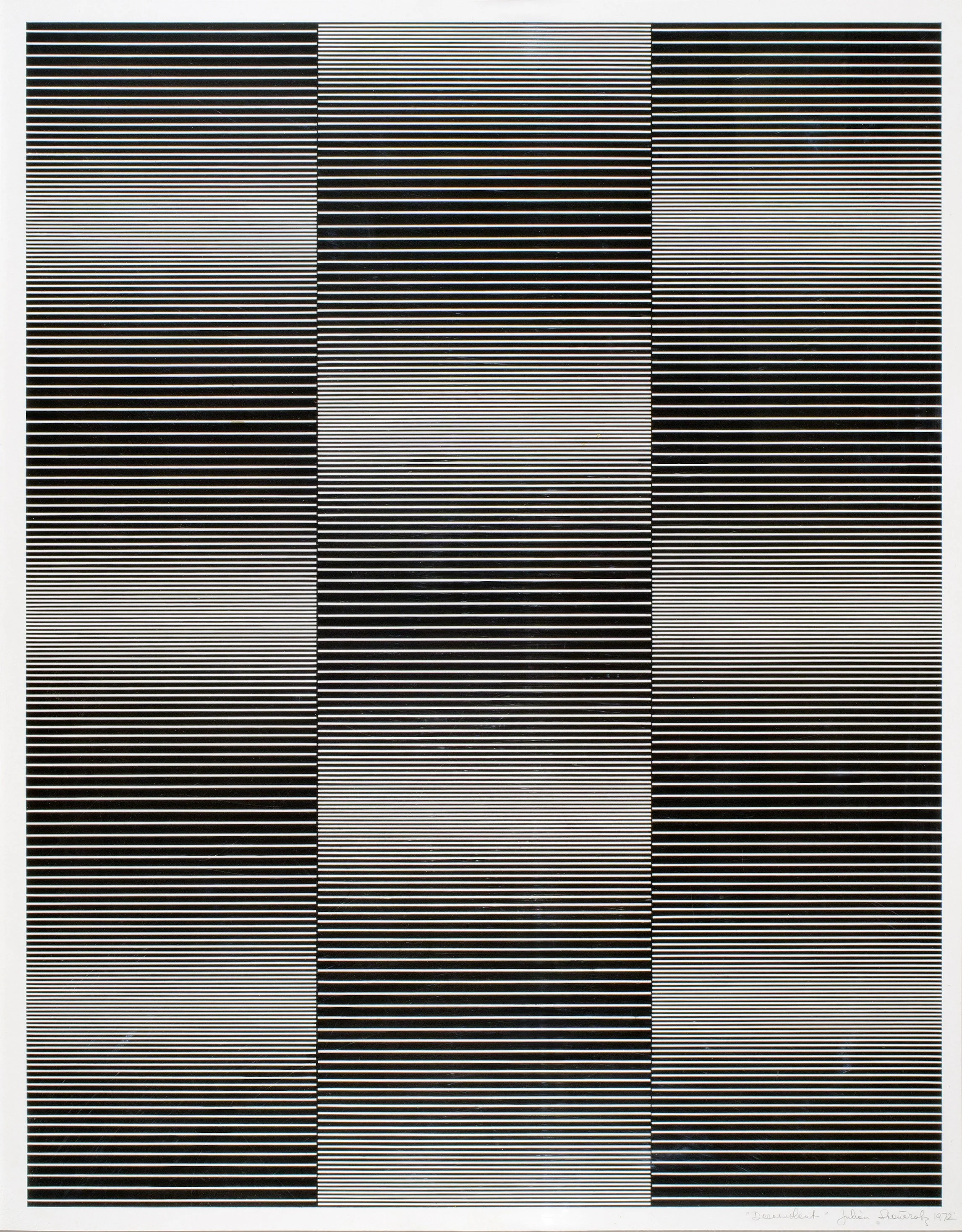
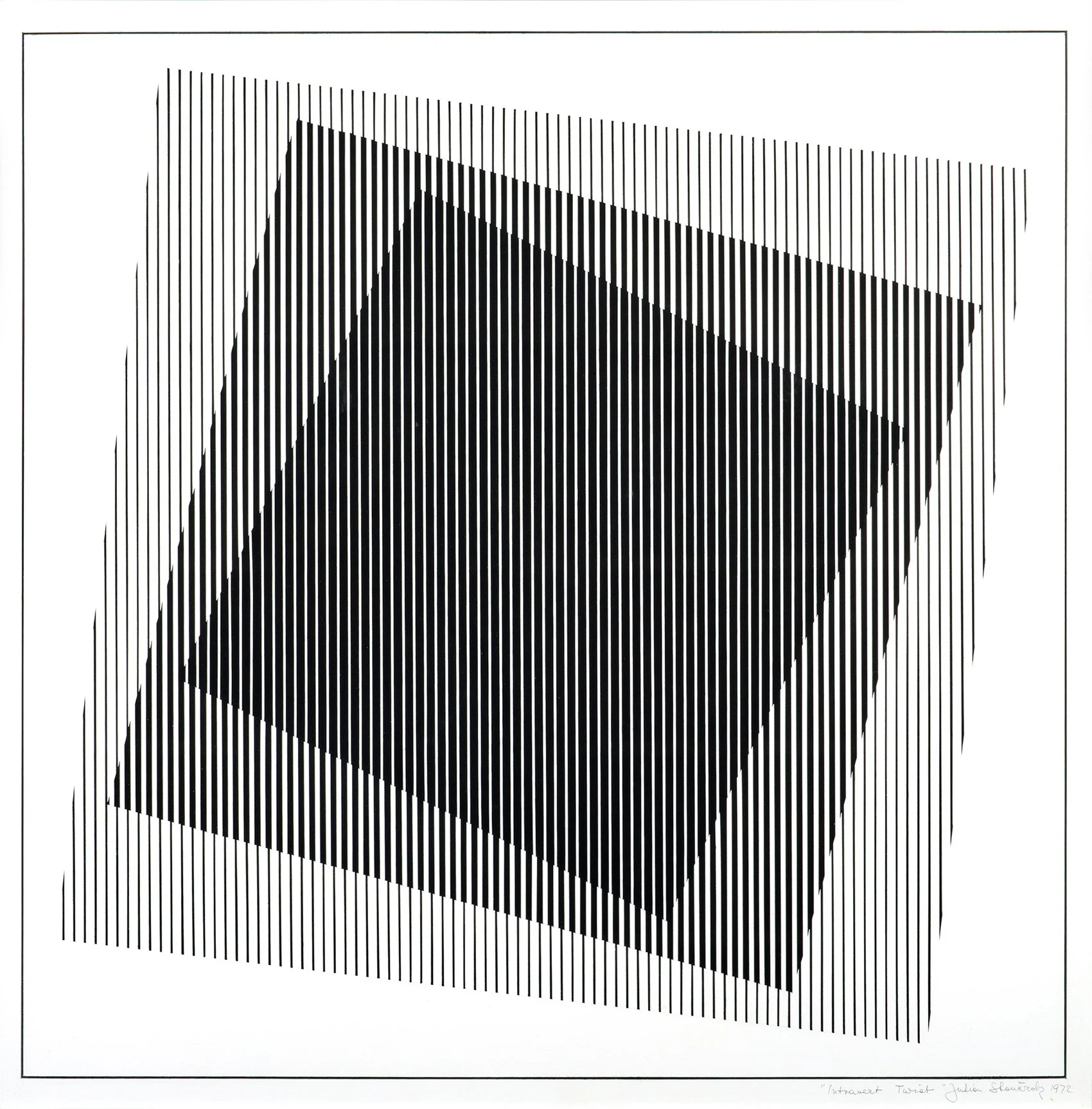
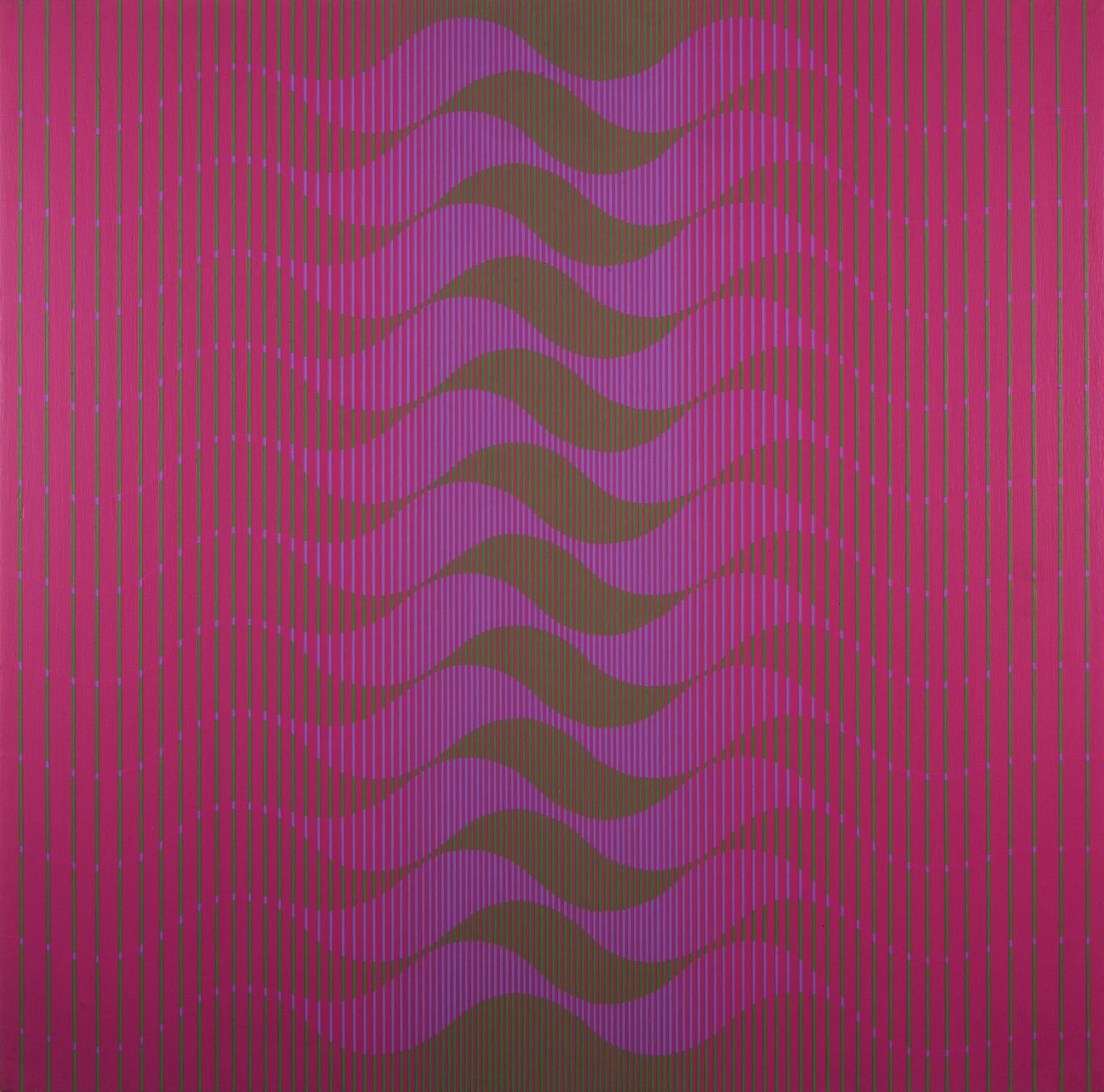
Stanczak also studied with Josef Albers at Yale and is unique with the American Op artists for his use of curved lines to provide organic rather than geometric movement. In Stanczak’s compositions of wiggles and juxtapositions of curved and angular forms, the paintings radiate energy and internal illumination, like Concurrent Oppositions, 1965. Stanczak’s method of taping challenged him to examine how the density of lines produced the sensation of measured space and unlimited movement. Because color is difficult to control, Stanczak would periodically turn to black and white to investigate the function of line in new ways.

The significance of Op Art as a movement is its fundamental shift from art as object to art as experience. A change that remains relevant today as a new generation of artists engage viewers through immersive approaches in painting, sculpture, video, and installations.

Biographies

MODERNISM AND THE AMERICAN SCENE

May 7 - Sept 15, 2016

Essay | Some works may still be available, please contact the gallery at 212-581-1657.


Essay by Deedee Wigmore

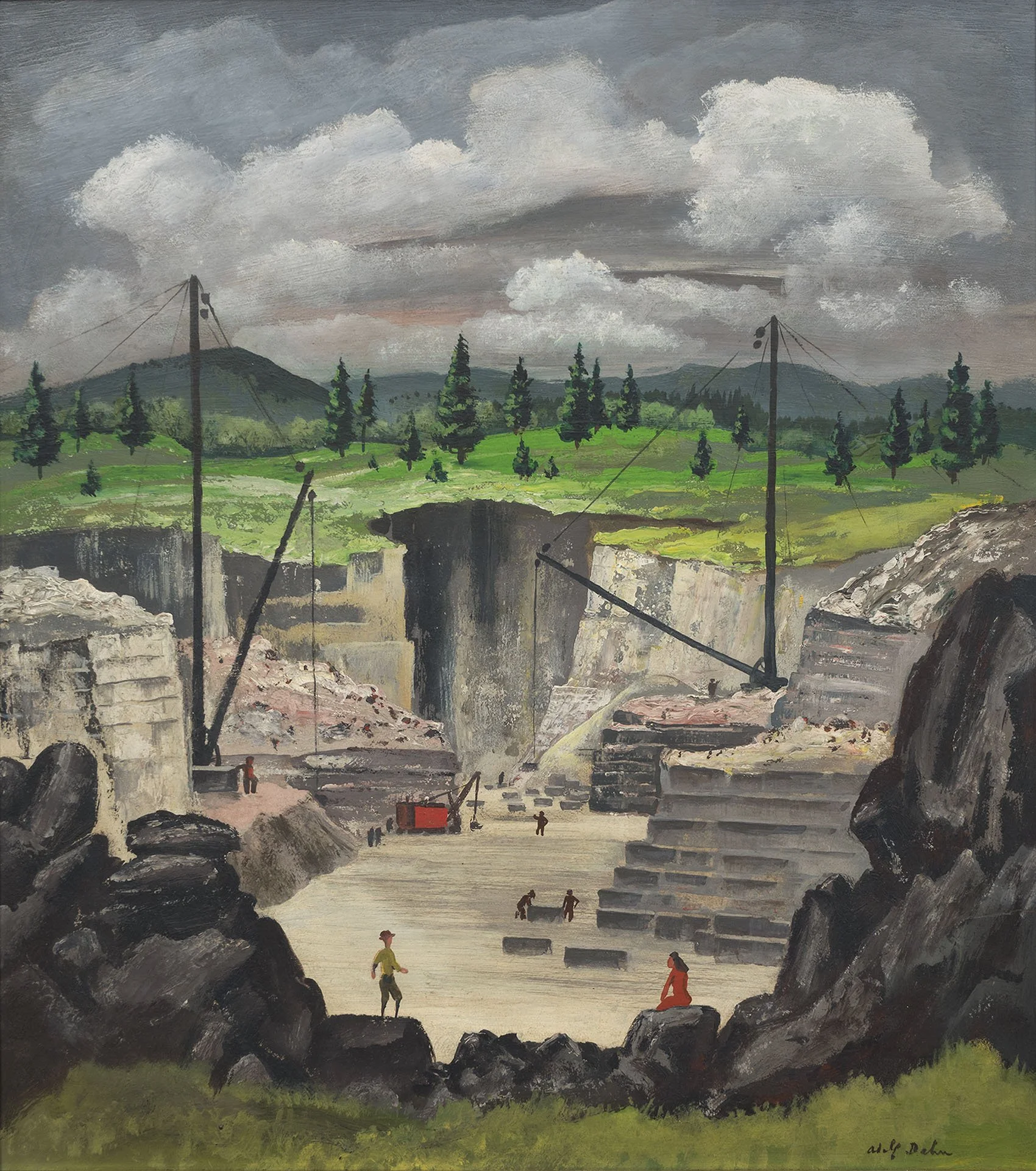
American Scene art has been labeled conservative because it is realistic and speaks of a country turned inward while looking at its past history for inspiration. This is in part due to the government’s W.P.A. program that required the subject matter provide validation of the American system in a realistic style that could be understood by all. However, this view overlooks the influences set loose on American Scene art by evolving European modernism. American artists’ passion for experimentation that began in 1913 with the Armory Show continued into the 1930s. American Scene artists appropriated art styles in a spirit of freedom that allowed them to take what they could use; radically altering, distorting, and rearranging a realistic composition to achieve a more compelling expression. This spirit was not a development unique to any one painter or group. Pockets of modernism occurred across America during the 1930s and 1940s. Some artists could shift between modernism and more conventional American Scene realism with ease.

There were several vehicles for the continued influence of modernism in America. One was that American artists were trained in Europe for decades and still looked to Europe for sophisticated up-to-date styles they could adapt to American taste. With the outbreak of the First World War, many trained American artists returned to their homes while continuing to explore modern European styles. These artists then spread art innovations of pre-war Paris to artists in their own communities and through summer art colonies they attended. Another wave of European influence came with the approach of World War II as artists who had been teachers or participants in the German Bauhaus brought Geometric Abstraction to America. The practical training artists received in American art schools opened the door to modernism through graphic design courses, which enabled them to earn their living in illustration for magazines and newspapers. This commercial work required an artist to shift into different styles, balance representation and abstraction, use color as a vehicle of feeling, and generally streamline the design to deliver a stronger message.

Cubism, Precisionism, Folk Art, photography, Surrealism, and commercial editing were all stylistic influences that brought modernism to American Scene art.

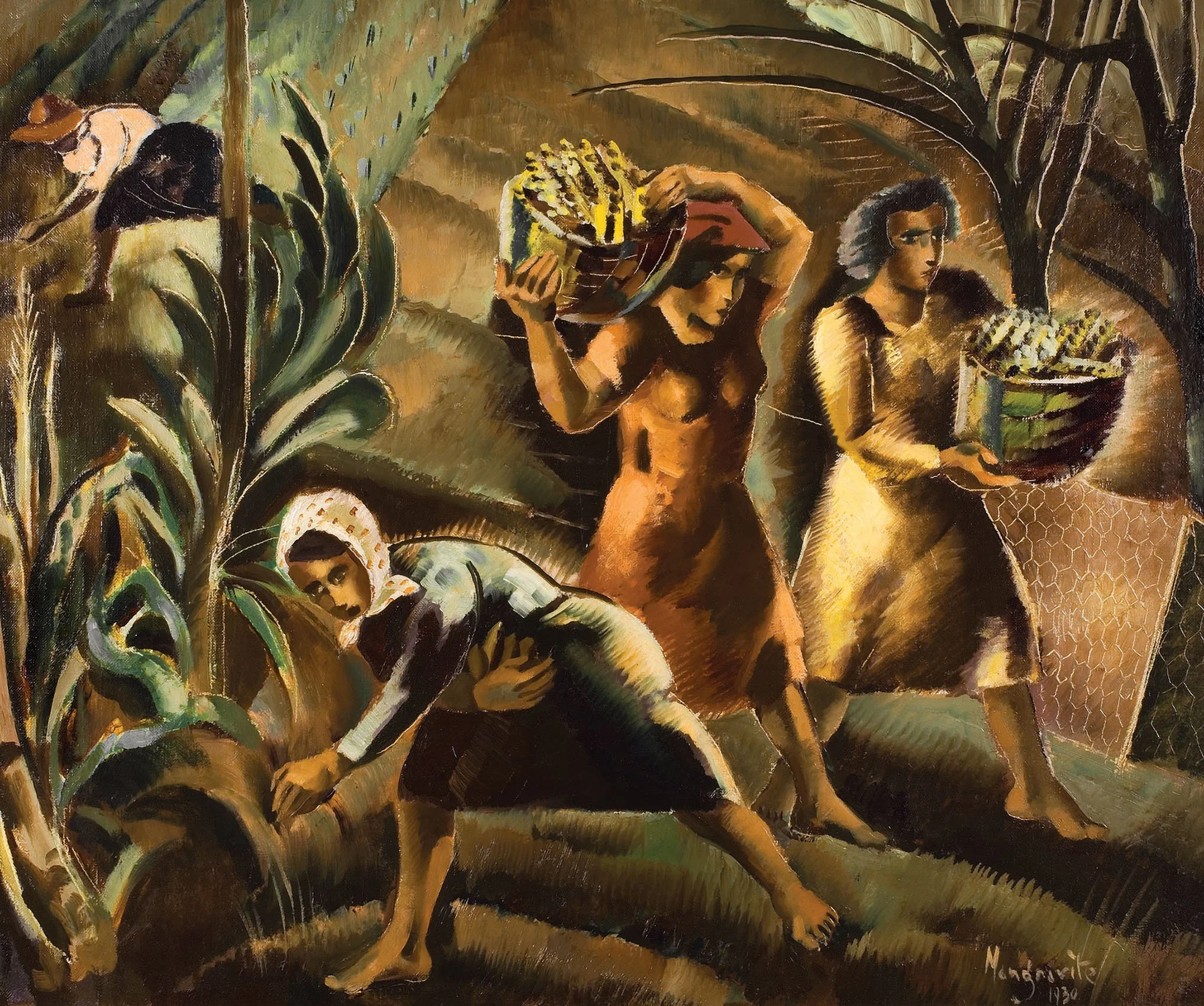
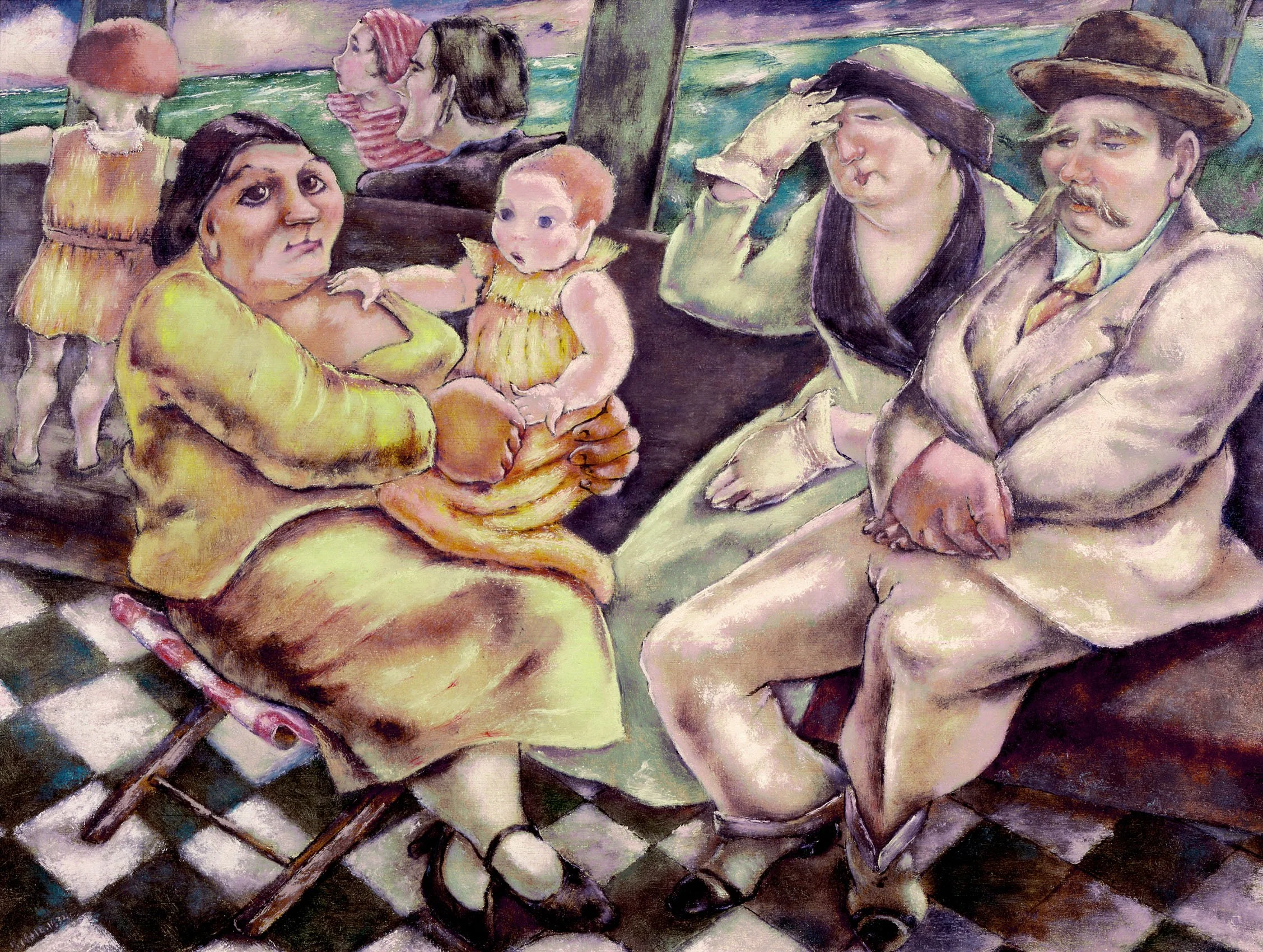
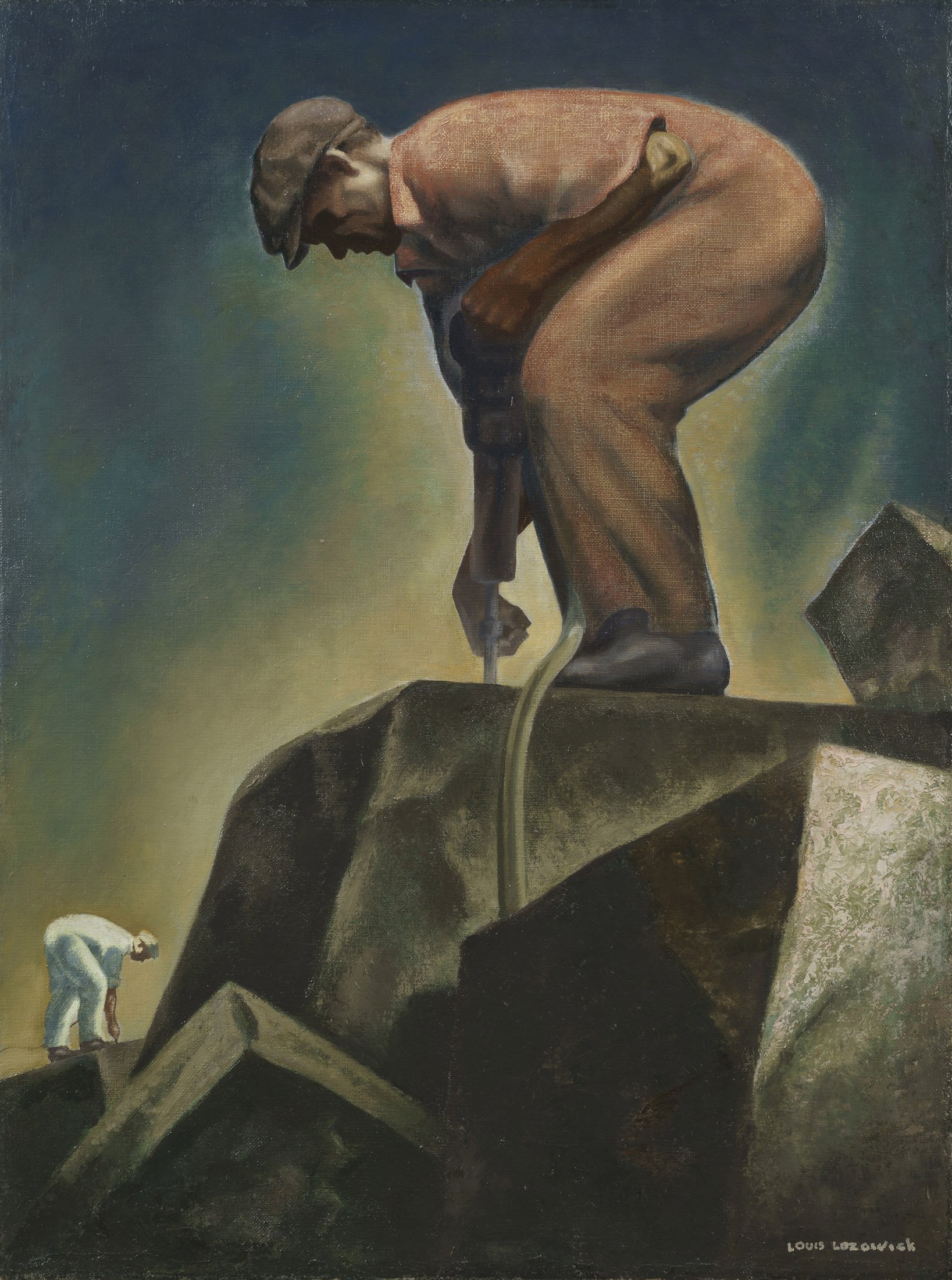
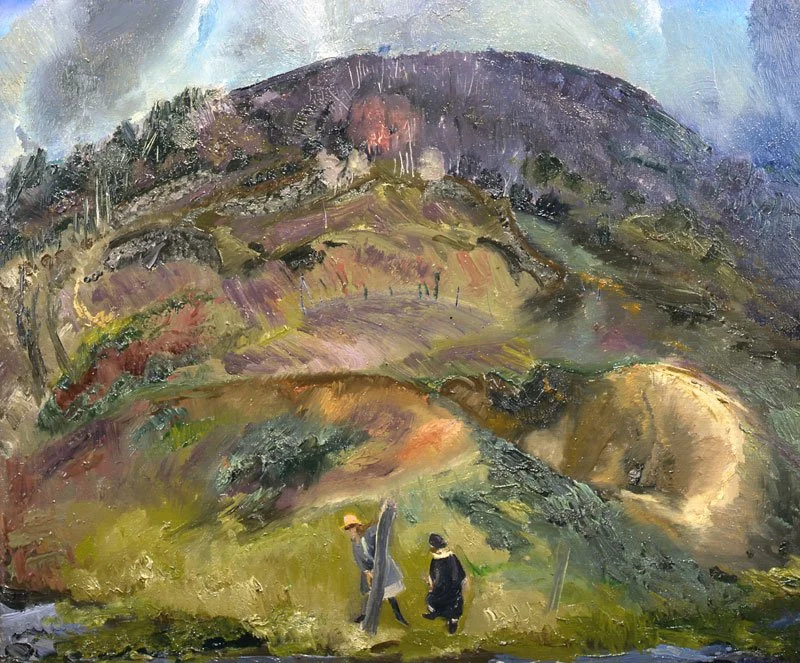
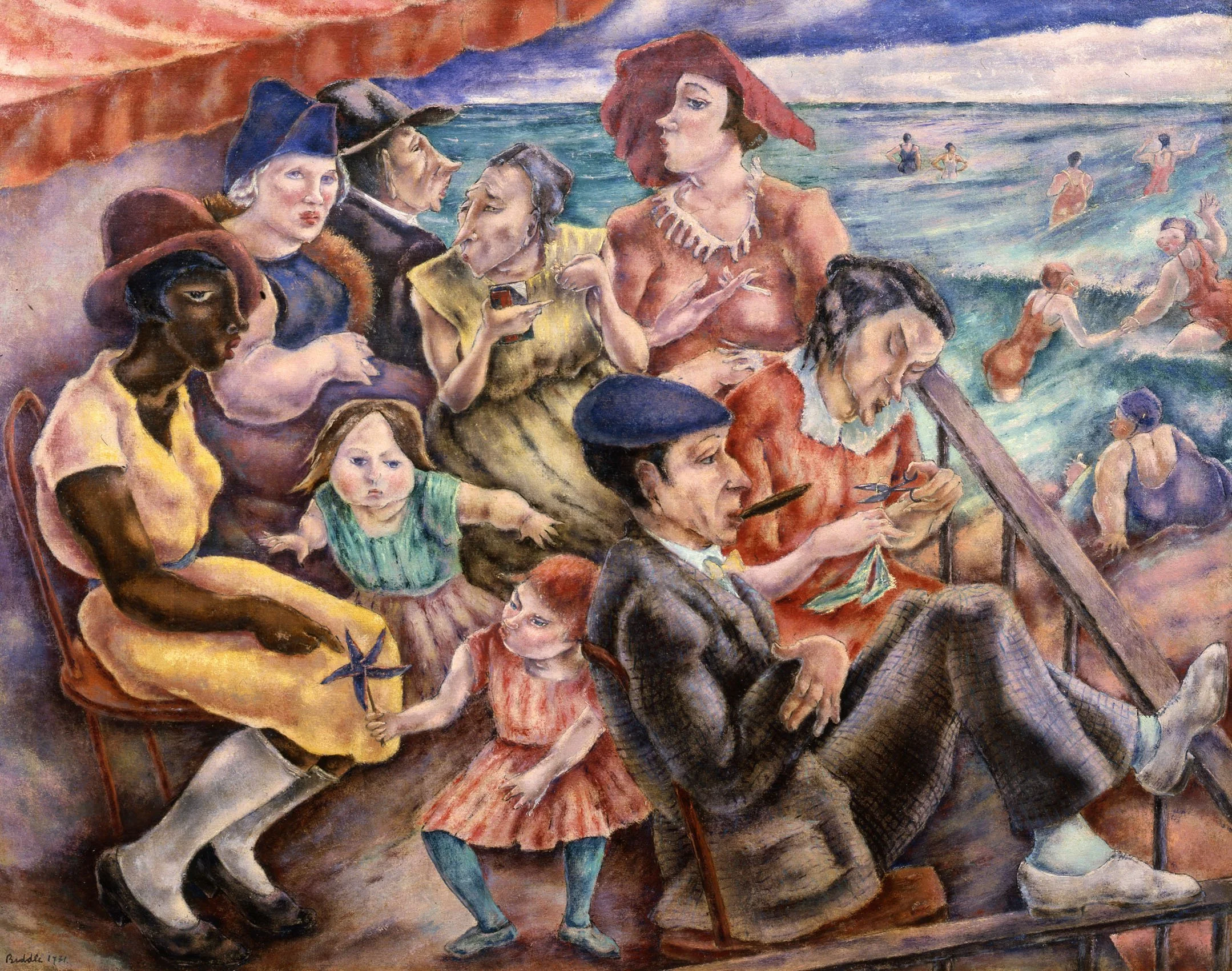
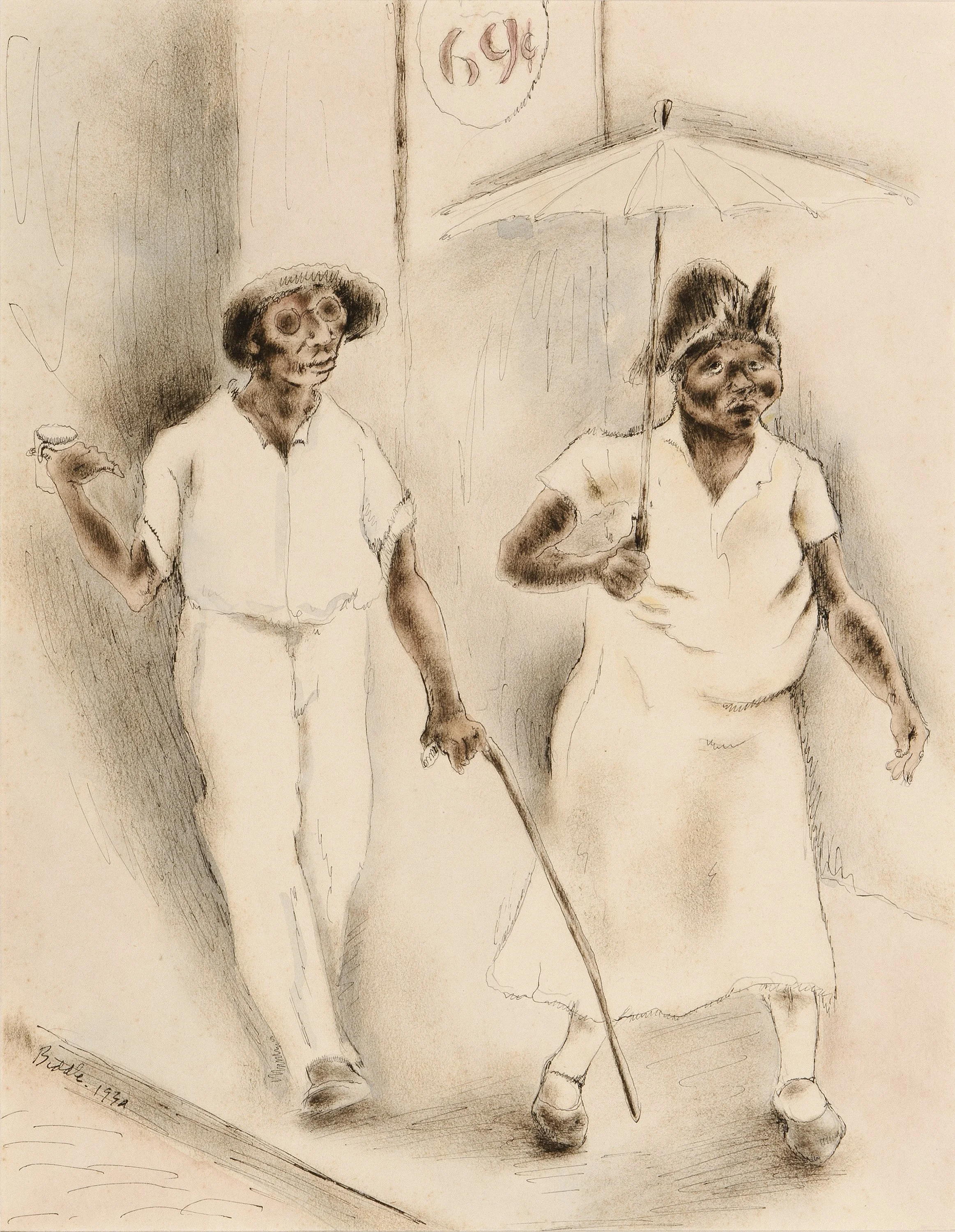
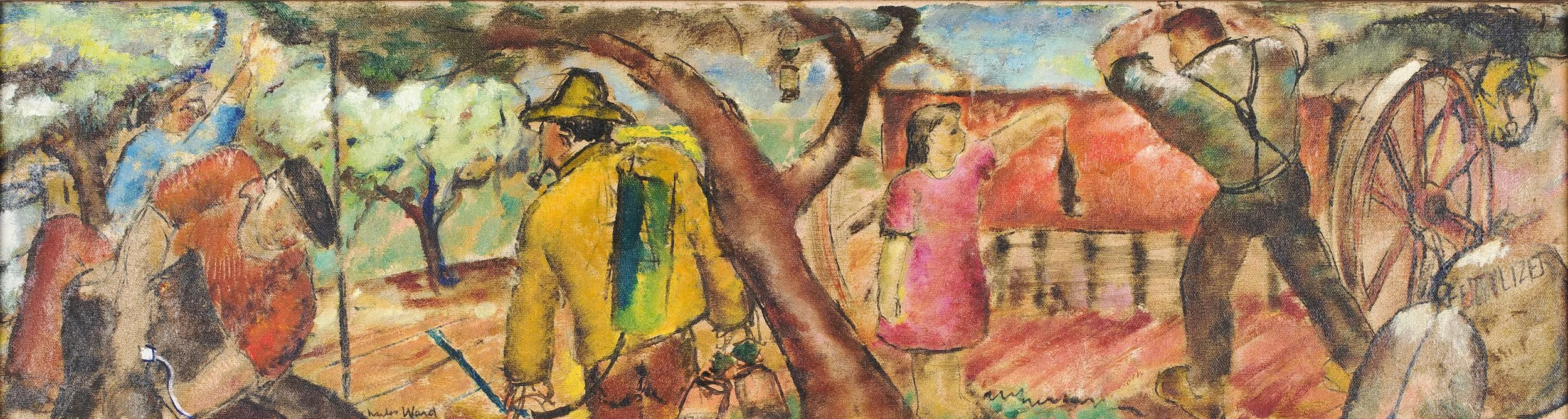
Two works in our exhibition deal with labor and immigration, prominent subjects of American Scene painting, using elements from modern abstraction. In both Field Workers, 1930 by Peppino Mangravite (1896-1978) and The Crossing, 1932 by George Biddle (1885-1973), the Cubist device of tipping the perspective of the composition to provide an overview in a compressed space is used. Mangravite uses a charged outline and Biddle uses brilliant colors to ensure their multiple figures are the central focus amid patterned and angled settings.

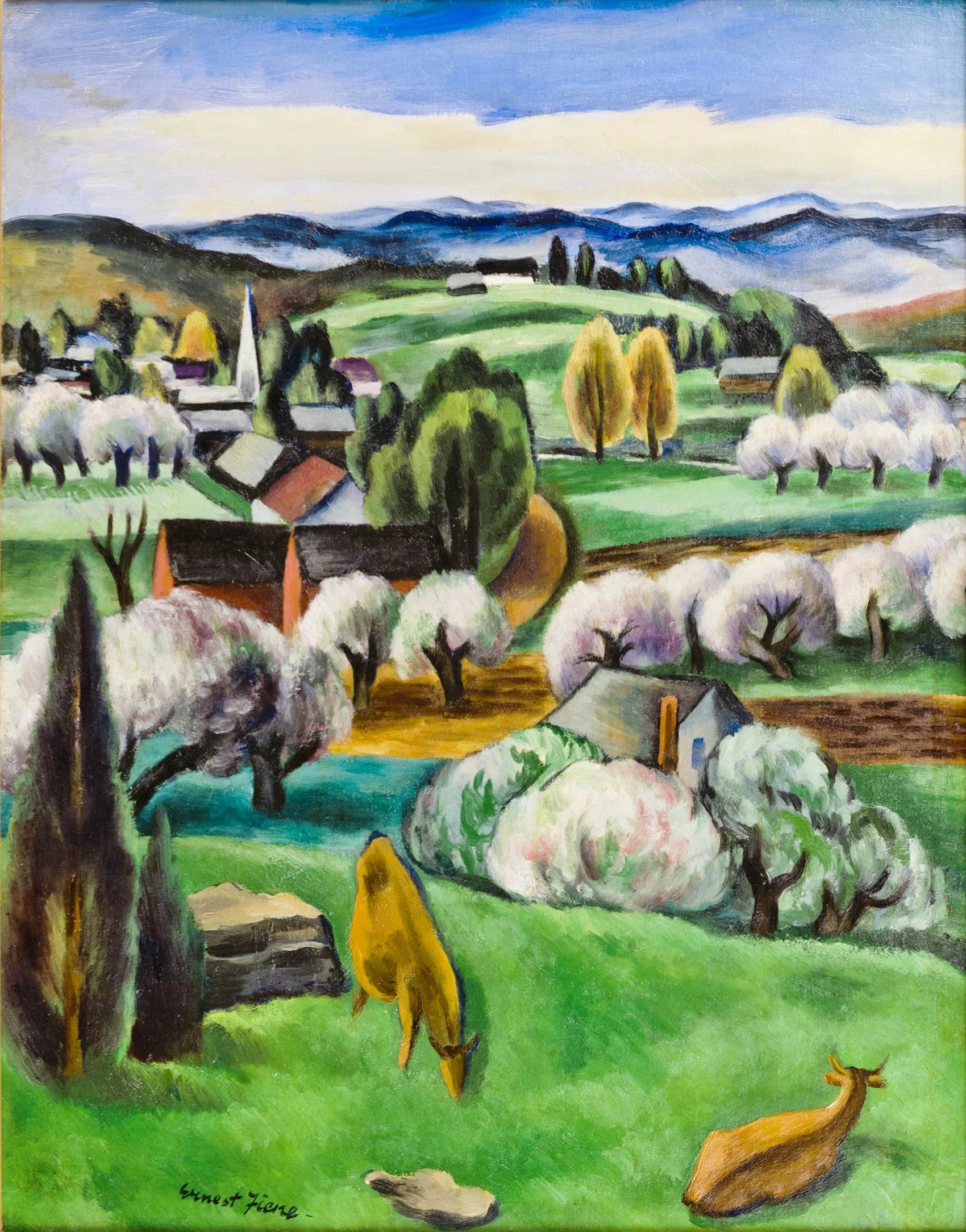
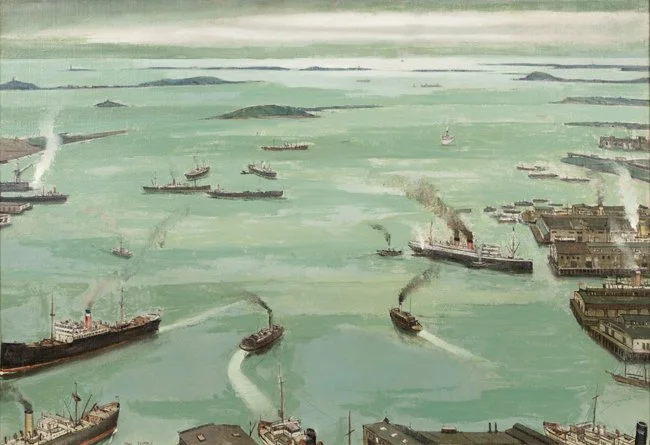
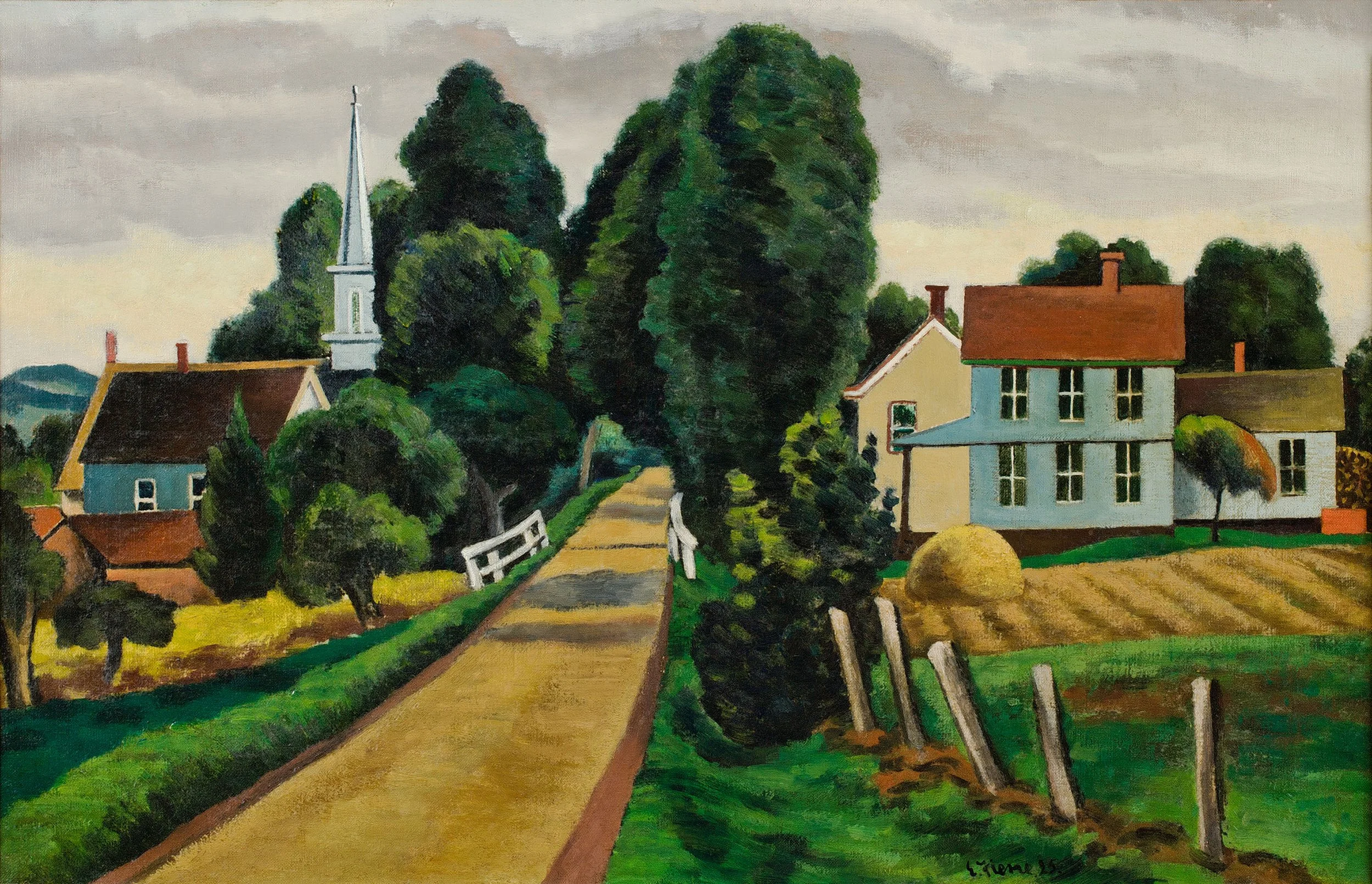
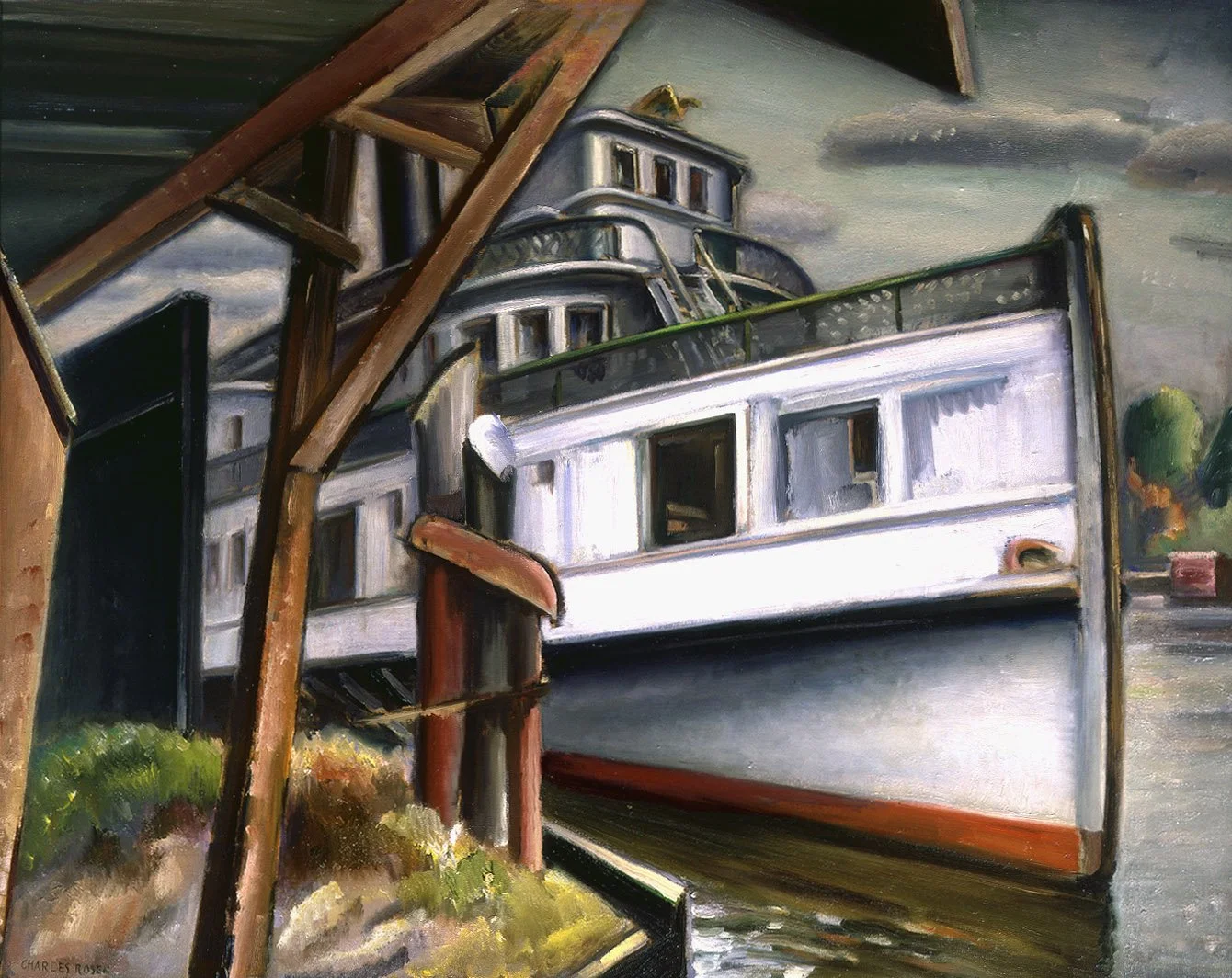
American Scene artists continued to use Precisionism, the American compromise between Cubism and realism characterized by sharped edged, simplified forms painted with large areas of unmodulated color in a smooth precise technique. Industrial subjects like Hudson River Boat II, 1927 by Ernest Fiene (1894-1965) and Industrial Scene, 1942 by Virginia Cuthbert (1908-2001) both make use of Precisionism’s geometric abstraction and dramatic perspectives. As artists began to work out how to make an abstract painting, the similarities between music and art in structure, sensuality, and even terminology were discussed. Considering painting as music for the eyes impacted American Scene artists who set color in motion through rhythm and repetition as seen in Ernest Fiene’s Woodstock Spring, 1930.

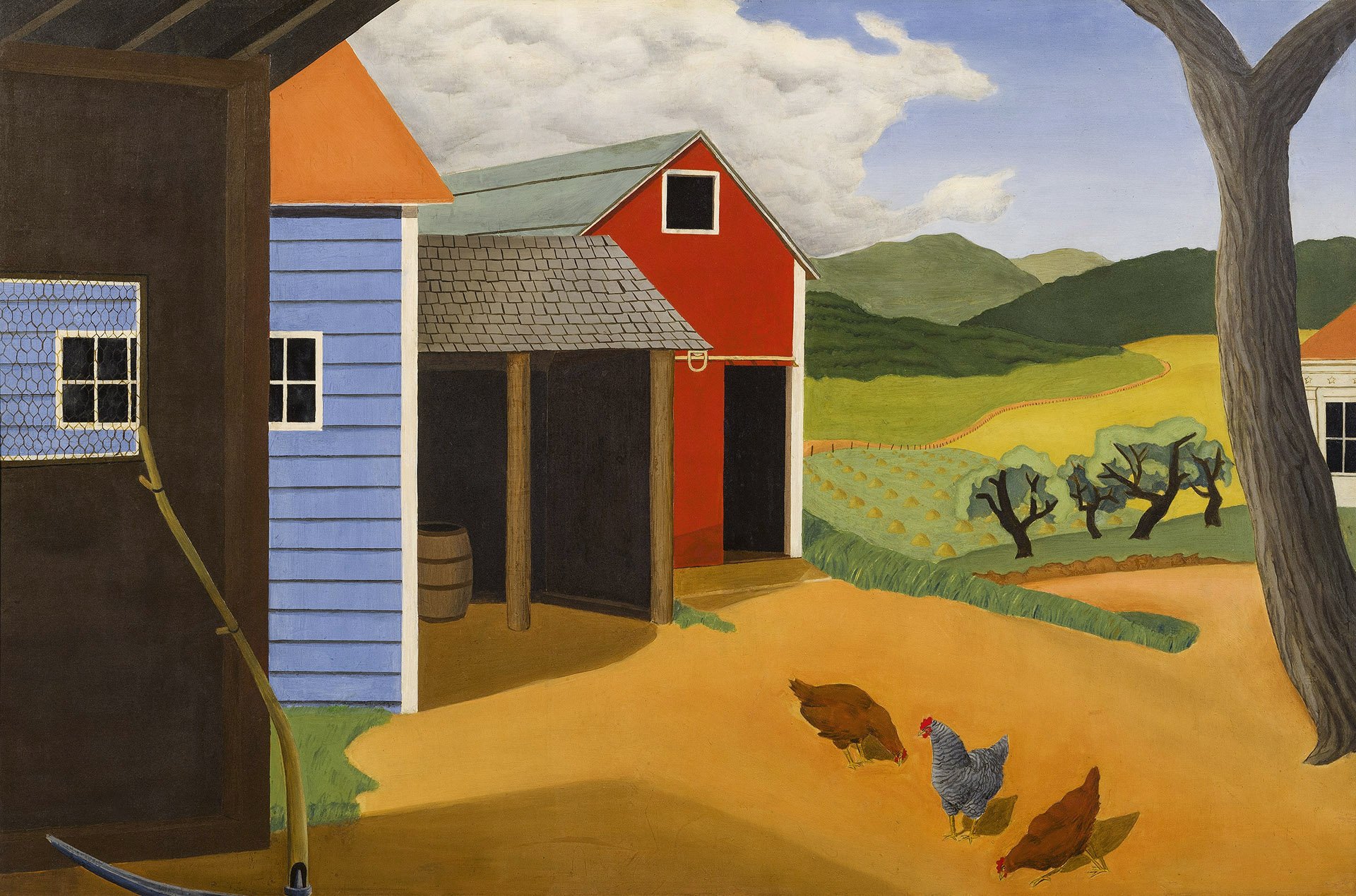
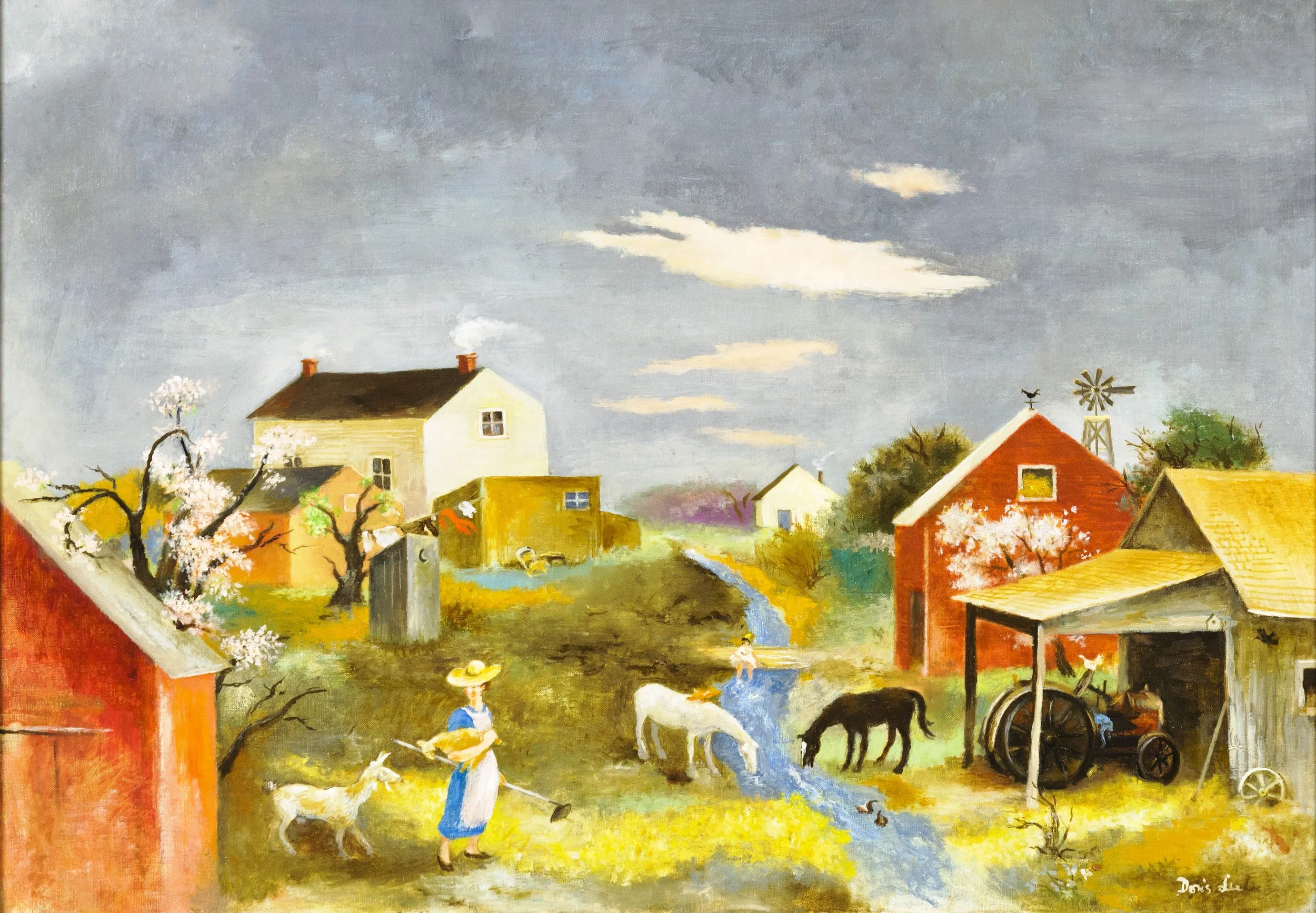
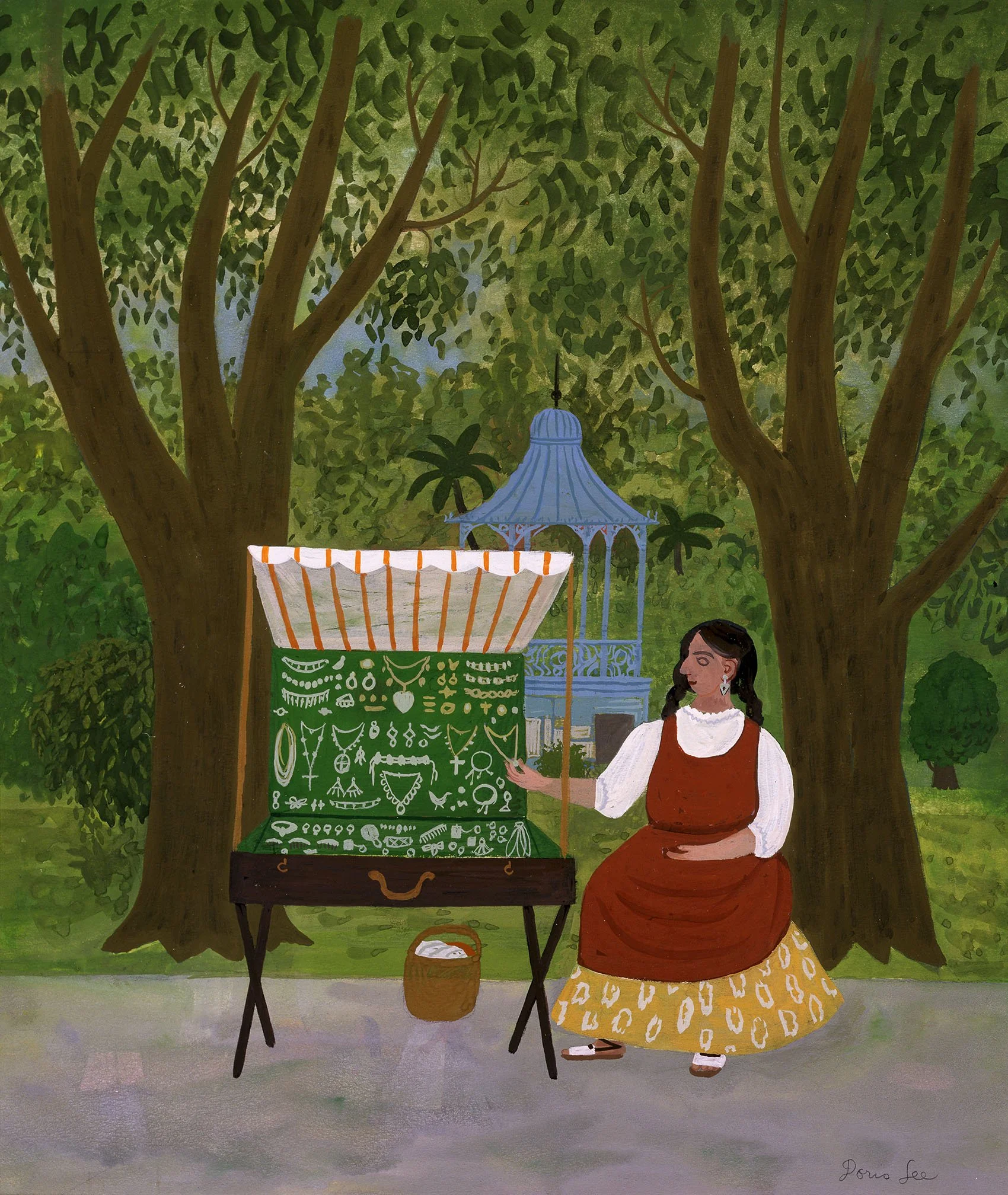
Folk Art is another progressive influence on American Scene art as it showed how to create a unified surface by ignoring unnecessary details and simplifying form in a flattened space. The combination of Folk Art’s naiveté and the sophistication of modernism can be seen in the farm scene Harvesting Wheat, 1940 by Ben Shahn (1898-1969). Two other paintings that connect with Folk Art are Pastoral, 1938 by Doris Lee (1905-1983) and American Farm, 1930 by Allan Gould (1908-1988). Both have flat rhythmical designs that enliven their descriptive realism. Folk Art also influenced sculpture, as seen in Elie Nadelman’s (1882-1946) Two Women, 1933 whose painted plaster shapes are adapted from Folk Art chalkware.

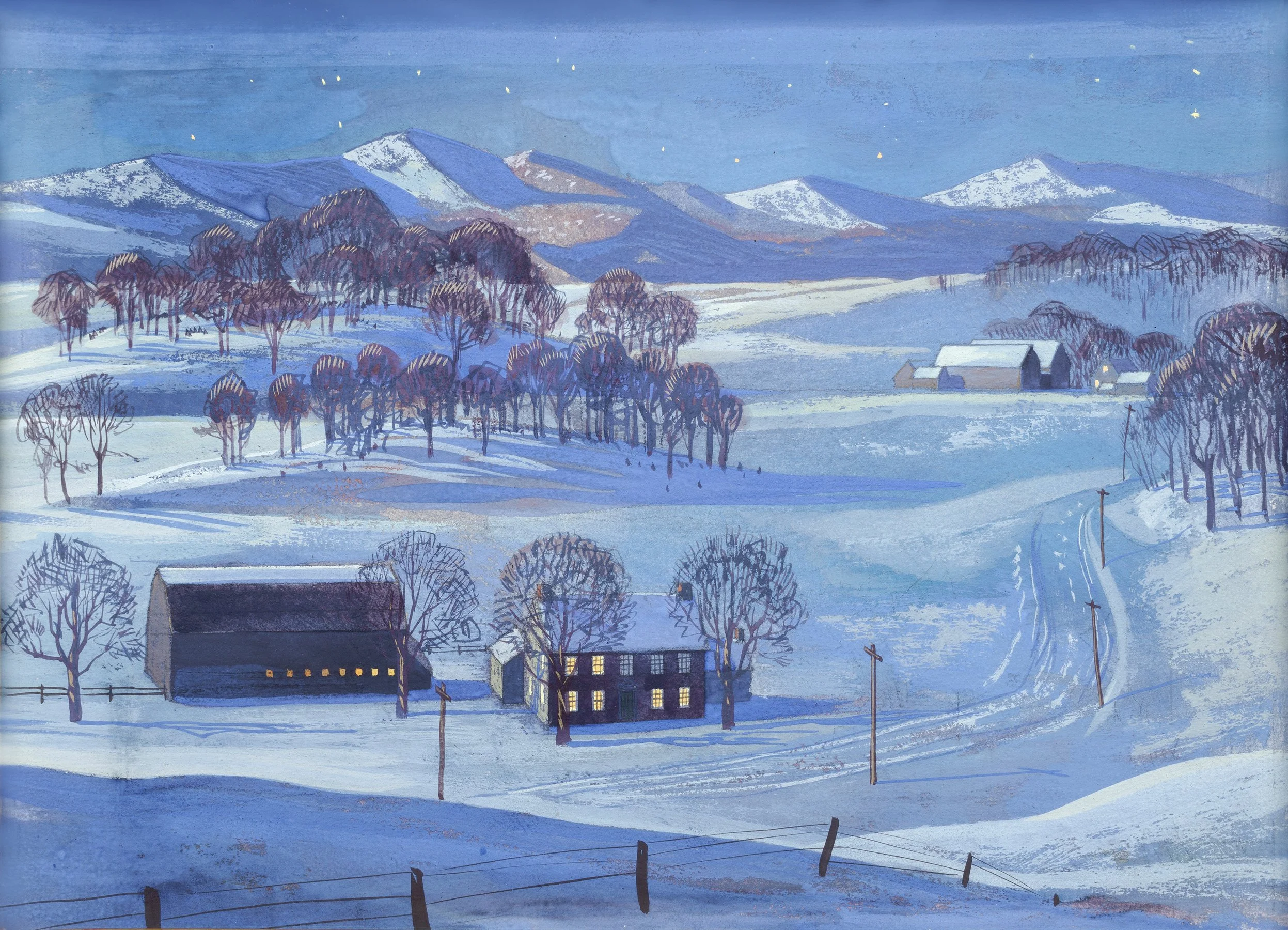
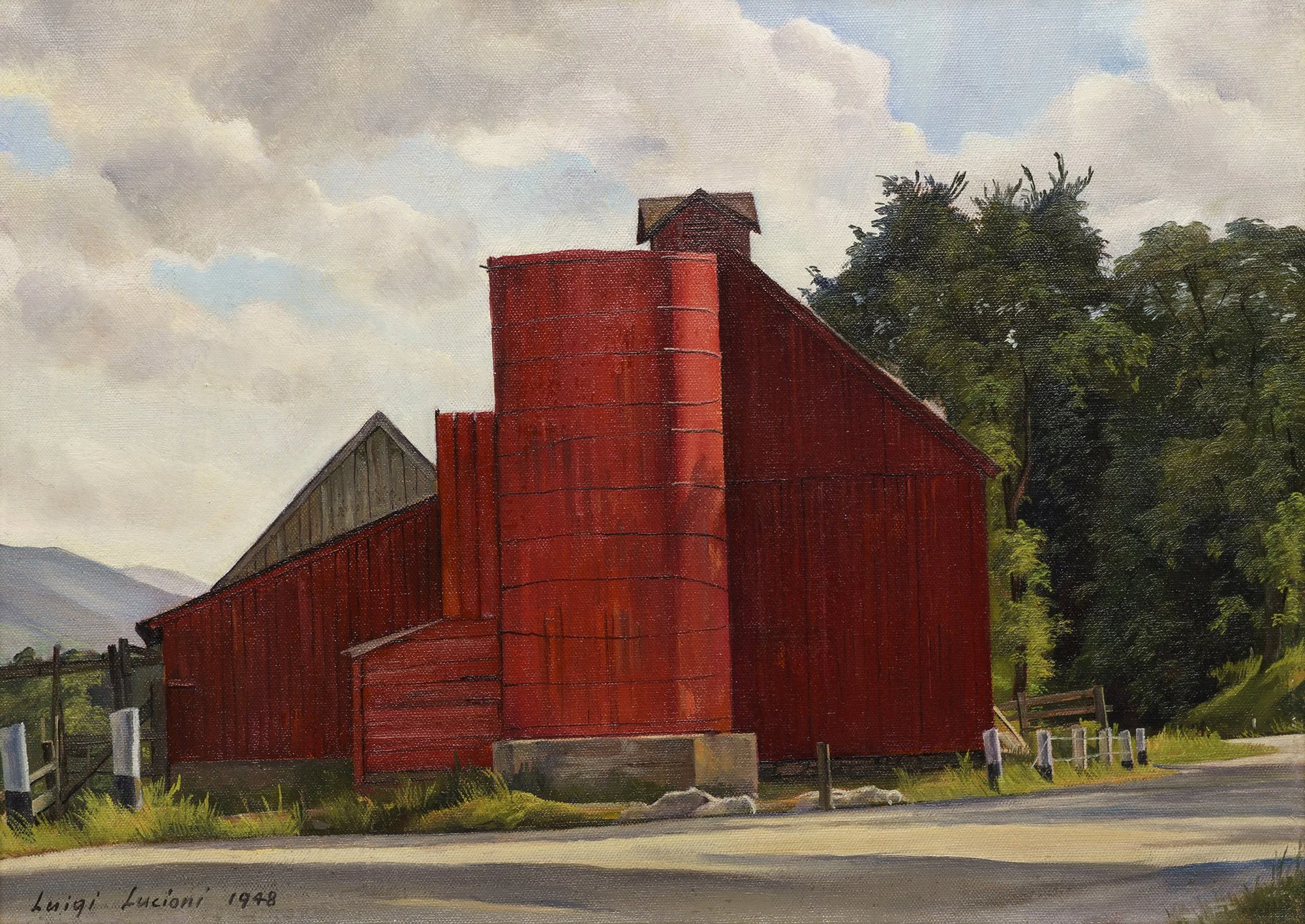
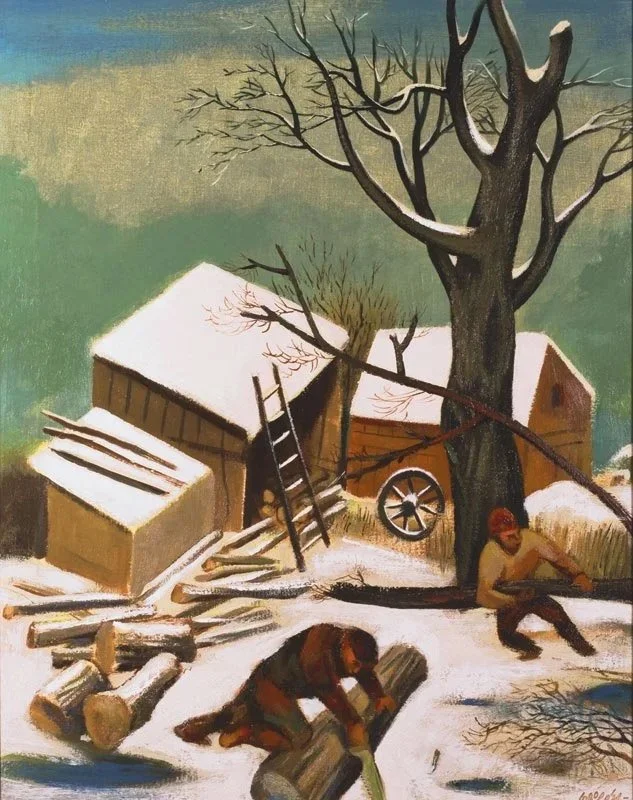
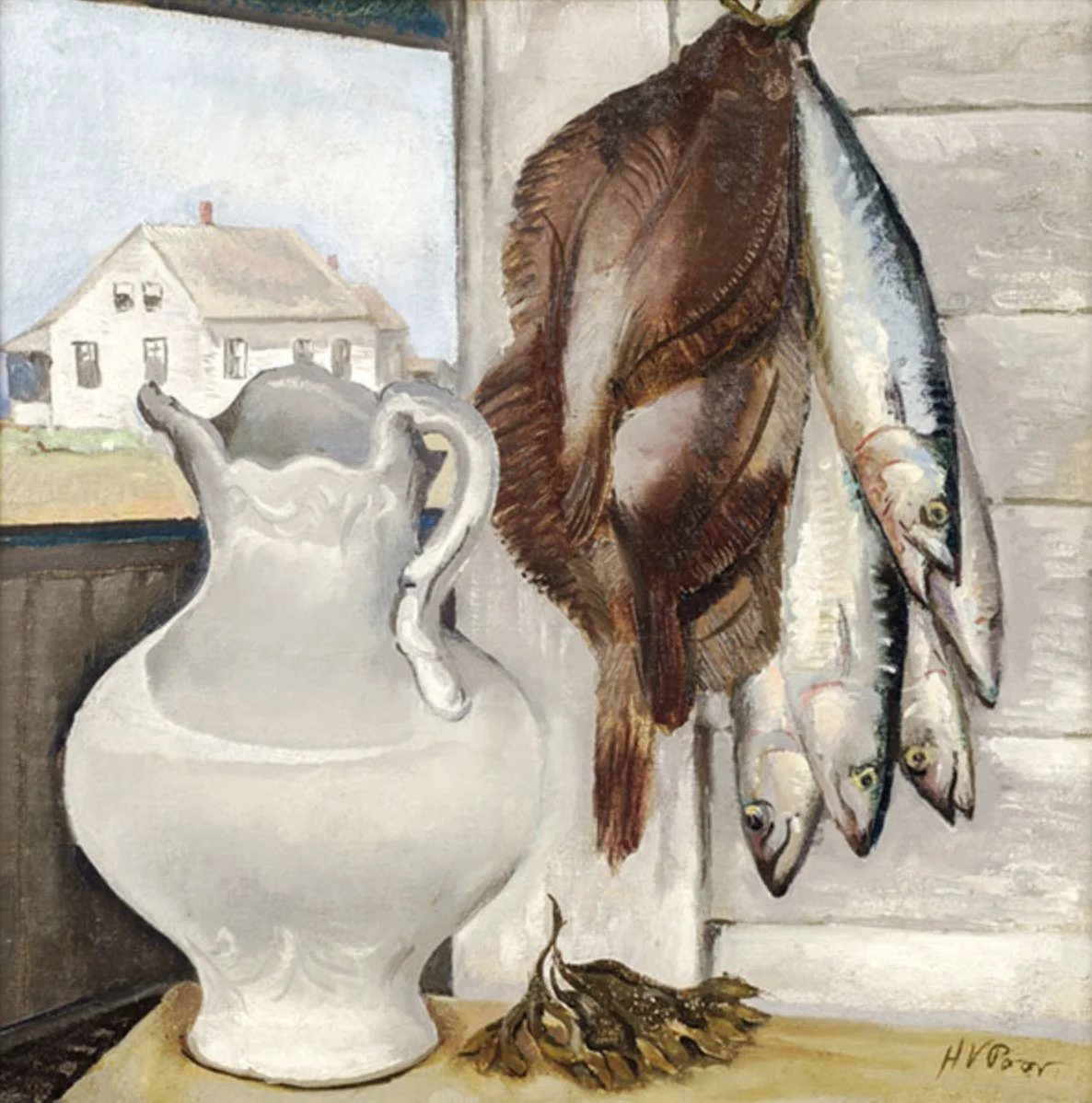
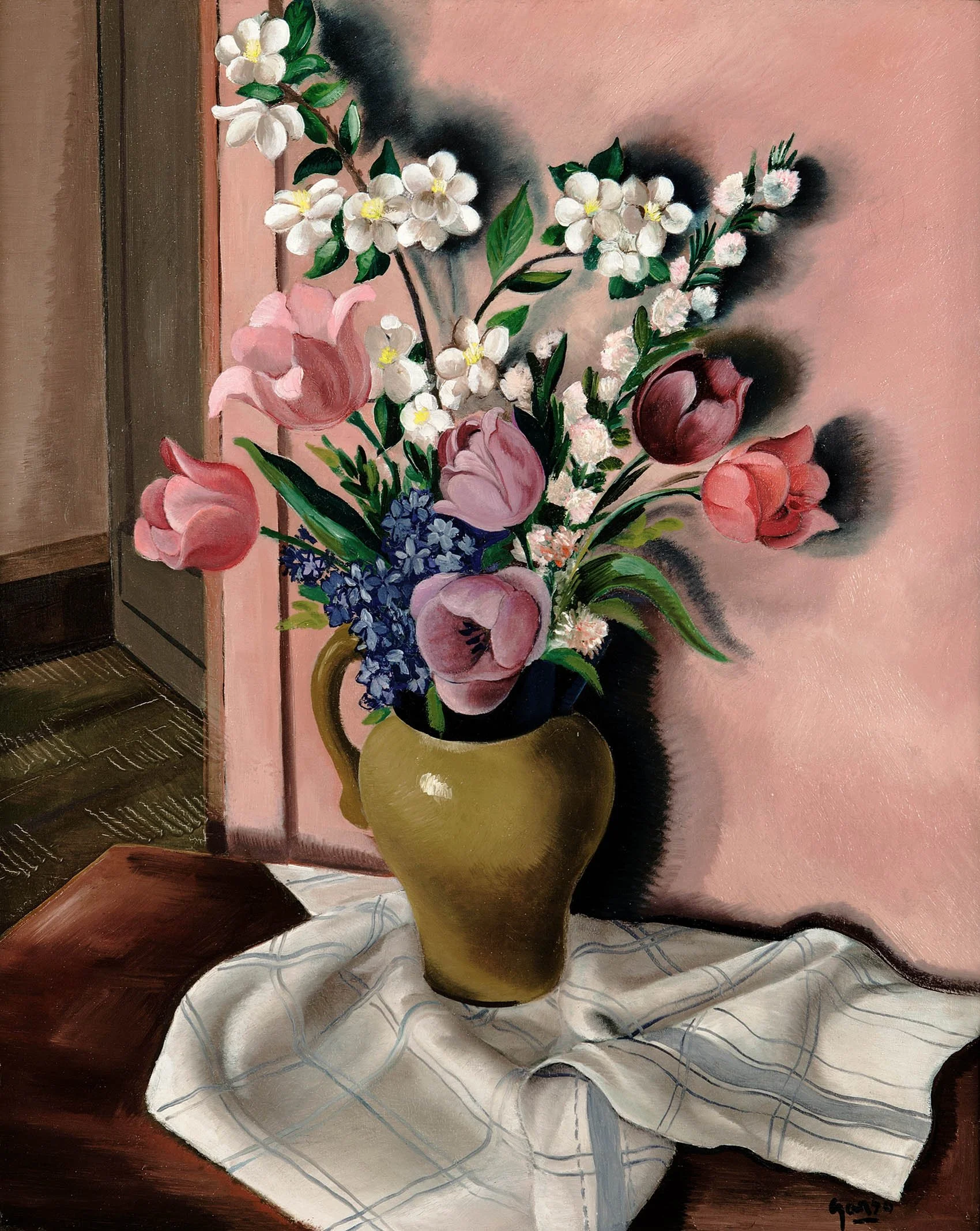
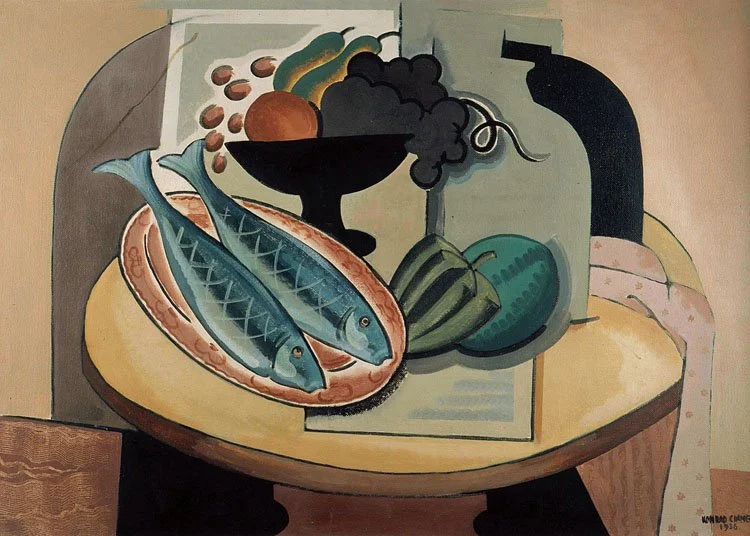
Photography treated as an art form became an important influence on painting, either through its direct use or subconsciously. In the 1930s cameras became portable and less expensive allowing artists to use photography as another way to develop a composition. This resulted in hard-edged, sharply focused compositions in a close-up cropped format. Rockwell Kent’s (1882-1971) Winter Evening, 1945 is painted with the informal framing of a snapshot taken from a distance. Time of day, weather, location and the probable activities of the inhabitants of Kent’s Adirondack farming community are all suggested. In contrast. Luigi Lucioni (1900-1988) paints with the sharp focus of a photographic close-up Barns on the Road, 1948, aiming to record the formal architectural structure of Vermont’s disappearing barns. Still life paintings with their formal arrangements and controlled lighting also evoke photography. Two examples are Fish and White Pitcher, 1934 by Henry Varnum Poor (1888-1970) and Spring Flowers, 1935 by Emil Ganso (1895-1941).

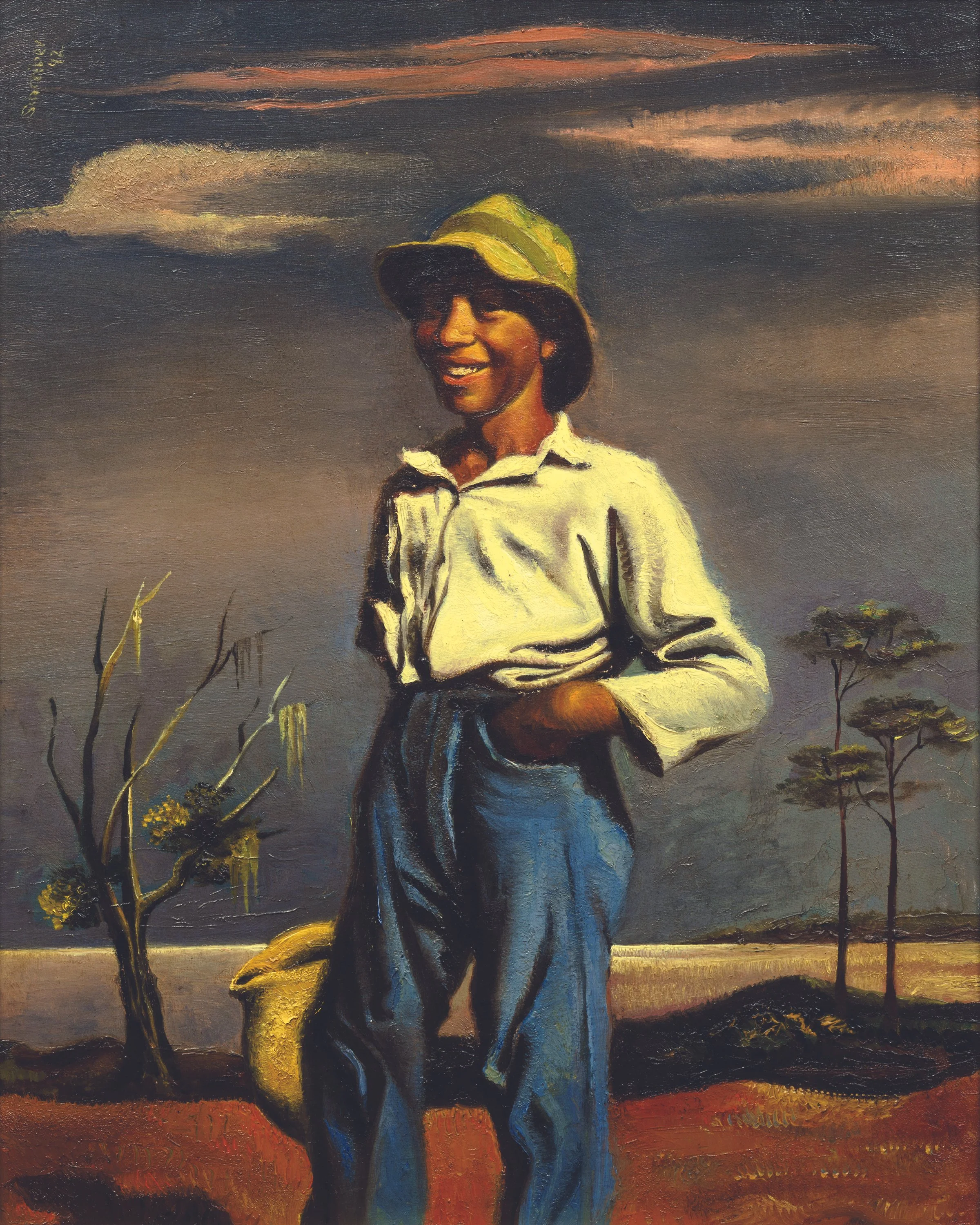
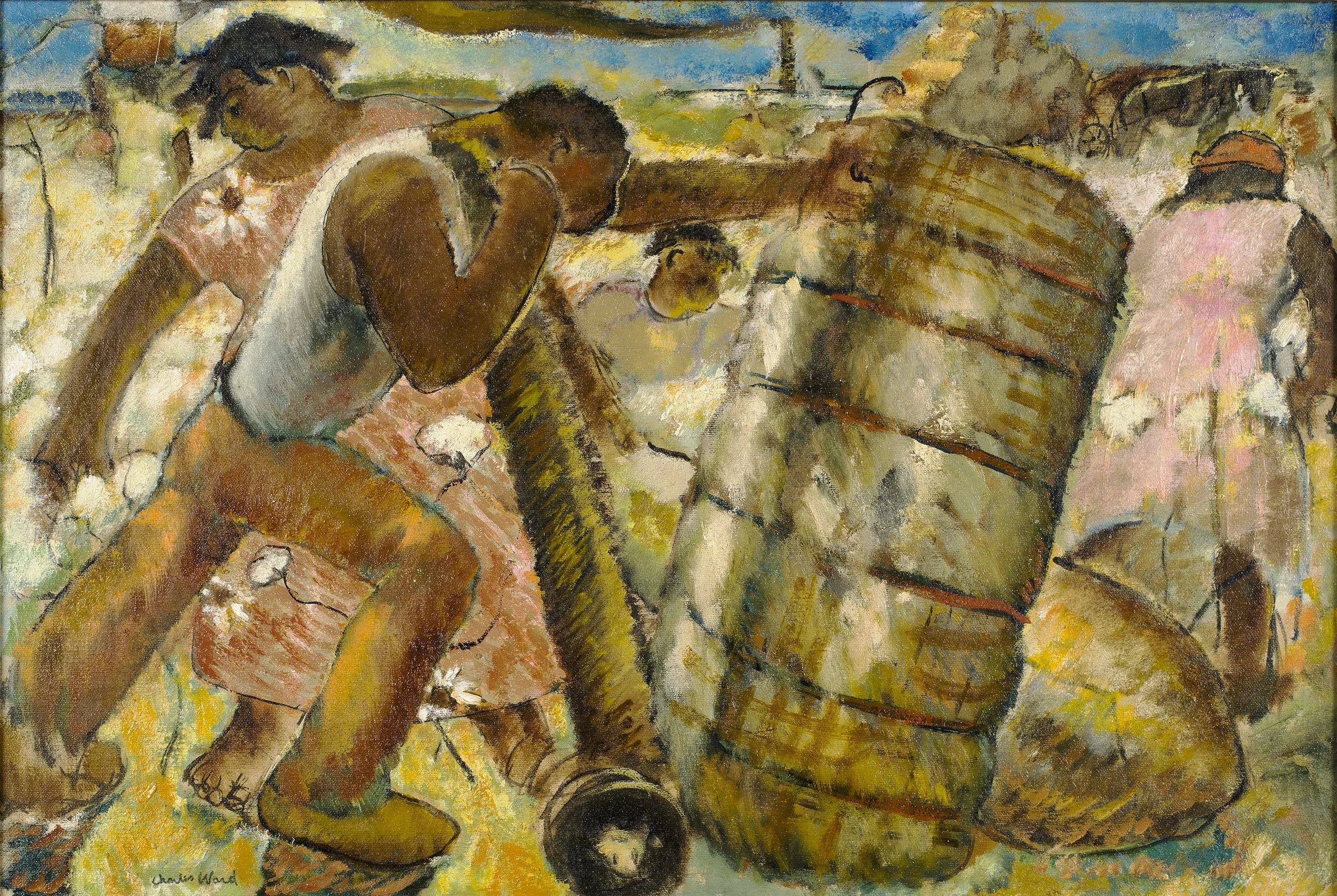
Surrealism’s exploration of automatism and the subconscious as the essential source of art arrived in America in the 1930s and many Surrealists artists themselves followed by 1940. Surrealism’s emphasis on the emotional elements of painting allowed realism to become interpretative and psychological while its blend of figuration with expressive symbols of mood allowed the artist to project himself into his paintings. American Scene artists developed a style called Magic Realism which used Surrealism’s fantasy of distortion to imbue social commentary into seemingly traditional subjects. This can be seen in Field Worker, 1942 by Georges Schreiber (1904-1977) which contrasts the joyful Black youth in the foreground with the dark and somewhat menacing landscape. The same extreme figural realism is seen in the close-up portrait of fellow Cleveland artist Clara McClean, 1931 by Clarence Carter (1904-2000). Miss McClean’s strong individuality contrasts with the repetitive houses behind her. In these Magic Realist paintings, the artists’ choice of background subtly locates and comments on the central figure.

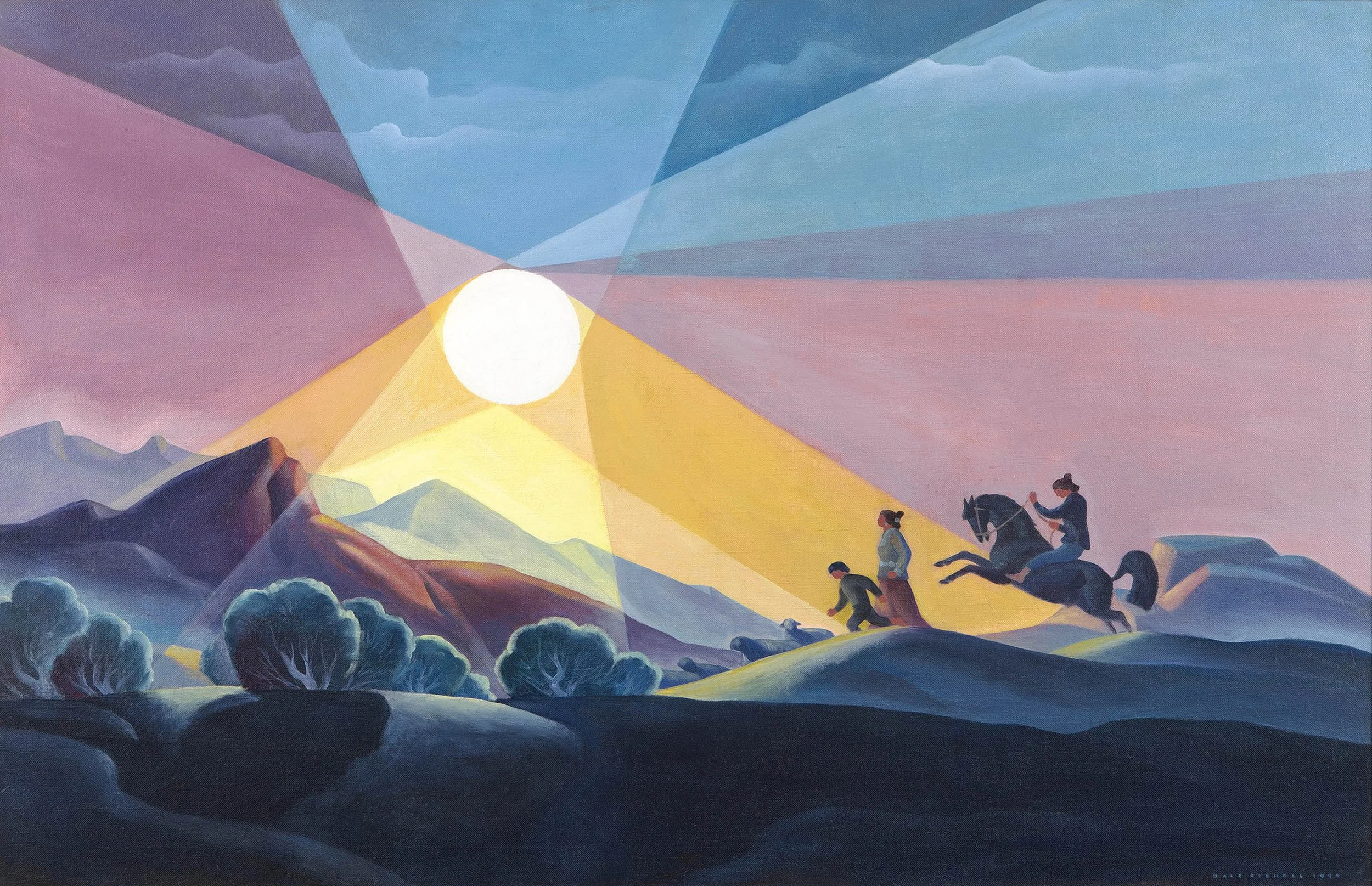
Artists who had earned their living in design or illustration developed a streamlined modernist vocabulary that used color as a vehicle of feeling and mixed recognizable forms with abstract shapes to bring attention to the narrative. Dale Nichols (1904-1995) began his career in illustration and believed fine and commercial art should not be mutually exclusive. Nichols painted America’s landscape and its people in Nebraska, Alaska, and Arizona. For Children of the Sun, 1944, Nichols used blocks of abstract color to make a positive social statement about Native American families in the American West. A painting in our exhibition that speaks to illustration as well as many other influences already discussed is Christmas Morning, 1938 by Francis Criss (1901-1973). Criss sets up the scene like a Victorian illustration for a women’s magazine and yet the composition is a fusion of 19th century genre, landscape, and still life painting all tied together in a palette influenced by black and white photography. Overall there is an impression of simplicity, emphasized by the woman’s form that evokes Folk Art, yet Christmas Morning is a highly complex painting as it contains so many style and subject references in one unified composition.

By the mid-1940s American Scene painting had begun to wane. The country became more international and American Scene’s focus on hope and jobs had been fulfilled as economic struggle relaxed in the midst of the war economy. Artists shifted their focus from subject matter to the various forms of modernism and the aesthetic dimensions of texture, form, color organization, and paint quality. Soon after 1945, with no market for art in Europe, the arrival of European artists and their dealers in America with their European tastes brought an end to American Scene art in our market until renewed interest developed in the 1980s.

[Top]


Modernism 1913-1950 | Realism of the 1930s and 1940s | Abstraction of the 1930s and 1940s | Post-War | Selected Biographies

PAUL JENKINS: COLOR AND FLOW

Feb 24 - May 3, 2016

Press Release | Chronology | Solo Exhibitions | Group Exhibitions
Museum Collections | 2009 New York Times Review
Some works may still be available, please contact the gallery at 212-581-1657.


Press Release

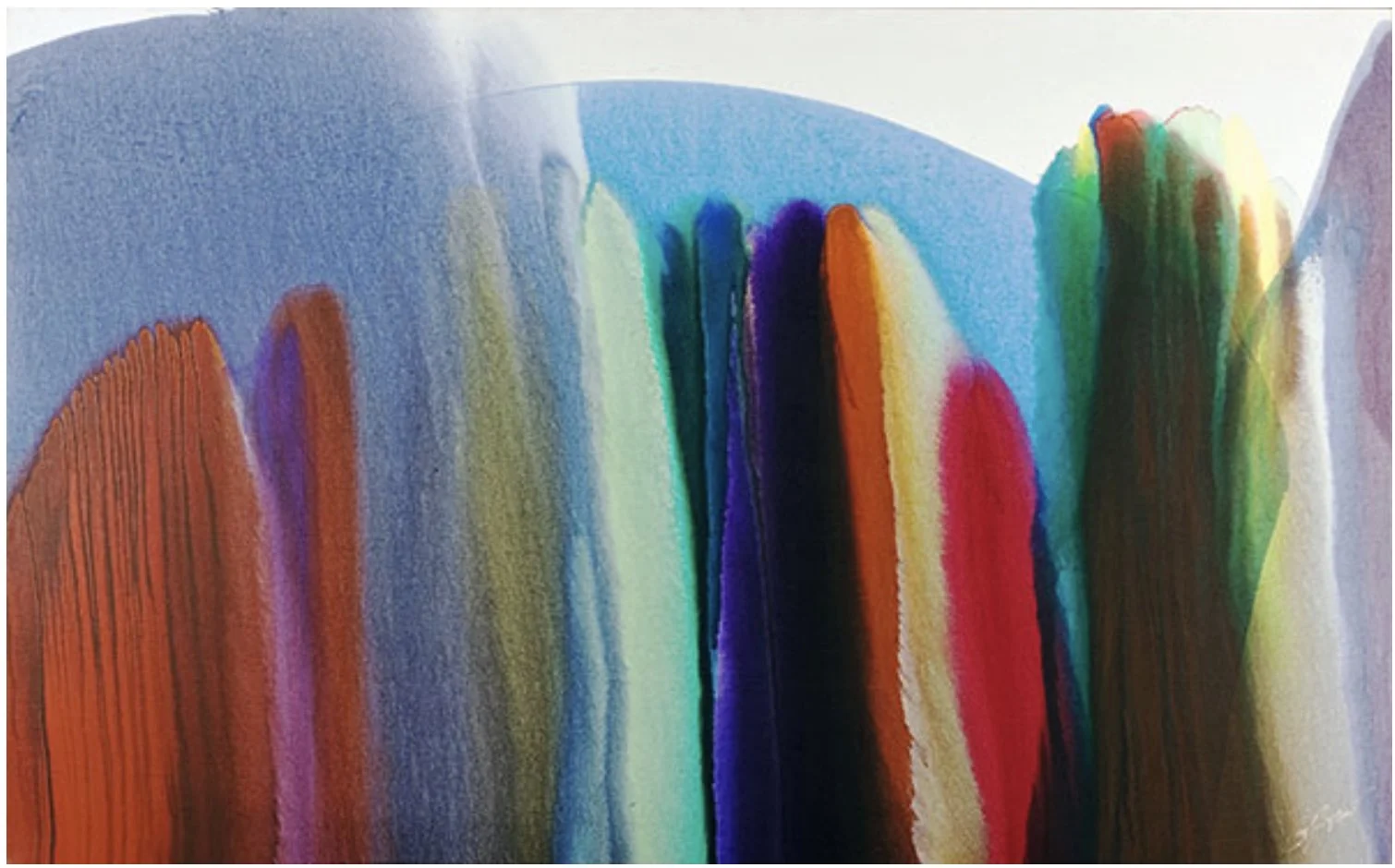
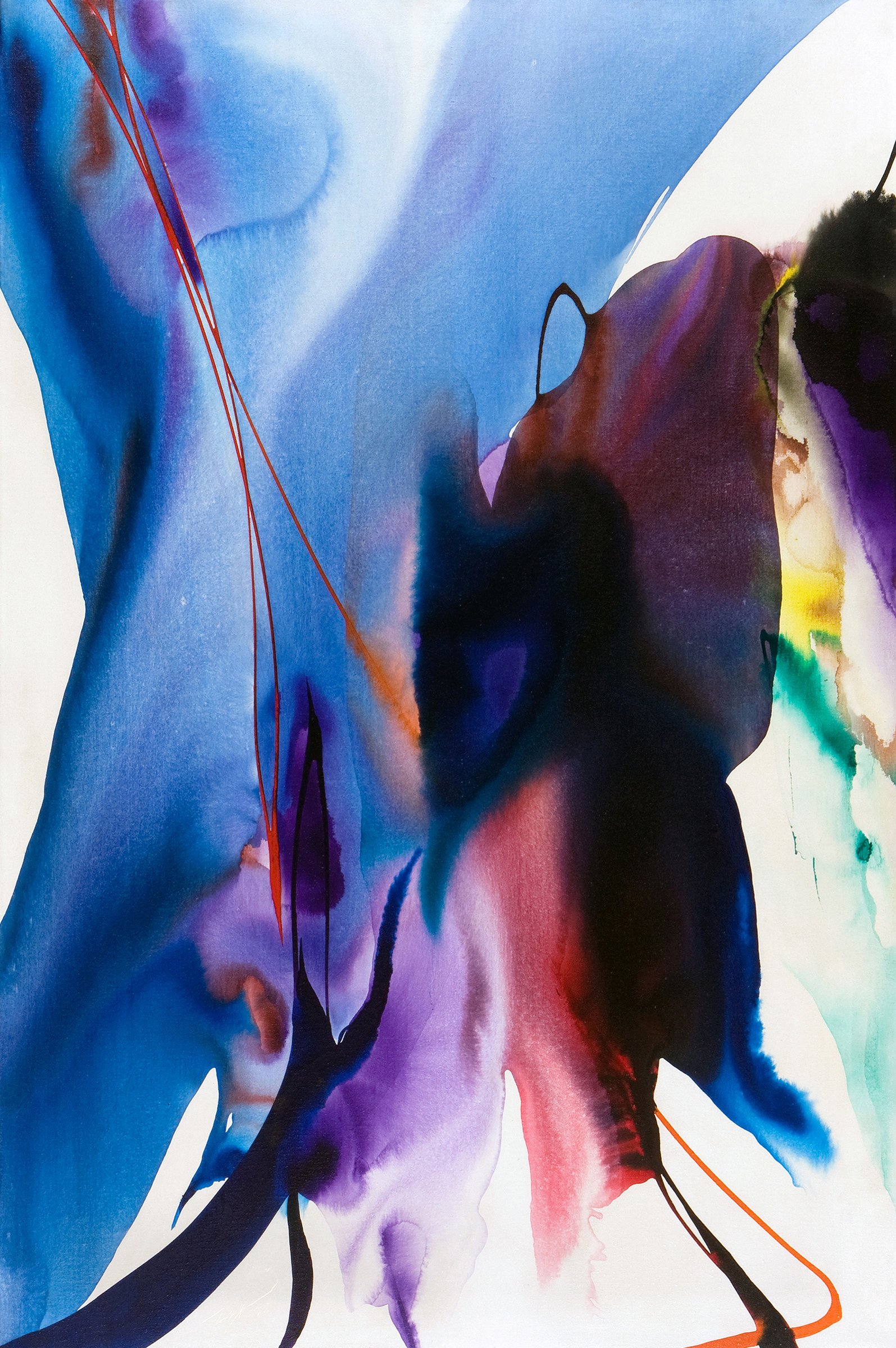
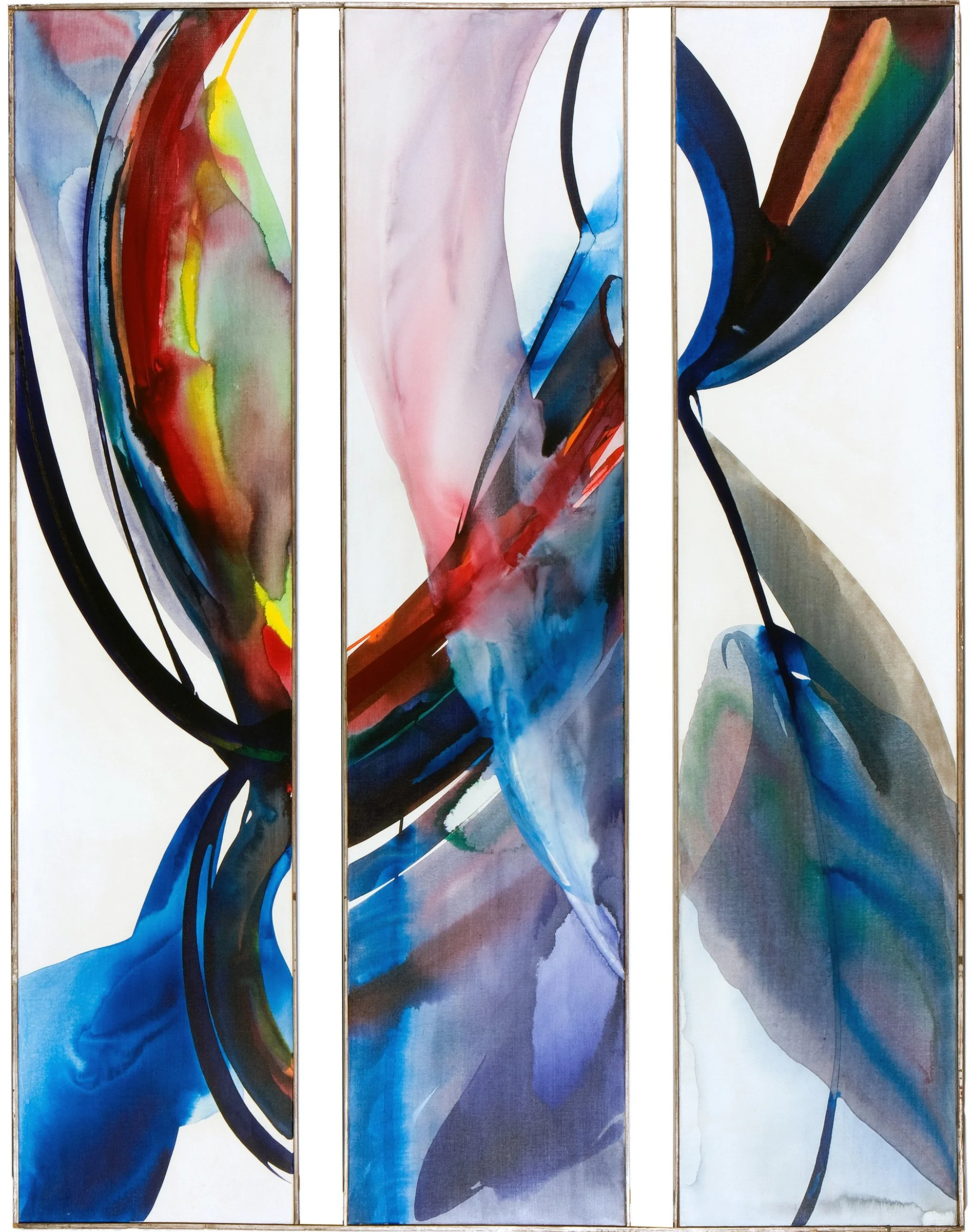
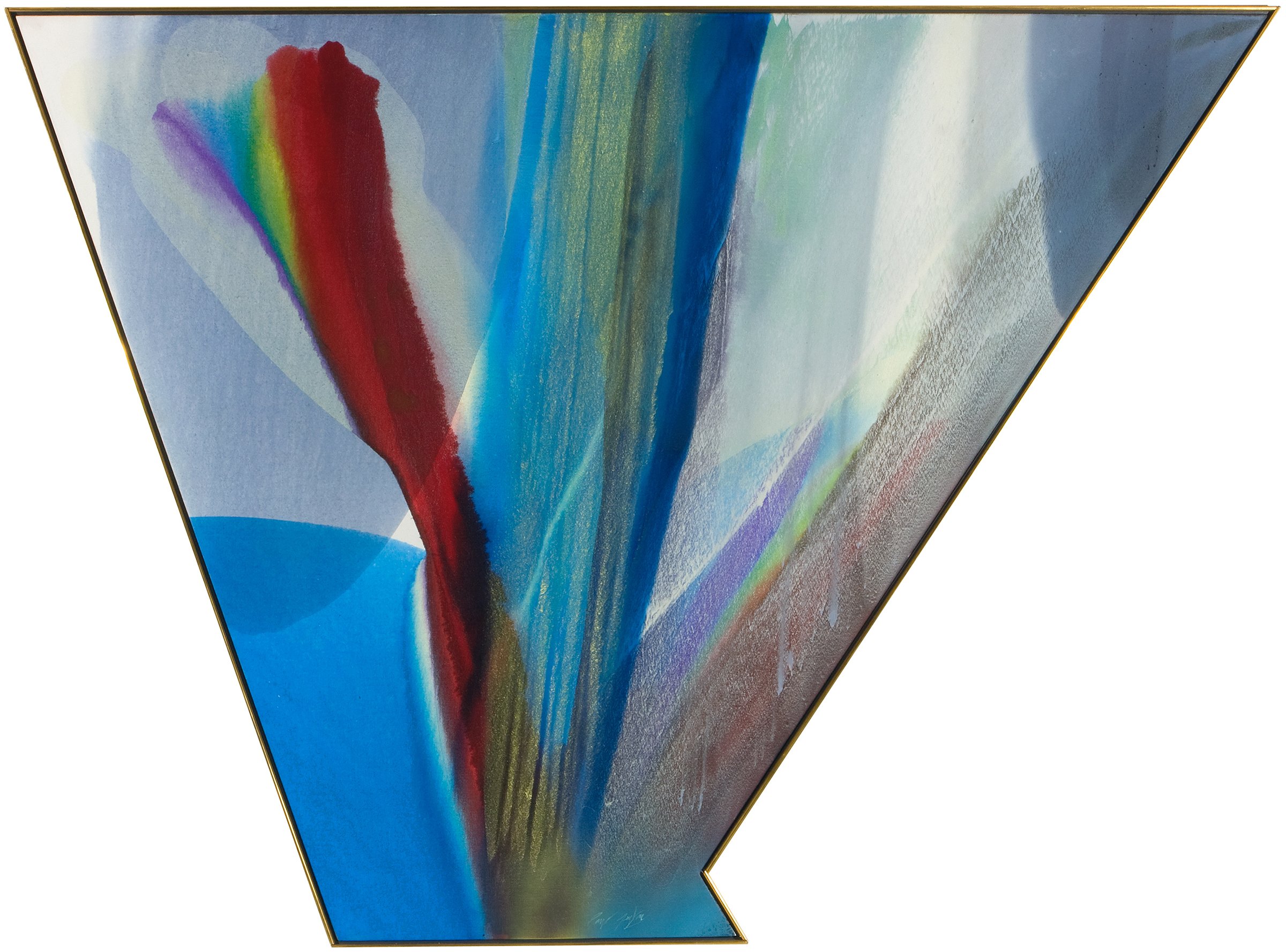
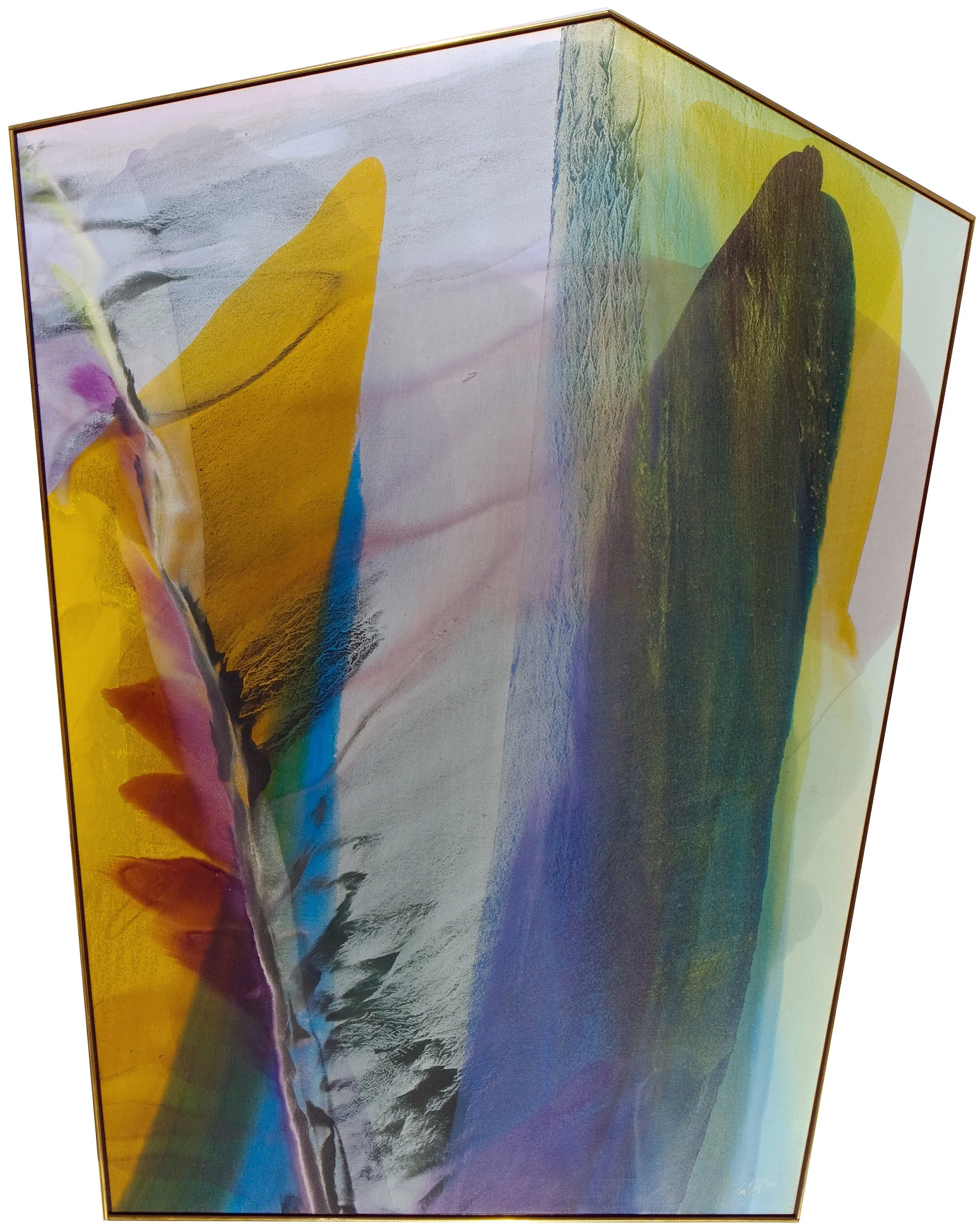
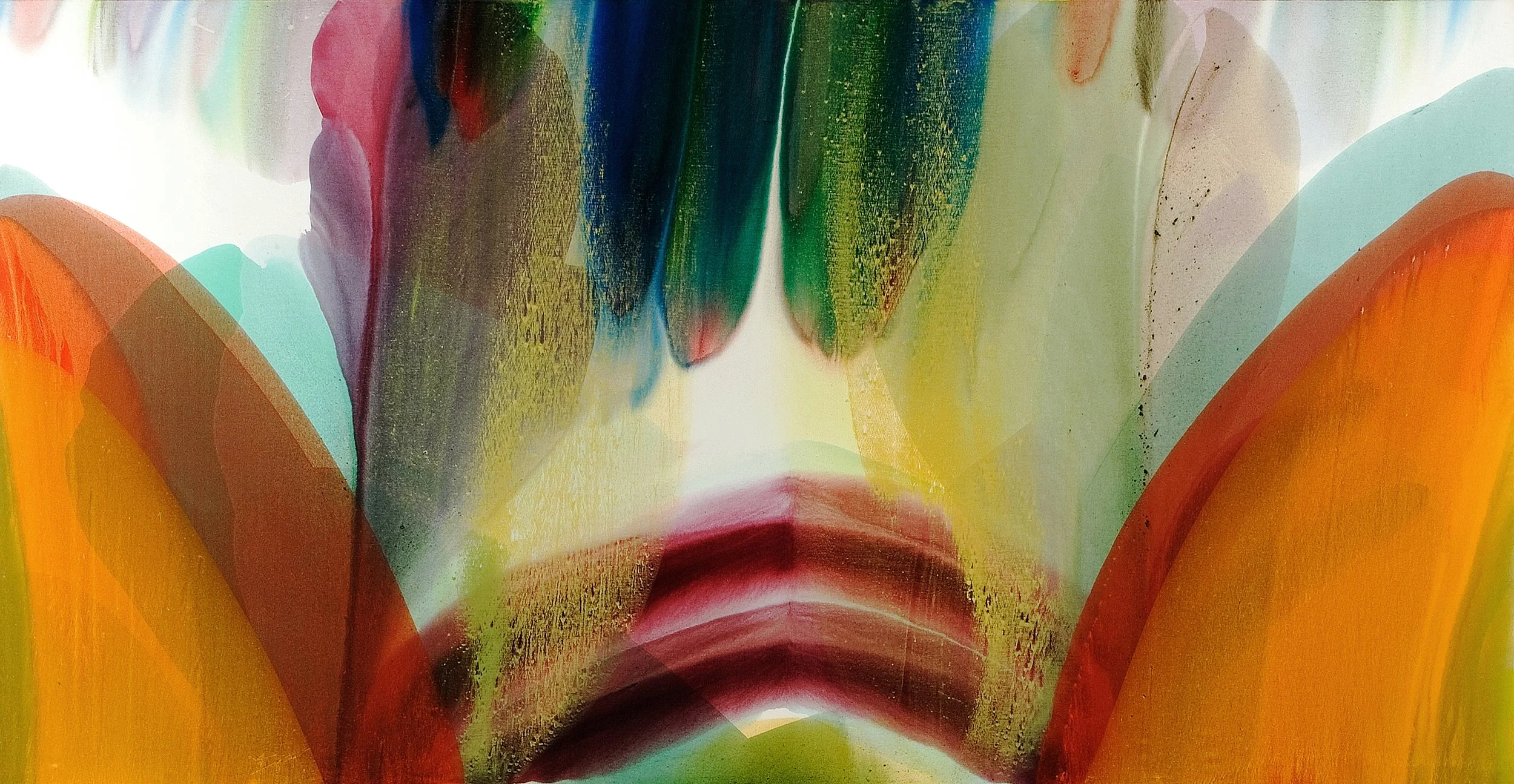
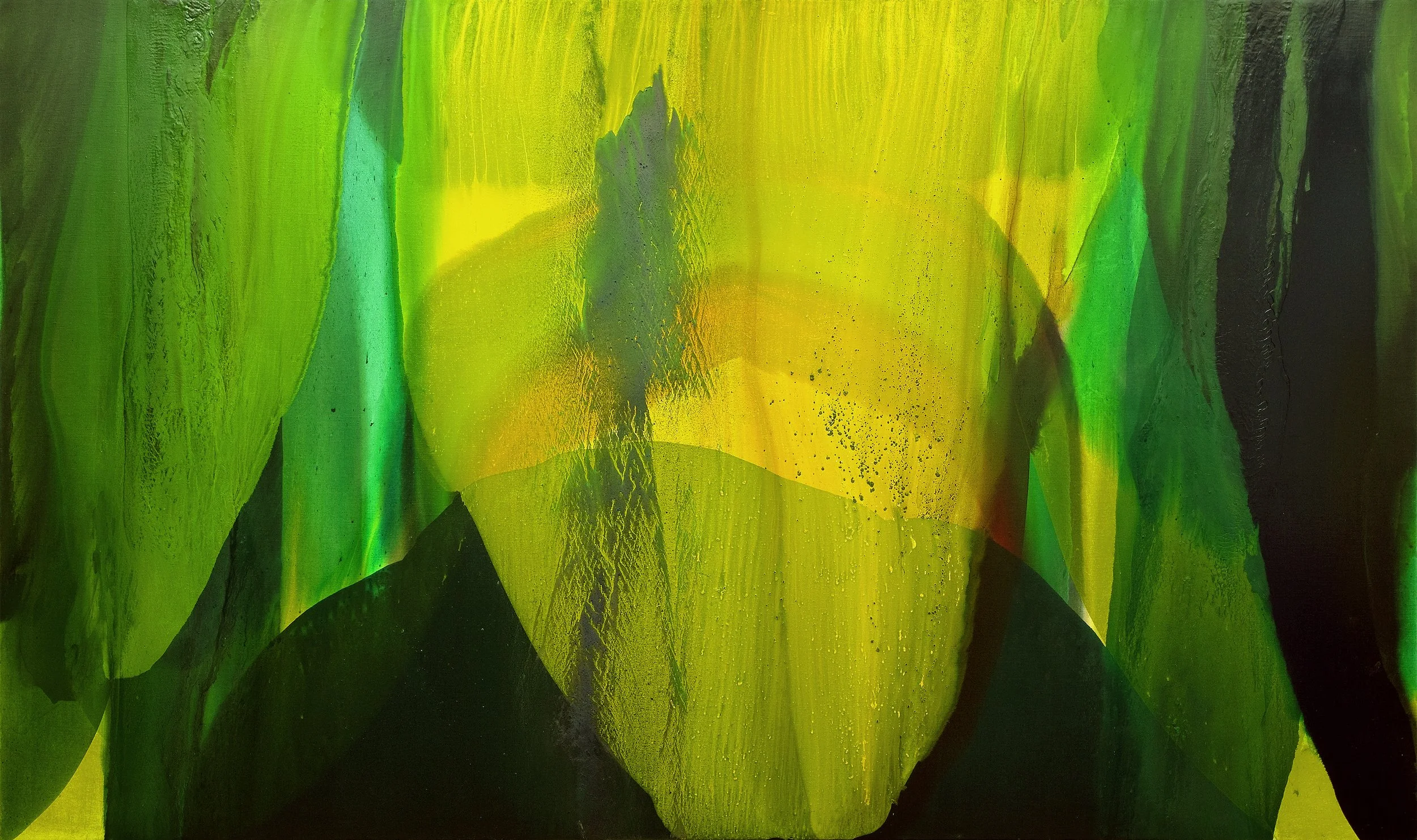
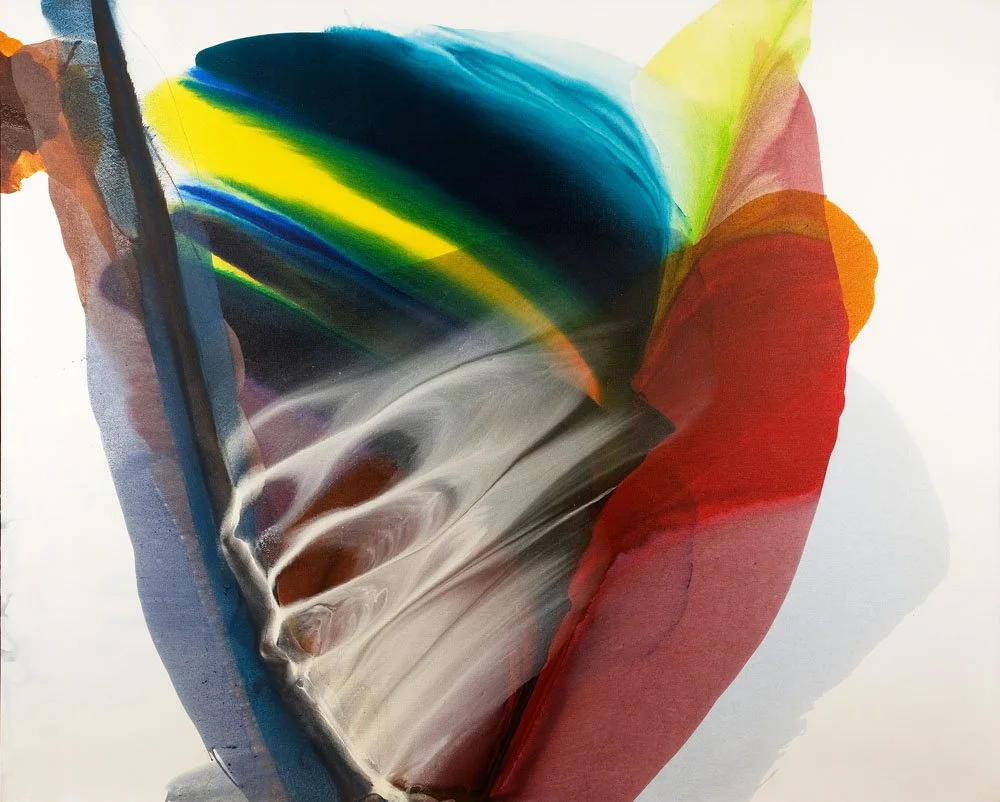
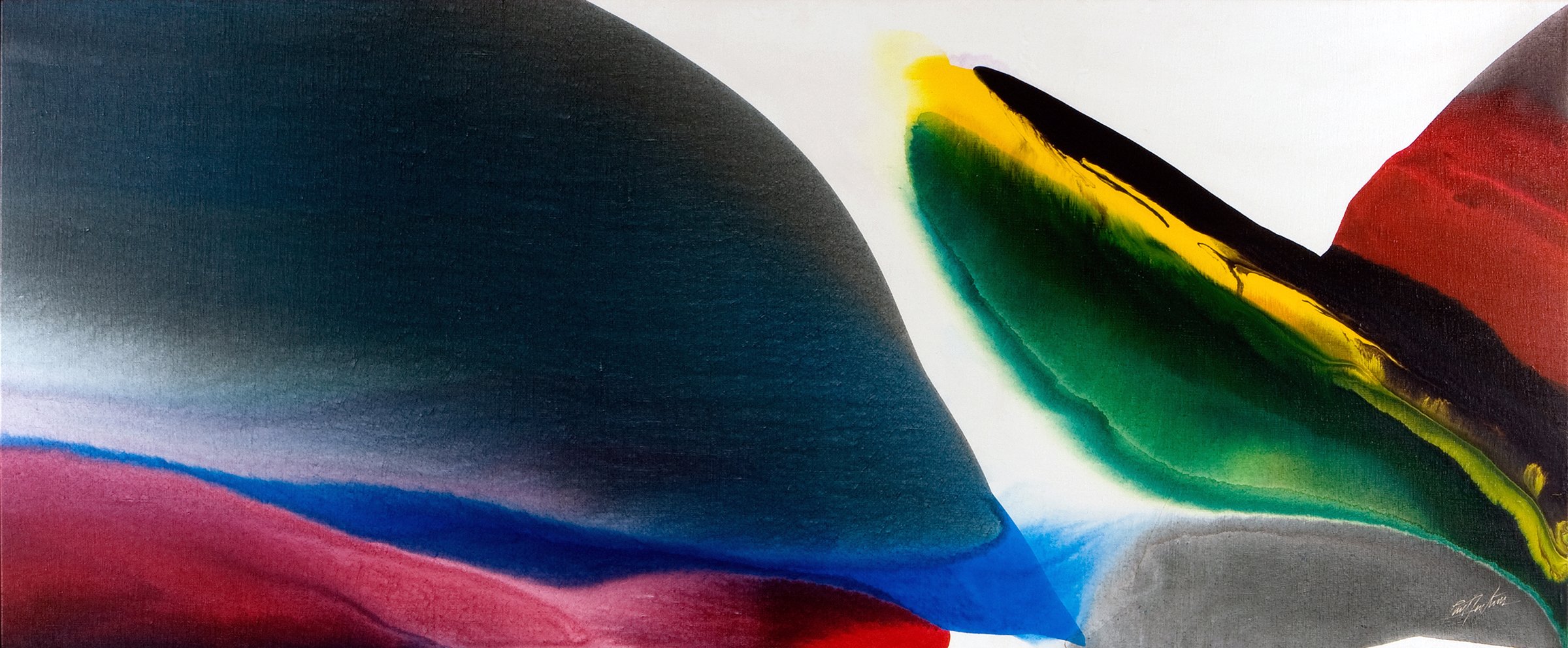
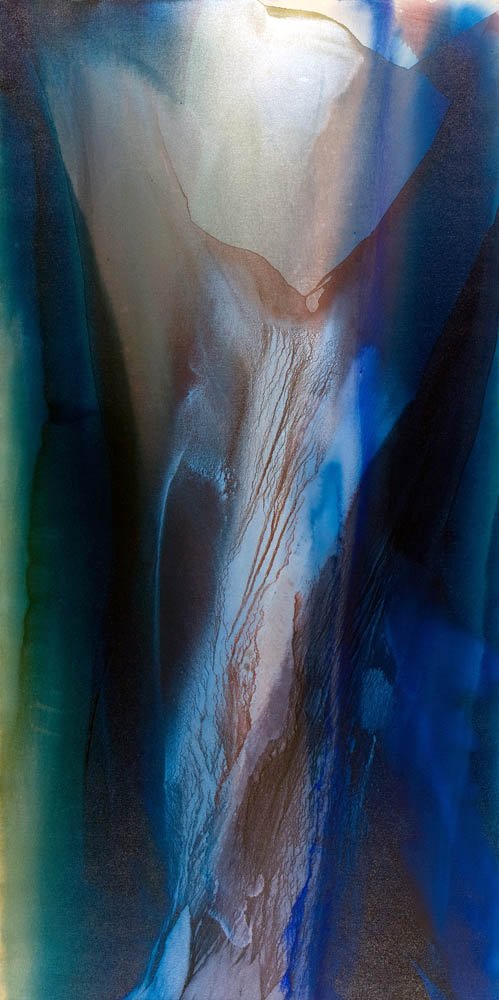
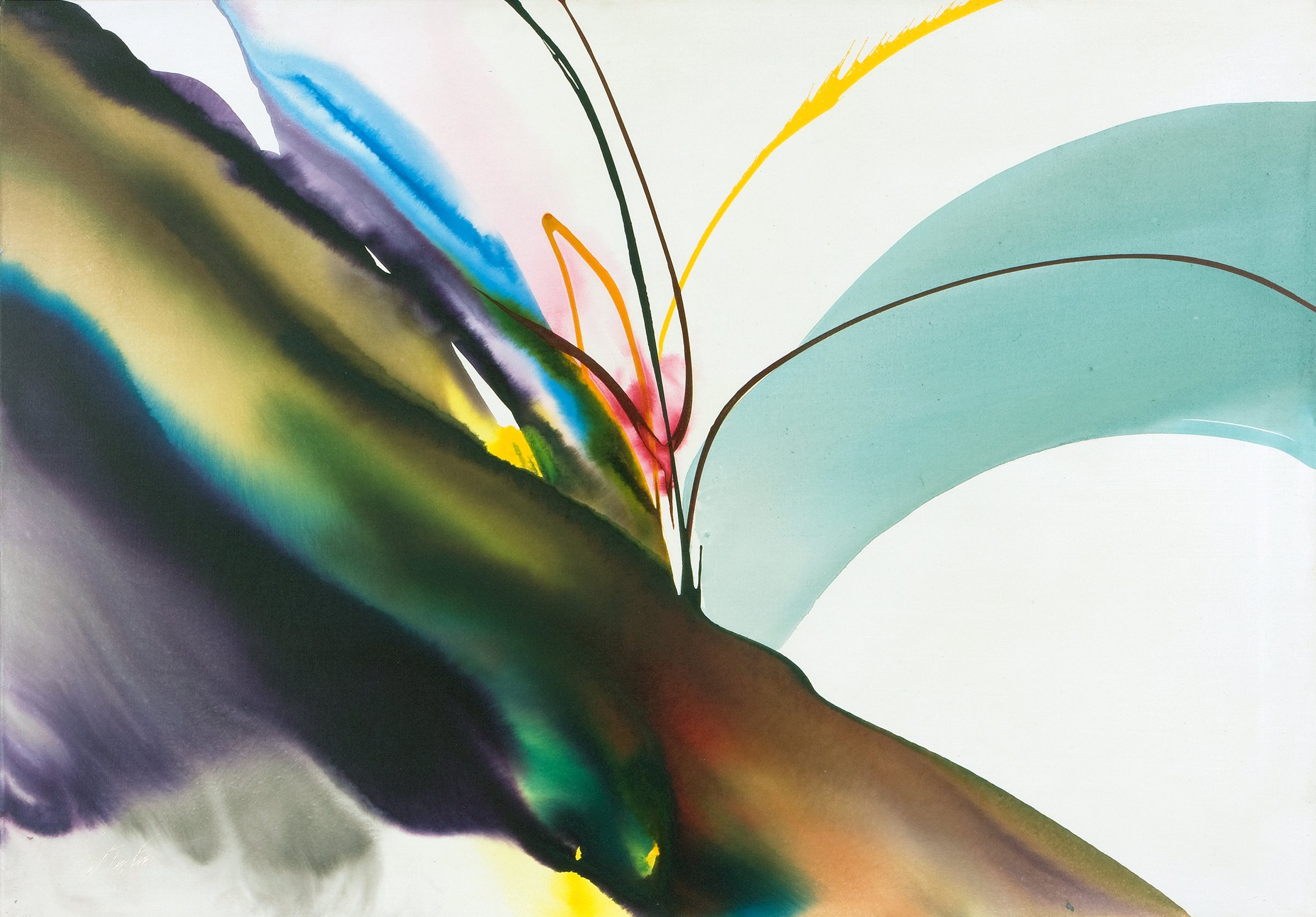
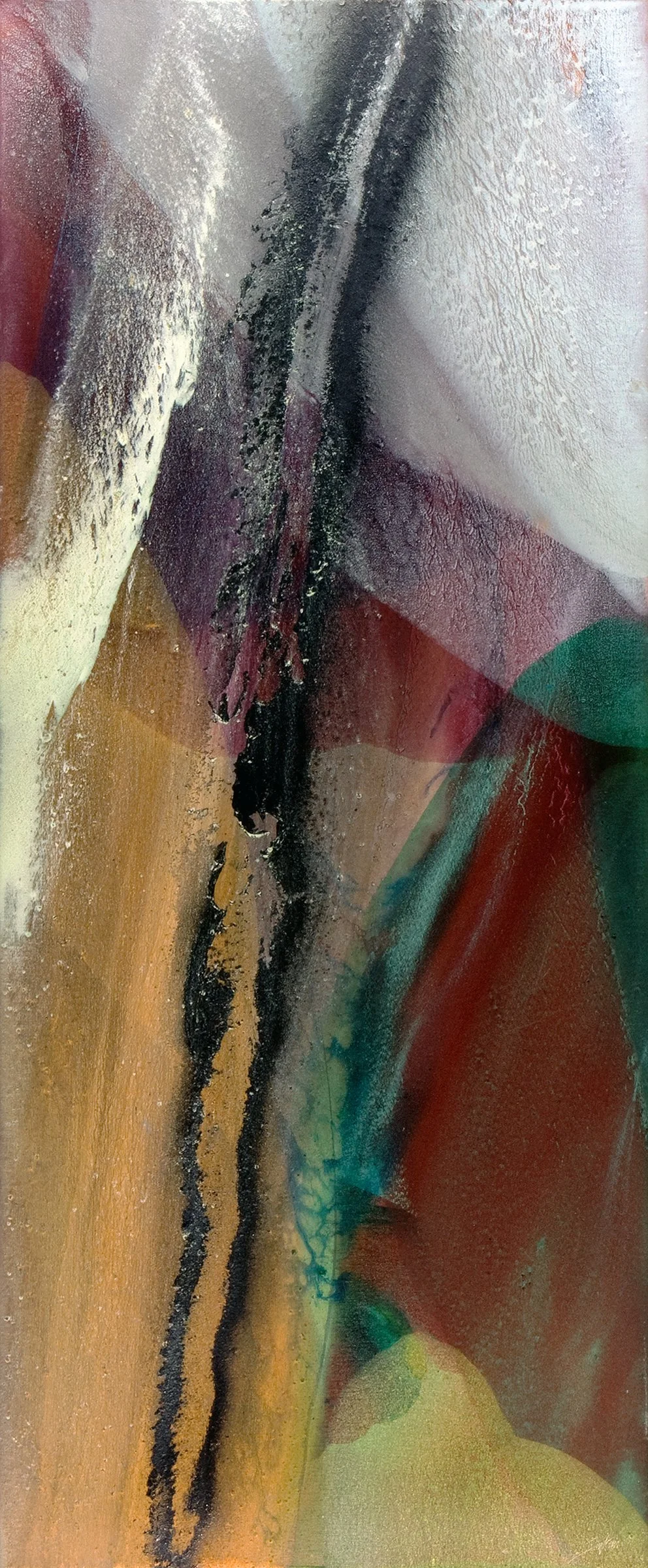
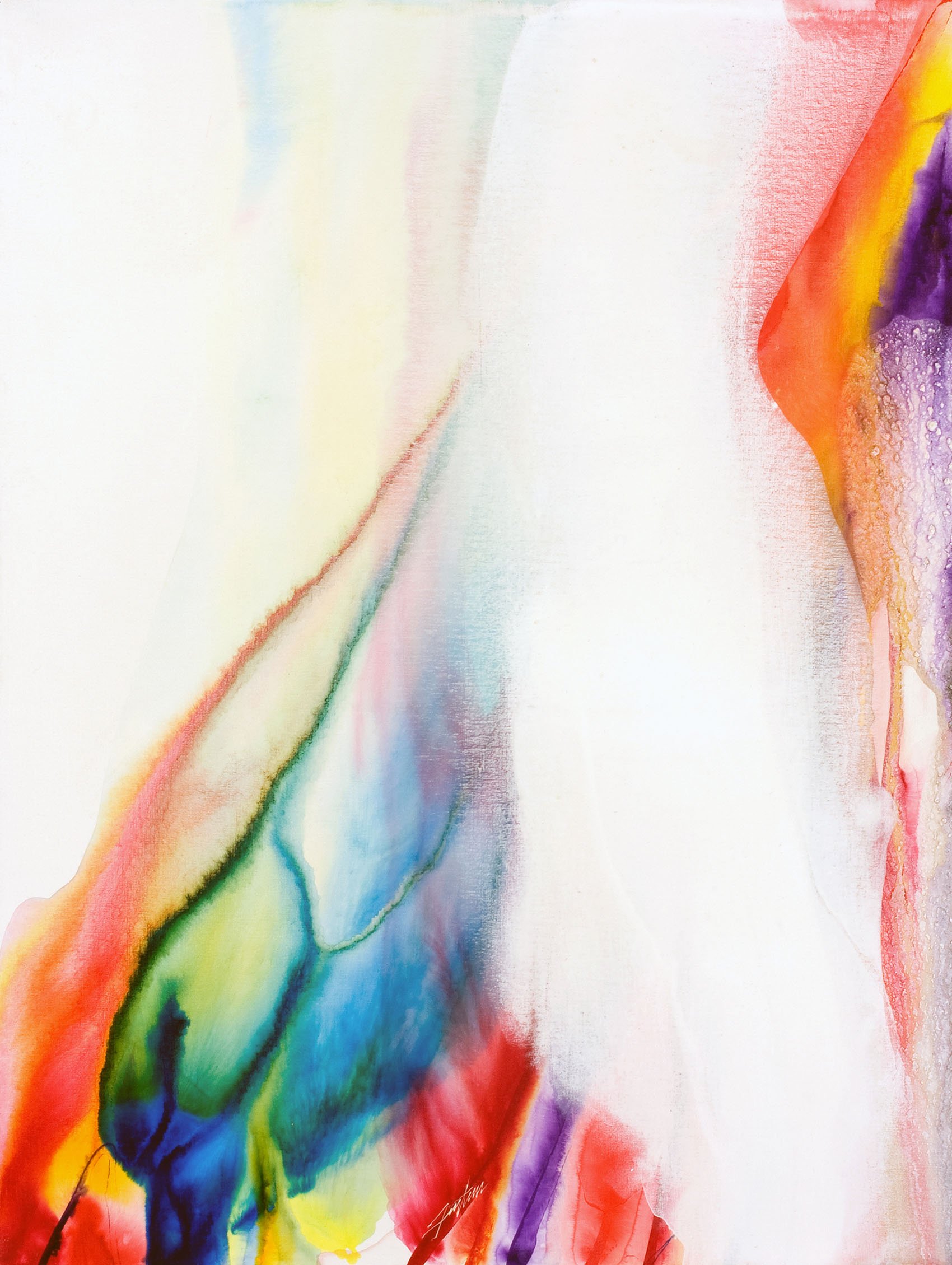
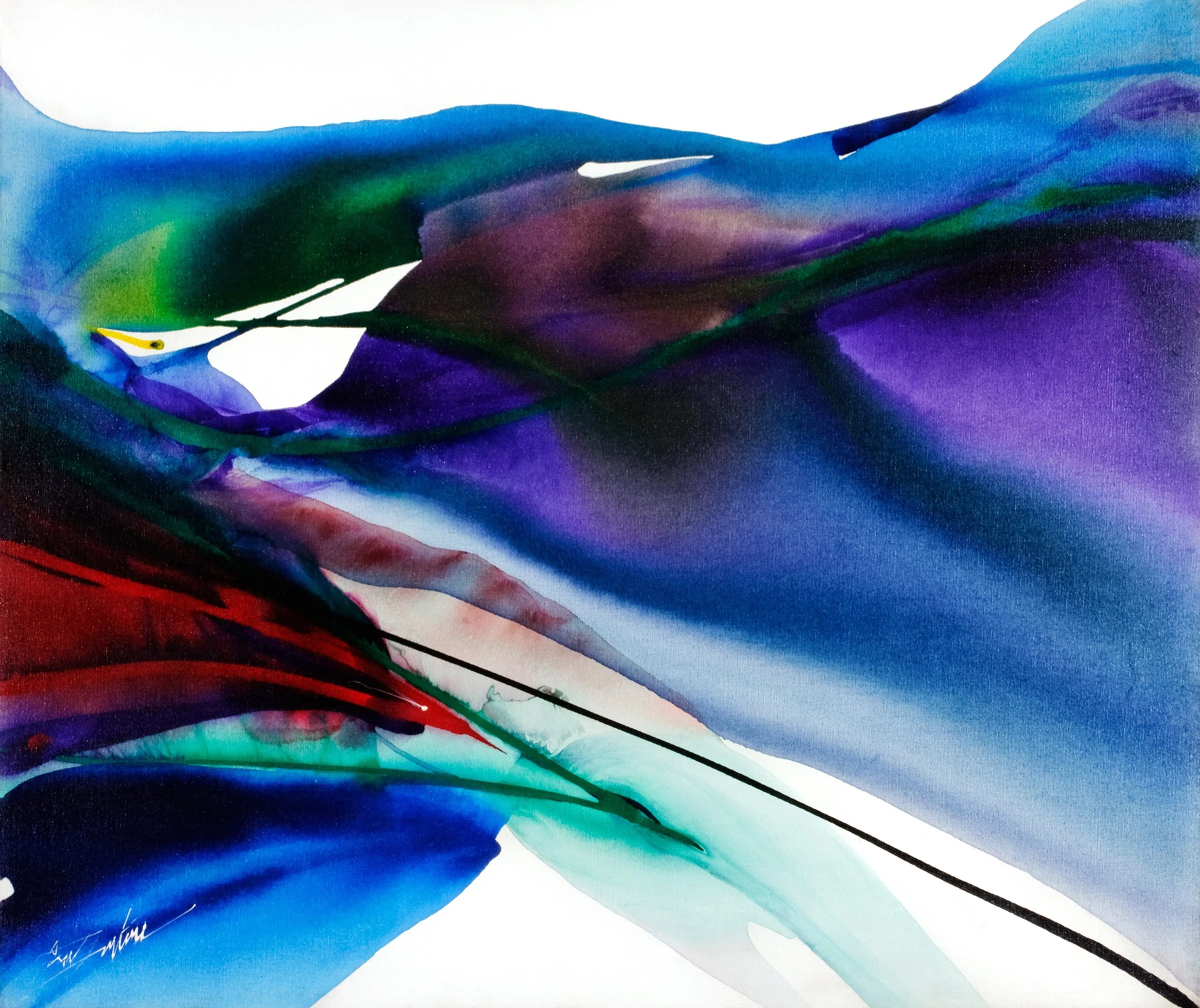
D. Wigmore Fine Art, Inc. is pleased to announce its exhibition Paul Jenkins: Color and Flow featuring 12 canvases from 1956 to 1979. The exhibition offers a refined selection of all-over compositions in oil and enamel of 1956-1958, monochromatic works in acrylic from 1962-1963, and vibrant veil paintings of the 1970s. Across these decades, Paul Jenkins’ singular use of color and flow create an individualistic style that remains distinctively his.

The controlled flow of paint is fundamental to Jenkins’ technique. The balance of tension and timing essential to Jenkins’ work was something he first experienced working in a ceramics factory in high school. There Jenkins saw how the skilled ceramicists had to relinquish control to the heat of their kiln. As an artist, Jenkins replaced fire with the natural force of gravity, creating his imagery directly on the canvas during the act of pouring and manipulating the paint. As Albert Elsen wrote “his craft of painting is vital to the character of his imagery and to our prolonged enjoyment of it. What he has found in the confluence of chance, feeling and calculation is a sustaining source for richly diversified images.” (“Paul Jenkins: The Marvels of Occurrence,” Art International, March 2, 1964).

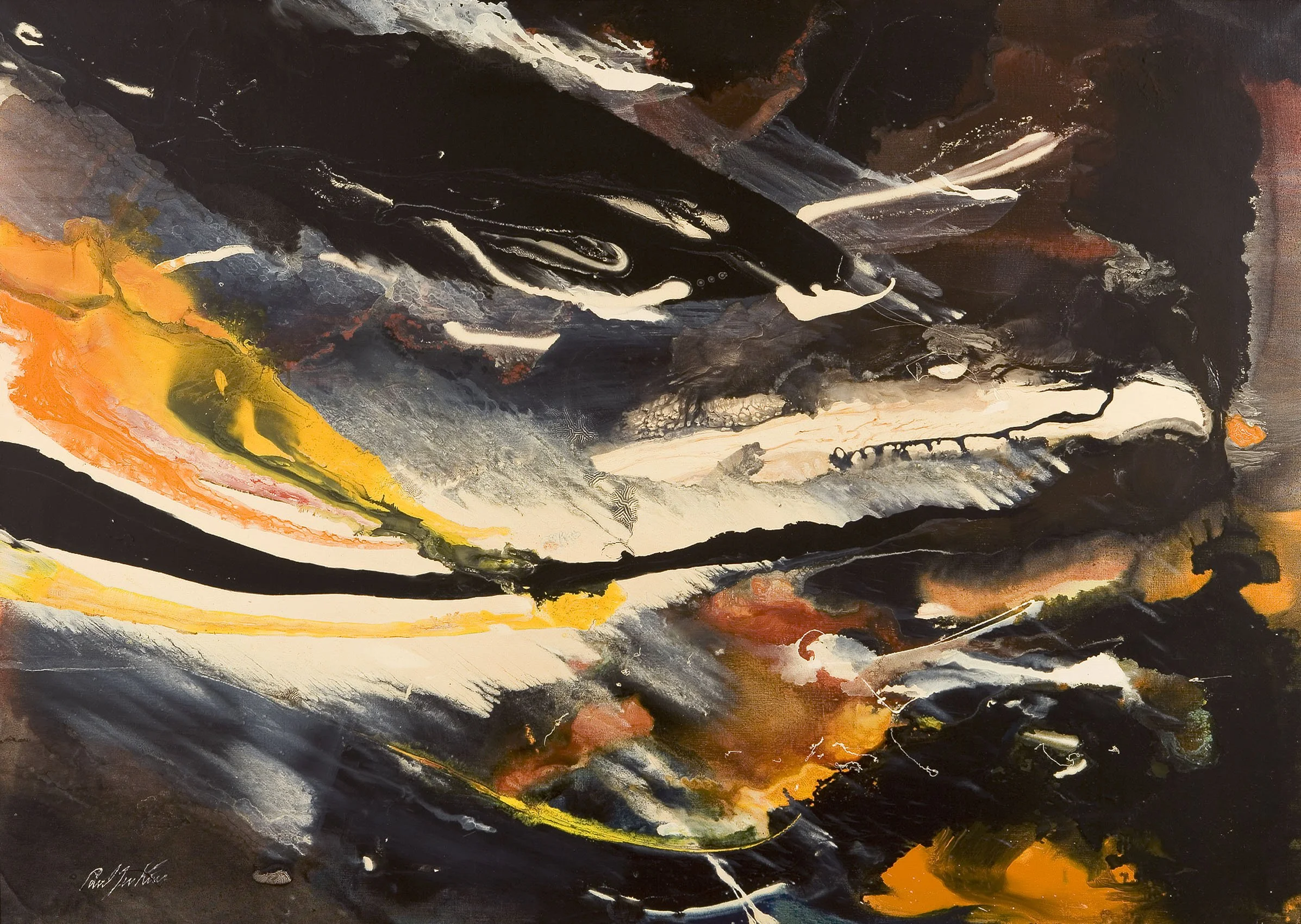
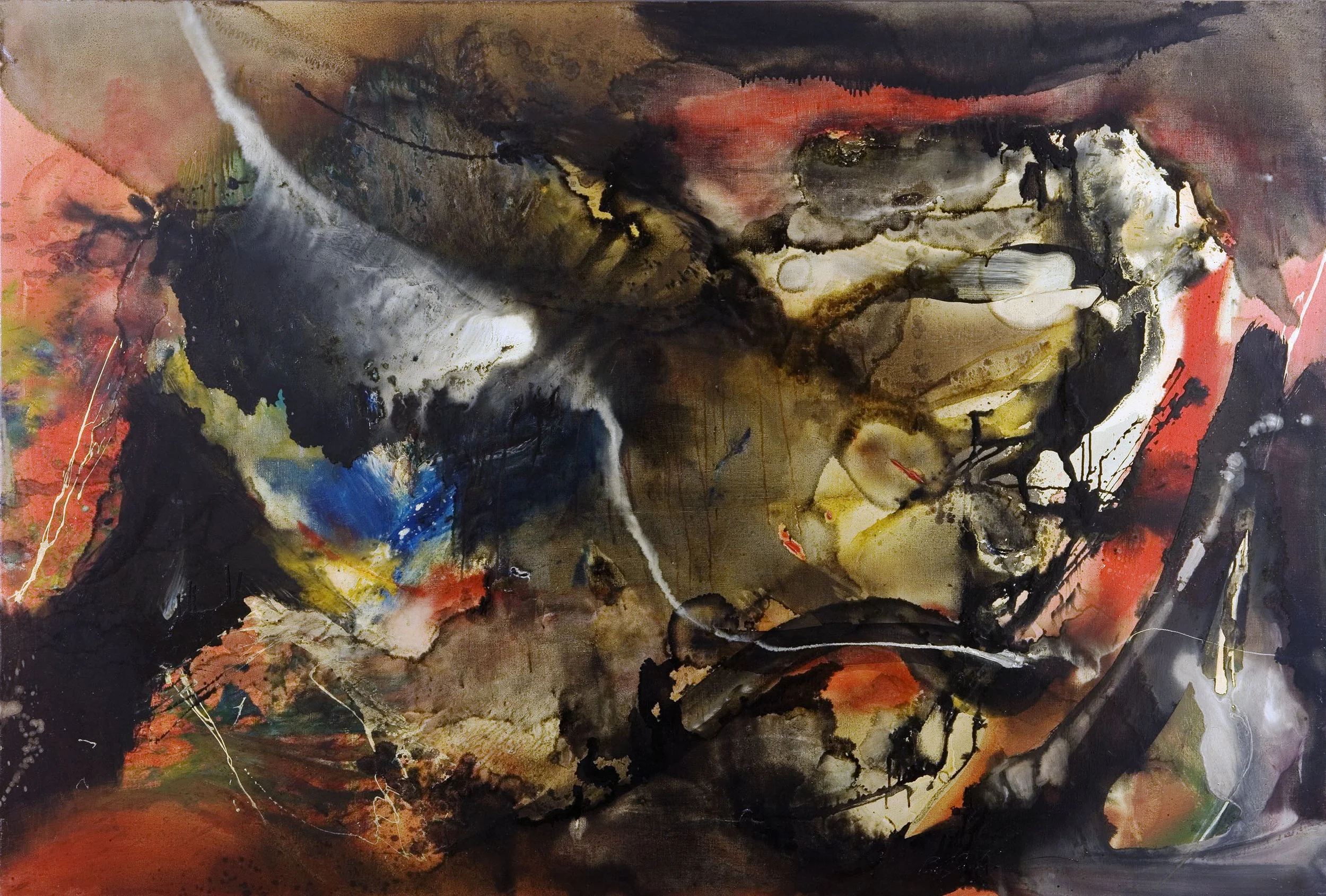
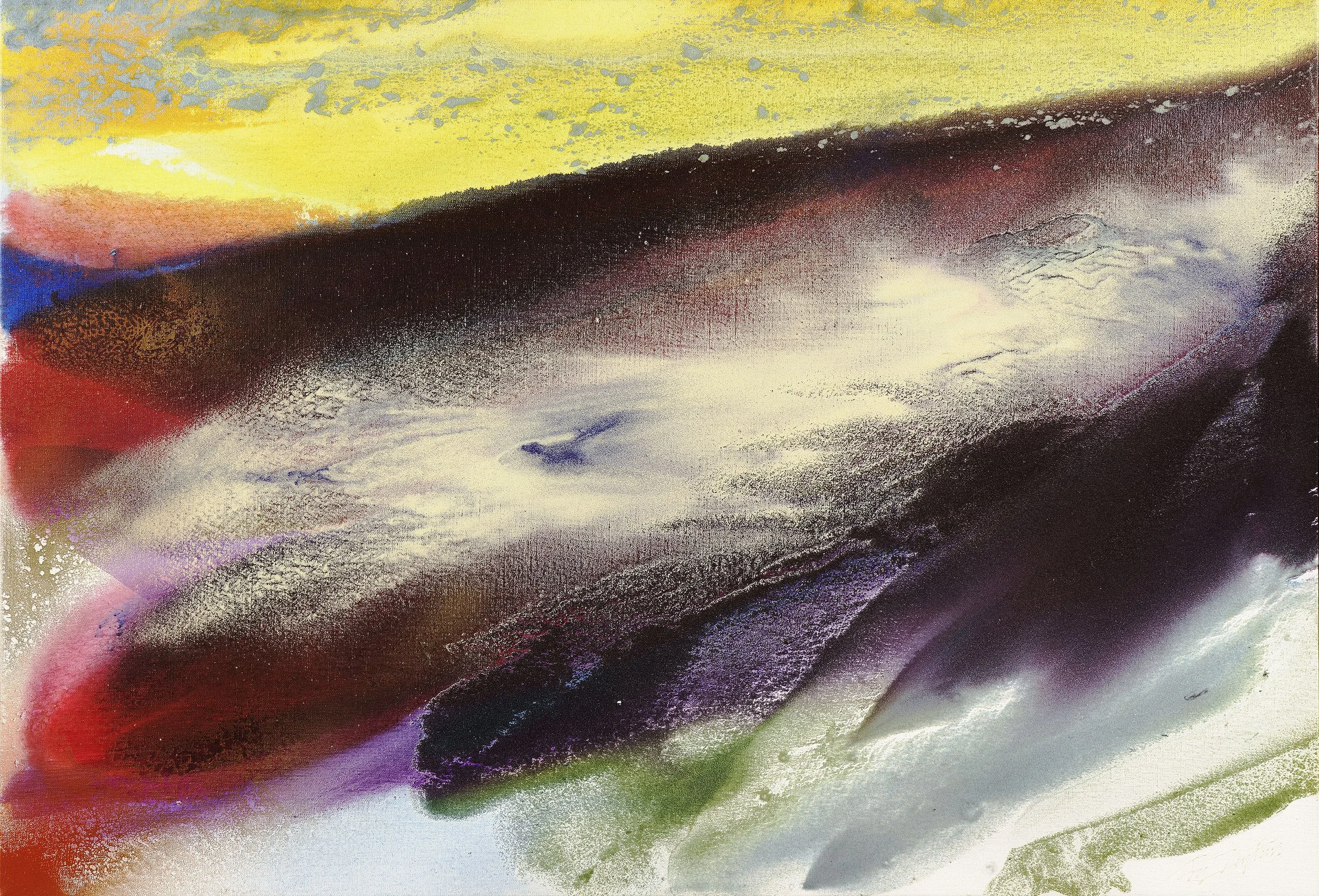
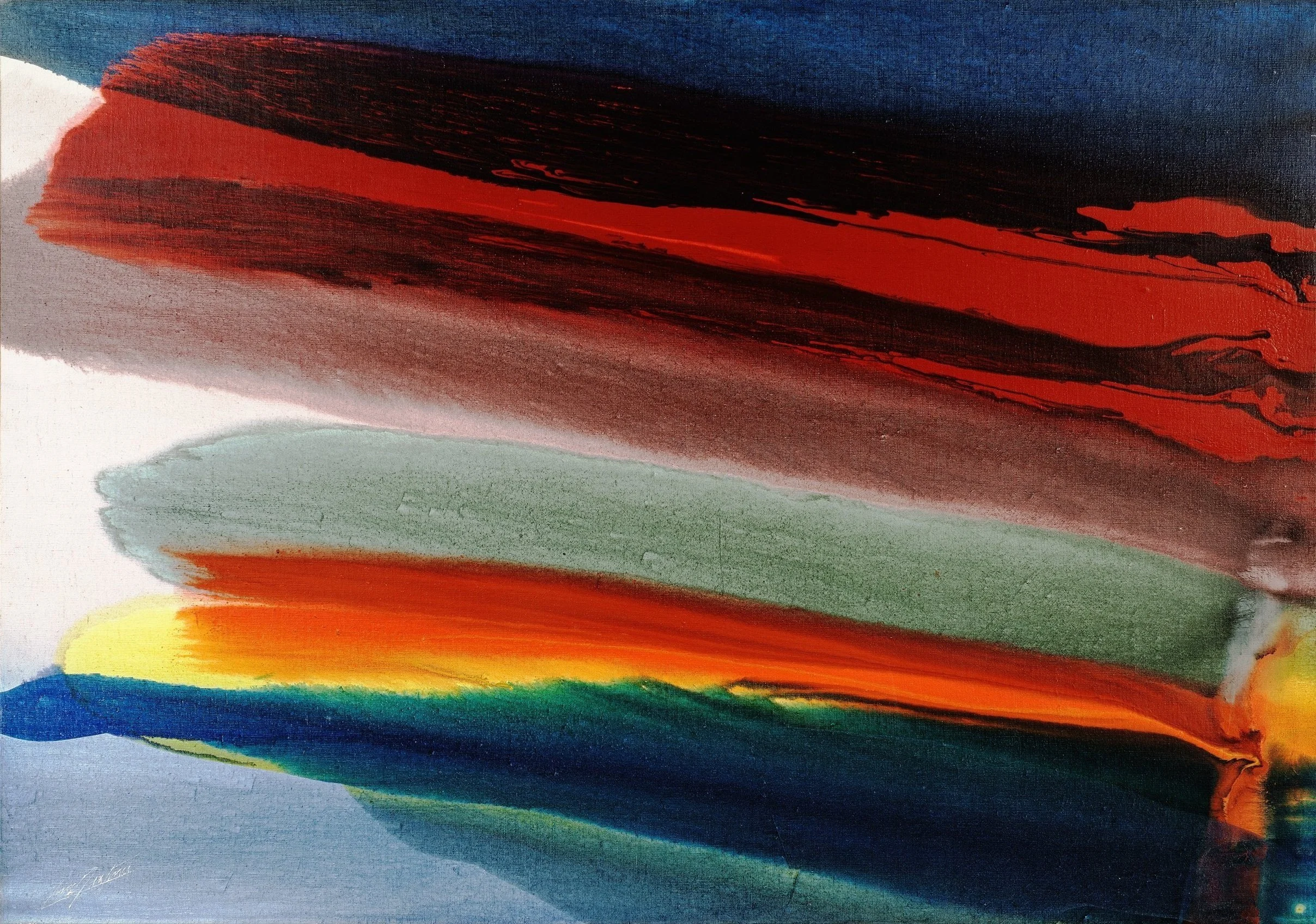
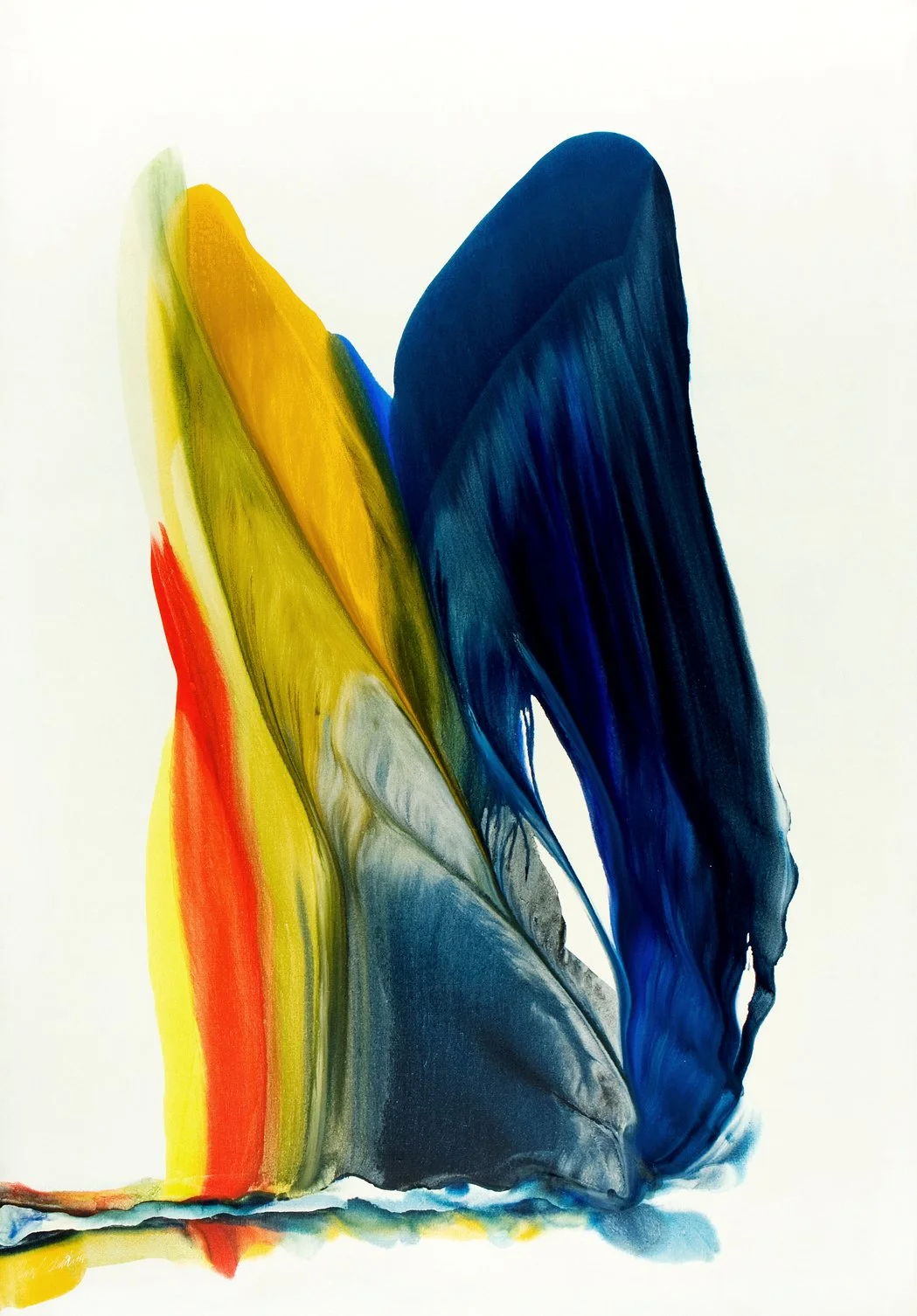
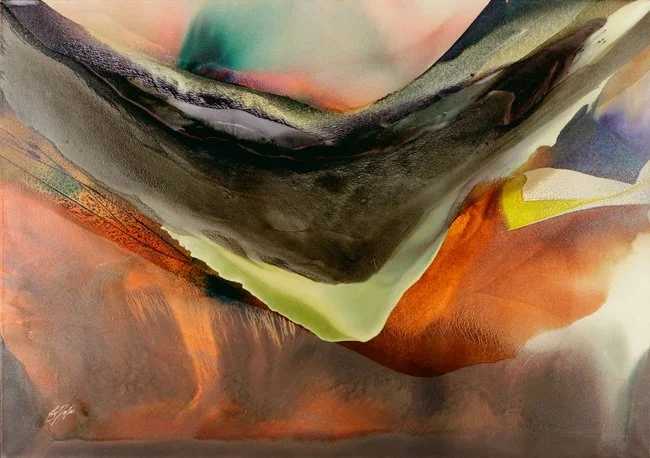
In the 1950s Paul Jenkins worked in oil and enamel, liquefying his medium to work in all-over compositions of color masses in sweeping movements. Throughout Jenkins’ career, color is essential to provide composition and structure. Yet the artist’s use of black and white is of equal importance in the three paintings from 1956-1958 in our exhibition. White chrysochrome enamel enabled Jenkins to create precise white lines as final points of contrast. In Skagerak, 1958, drifts of yellow rise from depths of blue and black while breaks of white chrysochrome lead the eye to the surface. In Albatross, 1956 flowing blacks are enlivened and shaped by reds and blues while openings of white chrysochrome act as a pathway out of the darkness. In Paris, 1957 amidst luminous flows of color is a core of black with calligraphic motions of white chrysochrome that lead the viewer into and up through the painting.

Helen Harrison noted the importance of movement in the 1950s works when she wrote, “Jenkins uses puddling, melting and chromatic blending to suggest movement not only across the surface but also beneath and beyond it.” (“Unveiling the Image,” text for Paul Jenkins in the 1950s: Space, Color, and Light, D. Wigmore Fine Art, 2005). Each 1950s painting in our exhibition is its own universe full of natural forces at work, creating a sense of scale independent of size with projecting and receding masses, a quality that makes Jenkins distinct among the leading Abstract Expressionists of the time.

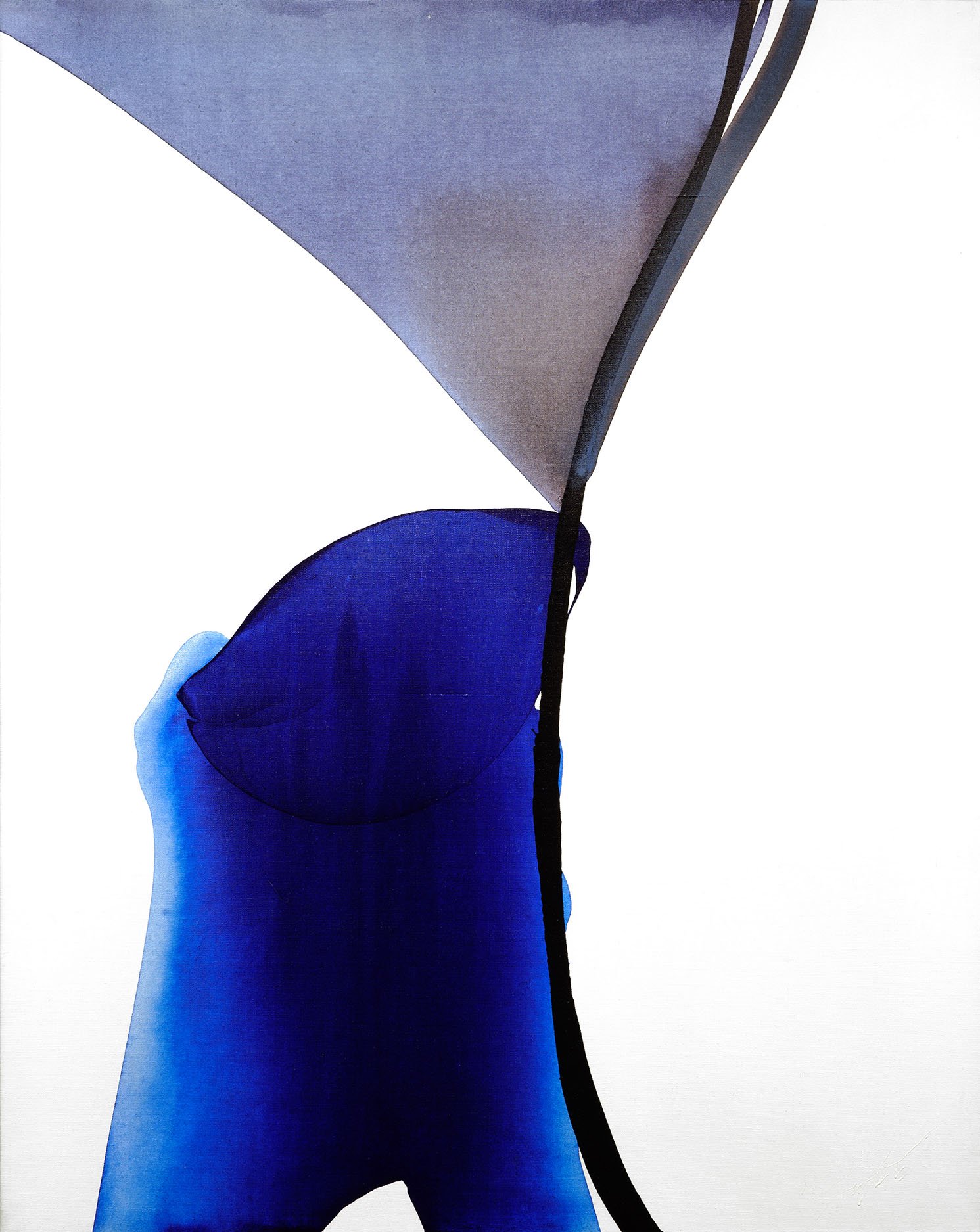
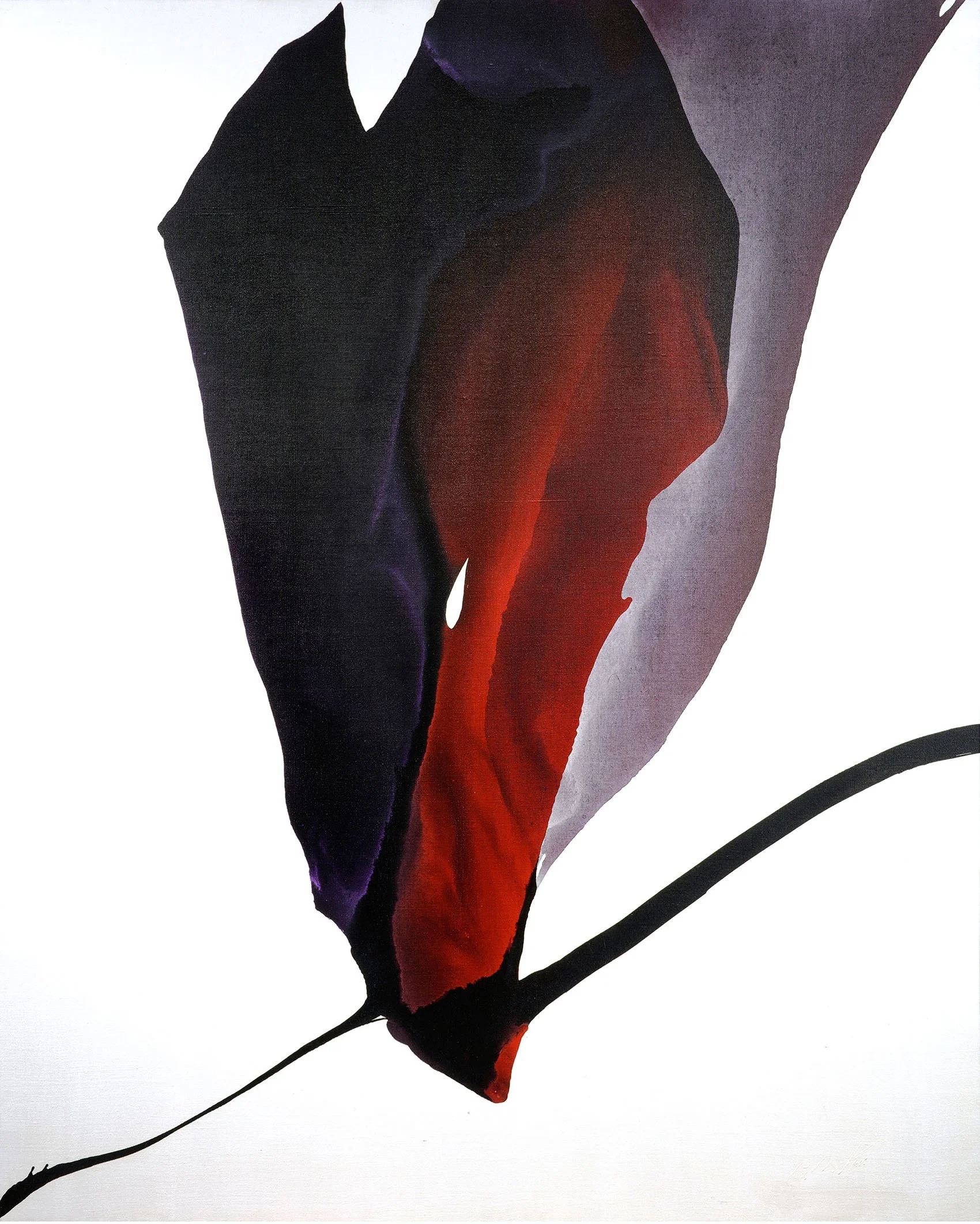
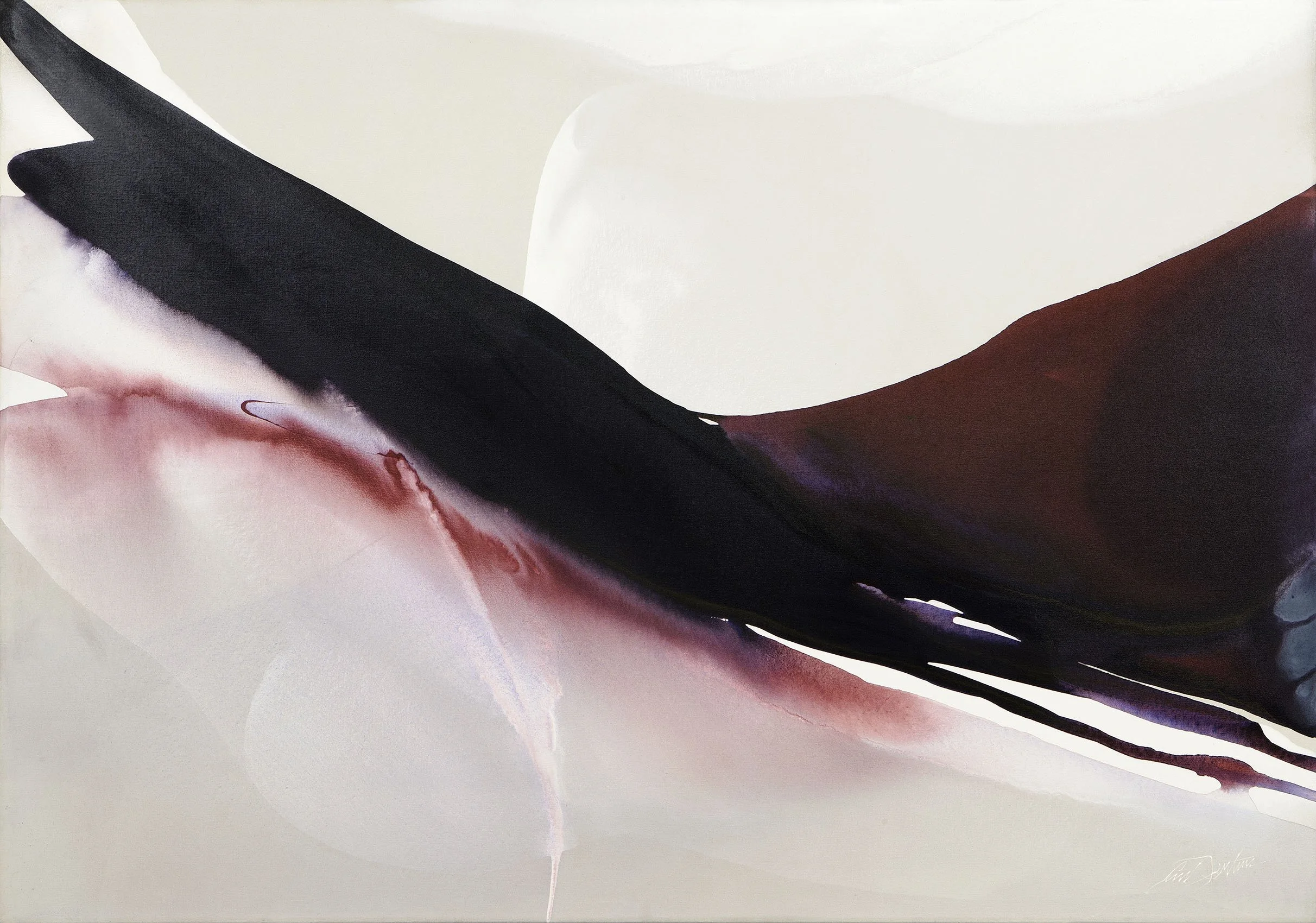
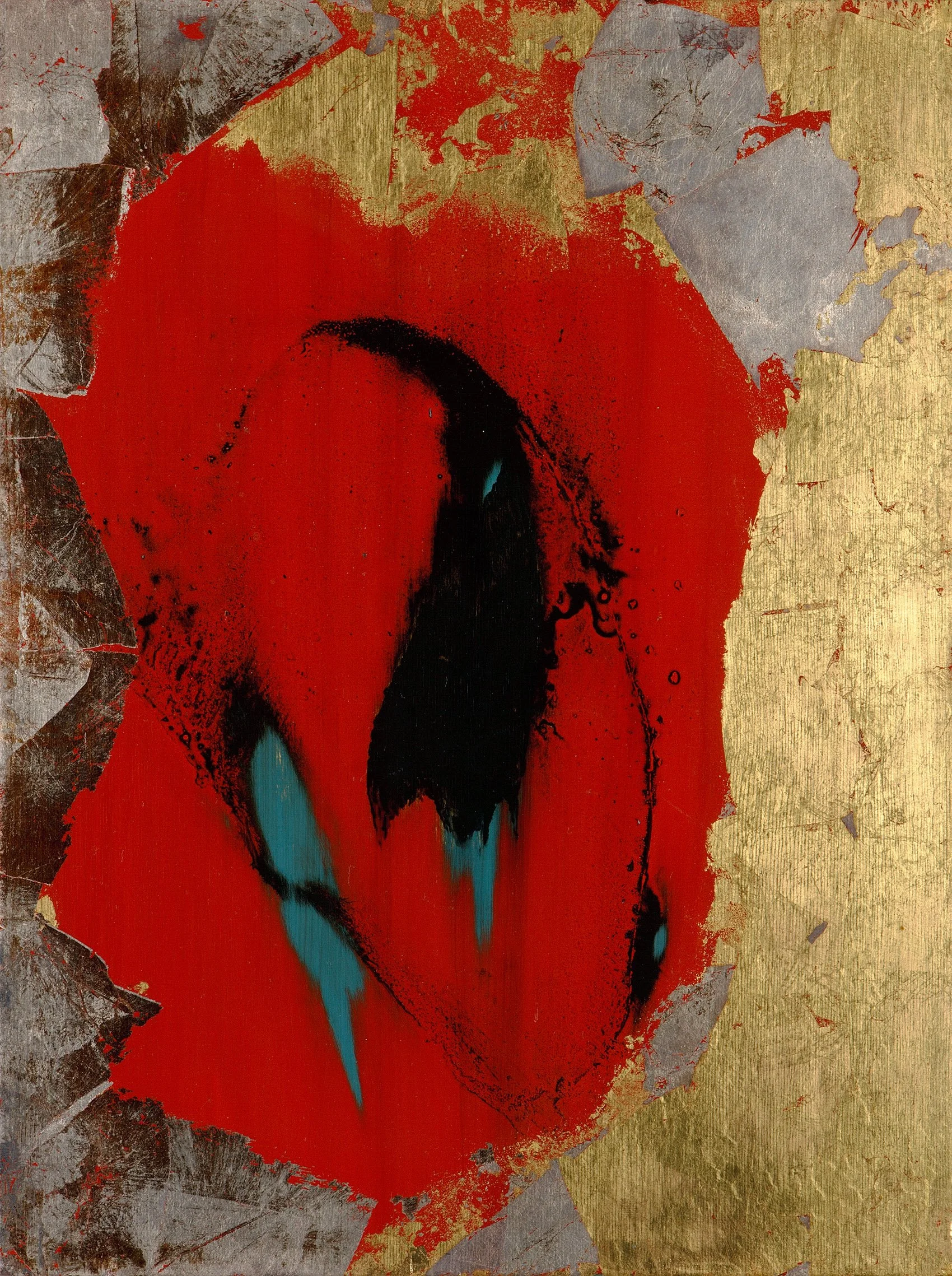
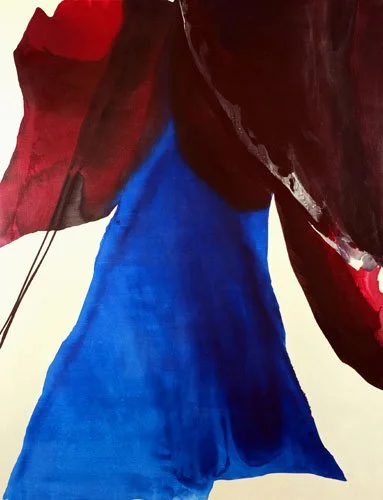
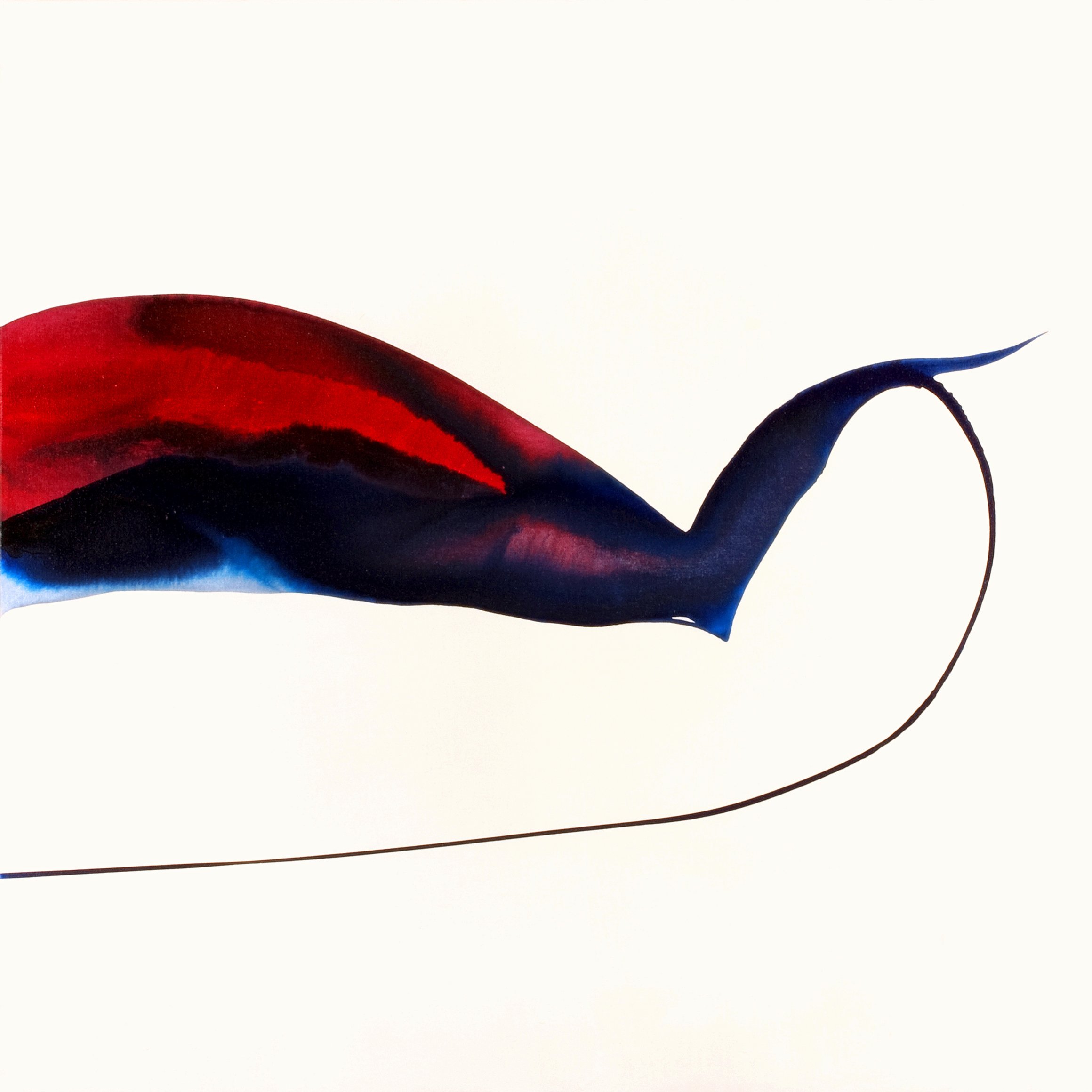
A major transition in Paul Jenkins’ work came with his move to acrylic paints in 1960. As the artist continued to prepare the ground of his canvas to prevent the paint from soaking into the weave, acrylic allowed for greater manipulation and action in his paintings. At the same time, the role of white switched from the surface to the ground and Jenkins began to explore a more minimal, centered composition. Acrylic paints allowed Jenkins to achieve both opacity and translucency as seen in Phenomena Blue Ligeance, 1963 where blue paint is densely pooled in the lower half and thinly spread in a veil of blue-black in the top half. In the three paintings from 1962-1963 in our exhibition, Jenkins created complexly layered centered forms of limited color in contrast to the white background. In Phenomena Play of Trance, 1962 a rich red pushes out from a strongly delineated flow of near-black while a diagonal line anchors the base of the shape to the canvas. Gerald Nordland wrote of these new forms as “ambiguously flat and yet suggestive of both softness and stone-like solidity.”

By 1960 Jenkins titled his works beginning with Phenomena, which as Helen Harrison wrote, opened “the door to multiple interpretations of imagery that has no specific counterpart in nature yet seems somehow to refer to the natural world.” Each Jenkins canvas serves as its own world, engaging the viewer in his or her own memories and experiences. The titles in our exhibition evoke a sense of exploration with references to water, geology, and spirituality in distant lands.

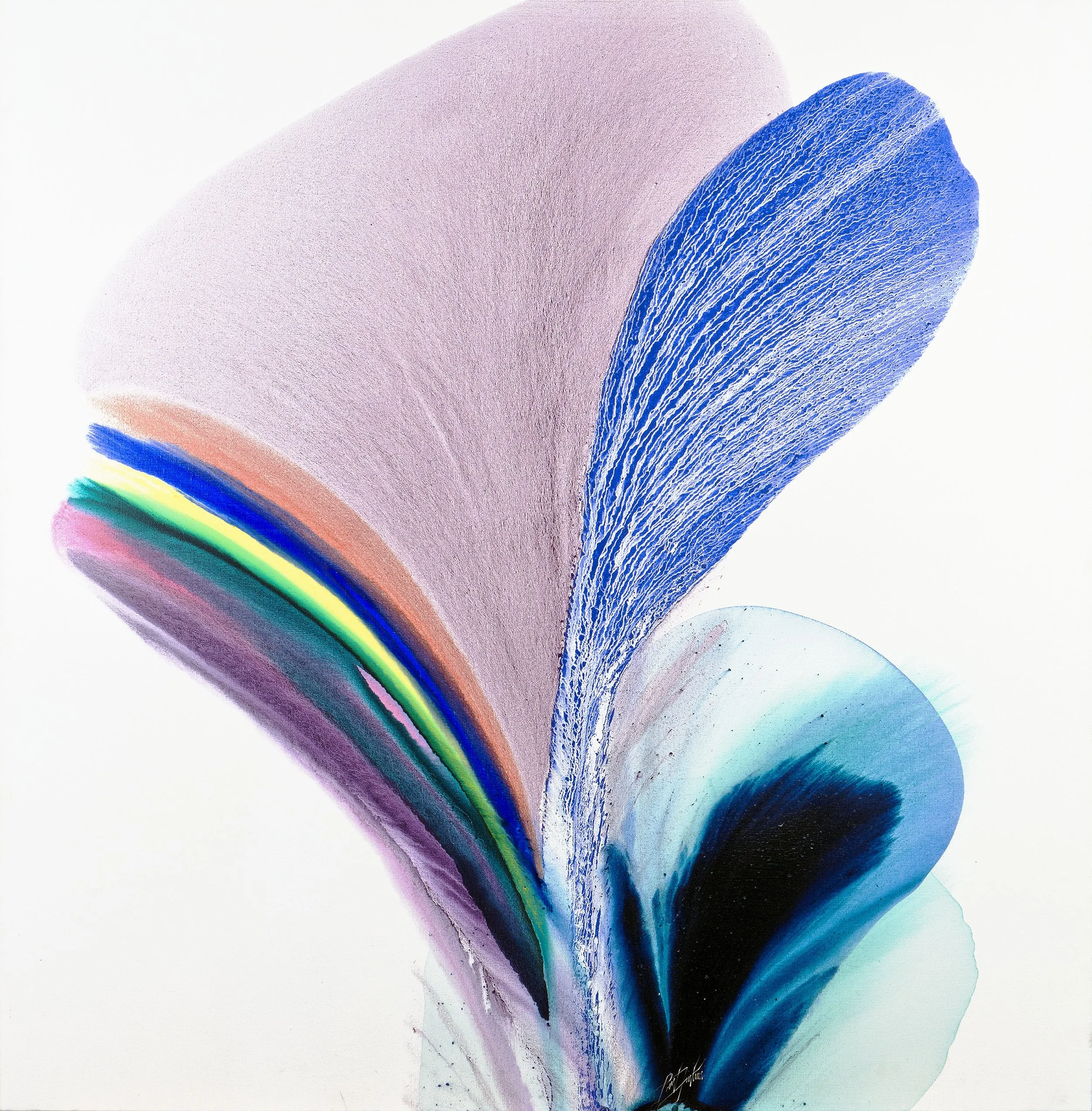
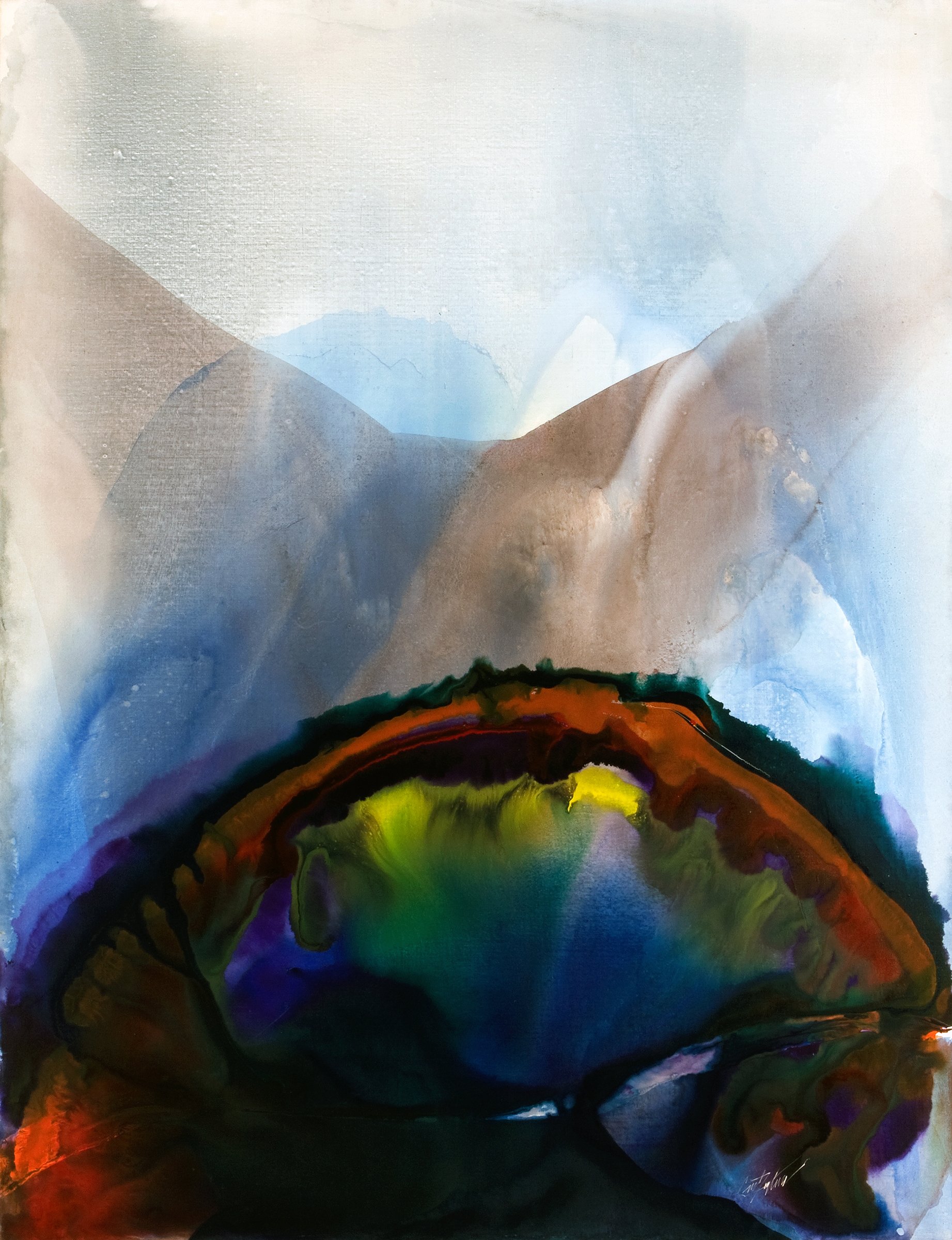
The 1970s paintings in our exhibition demonstrate Jenkins’ mastery of technique and medium which he used to move freely between order and chaos. Phenomena Spectrum Hour Glass, 1974 and Phenomena Prayer Rug, 1975 recall elements of 1950s works with their all-over composition and turbulent movement. Granular white veils now replace chrysochrome to provide accents of light. These paintings have an atmospheric quality with evocations of natural forces of weather and sedimentation. In contrast, Phenomena Sufi Procession, 1974 and Phenomena Ore Shaft, 1974 show orderly veils of multiple colors that immerse the viewer in celebrations of color and calm. In both paintings, Jenkins uses the fast-drying nature of acrylic paints to move between distinct colors in translucent and opaque veils that overlap yet remain separate. Structure and movement come together in Phenomena Maimonides Mantle, 1979 where colors flow from a central point into joyous plumes of color. A granular quality in the central veils of purple and blue provides an additional dimension of texture. For Jenkins’ individual and distinct style, the flexibility of acrylic paint proved to be his ideal medium. In the 1970s Paul Jenkins’ technical expertise gave him great freedom to explore different forms of movement and structure depending on where his process led him resulting in a wider range of compositions.

Paul Jenkins used color and flow as tools to create paintings that remain timeless and continue to engage the viewer today in a moment of awe and imagination. As Jenkins said in his monograph Anatomy of a Cloud, “Abstractions are extractions from nature. Concentrates of nature.”

All images Ⓒ 2016 Estate of Paul Jenkins

[Top]


Modernism 1913-1950 | Realism of the 1930s and 1940s | Abstraction of the 1930s and 1940s | Post-War | Selected Biographies

HUNT DIEDERICH: MAKING SCULPTURE MODERN

Jan 6 - Feb 13, 2016

Essay | Biography | For further inquiries, call 212-581-1657.


Essay by Emily Lenz

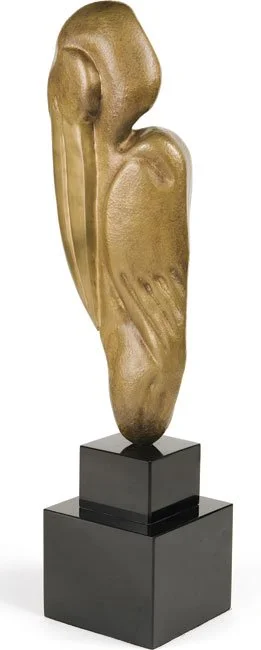
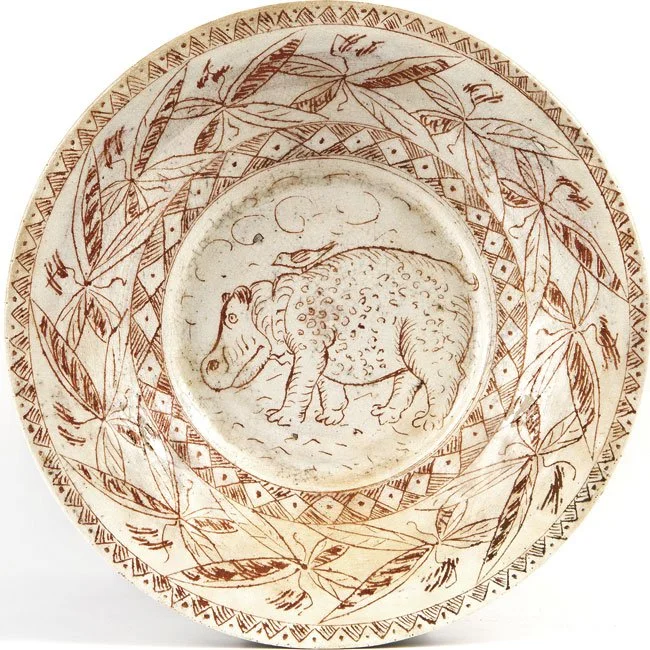
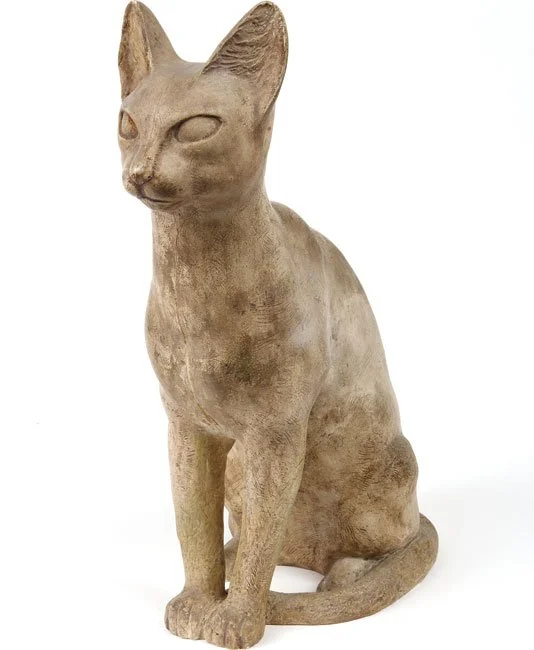
D. Wigmore Fine Art, Inc. is pleased to present with the family of William Hunt Diederich (1884-1953) a selection of works that show Diederich’s mastery of many media from 1914 to 1929. On view January 6 – February 13, 2016, the exhibition includes sculpture, metalworks, ceramics, silhouettes, and drawings. Diederich was a modernist who expanded the meaning of sculpture to keep it relevant in the 20th century. In his first major New York solo exhibition in 1920, he said, “Personally I like to work in as many different media as possible. Sculpture has too long been an affair of marble and bronze. It is too remote, too inaccessible. We must do everything possible to extend its scope and appeal, to insure for it a wider, more popular appeal.” Diederich succeeded in his goal and his fire screens, weathervanes, and lighting are coveted for their charm, elegance, and craftsmanship.

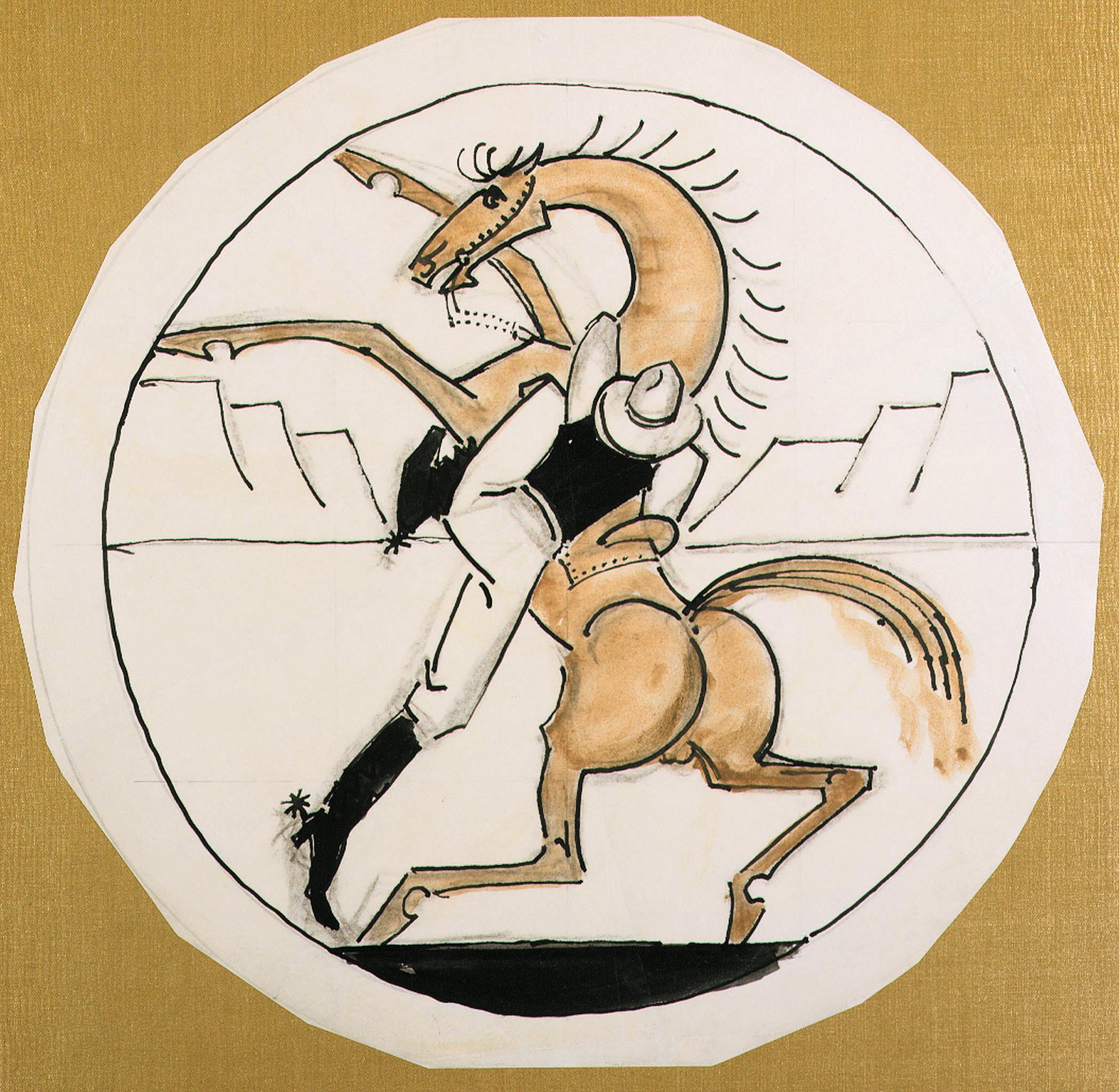
Hungarian-born Hunt Diederich’s fusion of German and American Western cultures is often discussed, yet that reading is too limited for Diederich’s cosmopolitan upbringing. His mother Eleanor was the second child of the Boston artist William Morris Hunt (1829-1879). The young Diederich took advantage of being a part of an artistic family. By 1910 when Diederich made his Paris debut, he had attended Swiss boarding school and Boston’s prestigious Milton Academy, trained with the preeminent French animalier Emmanuel Frémiet, worked as a cowboy in Wyoming, traveled through Spain with his good friend Paul Manship, and gained inspiration from textiles and ceramics he had seen in North Africa. Diederich’s choice of materials were as broad as his travels and with basic materials he elevated functional objects into works of art. Diederich was drawn to traditional folklore narratives, exploring in his silhouettes and fire screens subjects from Don Quixote, the Renaissance, Russian peasants, and African hunters. He was just as interested in new mythic-like symbols of masculinity and found the Spanish toreador as exotic as the Western cowboy or the New York boxer. Travels to Morocco and Mexico to study their rich ceramic traditions resulted in Diederich’s creation of pottery throughout his career; two examples are included in our exhibition.

Hunt Diederich’s formal art training included two years at the Pennsylvania Academy of the Fine Arts where he and fellow student Paul Manship became great friends. The two traveled through Spain in 1908, a creative and competitive summer Manship recalled with fondness. Perhaps this is why Diederich gave Manship the dueling warrior andirons included in our exhibition. The andirons appeared in a well-illustrated article on Diederich in New Country Life in 1917. The caption for the andirons reads: “The hinged tops may be bent down to keep dishes warm over the fire.” An example of how Diederich strove to bring beauty to functional objects, aligning himself with the Arts and Crafts tradition.

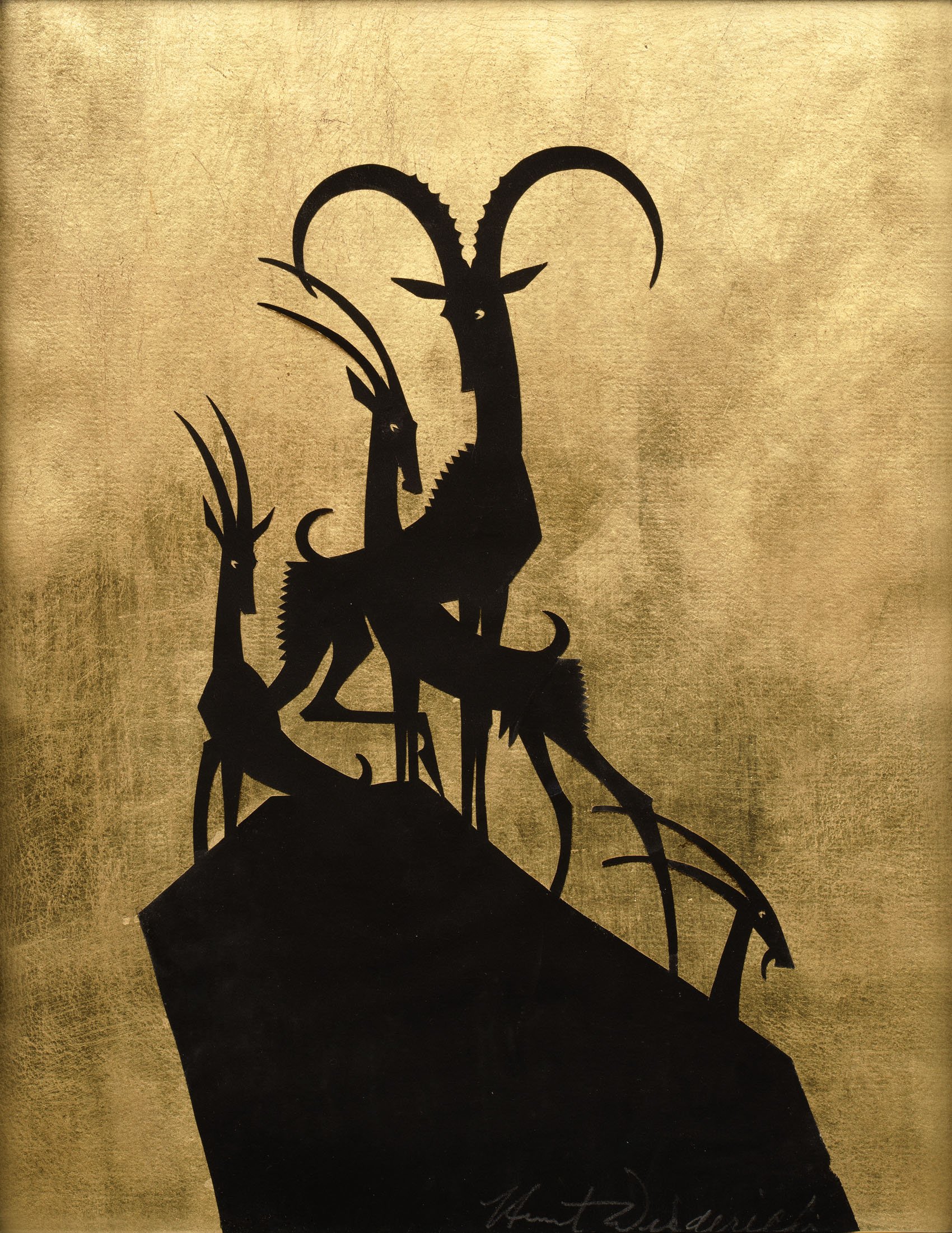
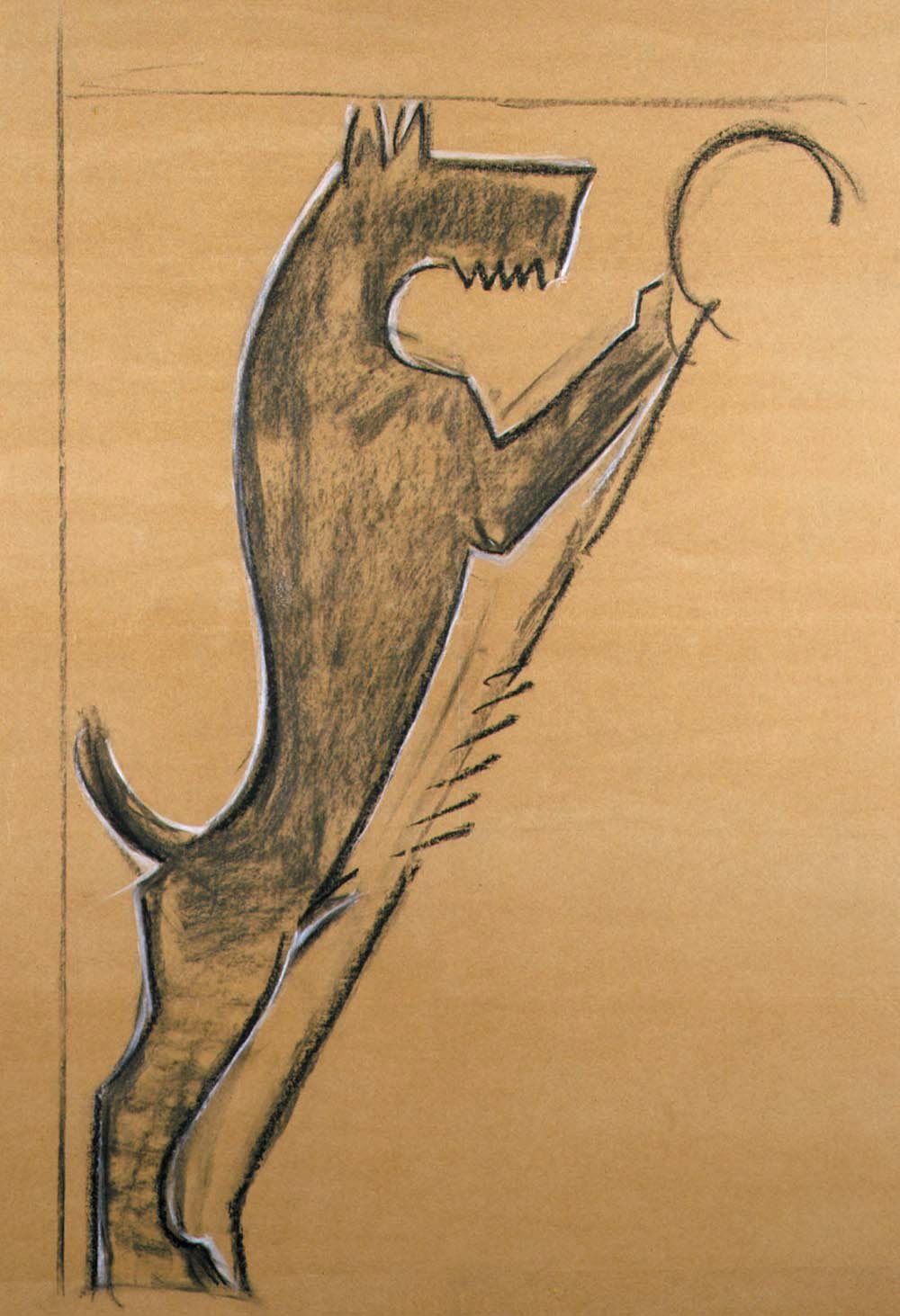
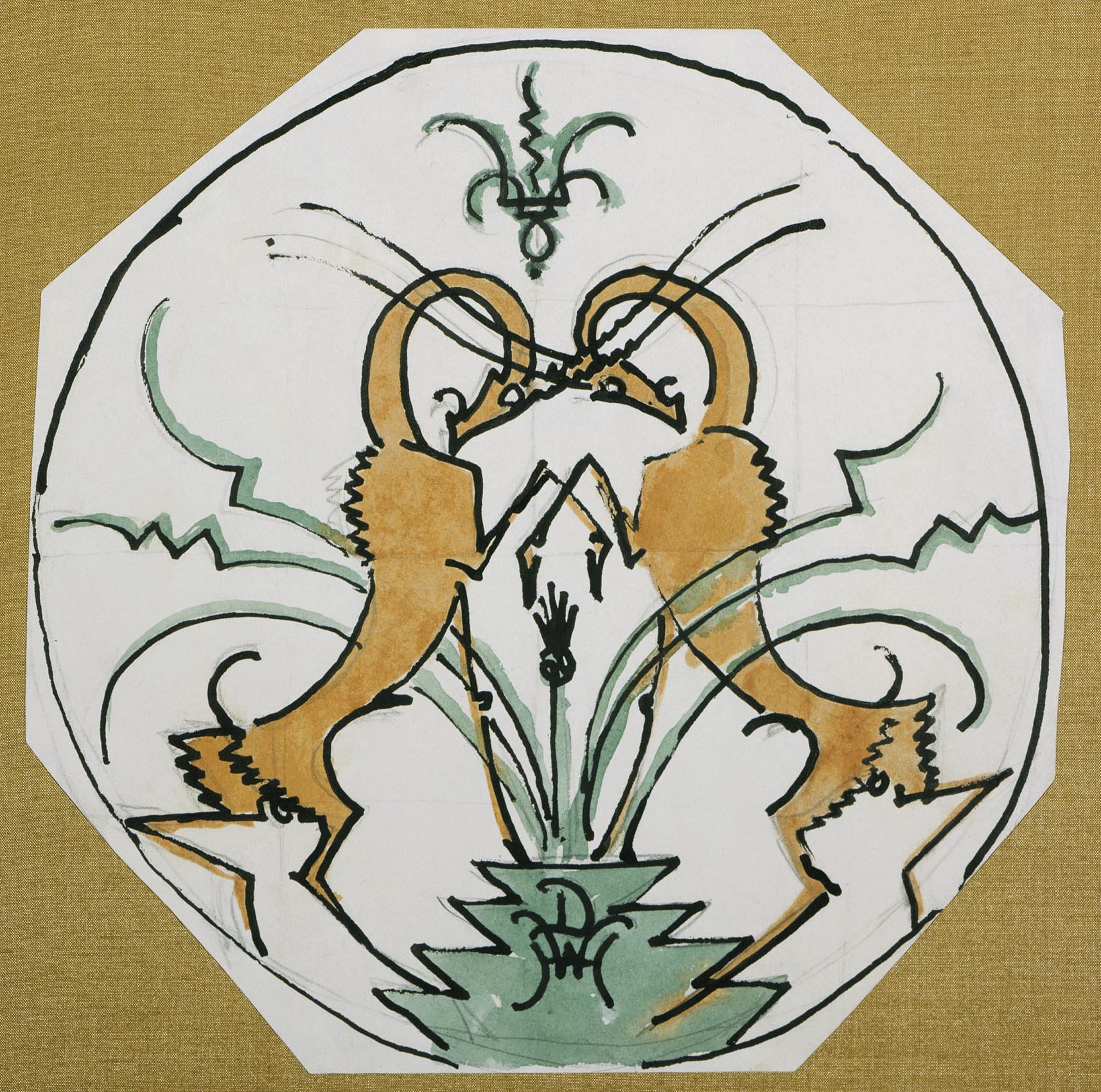
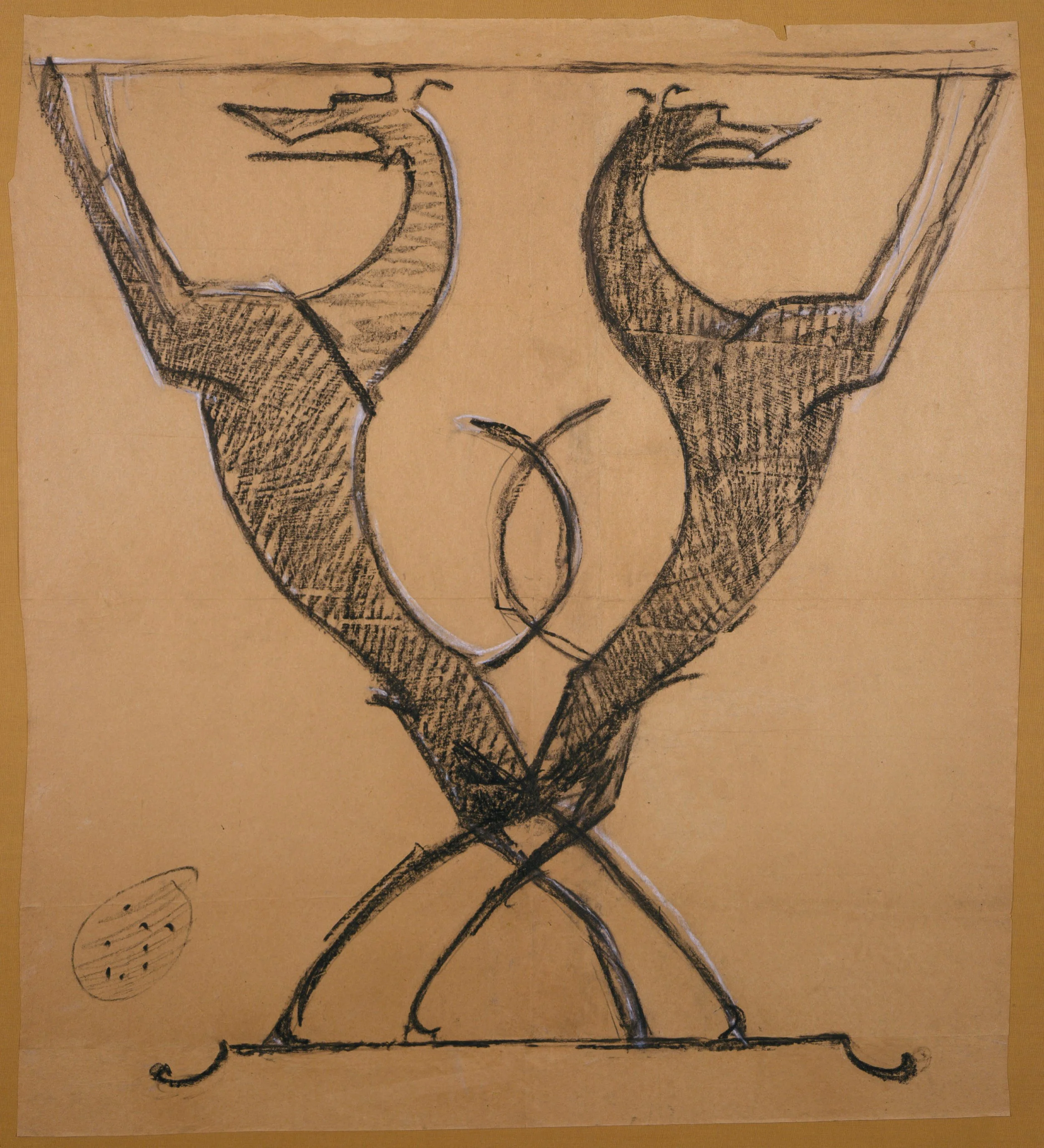
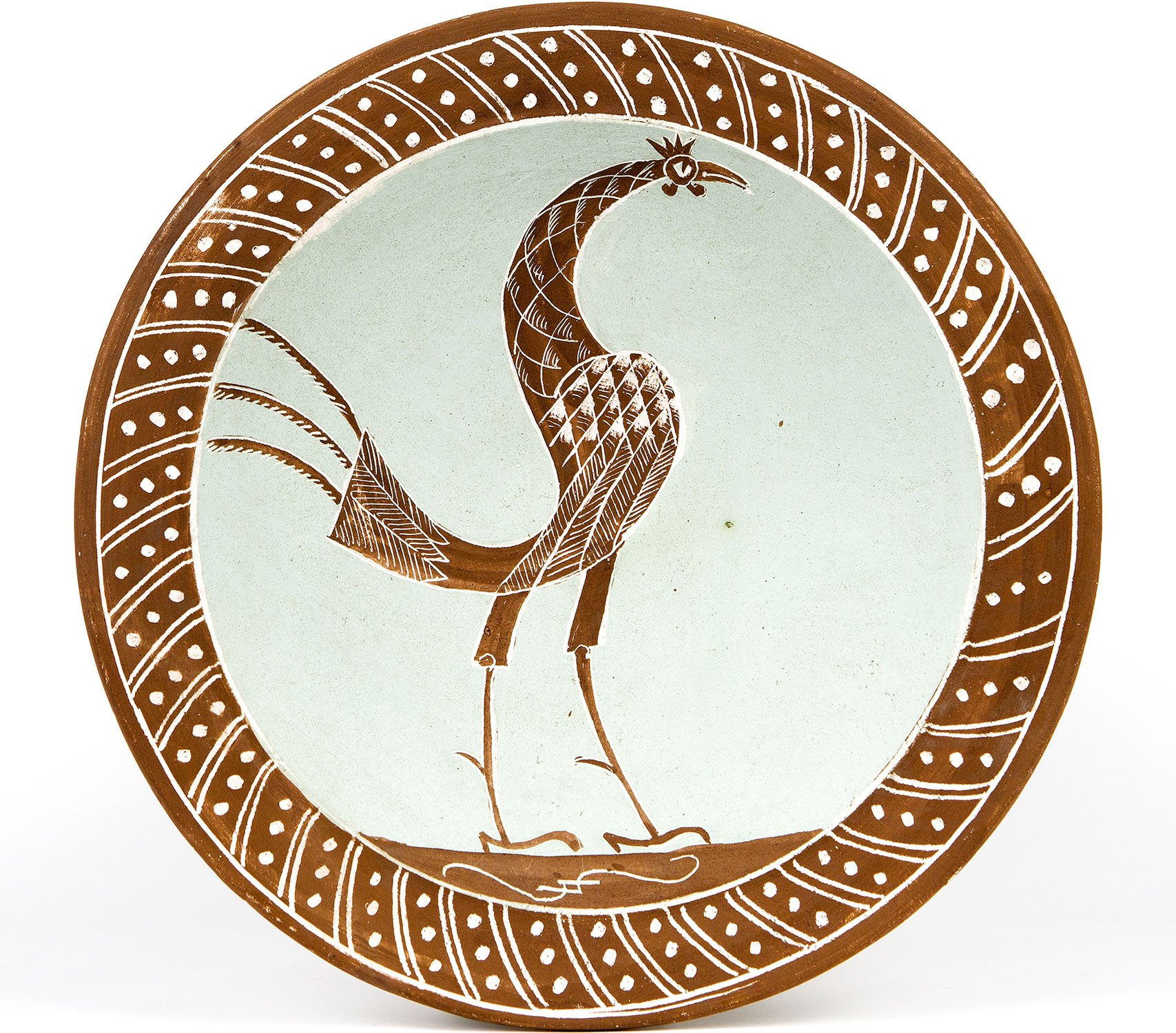
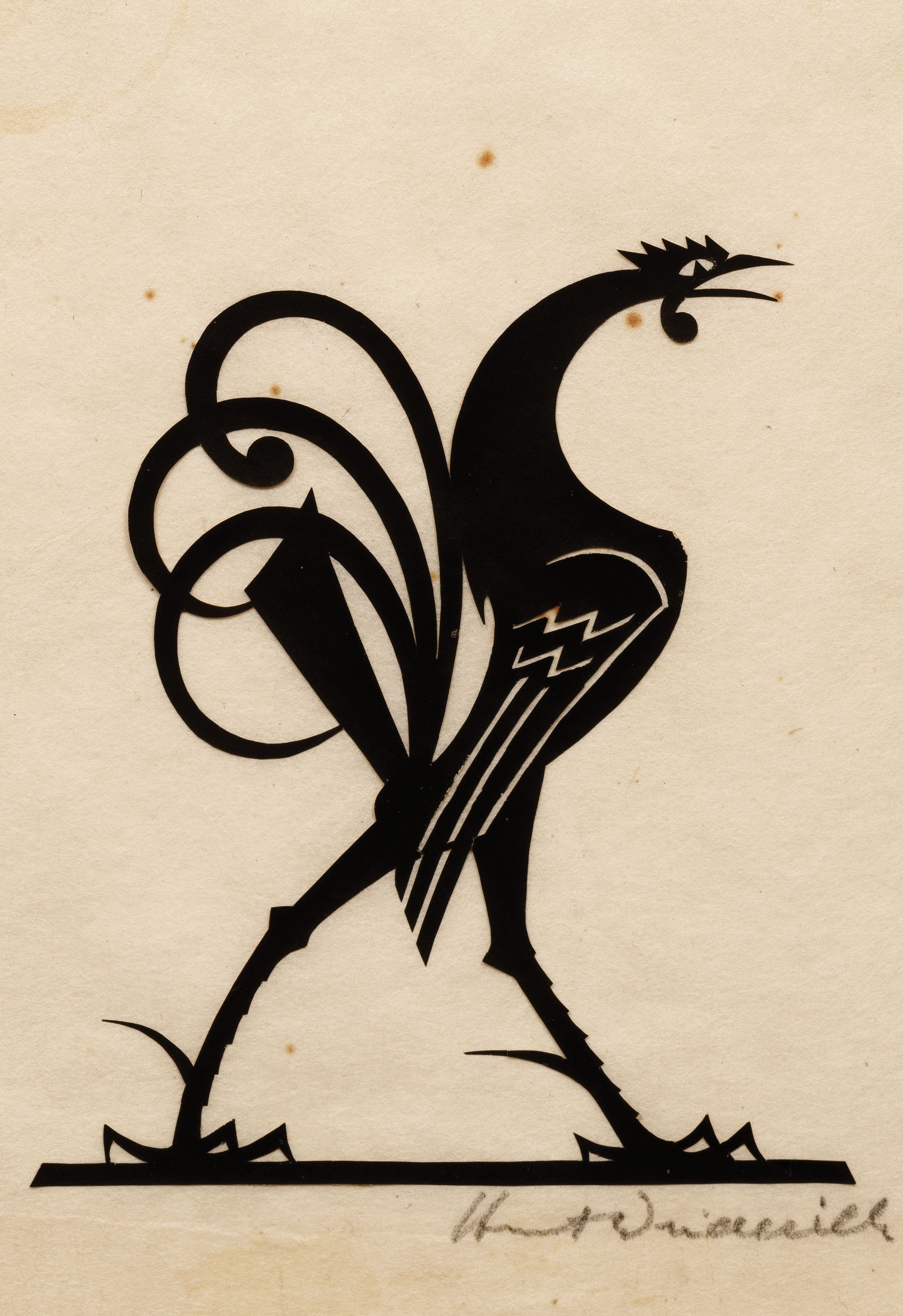
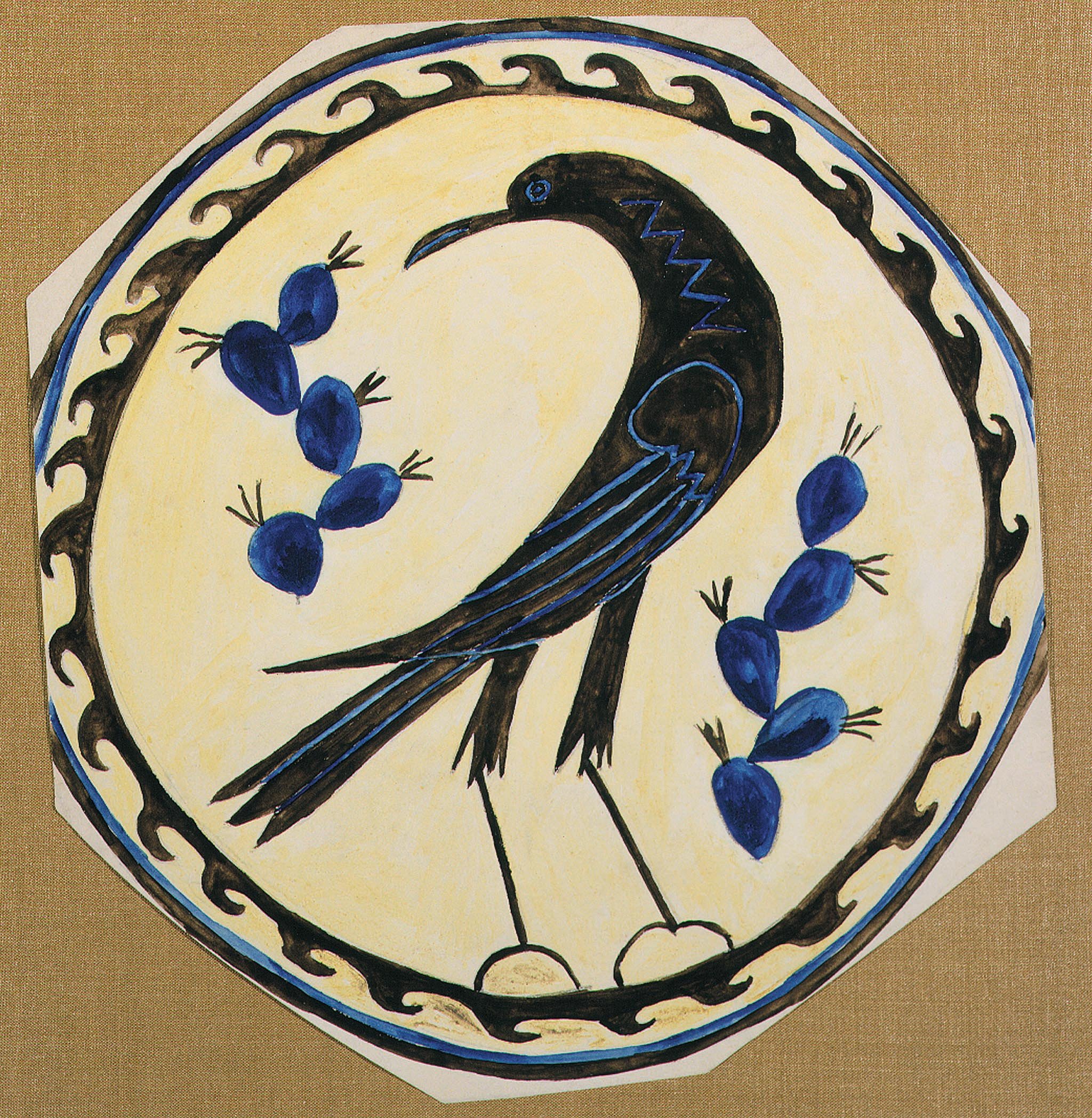
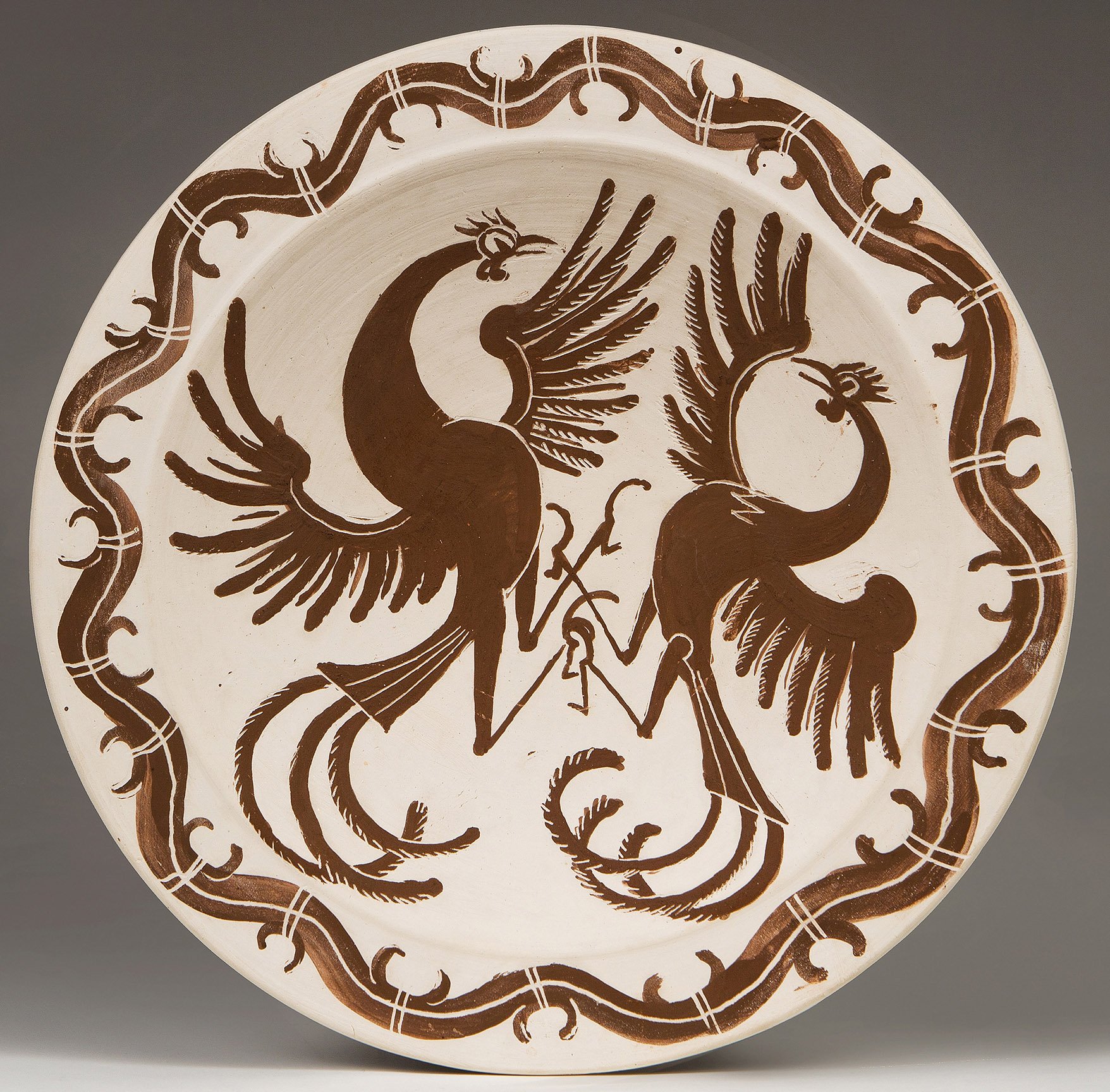
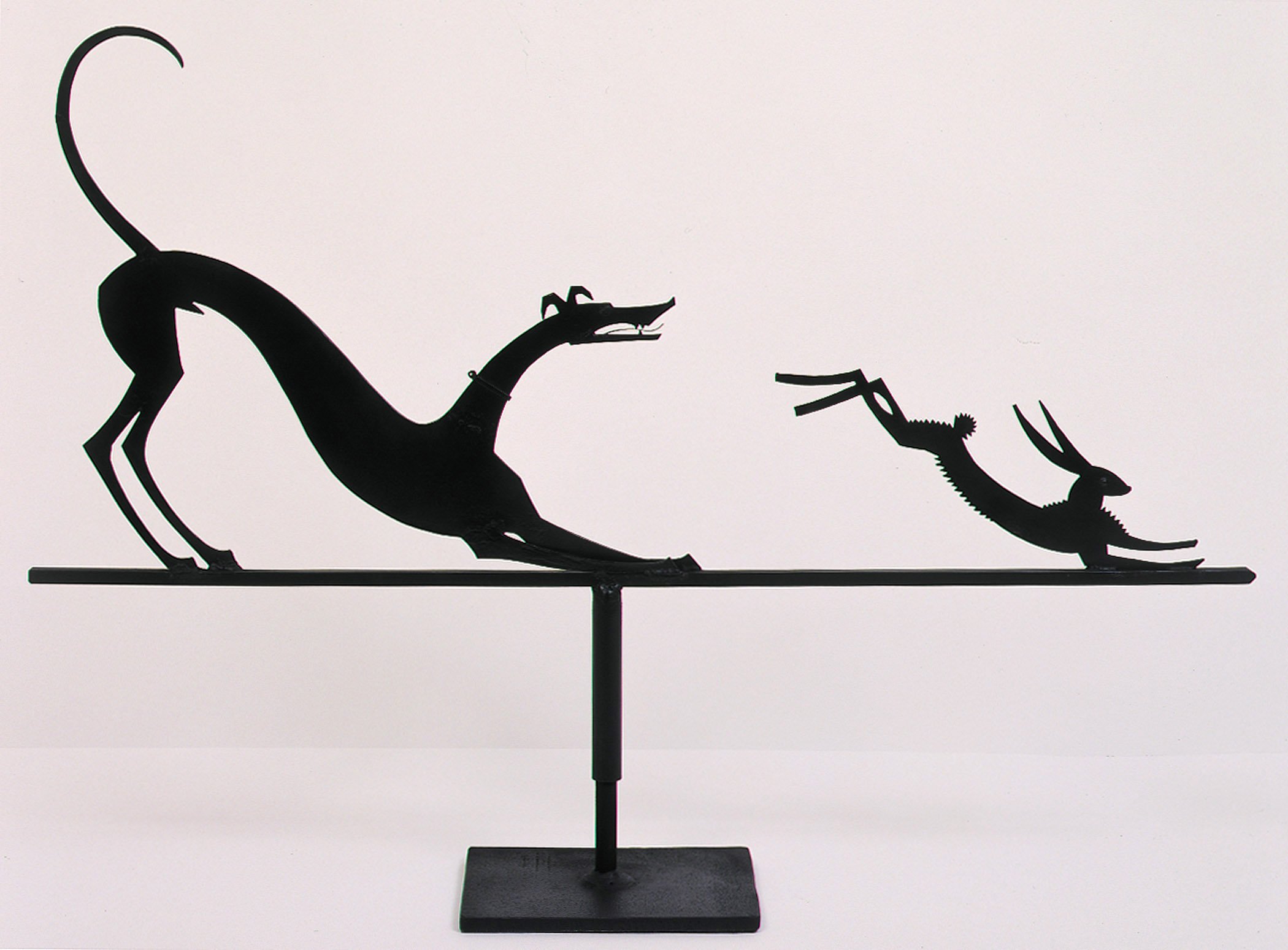
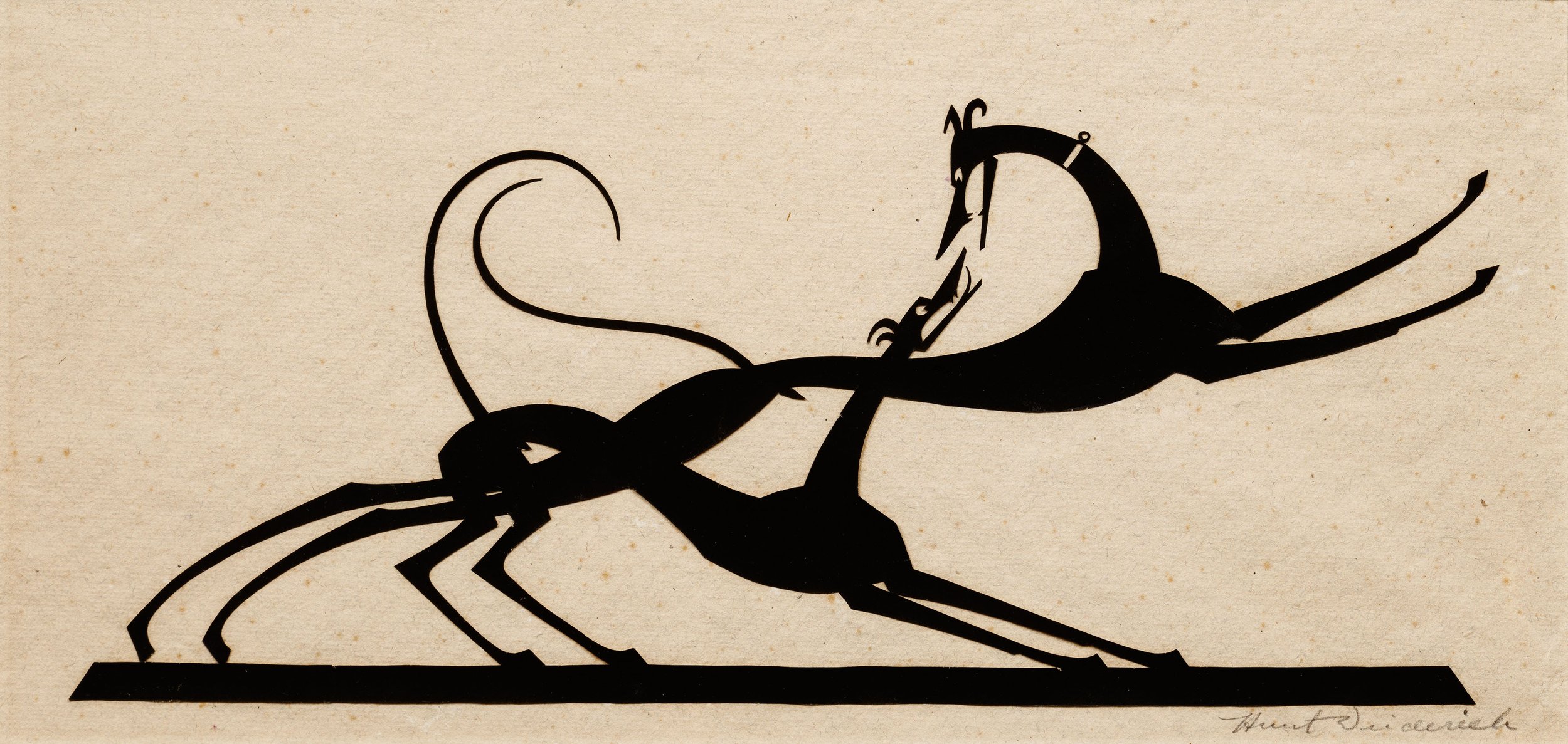
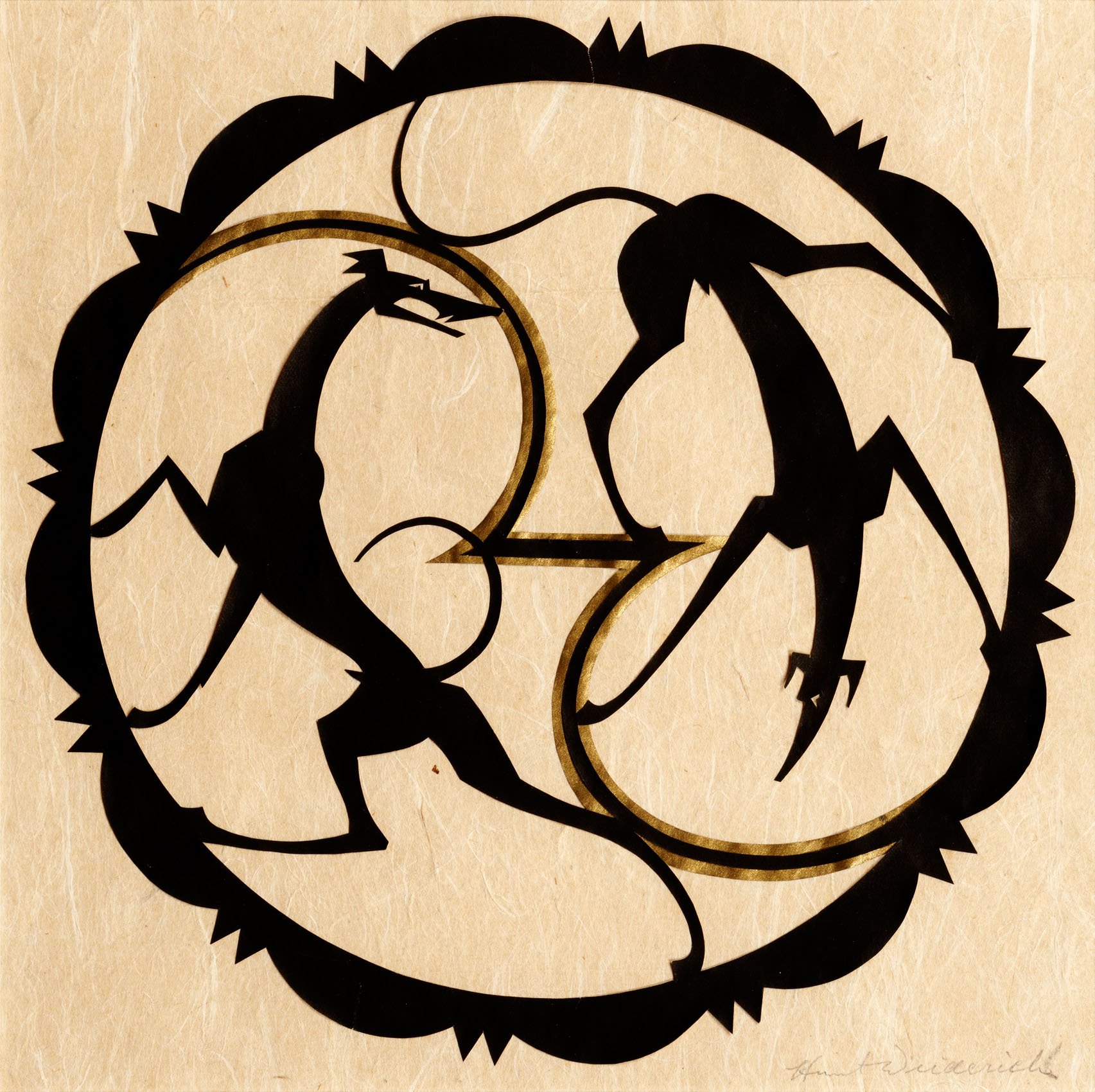
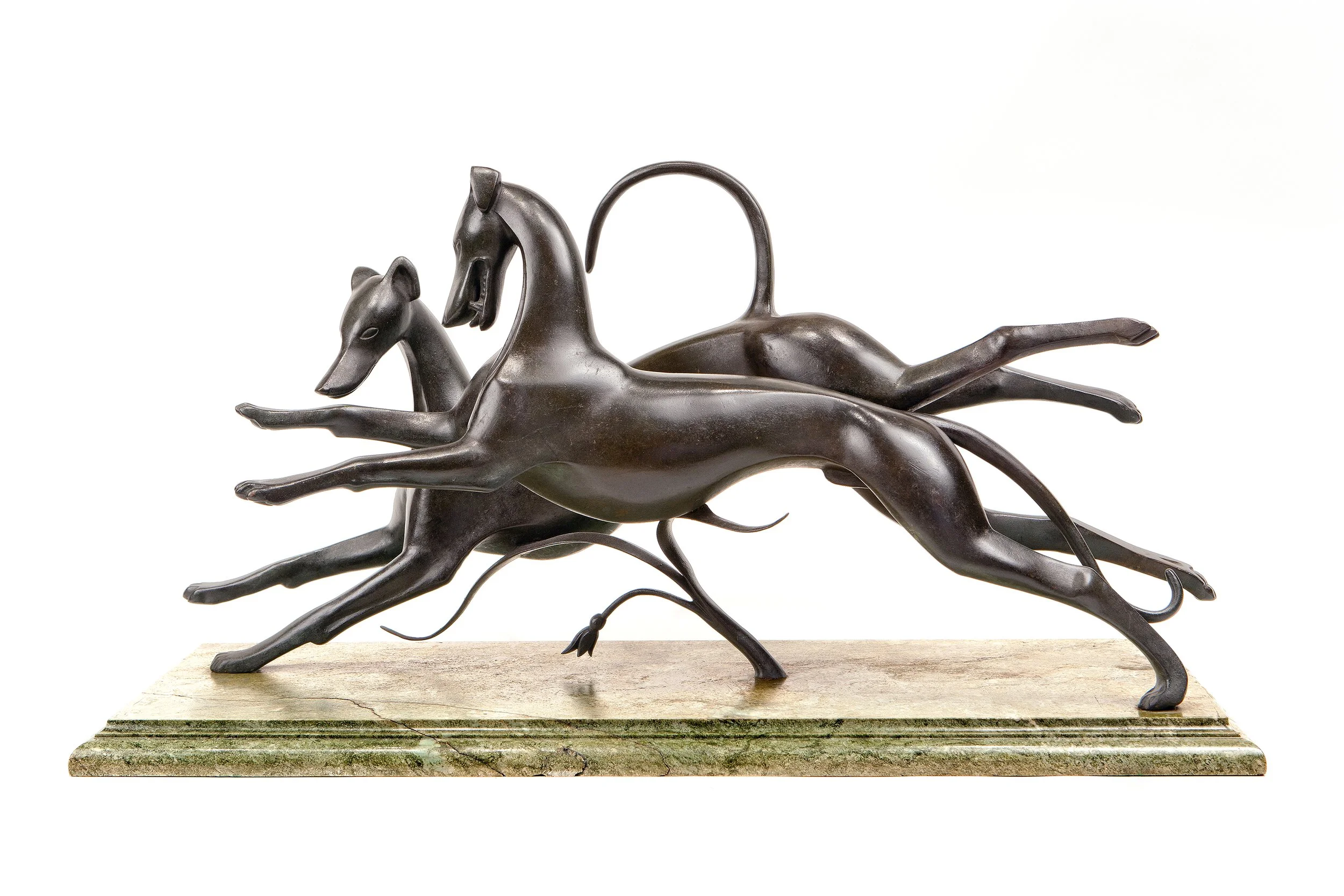
Hunt Diederich made his Paris debut at the Salon des Indépendants (the Spring Salon) in 1910 with two cast cement sculptures. His unusual materials were noted by the critic Clément Morro in Revue Moderne. In the current Picasso sculpture exhibition at MoMA, Picasso is given credit for his modernity in the 1930s for elevating the common building material when he cast his Boisgeloup plaster sculptures in cement. Diederich continued to innovate in the Teens with functional objects like brackets in cast iron and lively weathervanes in cut metal. Diederich developed his unique style through silhouettes, a practice he credited to childhood diversions in the German and Swiss tradition. Silhouettes provided a way for Hunt Diederich to focus on movement rather than mass to depict the energy of the animals he loved. Diederich’s mature style elongated forms into an Art Deco aesthetic with crisp lines that translated his silhouette forms into metal weathervanes, chandeliers, and most importantly for fire screens. In our exhibition one can see the fluidity of Diederich’s style between media with Two Greyhounds in the Round, a black paper silhouette accented with a gold outline, and Horse and Hare Trivet with similarly intertwined forms cut out of metal. The shape of the silhouette Strutting Rooster is also seen in Fighting Cocks Charger created at Diederich’s pottery at the Woodstock Arts and Crafts colony Byrdcliffe in 1929.

Diederich was drawn to folk culture and the elemental desire of humans across the ages to enrich their lives with beauty. For this reason, the best of Diederich’s work has a modern simplicity and energy that engages us today.

[Top]


Modernism 1913-1950 | Realism of the 1930s and 1940s | Abstraction of the 1930s and 1940s | Post-War | Selected Biographies

SALLY MICHEL: RHYTHMS OF LIGHT AND COLOR

All art by Sally Michel: Ⓒ 2015 The Milton Avery Trust / Artist Rights Society (ARS), New York


Essay by Tom Wolf, Professor of Art History, Bard College

Sally Michel lived her life dedicated to making art. She decided on that goal when a teenager, and pursued it with determination and dedication. This is what attracted Milton Avery, seventeen years her senior, when he met her in Gloucester in 1924, and what charmed him to pursue her to New York to woo and marry her. Together they formed an indissoluble unit until the time of his death in 1965. They lived together, had one daughter together, travelled together and painted together. Her vivacious personality complemented his taciturn manner. From extensive interviews with her it is clear that she was convinced that he was a great artist, and that she had no problems having him seen as the front man in their artistic relationship: “I wanted all the spotlight to be on Milton.” (1) She believed that his were the best paintings that could be made at the time, and hers were coextensive with his. They shared the same style of simplified forms and thinly brushed areas of expressive colors, approaching abstraction but always retaining an element of recognizable imagery rooted in the experiences of everyday life. (2)

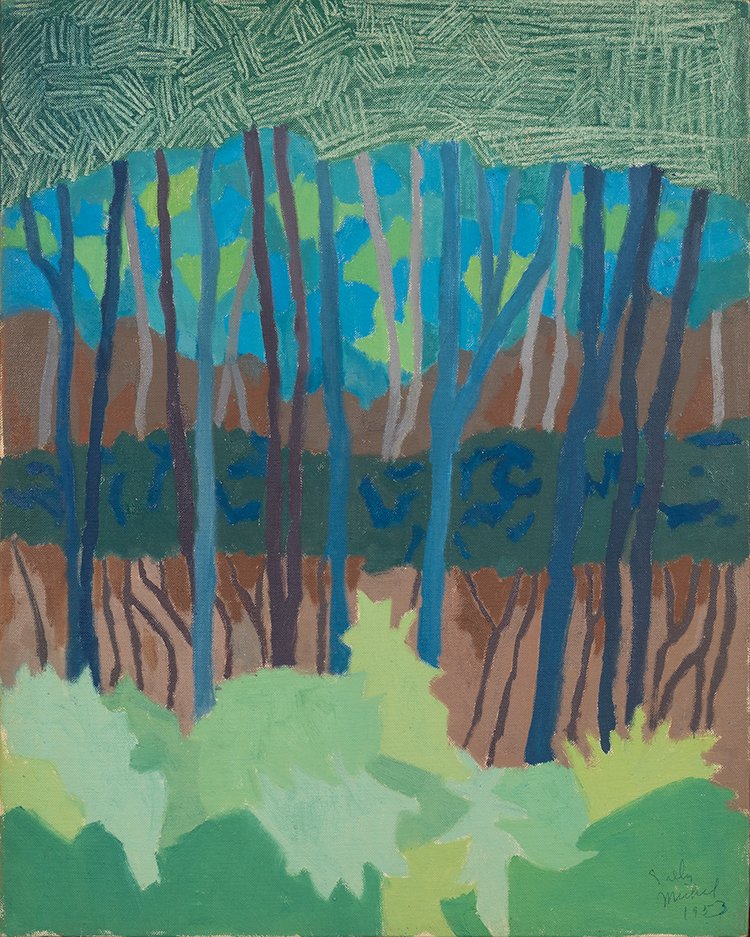
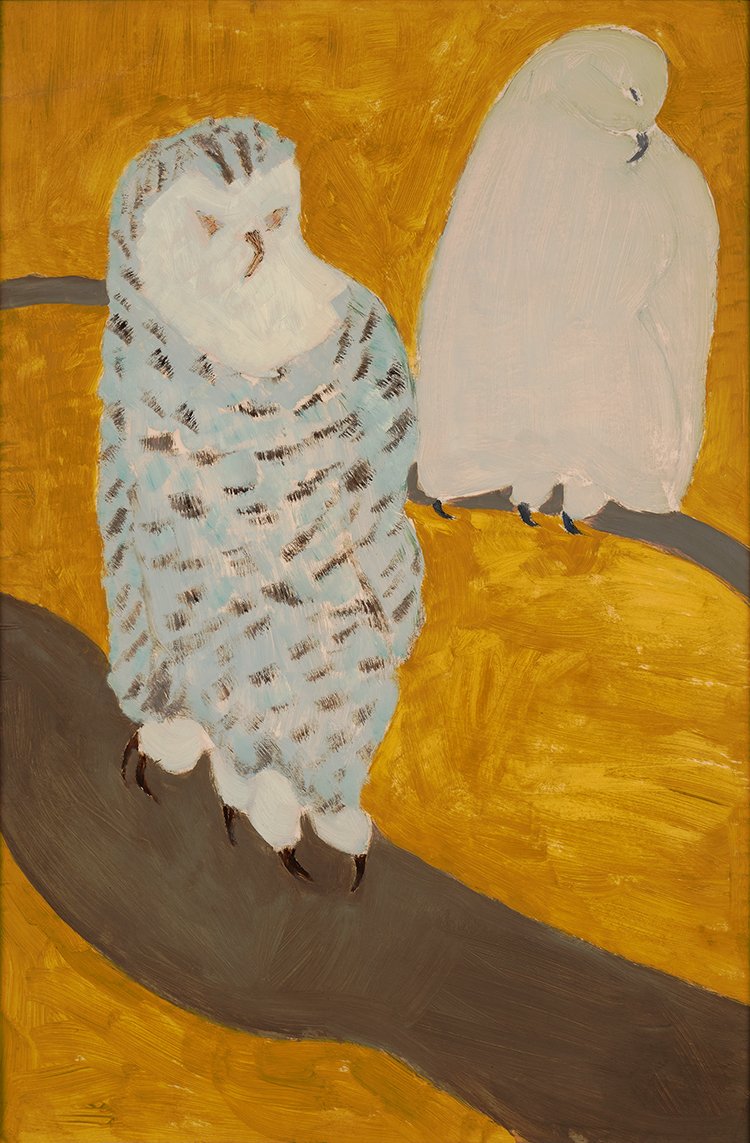
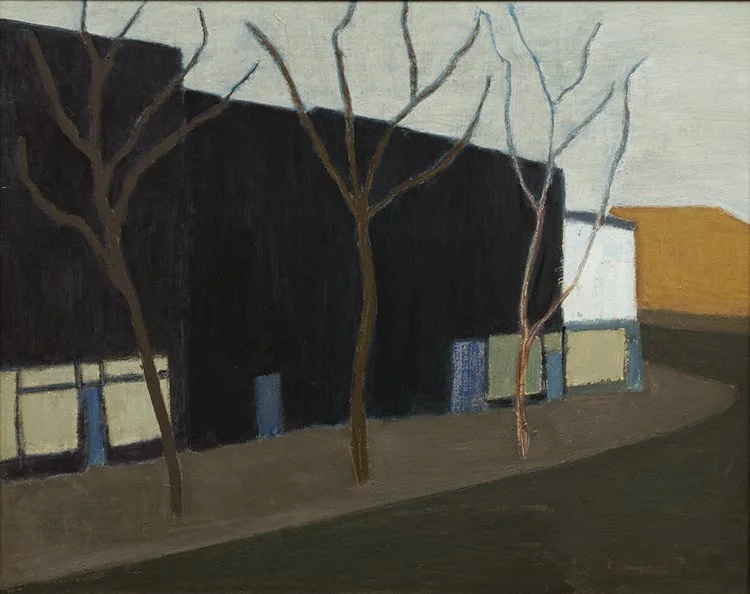
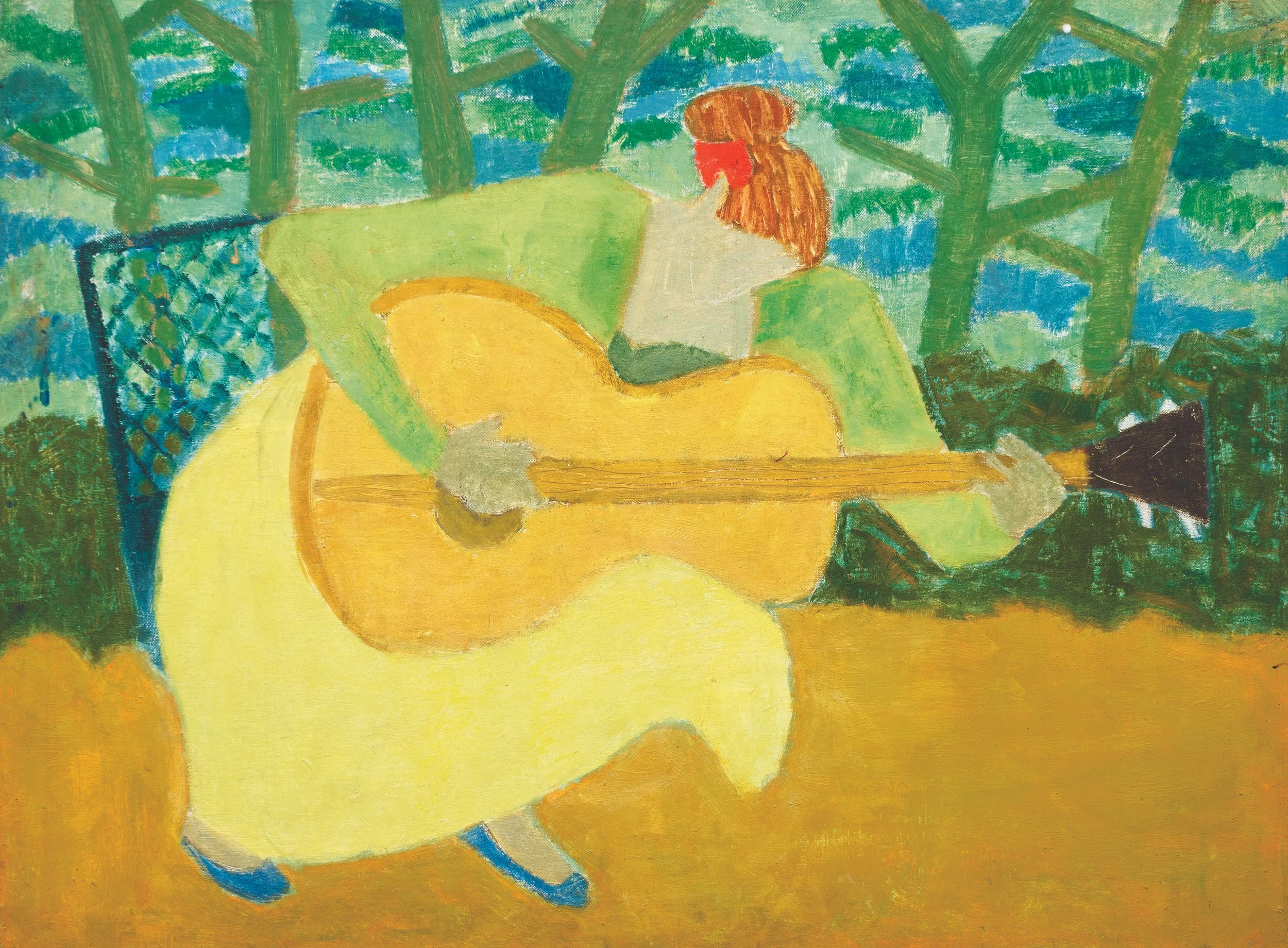
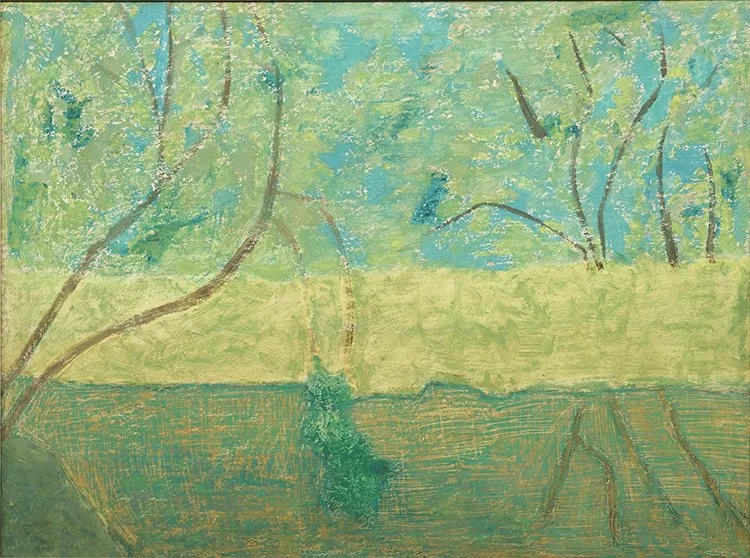
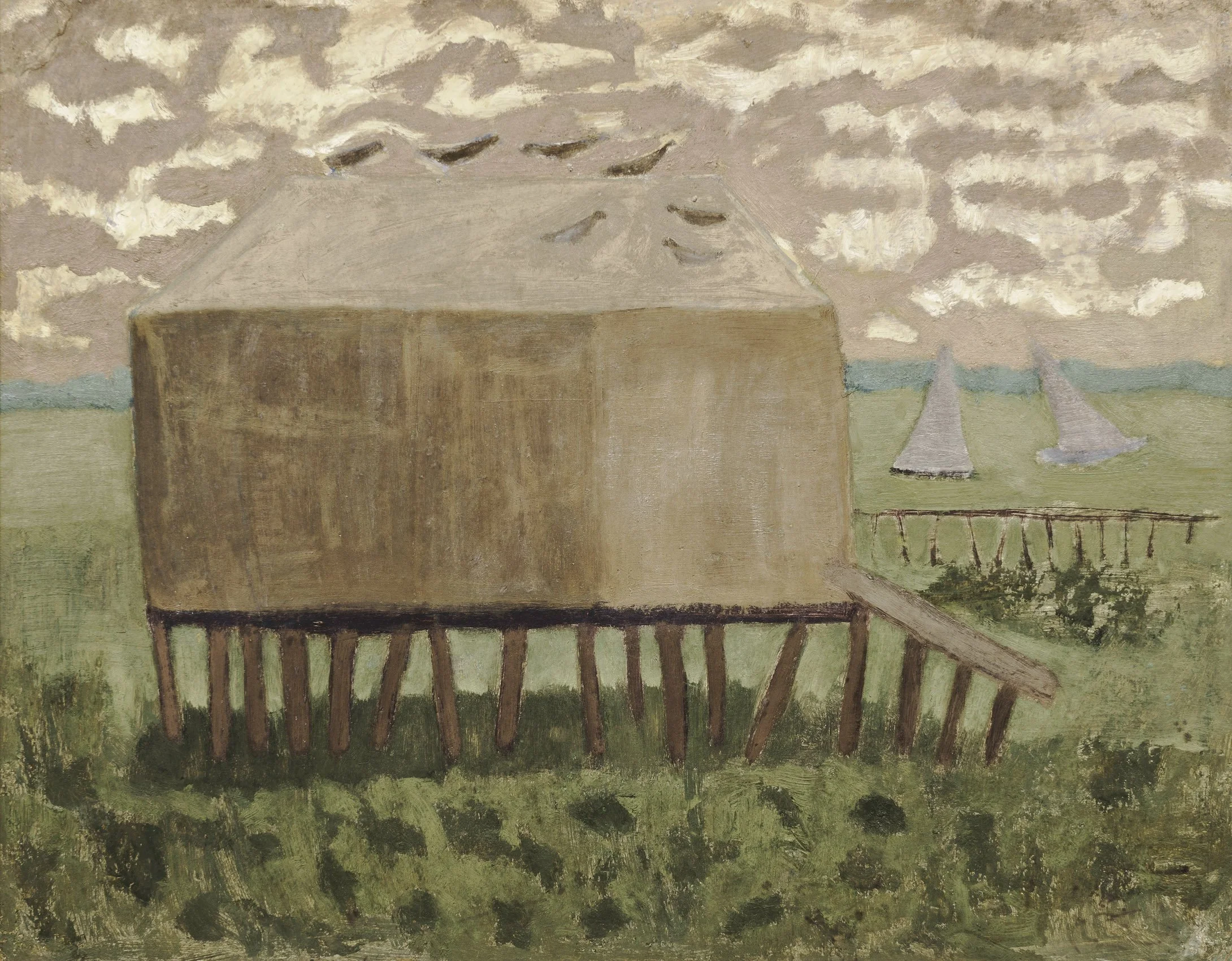
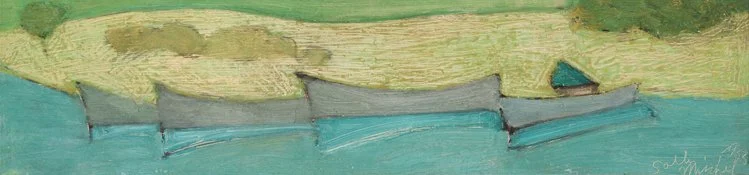
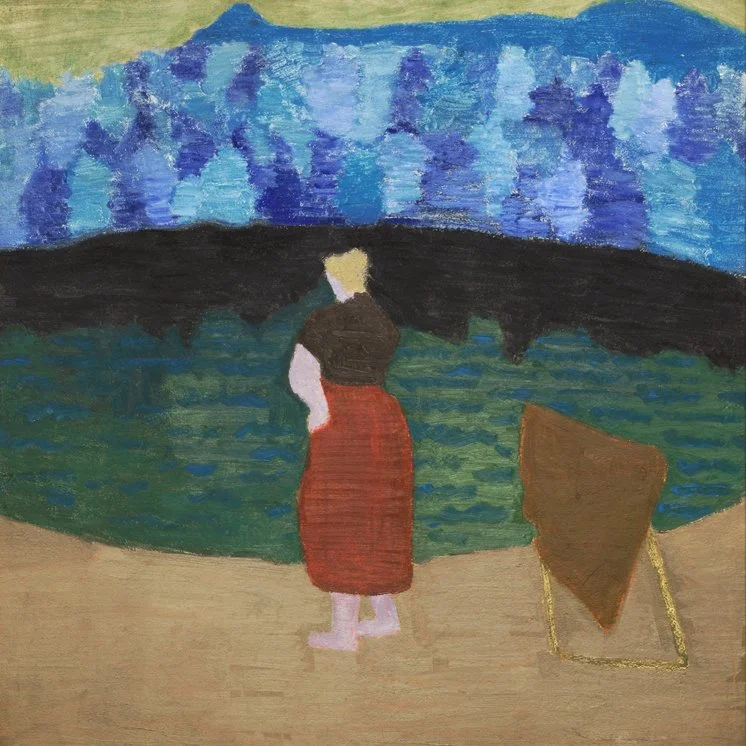
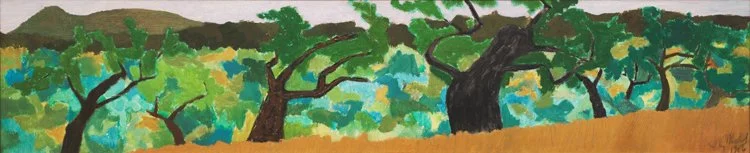
Within these parameters she achieved a wide range of expression, as can be seen in some of her landscape paintings in this exhibition. In a scene set in Provincetown where an elevated shed sits by the edge of the sea Michel rendered the objects as flat profiles, including the birds on the roof and the echoing sail boats in the water. They become vehicles for a rich play of muted colors, dull greens, tans, browns, subtly ignited by a thin band of blue water. In contrast Spring Forest erupts with bright color as Michel put pale purple bushes in dialogue with yellows and electric blue foliage. In Dense Forest with its blue tree trunks and orange and red earth Michel pushed her arbitrary, intuitive color to extremes that approach Expressionism. The hotly hued scene is divided into a few frontal planes, similar to the three horizontal bands that comprise Spring Landscape and Wooded Shore. The frontal planes of loosely brushed, luminous color remind us that in these years the Averys were close friends with the up-and-coming Abstract Expressionist painters, Mark Rothko and Adolph Gottlieb. The tripartite structure of Wooded Shore, with its horizontal planes of pale green, blue and yellow tied together by upright meandering lines that represent tree trunks, recalls Rothko’s mythic watercolors from the mid 1940s. Similarly in Birds the combination of the slender band representing the water at the bottom and the vast, bird-filled sky, resembles some of Gottlieb’s pre-Burst abstracted landscapes. But Michel always retained a reference to recognizable nature, which she sketched from almost daily. The figure in Woman by the Lake stands in for the artist, quietly contemplating the beauty of nature that surrounds her. Her pale lavender arm resting at her side is both a complicated abstract shape and a form that clearly expresses the anatomy of the arm and its function. This is one small example of the skill in drawing that inspired Michel’s passion for art when she was just a young child, and that was a central part of her practice as an adult artist. Her Guitar Player is rendered as a series of flattened, simplified forms, her skin an unnatural grey. But her pose, seated, leaning forward, head bowed towards her instrument, conveys her immersion in the music she is making, another example of Michel’s ability to convey real life experience with extremely distilled drawing.

For decades her husband had the freedom to spend his days painting because she was working as a commercial illustrator to support them. Thanks to her drawing talent she had a steady stream of work. She supported her family through her art, unlike many of the other artists’ wives, or for that matter, male artists in her circle. During the Depression when Avery was on the government’s WPA aid to artists program he would get $35 for a painting, which was about what she was making per hour for her commercial work. (3) Early on in her marriage to Avery she had jobs illustrating for Macy’s department store, the magazine Progressive Grocer, a trade publication founded in the 1920s that is still in business, and the Cannon Towel Company, among other clients. Her large, lively Cannon Towel poster, with its bright flat colors and assertive words, bridges the gap between the posters of Toulouse-Lautrec and Pop Art.

Her most consistent employment was illustrating the “Parent and Child” column that appeared weekly in the New York Times, a job she held for most of two decades, from around 1940 to 1960. When she retired from this job due to Avery’s failing health, the Times discontinued the column. (4) Michel earned the respect of her fellow artists by having a steady income that was a product of her artistic skills. As she said, “it’s possible to be a commercial artist and yet have a fine arts attitude.” (5) Working in the world of commercial art to support her fine art practice allied her with other American women artists of the period, like Peggy Bacon, Esphyr Slobodkina, Mabel Dwight, and Michel’s good friend, Doris Lee.

Michel’s “Parent and Child” drawings reveal her talent for communicating narratives visually, a skill shunned by the progressive artists who were moving towards pure abstraction. A few examples of her original ink drawings for the 1957 “Parent and Child” column have been preserved and they show her skill at capturing human experiences and conveying everyday dramas with a concise vocabulary. Made for reproduction in the newspaper, her images are exclusively black and white. Like her paintings, she built her images of juxtapositions of flat forms, with no shading and occasional perspectival passages, plus a sophisticated handling of patterns. These limited means relied on her closely observed insights into the behavior of children, and their interactions with adults.

Michel and Avery had one daughter, March, born in 1932, and raising her exposed Michel to the activities of children and parents in the first half of the 20th century. Beyond that she clearly was a perceptive observer of human experiences of all ages, as evidenced by her drawings. In one scene a sympathetic counselor meets with two concerned parents over a report card that displays grades of C, D, and F. (6) A symphony of patterns articulates the image and gives it visual punch, while the body language and concisely rendered facial expressions of the figures communicate the concern of the three protagonists. The father, as in all these illustrations, is a dapper version of Milton Avery, tall and thin, always with a moustache.

Another little known facet of Michel’s art is that she made many portraits of her artist husband, works on paper with a striking range of moods, executed in a broad variety of styles and media. There are probably several hundred of these, and they have rarely been seen. In some he is calm and peaceful, but others are almost Expressionist in their expressive color and distorted physiognomies. In 1949 Avery suffered a major heart attack and suffered from poor health for much of the rest of his life, and the intensity of these works seems to express his struggles as well as her empathy. She was both his caretaker and his companion, and true to Avery/Michel practice the subjects of her art came directly from their shared everyday lives.

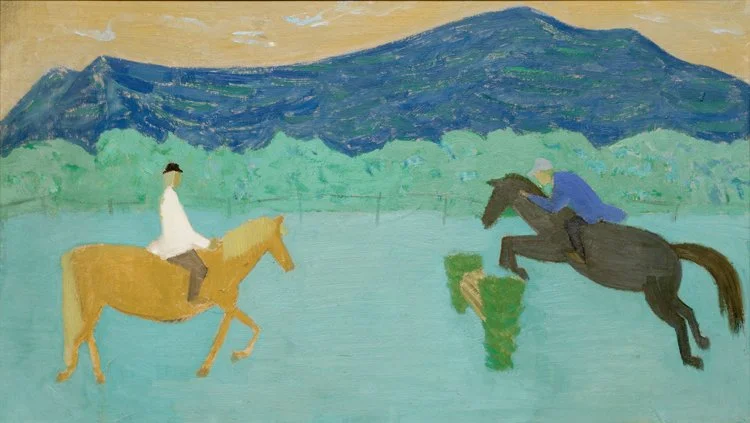
In Horse Jumping from around 1955 Michel created a luminous landscape where two horses with riders face each other in profile, the one on the right leaping over a hurdle (Fig. 14). The hurdle, the only perspectival element in the painting, is set against flat bands of land, mountains and sky, each rendered in poetically unrealistic color--witness the pale blues of the ground and the light orange sky. A comparable scene of a girl and a boy on galloping horses appears in a book she illustrated in her role as a commercial artist. (7) Comparing the two reveals the relationship between her art and her illustrations. The couple in the book is also rendered flat, with no modeling; the horses are also seen in profile. But the black outlines surrounding the images make them more graphic, less pure painting. Horse Jumping is typically thinly painted, but Michel also used the physical texture of the paint to expressive effect, with horizontal strokes of the brush visible in the blue ground and impasto patches of white paint for clouds. Compared to the illustration the painting features less anecdote, as broad areas of pure color replace story telling with visual delight. But Michel’s illustration does have narrative: the wide-eyed boy looks admiringly at the spirited girl and issues of gender are raised by the image, as they often were in Michel’s illustrations for the “Parent and Child” column.

The treatment of gender in her hundreds of illustrations raises intriguing questions, complicated by the fact that the drawings were made in dialogue with the texts of the articles. For example “Time Out for Hobbies” features four scenes; a boy plays with toy airplanes, another with a chemistry set, while a girl organizes shells, a scientific activity, and the second girl works printing photographs. But in the essay that accompanies the illustration in the Times it is a boy who practices photography. Michel changed the gender in her illustration as her girls pursue pre-professional activities that have nothing to do with being house wives. (8)

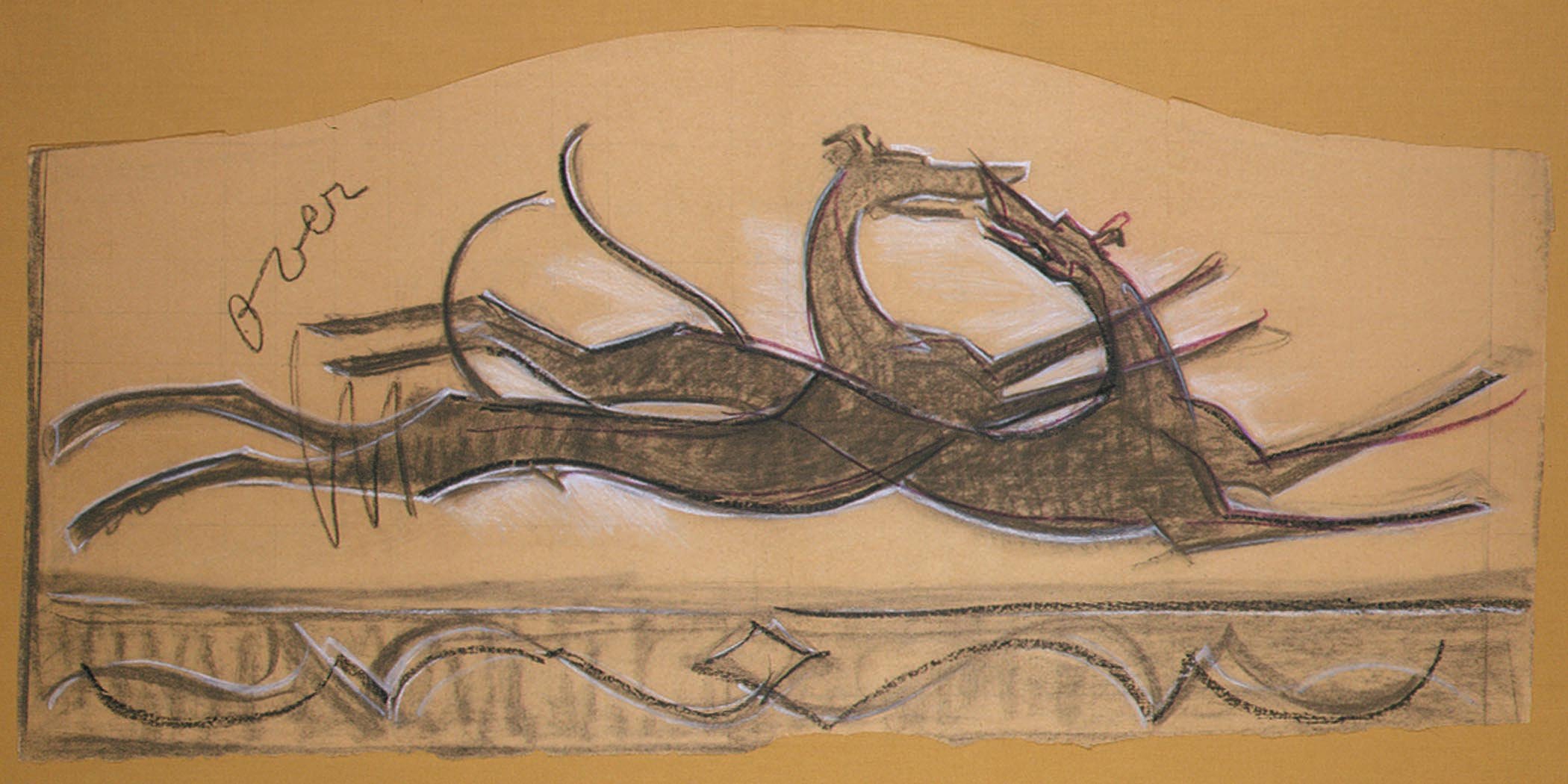
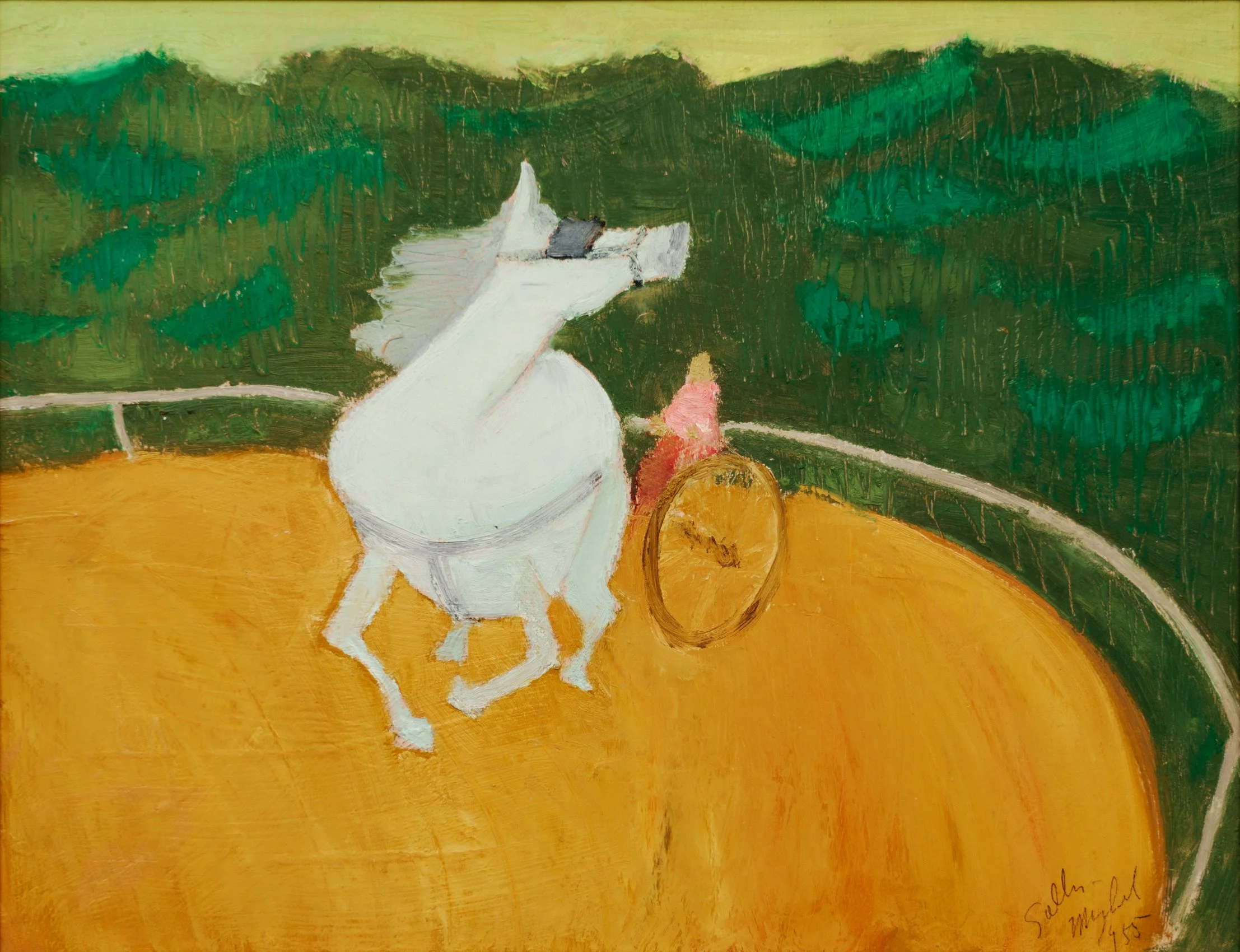
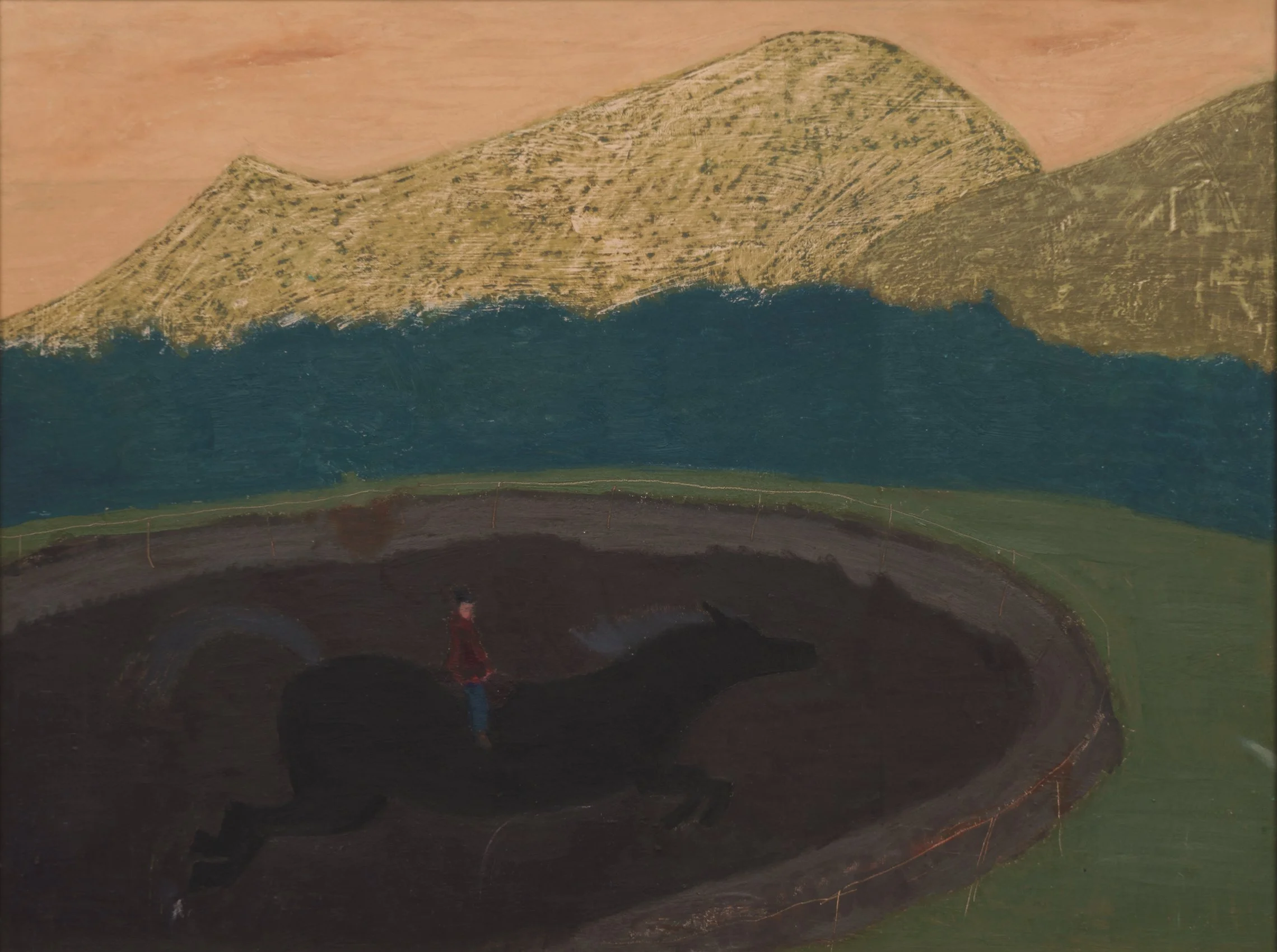
A horse dominates the 1955 painting, Harness Racing, against a typically simplified space, with a richly varied range of greens defining the land, hills and sky. In the center the galloping horse drags a small human figure whose pink shirt contributes a sharp note of contrasting color. The horse itself is a fine demonstration of Michel’s drawing talent: foreshortened, its head turns to its left while its body moves right, all encapsulated in one complex irregular shape, painted an unrealistic pale blue gray that indicates it is art, not illustration. Another horse, in At a Gallop, with its tiny rider perched on it as it races around a dark ring, recalls the haunting Death on a Pale Horse by Albert Pinkham Ryder, an artist greatly admired by the Averys.9 In Michel’s version the glowing colors of the landscape, surmounted by a pale orange sky, set off the dark environment of the racing horse and rider. The loneliness of the solitary figure evokes an existential mood uncharacteristic of the artist, but also hinted at in her Woman by the Lake with its lone woman isolated before nature, reminiscent of 19th century Romantic imagery. These two paintings stray from the sense of well-being and the harmony of everyday existence that characterize the Avery aesthetic, suggesting again that Sally Michel’s artistic achievement is deeper than presently recognized.

  1. I thank Deedee Wigmore for asking me to write this essay, Emily Lenz for her capable and encouraging assistance, Jeanette McDonald for her indispensable help with my research, Melissa De Medeiros for her gracious assistance, and March Avery Cavanaugh for her generosity with her Sally Michel materials, as well as Sean A. Cavanaugh. Informative interviews with Sally Michel Avery include: Louis Sheaffer for the Columbia Center for Oral History, December 19 and 26, 1978, January 2 and February 9, 1979; Tom Wolf for the Archives of American Art, February 19, 1982, and Nancy Accord for the Fresno Art Museum, December 2 and 3, 1989. The quote is from the Accord interview, p. 16.

  2. As Barbara Haskell described it, “The metamorphosis of representational elements into flat, interlocking shapes of homogenous color formed the basis of his mature work.” Milton Avery, Whitney Museum of American Art in association with Harper Row Publishers, New York, 1982, p. 49.

  3. Schaeffer interview, p. 9.

  4. Accord interview, p. 1.

  5. Accord interview, p. 2.

  6. The drawing appeared in “Counsel for the Troubled Family,” New York Times Magazine, June 30, 1957, p.167.

  7. The drawing appeared in Playtime with Music, lyrics and text by Marion Abeson, music and arrangements by Charity Bailey, illustrations by Sally Michel, Liveright Publishing Corporation, New York, 1952, np.

  8. “Time Out for Hobbies” New York Times, June 2, 1957, p. 225.

  9. Schaeffer interview, p. 9.

[ TOP ]

1960s HARD EDGE PAINTING

Sept 10 - Nov 10, 2015

Essay | Biographies | Some works may still be available, please contact the gallery at 212-581-1657.

LOS ANGELES

DC

NEW YORK


Essay by Emily Lenz

D. Wigmore Fine Art offers examples of 1960s Hard Edge Painting from Los Angeles, Washington DC, and New York in its fall exhibition. The Hard Edge style is defined as crisply edged geometric forms on a smooth surface devoid of heavily textured brush strokes. Each group in the exhibition achieves this through their own distinct technique: the Abstract Classicists of Los Angeles worked in oil; the Washington Color School stained acrylic into their unprimed canvases; and the New York Op artists built up their acrylic on primed canvases. Each group worked serially to varying degrees, finding that a predetermined compositional format allowed for deeper exploration of color, line, shape, and space. The treatment of color and form and the role of materials used resulted in different presentations of movement and space for each group. Yet upon entering the exhibition at D. Wigmore Fine Art, it is apparent that all the works share a binding geometric look- the Hard Edge style.

In our exhibition Los Angeles is represented by the four Abstract Classicists: John McLaughlin (1898-1976), Lorser Feitelson (1898-1978), Frederick Hammersley (1919-2009), and Karl Benjamin (1925-2012). Recognizing that their work shared formal color relationships and rhythmic patterning within a unified single plane, Peter Selz, chairman of the art department at Pomona College, offered the four independent artists a group exhibition at the college in the mid-1950s. The critic Jules Langsner got involved with the group as well and pushed for a museum venue instead. The result was Four Abstract Classicists, which opened at the San Francisco Museum of Art in 1959 before traveling to LACMA and the Institute of Contemporary Art in London—a bold announcement of an alternative to the dominant East Coast Abstract Expressionism. The Abstract Classicists worked in oil and often used masking tape to create crisp edges separating colors in a minimal arrangement of geometric forms. In the catalogue text for Four Abstract Classicists, Langsner noted the precedent for their reductive geometry established by the founders of geometric abstraction Kazimir Malevich (1879-1935) and Piet Mondrian (1872-1944).

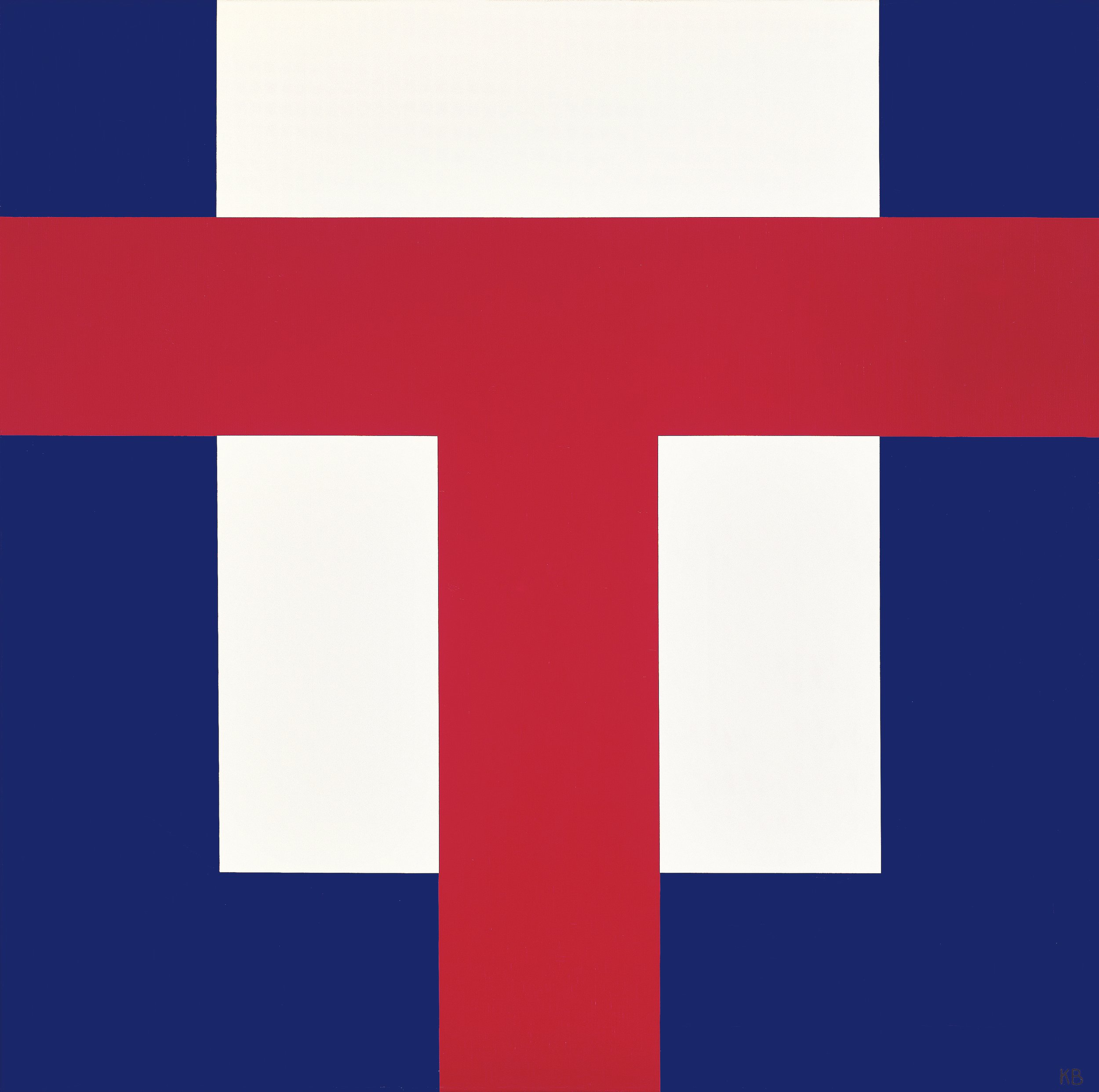
The Los Angeles artists emphasized a unified whole by creating paintings of centered, though not always symmetrical, composition of forms connected on a flat surface. The effect is a painting seen in its entirety rather than one element at a time. Limited movement is provided by color contrasts that create a tension between the shapes but not depth. Because the Abstract Classicists formed their style in the 1950s, the artists all paint in oil on primed canvas resulting in rich, luminous colors. John McLaughlin’s lifelong interest in Japanese culture brought an Eastern philosophy to his paintings, so the artist believed his minimal arrangements of rectangles in contrasting colors could stimulate contemplation in the viewer. McLaughlin arranged his shapes slightly asymmetrically on a central vertical axis to force the viewer to consider the composition as a whole as seen in #3, 1964. Inspired by Surrealism, Lorser Feitelson’s first abstractions created in the 1940s showed biomorphic shapes in a deep space which he called Magical Forms. He then eliminated pictorial depth for a field of color in the 1950s, calling the works Magical Space Forms to recognize the importance of the flattened space. One can see this development in Feitelson’s Untitled (July), 1968, in which curves of red and white bisect a field of blue to create movement, but not volume, as neither color can be interpreted as shadow. Inspired by jazz, both Hammersley and Benjamin created a strong sense of rhythm in the interlocking forms of their works in which color creates movement and form provides monumentality. This can be seen in Benjamin’s #40, 1965, in which a red T-shape is anchored by a purple U-shape. Equally vibrant, neither color nor shape recedes or projects, producing a unified flat composition. With all the Abstract Classicist paintings, the balanced geometric forms appear spare and refined, enriched by vivid colors of oil paint. The term Classic is well applied to the LA group for the simplicity, clarity, and balance of their compositions.

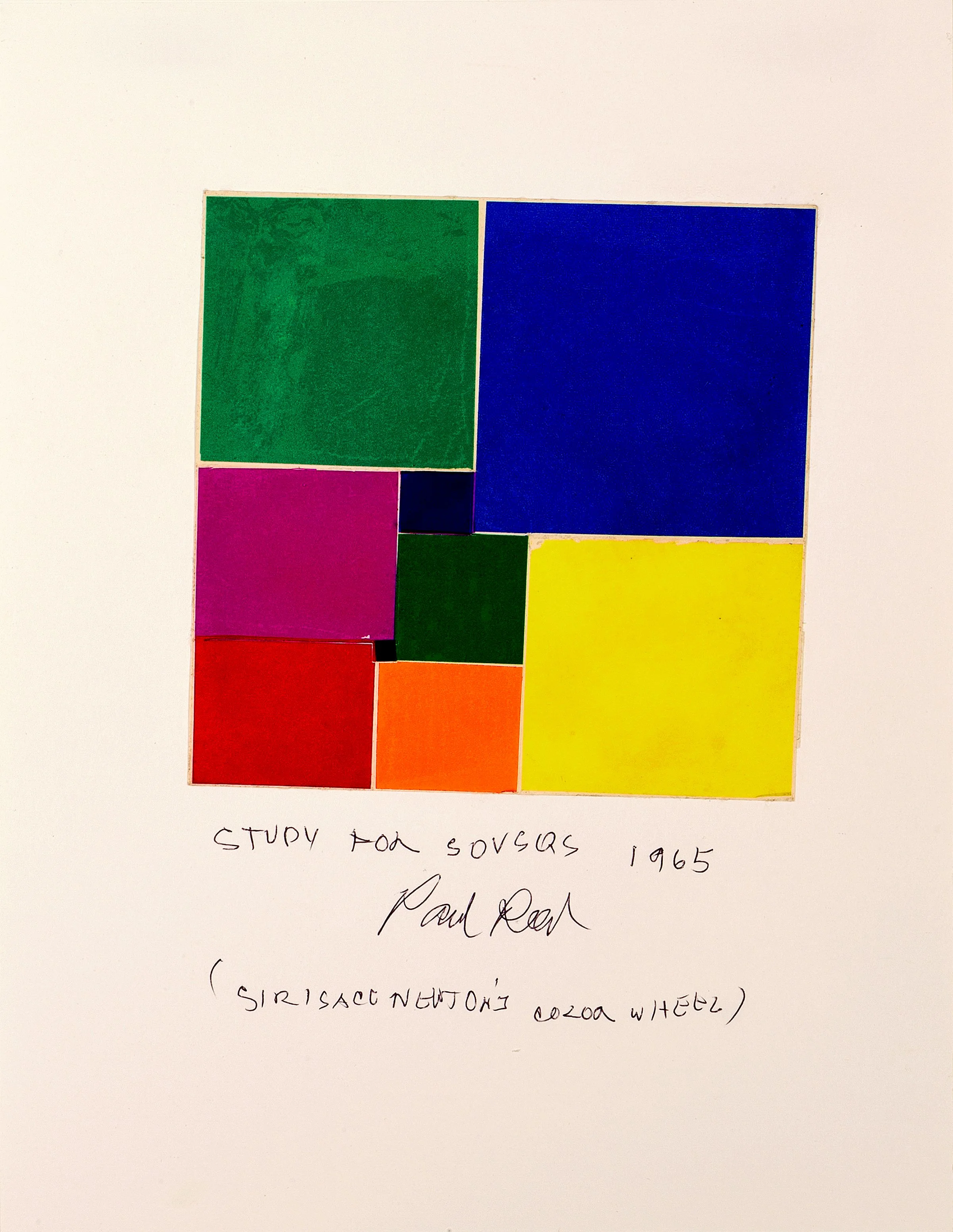
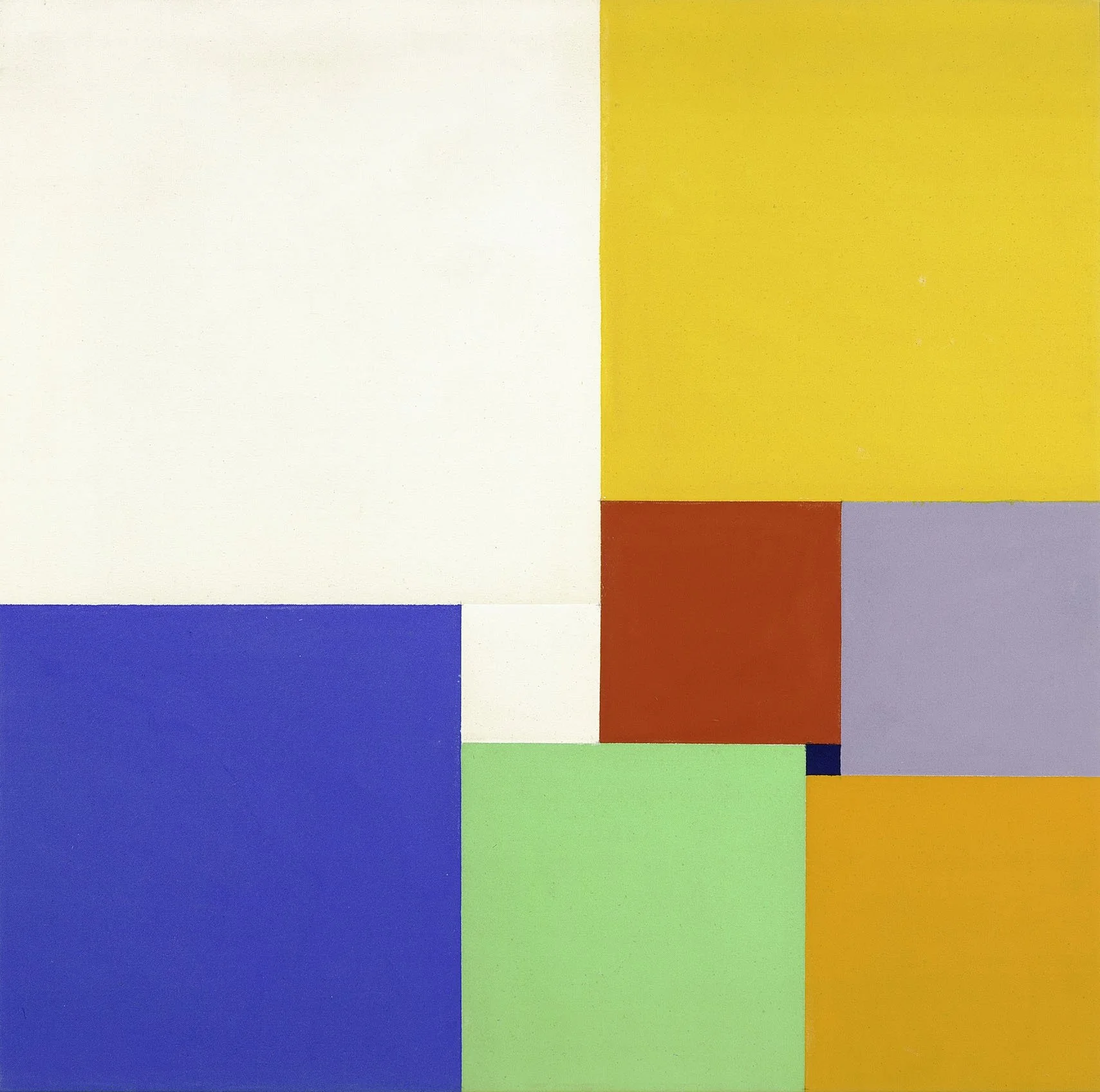
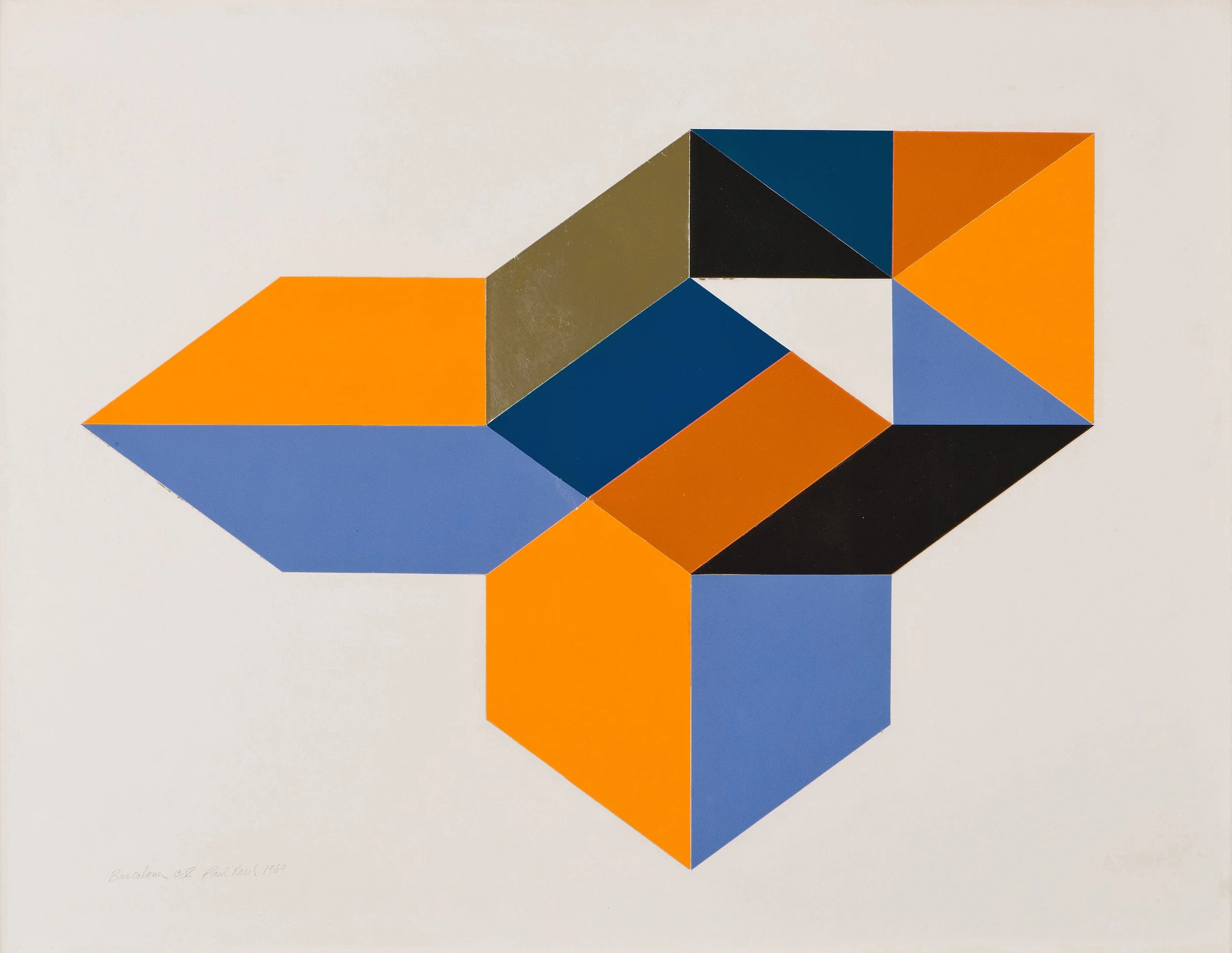
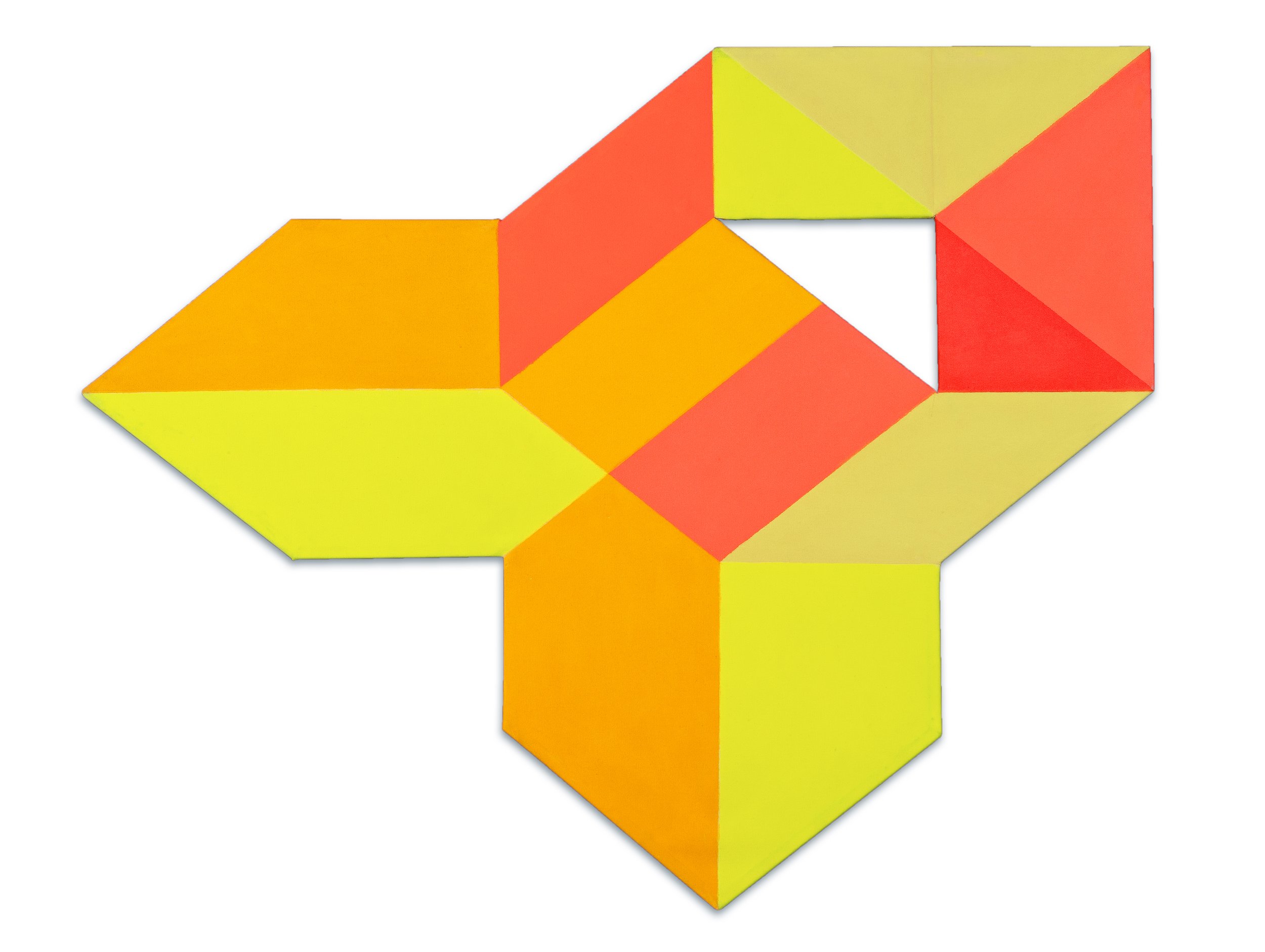
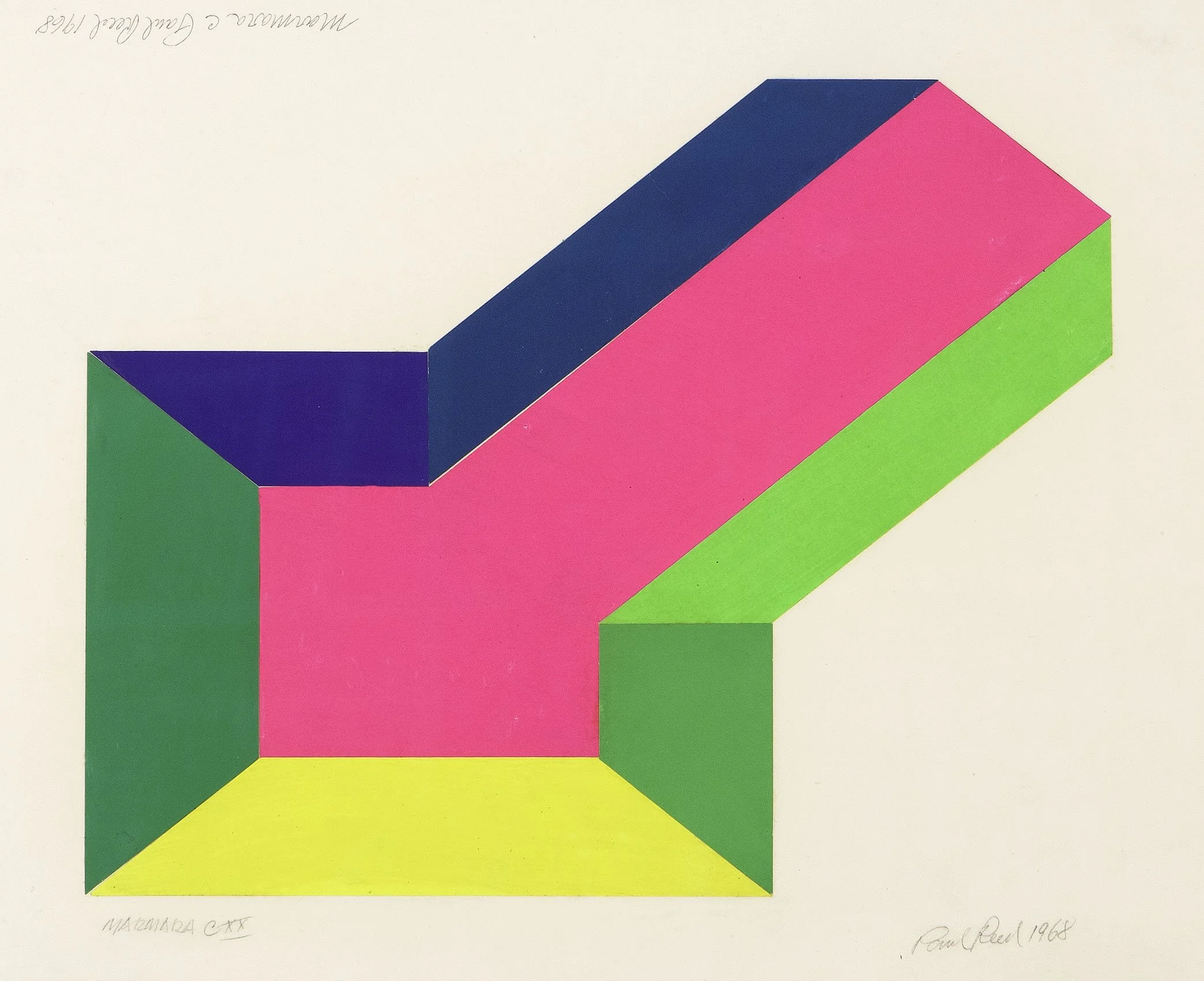
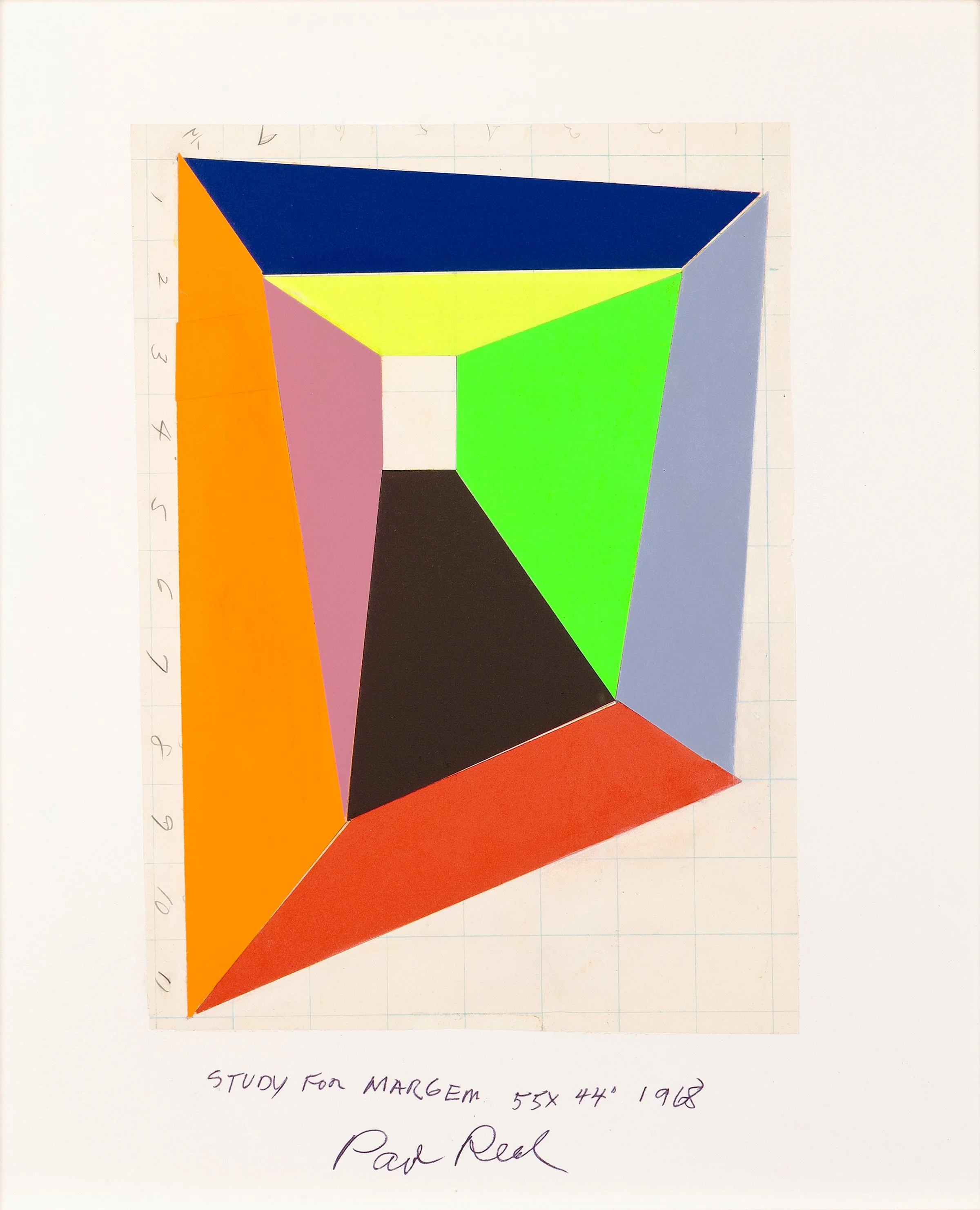
The Washington Color School has its origins in the mid-1950s but was formalized as a group of six painters in the 1965 exhibition Washington Color Painters at the Washington Gallery of Modern Art, curated by Gerald Nordland. The artists included were Morris Louis (1912-1962), Paul Reed (b.1919), Gene Davis (1920-1985), Kenneth Noland (1924-2010), Thomas Downing (1928-1985), and Howard Mehring (1931-1978). We selected Reed, Davis, and Downing for our exhibition because they were the most consistently geometric of the DC group throughout the 1960s. Staining acrylic paints into their canvases rather than painting onto primed canvas set the Washington Color School artists apart from their California and New York counterparts. Among the three groups in terms of seriality, the DC artists worked the most strictly within set geometric compositions to examine the function of color. The group had its start in the mid-1950s working loosely as they experimented with staining in Magna paint, but the artists came into its own through geometry. The group’s shift to the geometric in the late 1950s may be attributed to Kenneth Noland’s time at Black Mountain College in the late 1940s when he studied with Bauhaus teacher Josef Albers (1888-1976) and New York abstractionist Ilya Bolotowsky (1907-1981). The DC artists were closely associated: Noland taught at Catholic University where he gave Gene Davis his first exhibition in 1953 and had Downing and Mehring as students. Moving back from New York in 1950, Reed was introduced to the group through Davis, a high school friend. This close association resulted in a shared working method of self-imposed constraints to generate new structures and patterns.

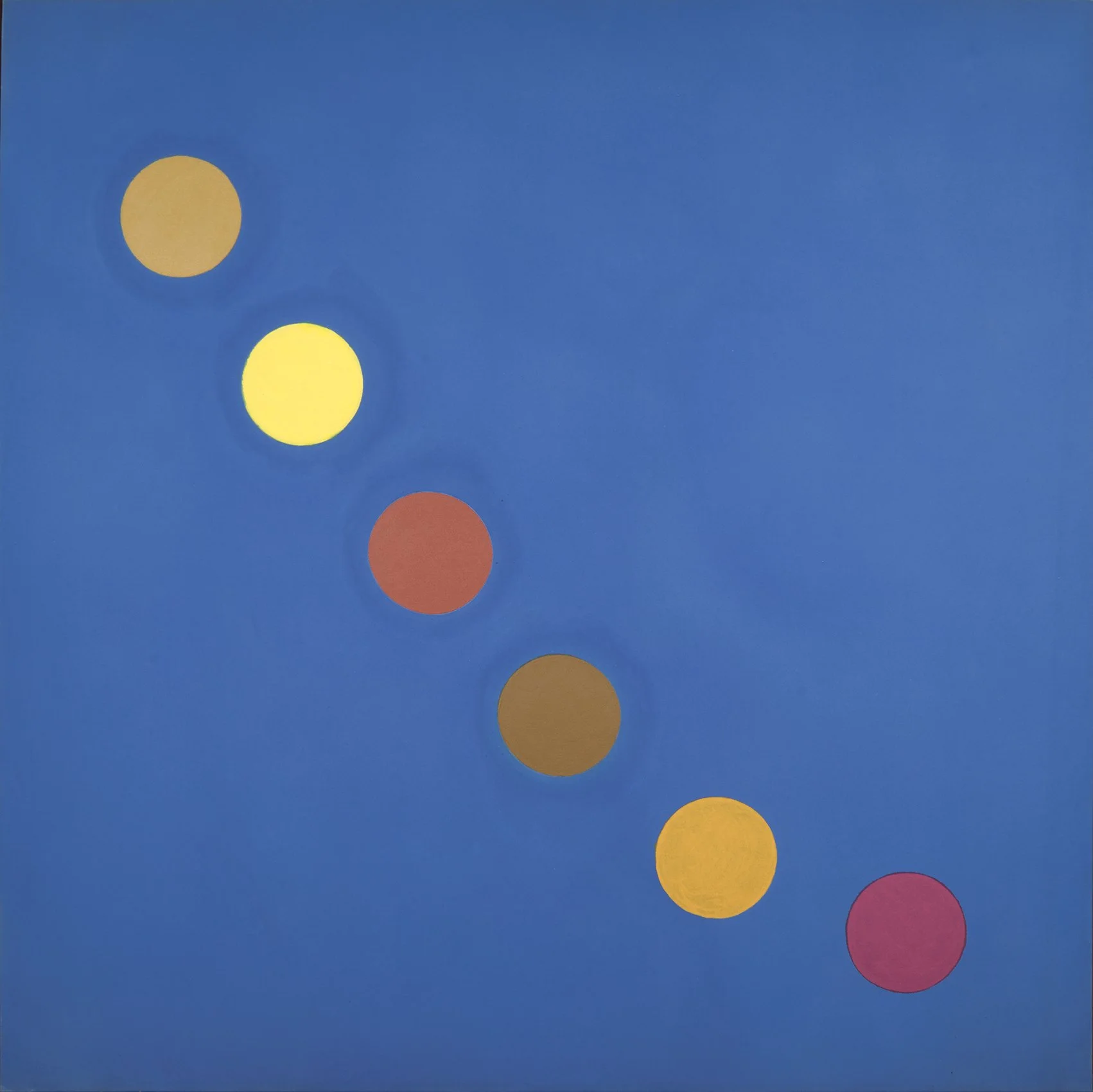
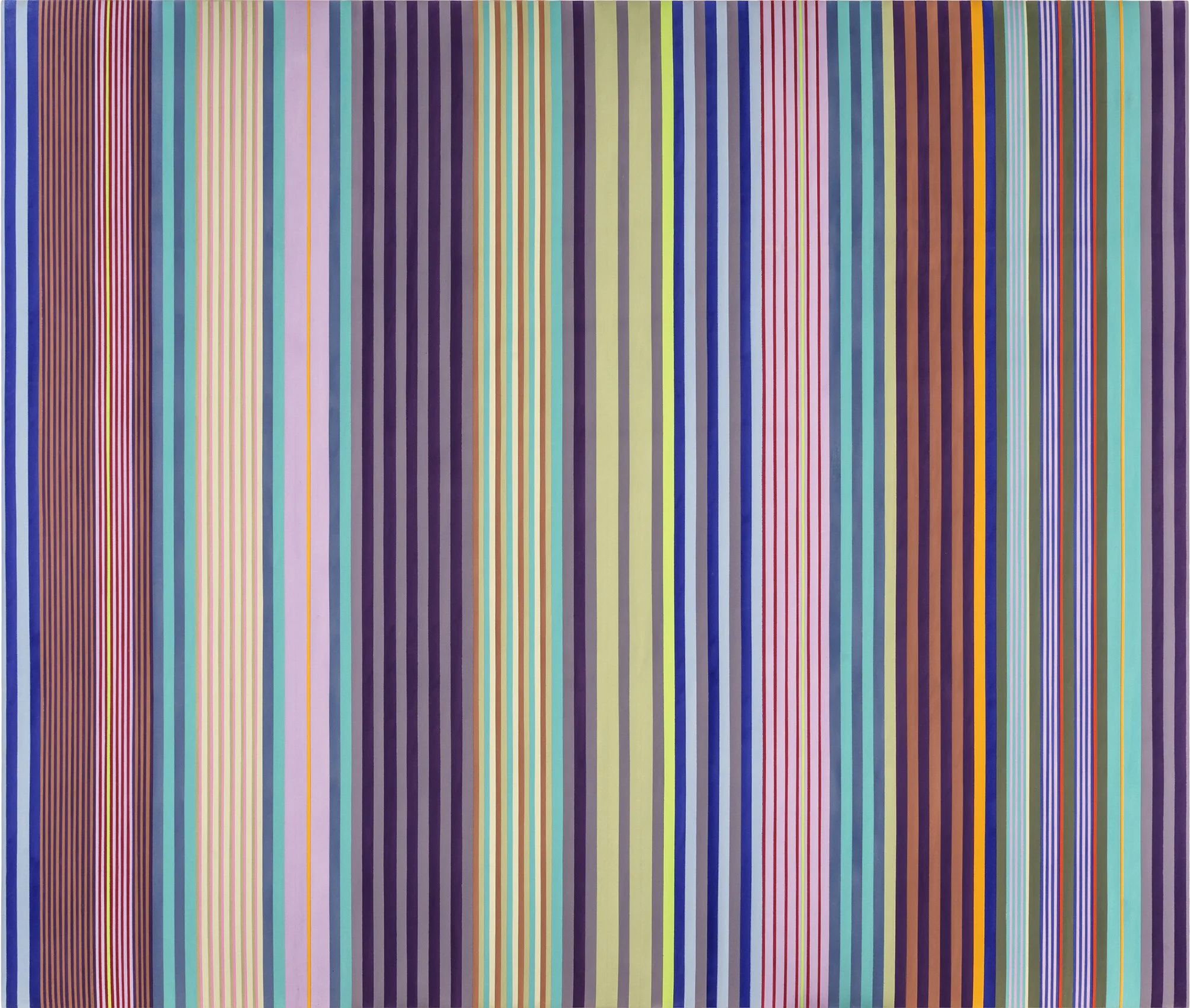
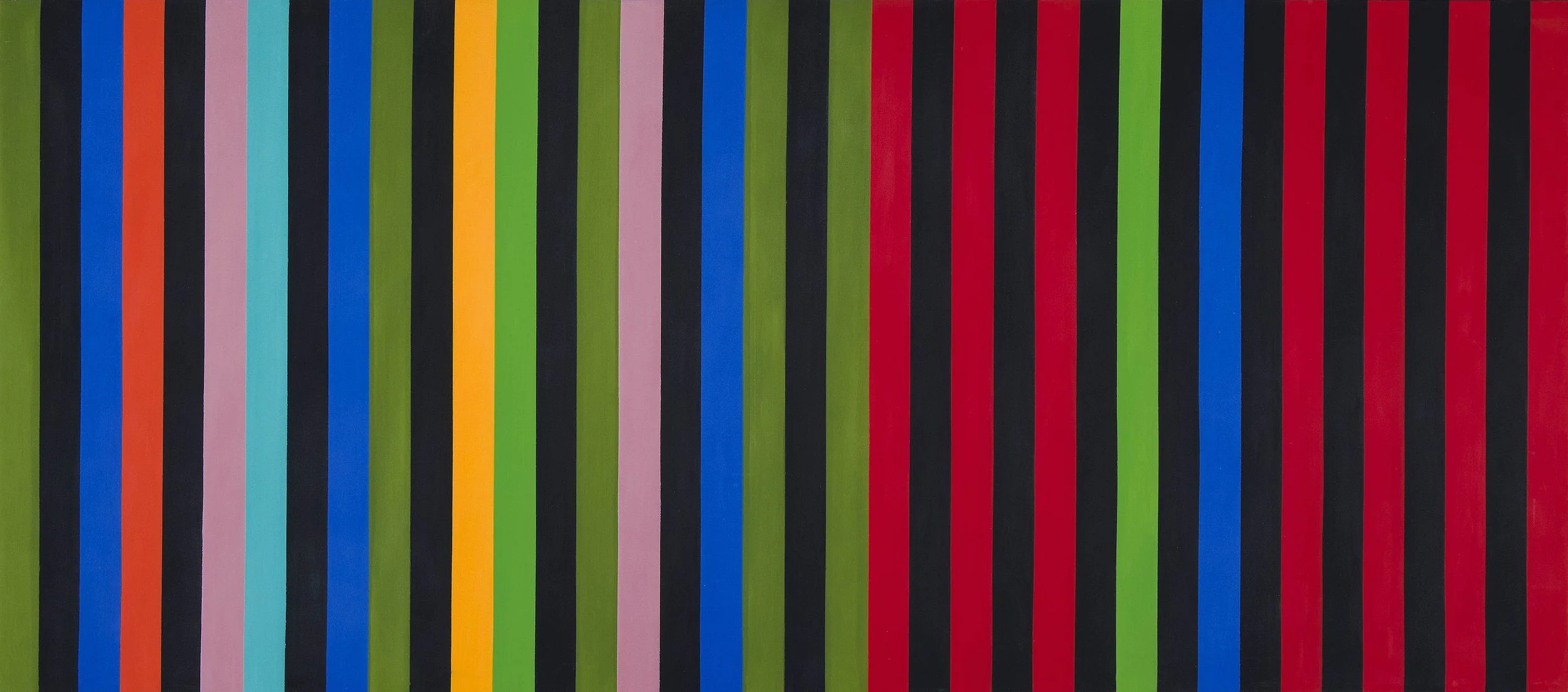
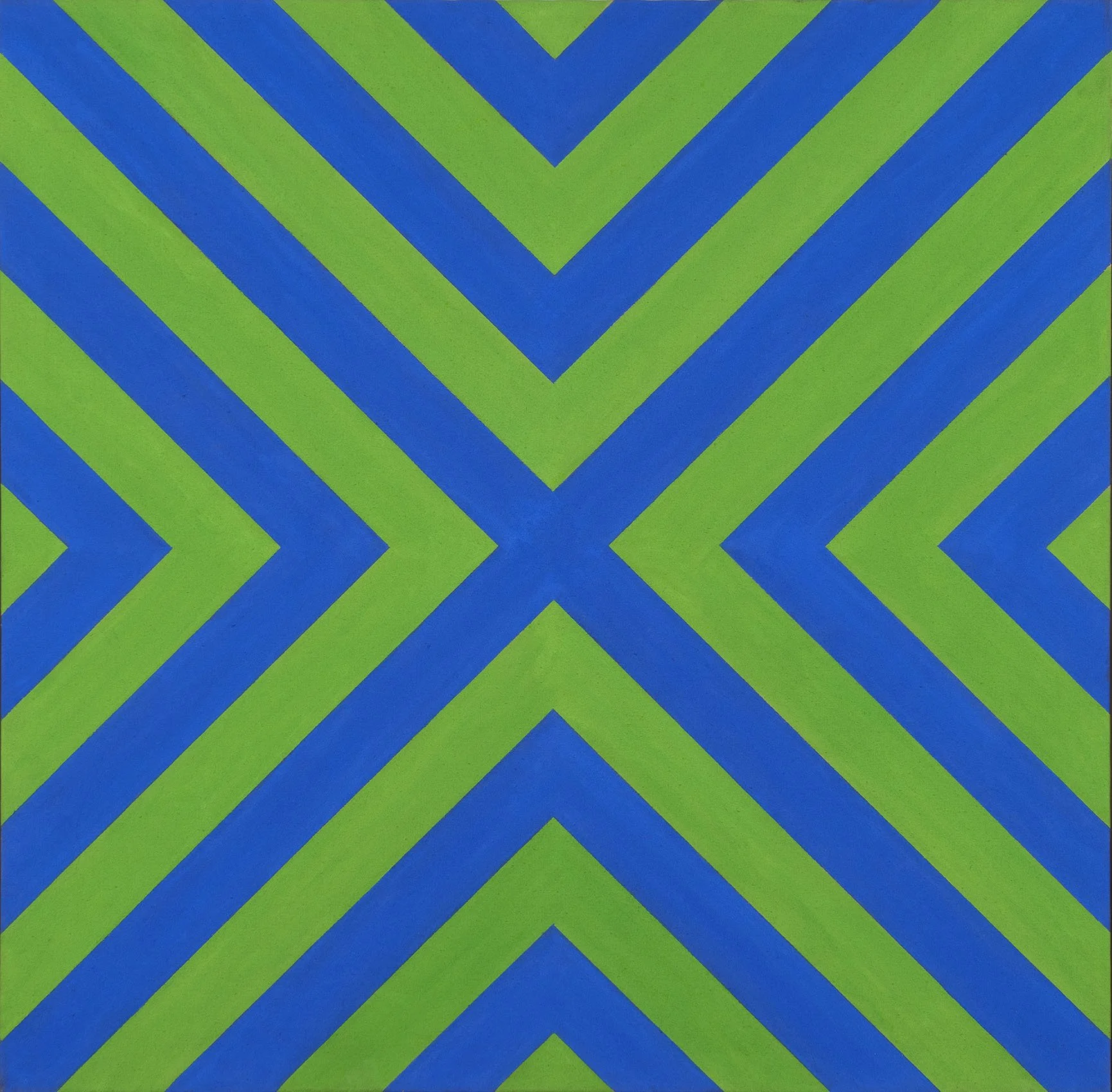
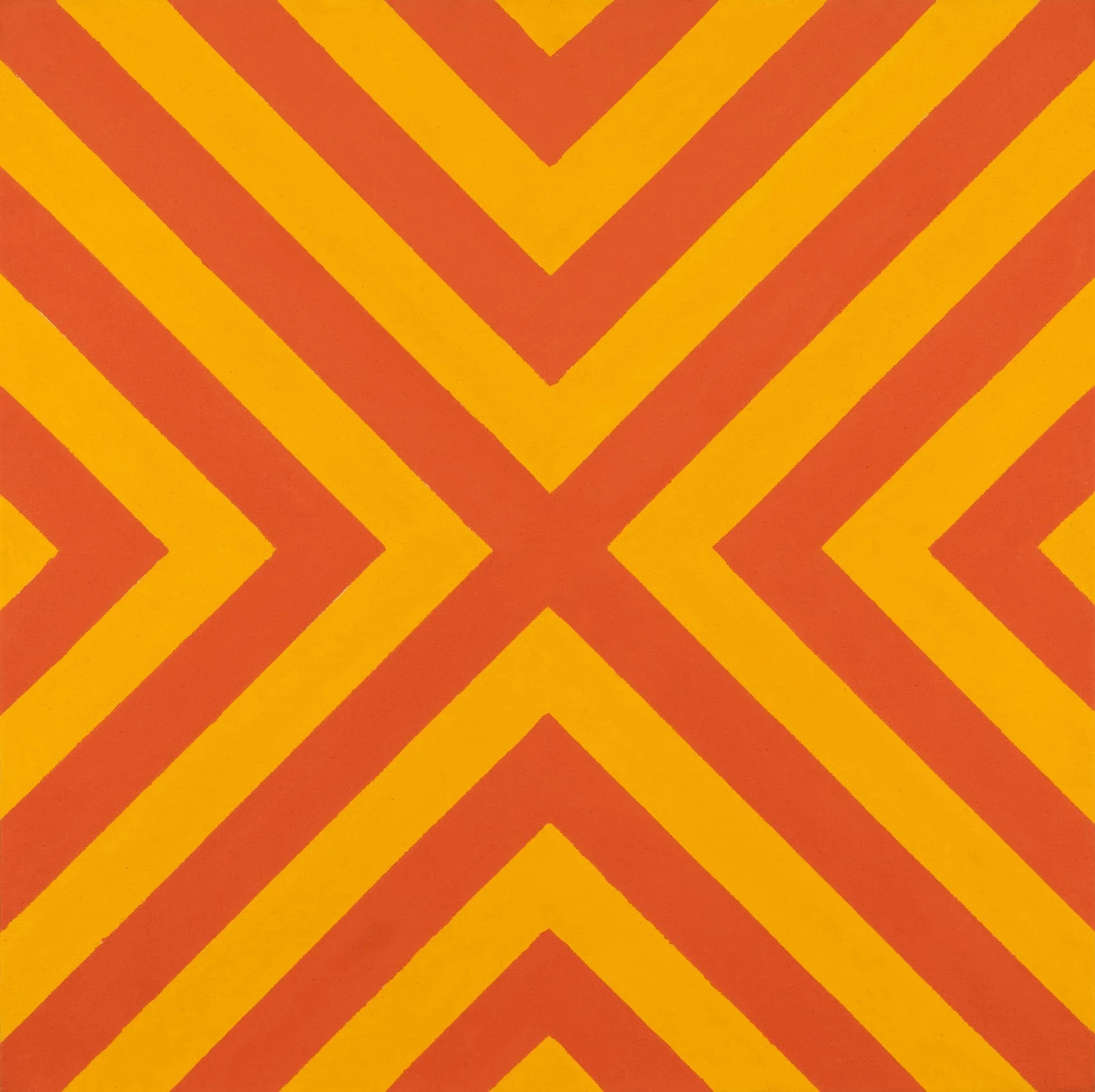
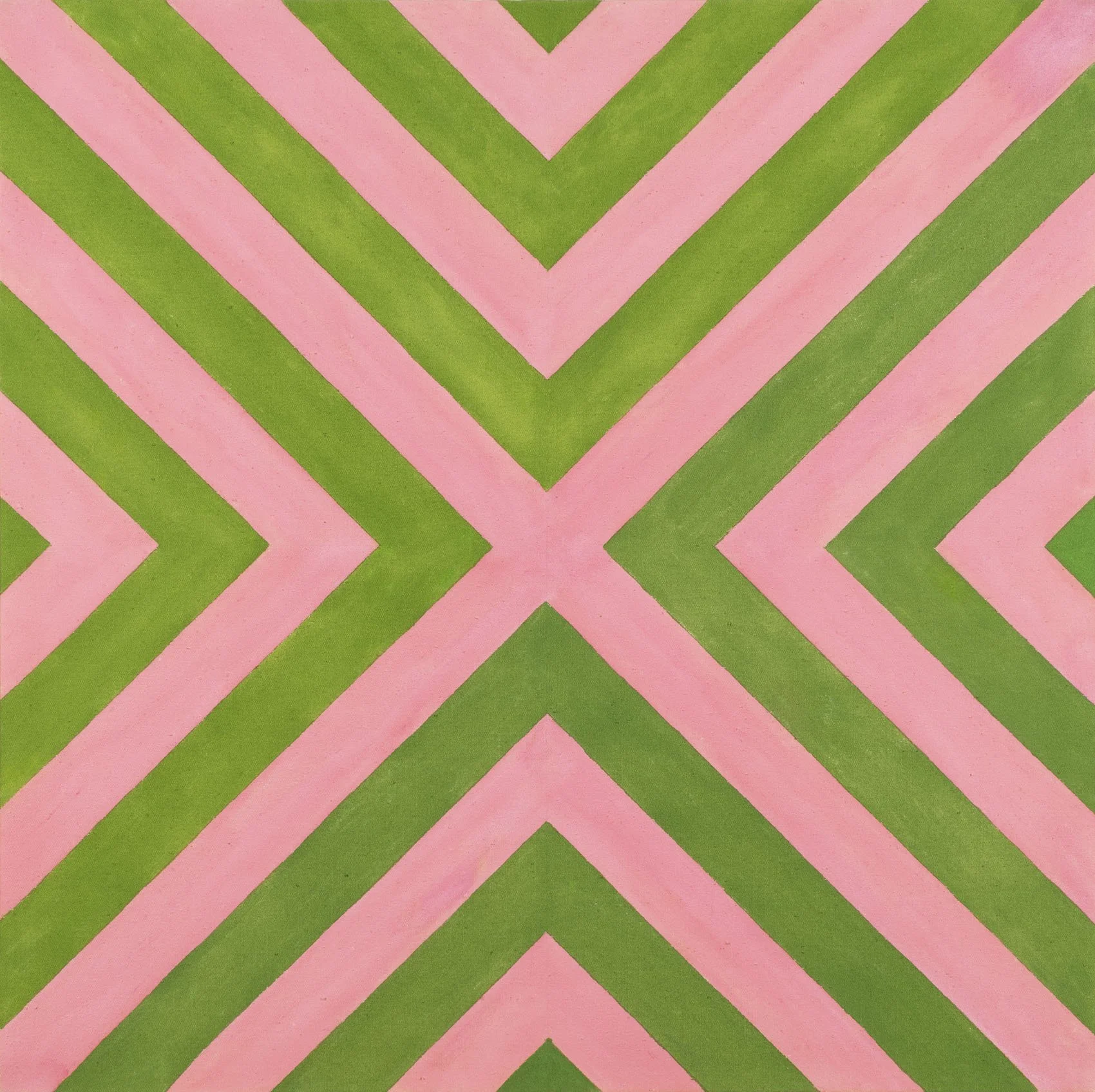
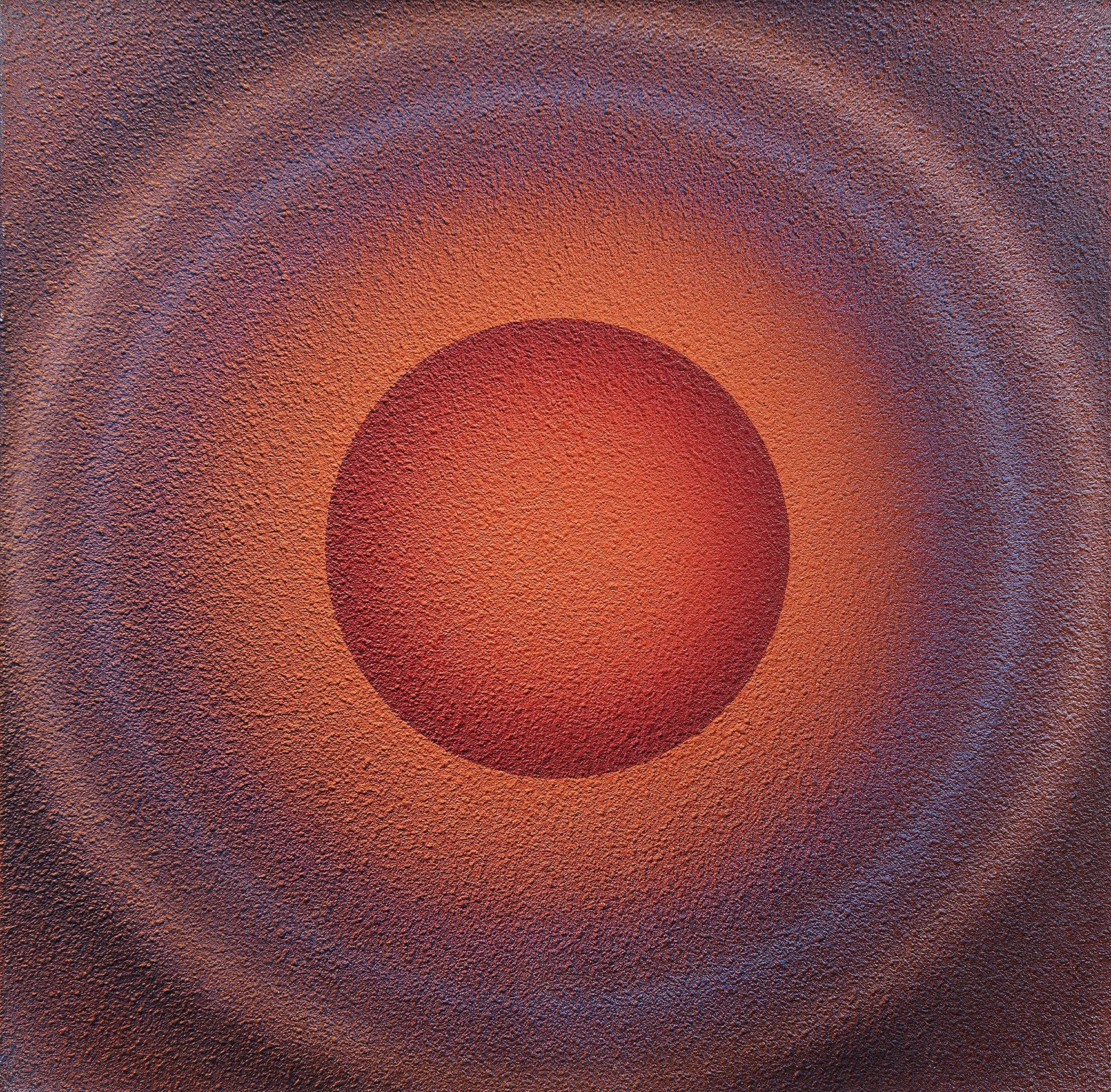
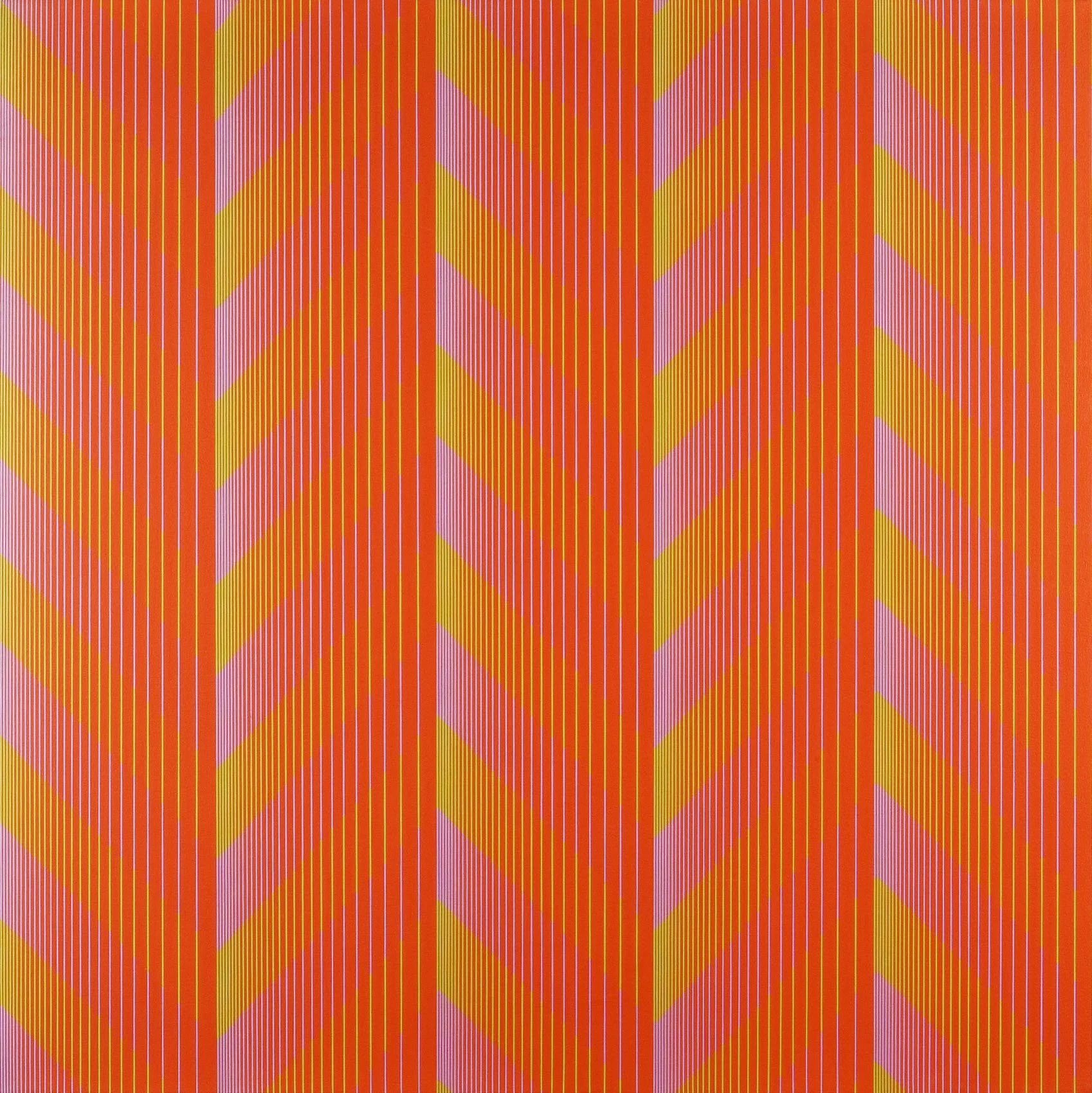
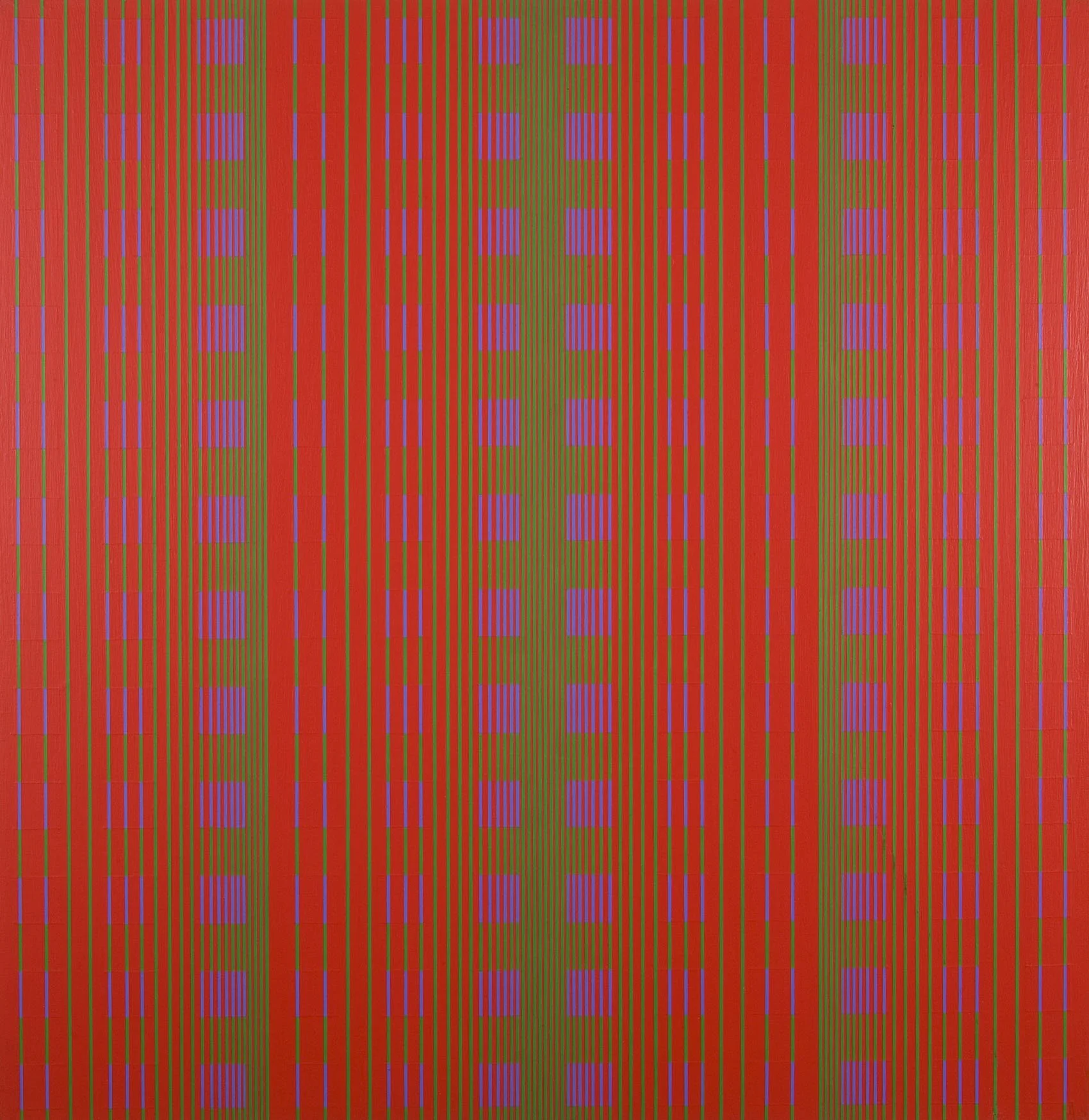
The Washington Color School artists used geometric arrangements in all-over compositions to explore how color moves the viewer rhythmically across a canvas. With the paint soaked into the canvas, the color appears less solid creating the sensation of floating color. Examples of the Washington Color School in our exhibition are provided by Gene Davis, Paul Reed, and Thomas Downing. Gene Davis developed his signature style of vertical stripes in 1958 influenced by Jasper Johns’ target painting on the cover of ArtNews that year and Barnett Newman’s 1951 exhibition of stripe paintings at the Betty Parsons Gallery. Davis methodically laid out the width of his stripes in pencil then shifted into a more intuitive mode when adding color. Royal Veil, 1971 provides a sizeable example of how Davis created rhythm and tension through the irregular repetition of purple, teal, and orange stripes that move the viewer’s eyes back and force across the balanced composition. Paul Reed experimented with Magna paint in the mid-1950s but started working exclusively in staining in 1958-59 when the new water-based acrylic paintings, which were less toxic than Magna, became available. Reed’s earliest geometric stained works date from 1961. Reed’s 1962 series of concentric Xs in two contrasting colors titled xA, xB, and xC are included in our exhibition. In increasingly complex series, Reed went on to systematically explore the function of color in defining form and structure in lattices, biomorphic shapes, and starting in 1967, shaped canvas compositions. Thomas Downing used dots as his primary geometric shape to investigate color’s capacity to extend visually beyond the canvas. In Iambic Time, 1963, a curved line of colored dots cascades down a field of blue. The vibrancy of the opaquely painted circles against the matte blue makes the dots appear to float off the canvas—buoyant, transcendent color achieved through the Washington Color School’s signature staining technique.

For the New York Hard Edge artists, the viewer’s interaction with a painting and response to its perceptual effects was of primary importance in the 1960s. For this reason, the style was termed Op Art, which was identified as an international style in MoMA’s 1965 exhibition The Responsive Eye. The viewer’s participation in an active visual dialogue with a painting was in fact a part of all Hard Edge painting and the MoMA exhibition included examples by all three schools. The New York Hard Edge artists selected for our exhibition are Richard Anuszkiewicz (b.1930), Julian Stanczak (b.1928), Tadasky (b.1935), and Bill Komodore (1932-2012). New York was an international art center in the 1960s so many artists came to develop their careers in the city’s numerous galleries and museums. As a result, the New York Hard Edge artists were not a close-knit group like in LA and DC. Josef Albers was a significant influence for many of the New York school. Anuszkiewicz and Stanczak studied together with Albers at Yale University while Albers was developing his Homage to the Square series. Seeing Albers’s paintings reproduced in a magazine in the 1950s inspired Tadasky to come to America to pursue geometric painting. Komodore studied with Mark Rothko in 1957 at Tulane University, as well as with the Kinetic sculptor George Rickey, before arriving in New York in 1961. Developing their careers in the 1960s rather than the 1950s, the New York artists used new water-based acrylic paint on primed canvas to achieve an oil-like richness of color along with crisp lines through acrylic’s plastic quality. While both the California and New York artists often used masking tape to execute a hard edge, the fast-drying acrylics allowed the New York artists to execute finer lines for complex color interactions and compositions. Because line and color were of equal importance to the New York artists, they often produced multiple variations in their compositions within each series, especially in comparison with the DC artists’ set compositional formats. The New York artists embraced spatial depth that either projected towards the viewer or receded infinitely, distinguishing their paintings from both the flatness of the California group and the floating color of the DC group. The treatment of space by the New York group results in a more calculated rather than intuitive feeling, even though the New York artists experimented with their color choices like the DC and LA artists.

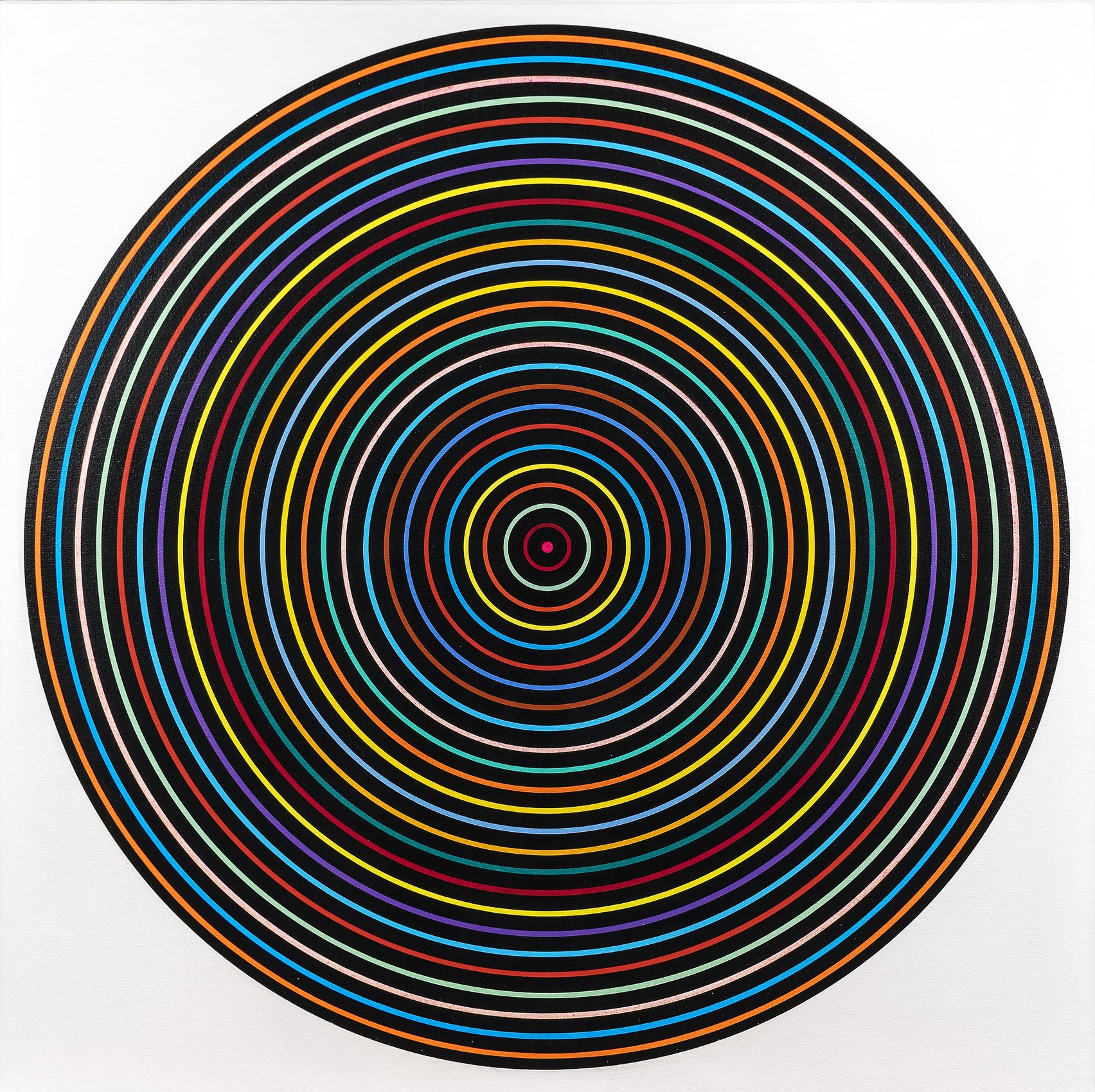
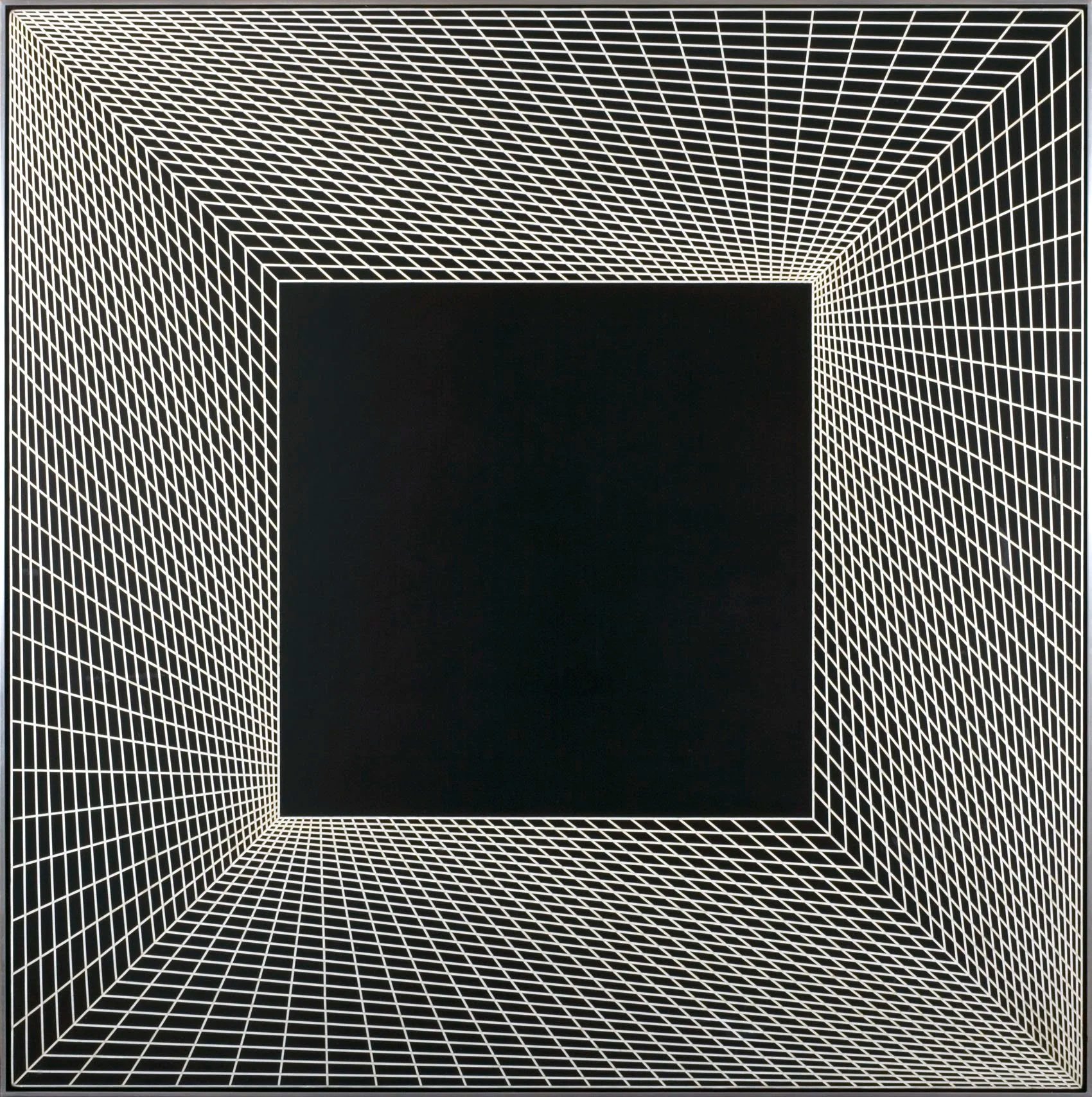
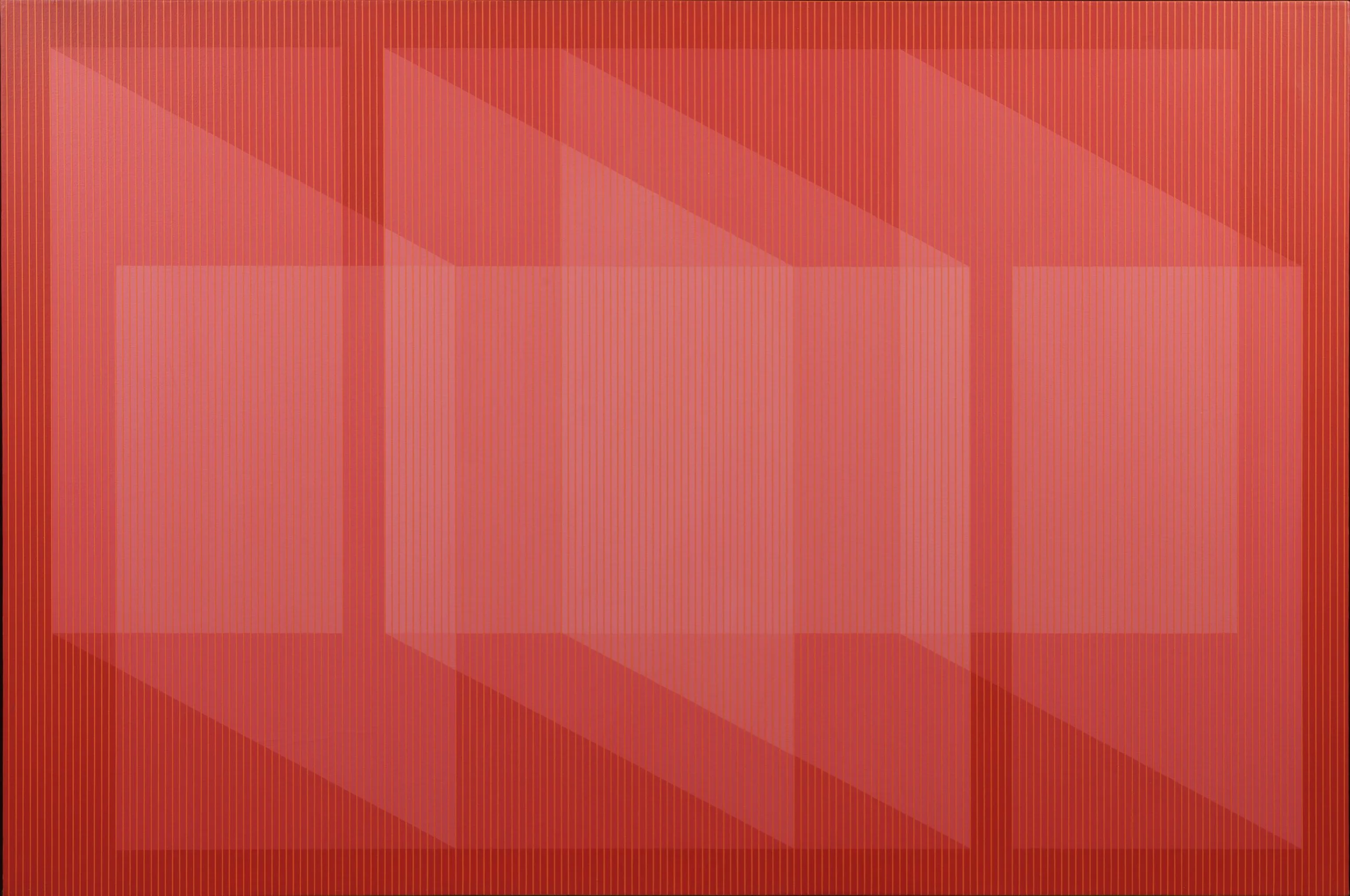
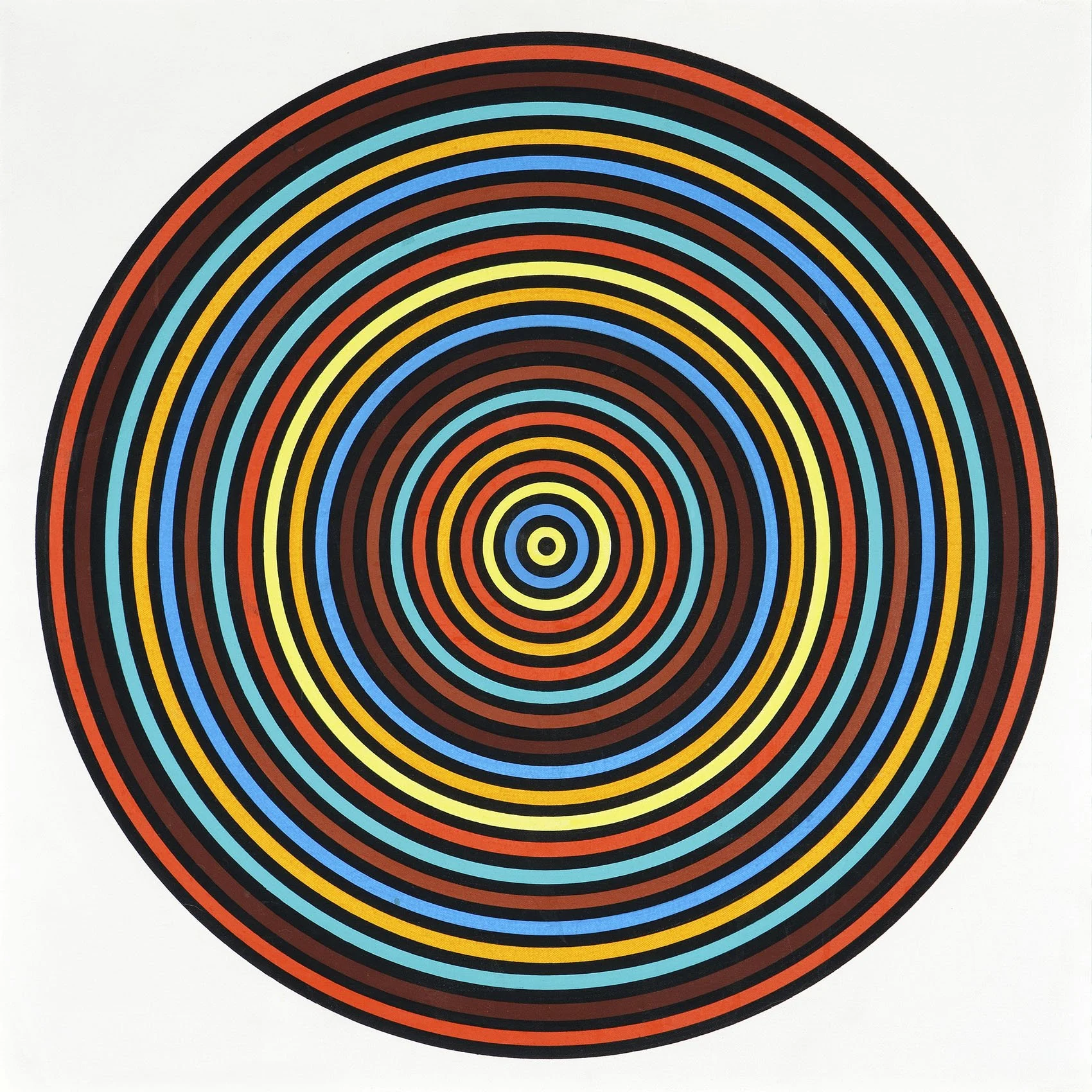
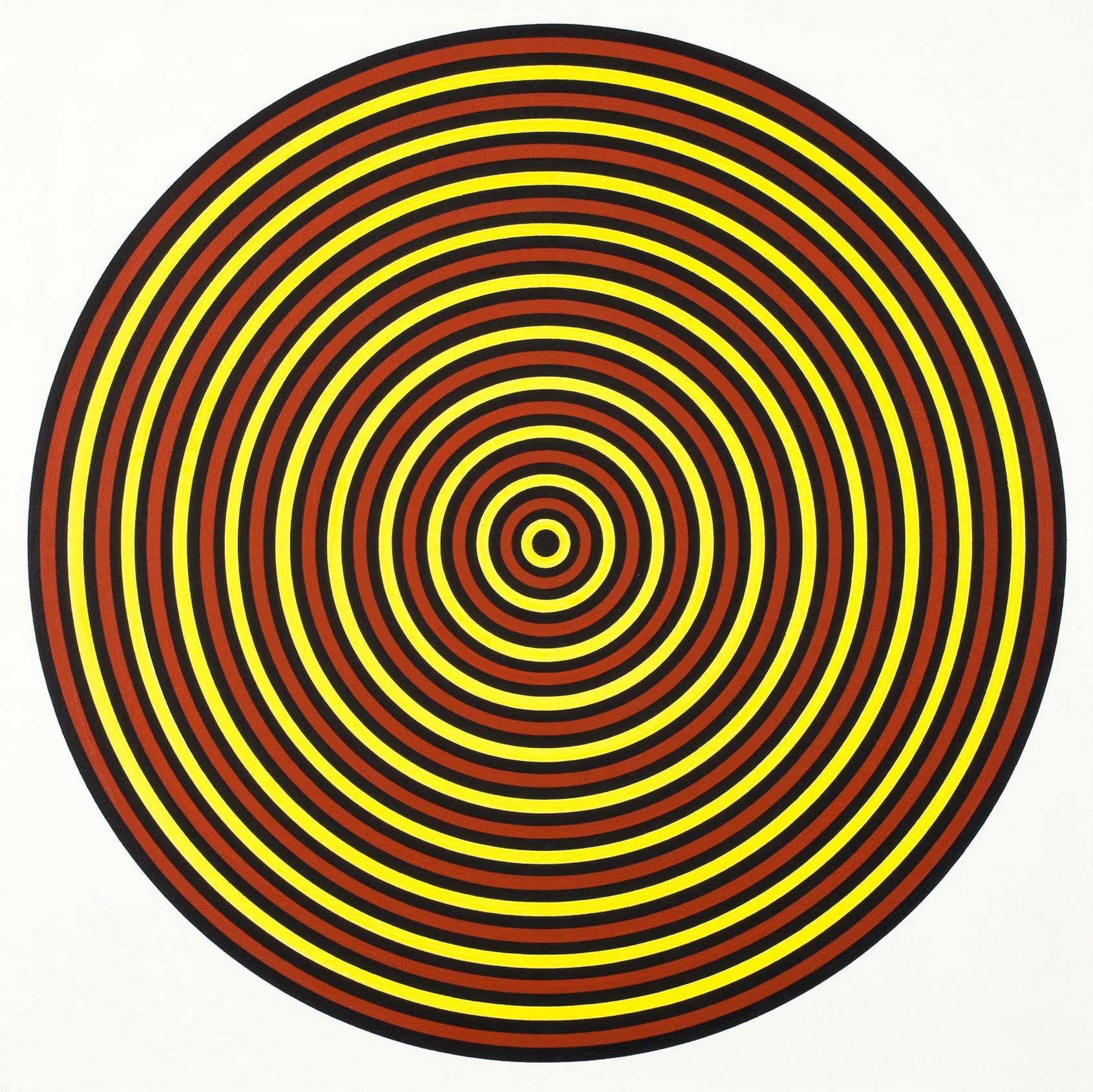
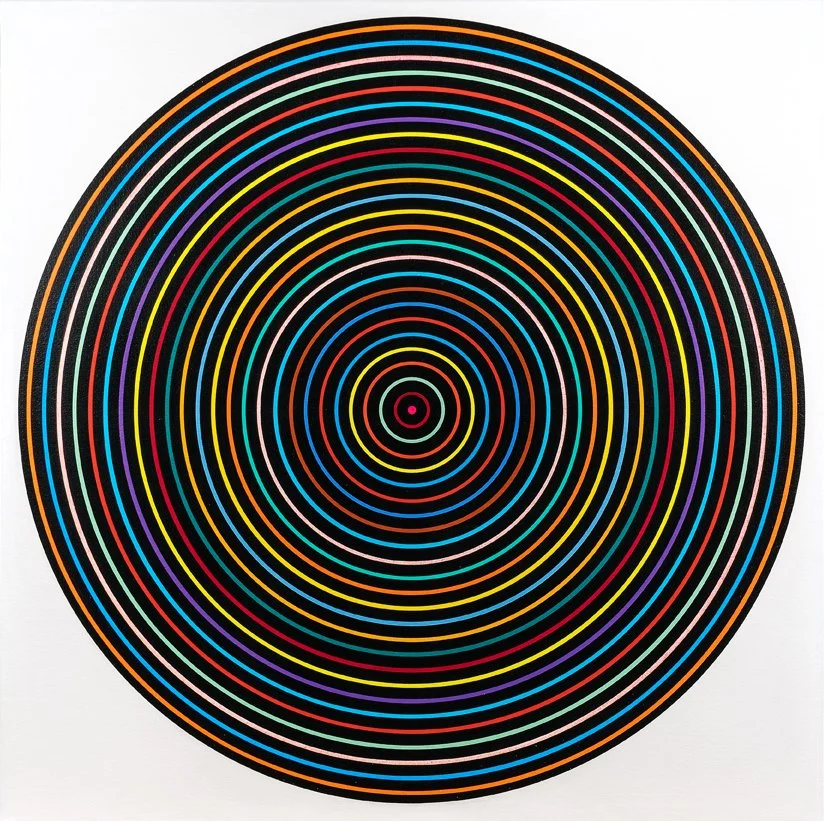
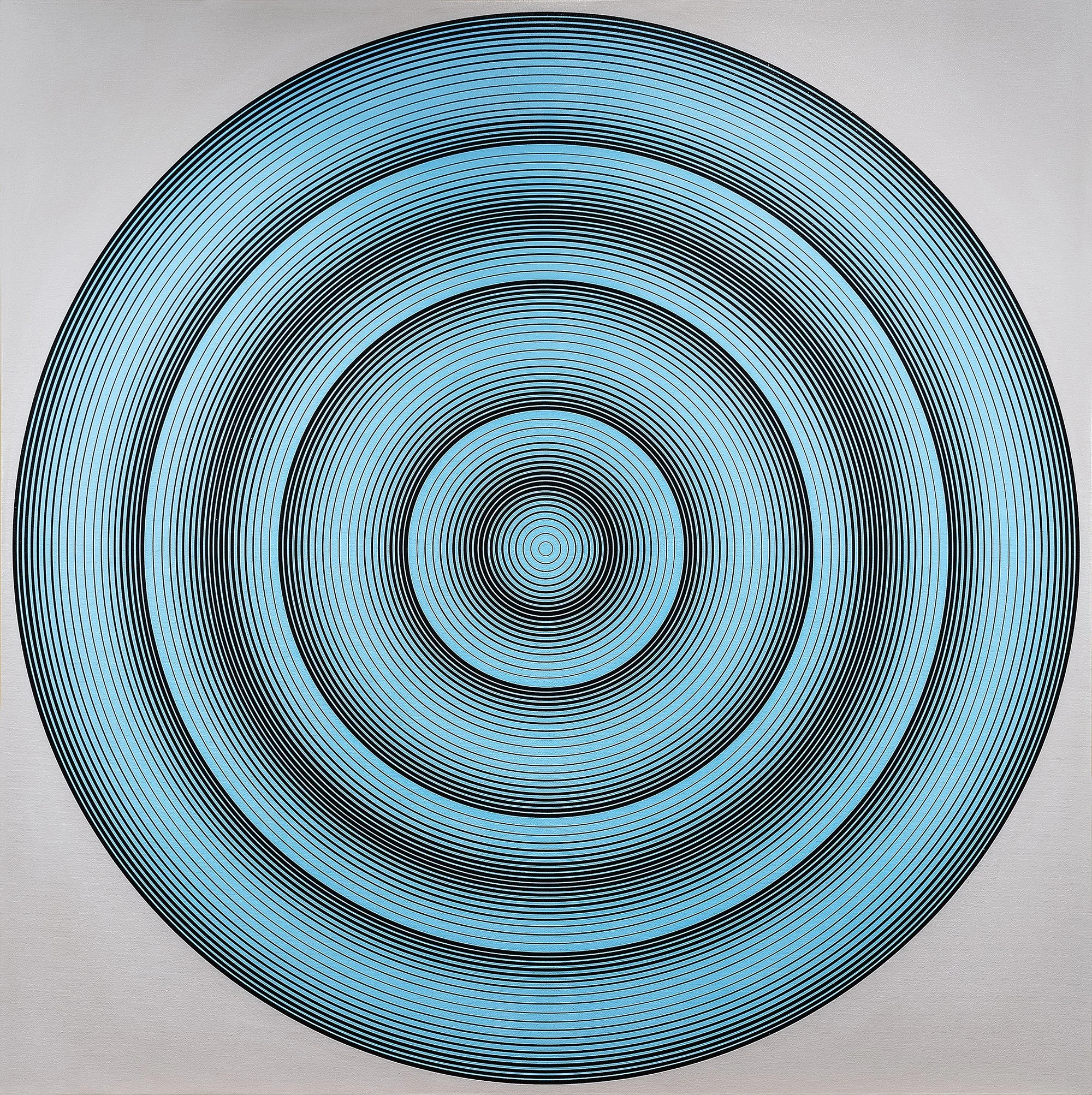
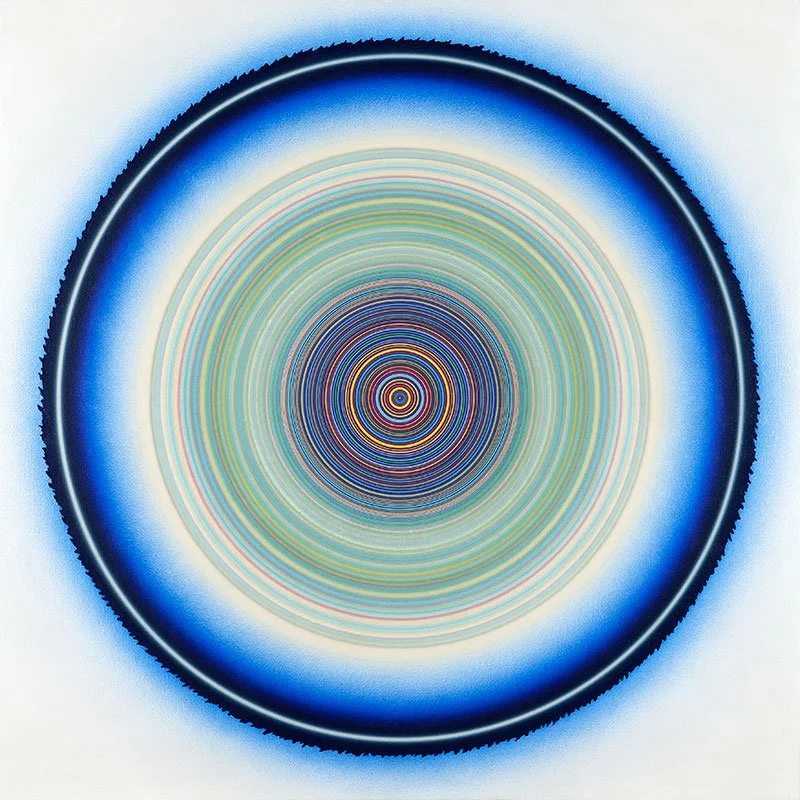
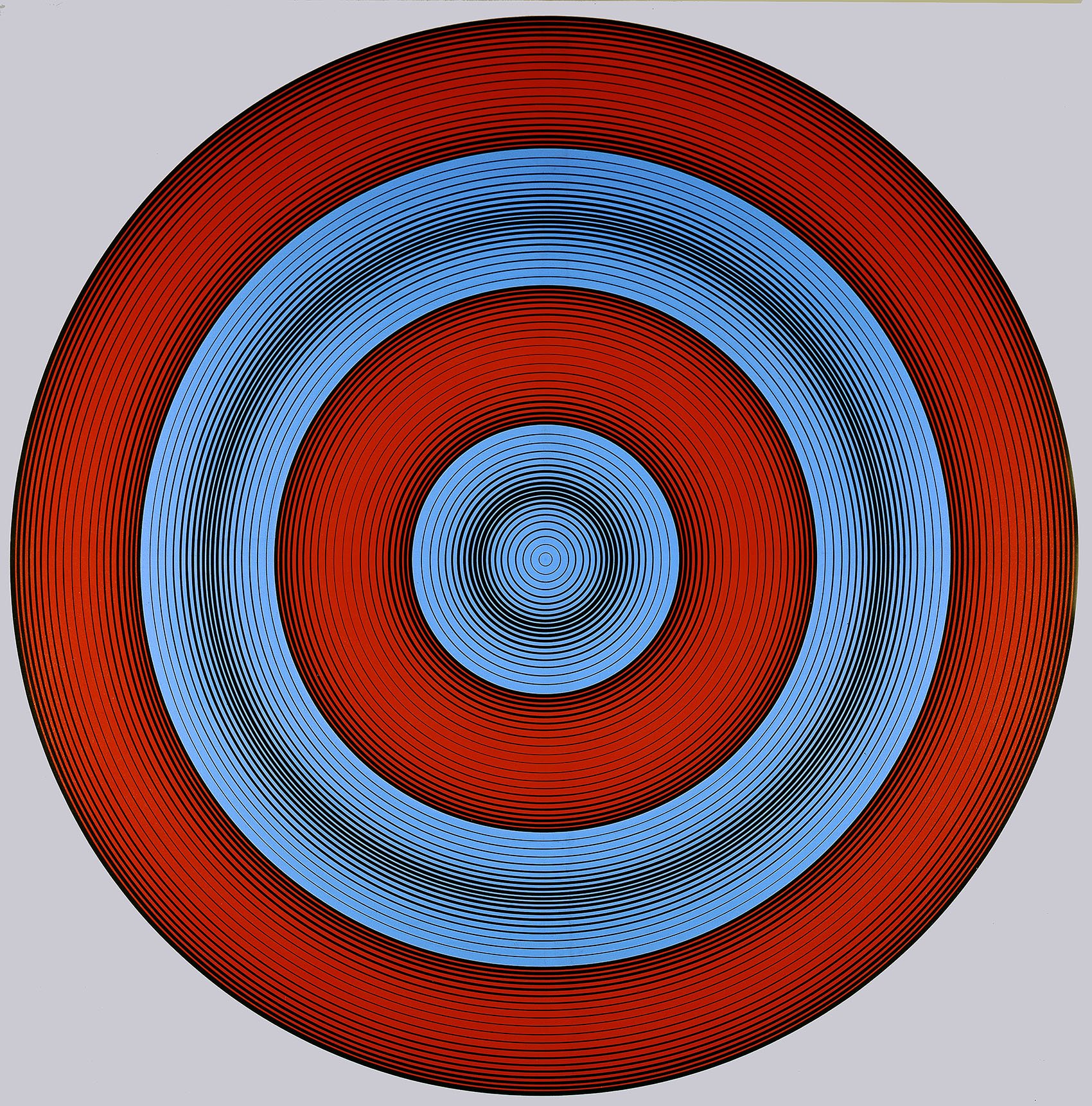
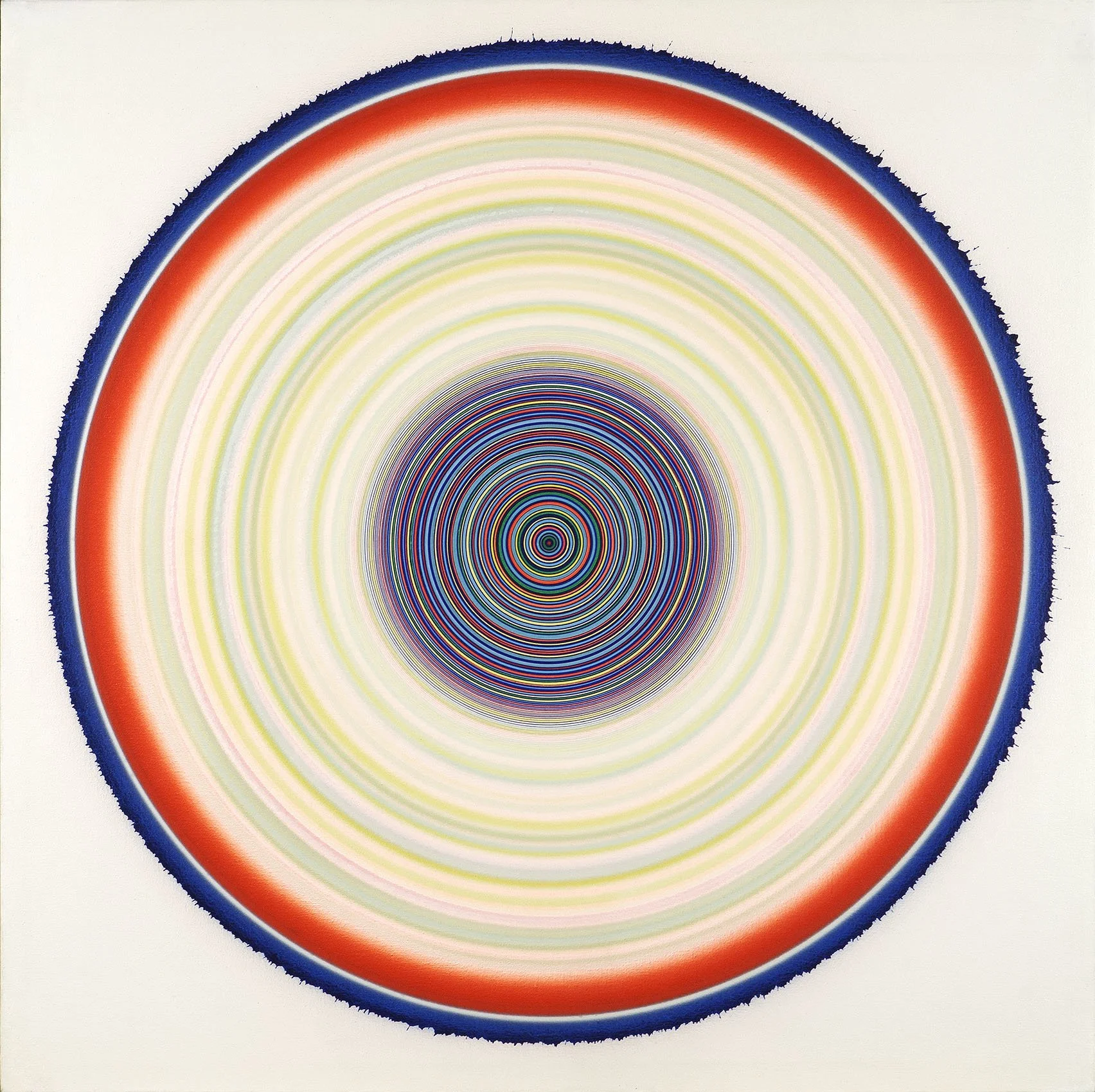
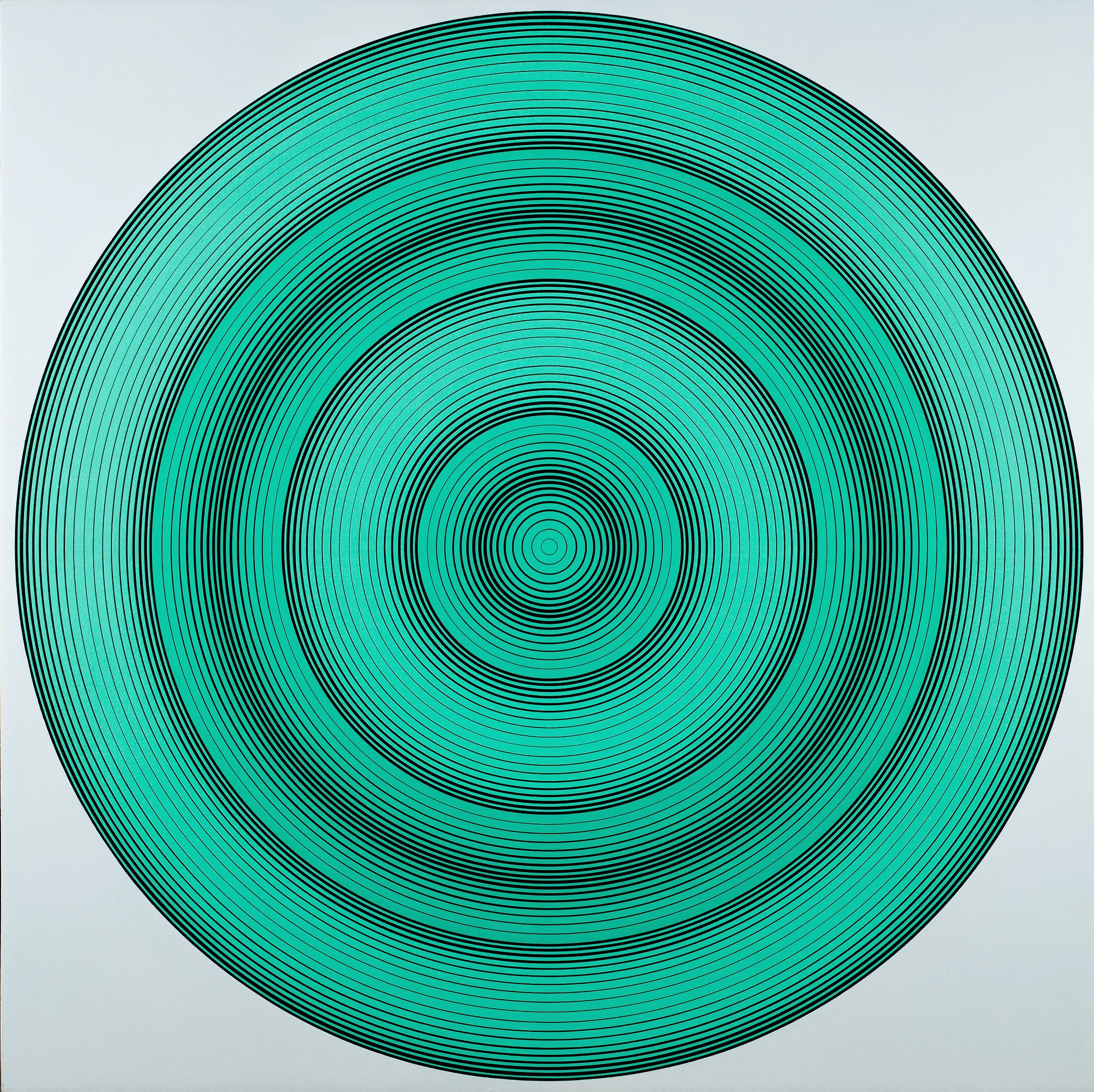
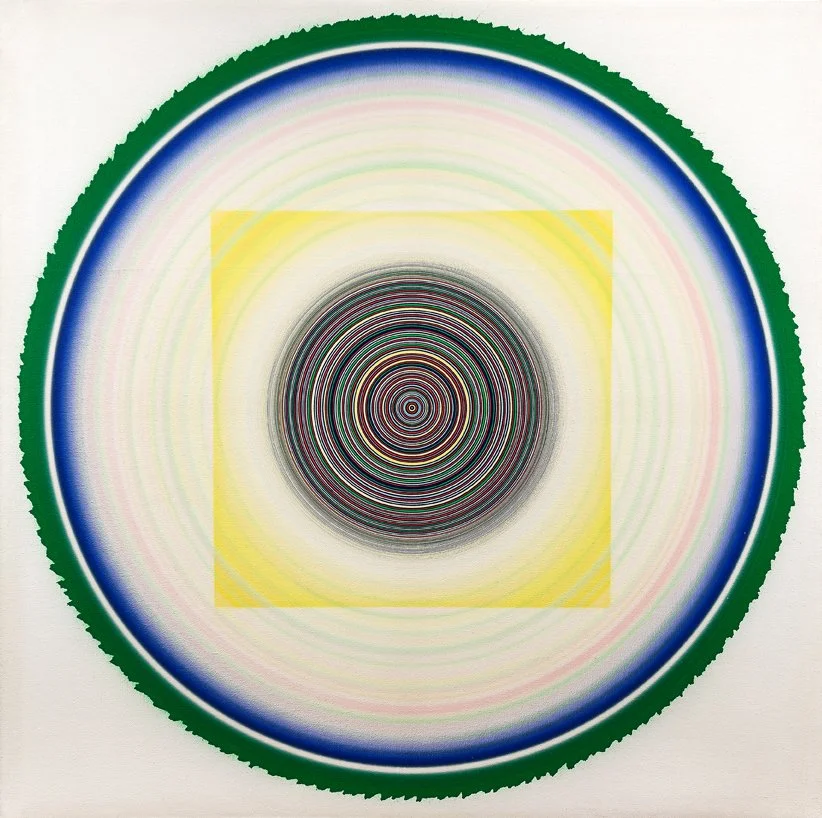
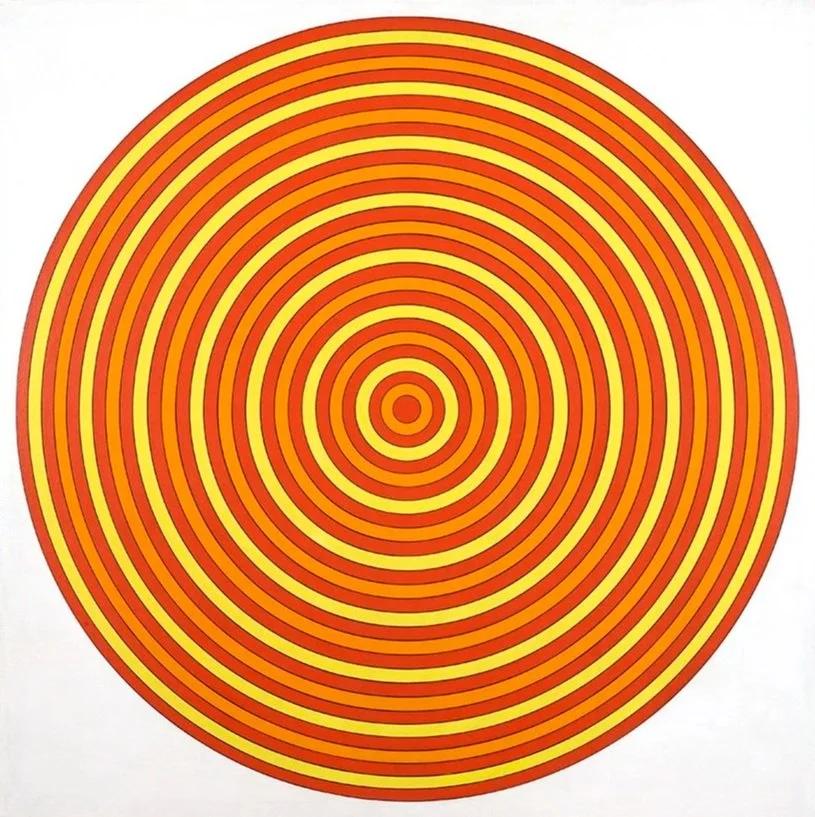
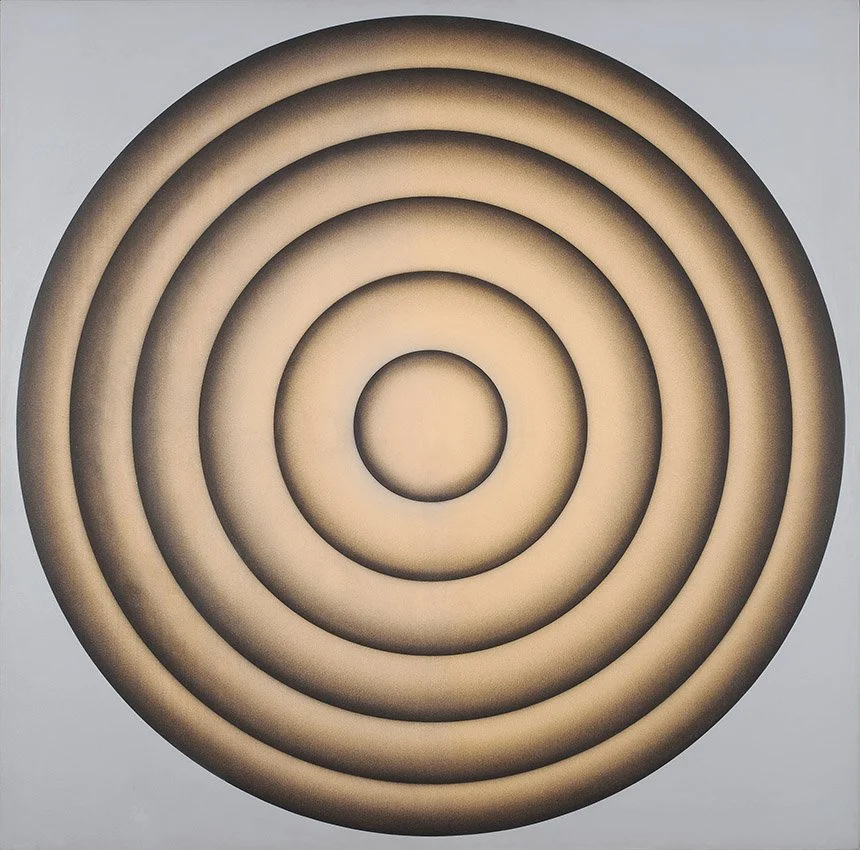
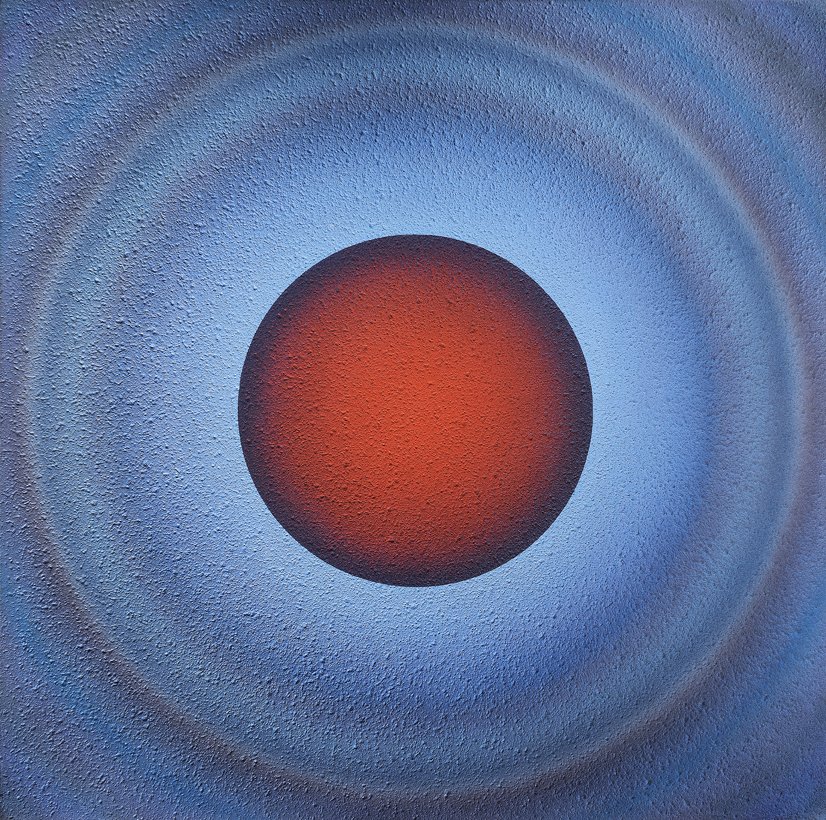
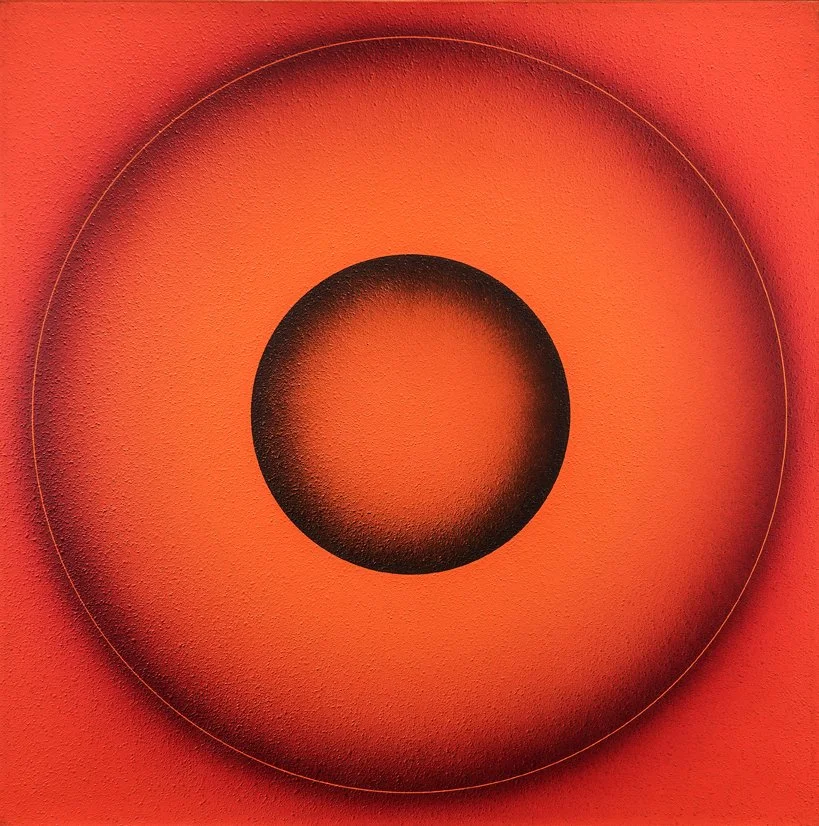
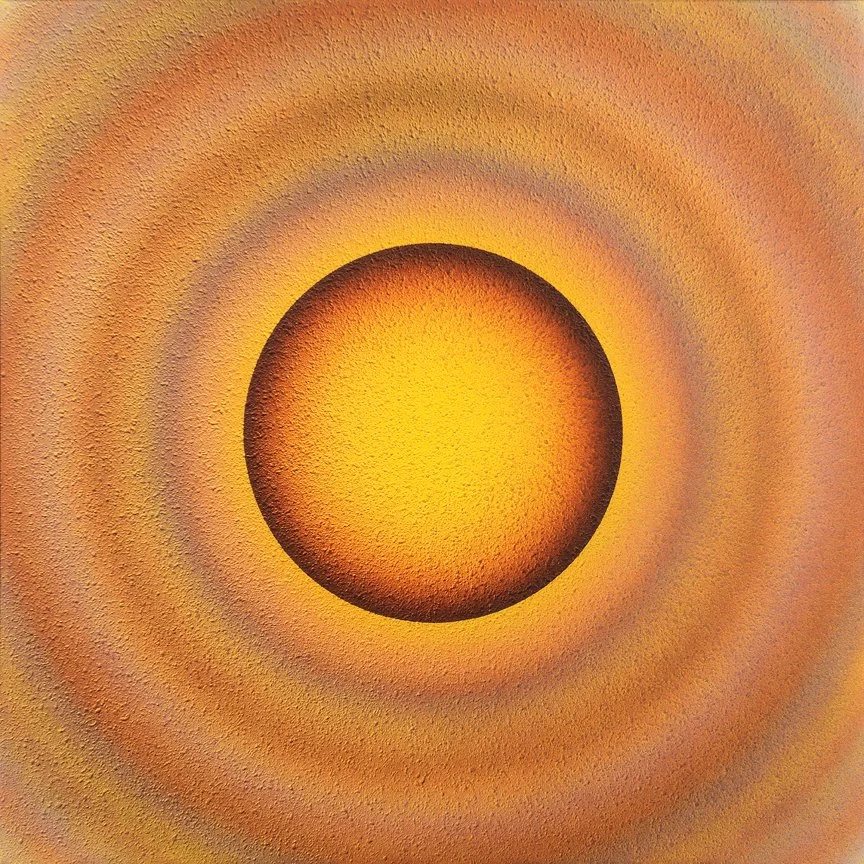
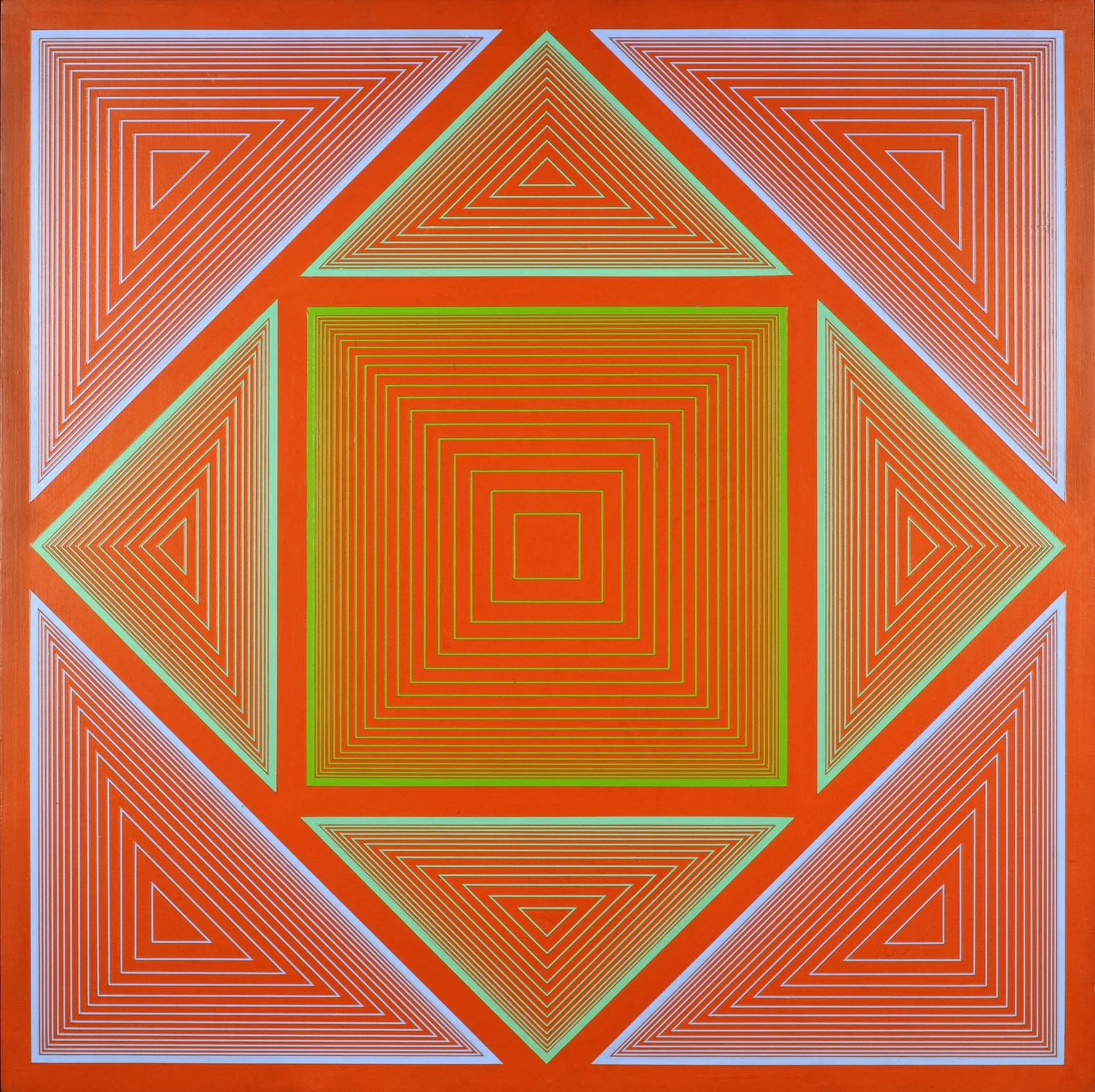
The New York school were the group most interested in how color is perceived and understood. The artists created a new model of depicting space by using only the relationship of color and line without texture or shadow to achieve movement that projects and recedes. They painted overall symmetric compositions that explore the tension between the center and edges of a canvas. The artists achieve their fine lines by using acrylic paint on primed canvas, often assisted by tape or other tools. Richard Anuszkiewicz and Julian Stanczak used masking tape to create fine lines of color that interact to create a sense of additional floating colors. Anuszkiewicz used colors minimally—often applying three colors to create the impression of multiple shades of each as seen in Quiet Center, 1962. Stanczak worked quite differently—one might call him a color maximalist—sometimes using just two or three colors to create a multi-colored effect and other times using up to 30 shades to create the impression of a single color. The astounding luminosity of his Folded Forms series, begun in 1968, can be seen in Festive Red, 1970-71. Stanczak used five shades of red with an undercoat of orange to create the impression of monochromatic geometric structures that shift and fold onto each other. Tadasky works differently, applying paint as raw color without taping, using the proximity of his rings to create optical blending in his circle-in-the-square compositions. In his early works, alternating rings of two or three colors create a pulsing or spinning effect. One of Tadasky’s more complex color relations is seen in C-177A, 1965 in which thick rings of black separate thin brightly colored rings that glow as if made of neon lights. Bill Komodore worked with both primed and unprimed canvas in the early 1960s. He produced dazzling works in 1964 by staining fine lines into an unprimed canvas where the slight wobble of the lines produced flashes of phantom colors. Alongside the stained works, Komodore made bolder patterned paintings using masking tape on primed canvas. In our exhibition, three 1967 paintings have been selected. Their minimal compositions of a single central field show the influence of both Rothko and Albers, yet these works have an Op quality derived from the contrast of light and dark along the border of the canvas, which may be an influence of Rickey. In Ten Ten Fifth Avenue, 1967, Komodore uses an intricate border on top of a field of black to provoke consideration of open and closed space. The same year Richard Anuszkiewicz also considered the edge’s ability to define an infinite center depth or projection in Inflexion, 1967. These 1967 paintings by Komodore and Anuszkiewicz demonstrate the New York interest in ambiguous spatial depth which varied greatly from the California artists for whom a unified composition with no sense of background and foreground was essential.

Hard Edge Painting emerged as more than a reaction against Abstract Expressionism; it reflected a renewed interest in color isolated from emotion using geometric abstraction and a new approach to compositional unity within a single plane. It also identified with new scientific understandings of how the brain controls vision and the essential role of the viewer in experiencing a painting. While each of the groups in our exhibition had distinct aesthetic positions, they were united by a common interest in empirical investigations of color and new models for pictorial space. Their work raised questions of how colors meet and melt into one another and how the interplay of background and foreground can produce an ambiguous sense of space within a painting. In the 1960s, Hard Edge art was an exploration of how the elements of a painting are organized. In the process, intuitive and predetermined compositions were used to investigate the effect of size, shape, line, and color on a viewer’s perception. These Hard Edge paintings are creative in conception, immensely skillful in execution, and offer the viewer a central role. For all of these artists, the ultimate goal was to create a heightened awareness of what it means to see.

Biographies

TADASKY: CONTROL AND INVENTION, 1964-2008

Feb 7 - Apr 25, 2015

Essay | Press Release | New Criterion Review

Some works may still be available, please contact the gallery at 212-581-1657.


Essay by John Houston

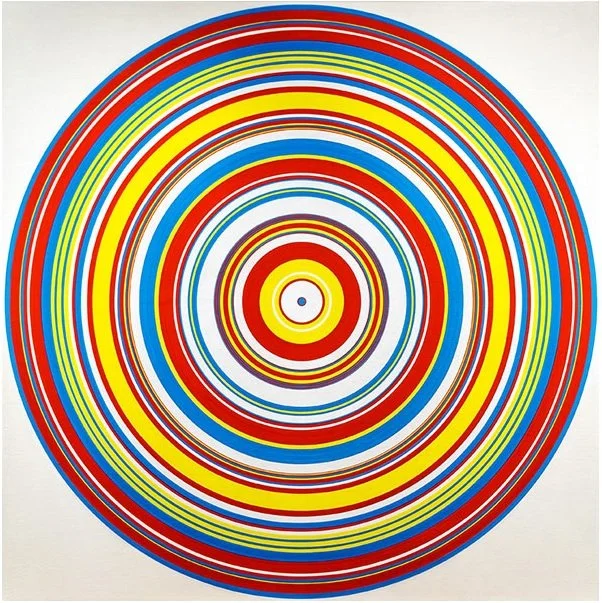
There is a breathtaking continuity to Tadasky’s lifelong enterprise. For more than fifty years he has made paintings of a single form: the circle. Both delimiting and infinite, the circle proliferates and reverberates in his painted universe, emerging as a powerful catalyst for stimulation and contemplation. Organized around a central axis, his orbital compositions bring our perception into sharp focus, a process that leads the attentive viewer to expanded awareness. The duality of concrete form and transcendent experience in Tadasky’s paintings, a concept whose lineage dates back to the origins of geometric abstraction, makes manifest the diverse eastern and western influences that have shaped his work from the beginning.

Tadasky was born Tadasuke Kuwayama in 1935 in the industrial city of Nagoya, Japan, the youngest of eleven children. His father was a prominent shrine builder, whose factory specialized in Shinto shrines characterized by symmetry and lack of extraneous ornament. The young Tadasky took a keen interest in the design and construction of the impressive and elegant structures, and, over time, gleaned fundamental carpentry skills from the expert craftsmen. The Kuwayama business thrived due to the demand for large scale shrines on the Korean peninsula. The factory burned during the US bombing of Nagoya in the 1940s and after the war the Kuwayama business endured by shifting its focus to miniature shrines. Tadasky still had expectations of joining the company, and after being sent to a strict religious school in Chiba, he pursued advanced study at a technical school in Tokyo, earning a certificate of engineering. But both his parents passed away while he was at school and another sibling took direction of the family business, freeing him to pursue his growing interest in art.

As a student in Tokyo Tadasky gained his first exposure to modern painting, and through American magazines, became especially enamored with geometric abstraction of Bauhaus origins. The spare Homage to the Square compositions of pioneering formalist Josef Albers were a particular revelation. Painting of such deliberate clarity had no parallel in Japan, and yet, its formal rigor resonated with the purity of the Shinto architecture Tadasky had long admired. Although postwar Tokyo was fast becoming a cosmopolitan city, vanguard art remained a foreign endeavor, and there existed few venues for modern art forms. Artist organizations and academic officials exerted control over exhibitions, mostly sanctioning traditional Japanese arts and western-style academic realism. Seeing little prospect for pursuing advanced painting in his own country, Tadasky looked toward America.

To gain admission into art school in the United States Tadasky spent several years developing a portfolio of paintings and drawings, which earned him a scholarship in 1961 to the historic Cranbrook Academy of Art in Michigan. However, at the encouragement of his older brother Tadaaki, who had emigrated to New York several years earlier, Tadasky headed directly to New York. He soon won a scholarship to the Art Students League, taking their top prize with two sculptures and three paintings featuring circular motifs, harbingers of what was to come. Always an independent spirit Tadasky was uninspired by the traditional course of study at the League and disliked clocking in every morning as required. When Augustus Peck, director of the Brooklyn Museum Art School, offered to let him work independently in his own studio, Tadasky switched enrollment, becoming classmates with a group of young Japanese émigrés, Arakawa among them. Working undisturbed in a studio he renovated on Canal Street in lower Manhattan, Tadasky embarked upon an obsessive daily regimen of painting.

By 1962 Tadasky limited his repertoire to concentric circles radiating from a central point of his compositions. His earliest efforts executed in his own acrylic and pigment paint mixture on rectangular scraps of Masonite were characterized by staccato brushstrokes of primary colors swirling around a central pivot point, an effect akin to a Neo-pointillist cyclone. As his technical confidence increased, the raw agitation of these early works incrementally gave way to a more organized and restrained energy. While always eschewing specific external references in his paintings, Tadasky acknowledges that his ideal geometric form has many parallels in the real world, and has long surrounded himself in the studio with collections of cacti, geode cross sections, and other reminders of nature’s hidden order. “The circle is the essence of nature,” he has noted, but he has no wish to depict nature, only to convey “a power, a vibration,”1 the inherent potency of what Gestalt psychologist Rudolph Arnheim called the "primordial circle." Although Tadasky does not profess a particular religious practice, the circle in its pure form resonates with spiritualist philosophy, and appears in ritual symbols throughout diverse cultures. Critic Donald Kuspit has noted a direct correspondence with the symbolic "squared circle" of Buddhist and Hindu veneration, viewing Tadasky's abstractions as "mandalas for modern 'scientific' eyes."2

It is perhaps not surprising that Tadasky's thoughtful painting process mirrors an act of meditation. Prior to beginning each painting, Tadasky sits quietly by his blank canvas, resting his mind until a painting gains clarity in his imagination. He then executes the work starting from the outermost ring and working inward until he fully realizes his original conception. Each painting is thus envisioned in all its formal specificity following its predetermined path, deviations from which Tadasky considers "taboo." Moving to a more expansive studio in lower Manhattan Tadasky was able to execute progressively larger canvases up to six feet square, the limit of his reach. Early on he had discovered that the most effective way of painting circles was not by moving the brush across the picture plane, but by rotating the canvas under his brush, and he devised a delicately balanced turntable "easel" for the purpose. Sitting cross-legged atop a wide plank suspended over the surface of his canvas, he gently spins his turntable with one hand, while holding the brush in position with the other. Using long haired calligrapher's brushes, Tadasky carefully calibrates the flow of paint onto the undulating surface of the stretched canvas, an exacting technique that requires absolute concentration.

In works dating from 1962-1963, many of them monochrome, his concentric patterns appear as textural striations within a thick layer of paint, at first expanding beyond the boundaries of the rectangular panels. By 1964, his circular patterns are suspended within the confines of the canvas, grounded by a margin of white gesso, a neutral hue, or reflective gold and silver leaf. Within this minimal structure, Tadasky summons a wide variety of visual and expressive effects, ranging from the measured tones of C-182 (1964) to the festive, multi-hued C-200 (1965). The gyrating rings of his compositions, whether placed equidistant or in diminishing progression, captivate our attention and activate our vision in inexplicable ways. Given time, his circles can appear to wobble, spin, and vibrate in response to one’s own perceptual anomalies, even inducing a vaguely hypnotic sensation.

In 1962 Tadasky vowed to complete 100 paintings before revealing the results of his labors, and began to identify his works sequentially with an alpha-numerical system, purposely avoiding descriptive or otherwise delimiting titles. During this time he met Patricia Hagan, whom he married in 1963. Tadasky earned his living with a range of carpentry projects for various clientele, including gallerists Betty Parsons and Leo Castelli. Ivan Karp, director of the Castelli gallery, enlisted Tadasky to construct canvas stretchers for artists Roy Lichtenstein, Jasper Johns, and Robert Rauschenberg. Known for nurturing new talent, Karp encouraged William Seitz, a curator at the Museum of Modern Art to visit Tadasky's studio. Seitz responded enthusiastically to Tadasky’s art, choosing several works to be delivered to the museum, one of which his MoMA colleague Philip Johnson acquired for himself, and one of which Larry Aldrich acquired for MoMA, a painting titled A-101 (1964). This two-toned composition of evenly spaced cobalt blue circles scribed against an atmospheric fade of ochre became a centerpiece in the international exhibition The Responsive Eye, which opened in February of 1965.

In preparation for his groundbreaking exhibition, Seitz visited studios throughout Europe and the Americas to gather art employing new modes of geometric abstraction, much of which embraced new materials and technology, while engaging recent research into optics and perceptual psychology. Largely unknown to each other at the time, many of the artists Seitz selected, such as Bridget Riley, Luis Tomasello, and Victor Vasarely were creating hard-edged compositions with repetitive linear structures and modular forms. This “new tendency,” as it was becoming known in Europe, was expanded upon by Seitz, who presented the diverse group under the banner of “perceptual abstraction.” Even before the exhibition opened, The Responsive Eye generated significant fanfare, and the press dubbed the optically stimulating work “Op Art.” Along with Riley, Vasarely, and the inspirational Albers, Tadasky was featured in the pages of LIFE magazine and other prominent publications. His concentric compositions echoed the circular design of the human eye, making it a fitting poster for the MoMA exhibition and an irresistible icon for the burgeoning movement.

In January of 1965, just weeks before The Responsive Eye debuted, Tadasky opened his first solo exhibition at Kootz Gallery on Madison Avenue, a premiere venue for European and American modernism. These two successful exhibitions were followed in 1966 by Tadasky’s inclusion in MoMA’s The New Japanese Painting and Sculpture, which traveled to museums throughout the country over several years. Seen in context with a variety of Japanese-born abstractionists, a growing number of whom were now working in Manhattan, Tadasky’s compositions appear distinctly minimal and more structurally rigorous, sharing little affinity with the emotive and painterly approaches of Kazuo Shiraga, Atsuko Tanaka, and other prominent artists of his generation. Tadasky’s progressive work gained attention in Japan and in 1966 the Tokyo Gallery mounted the first solo exhibition in his homeland. Later that year Yoshihara Jiro, founder of the Gutai Art Association, invited Tadasky into the legendary group and mounted a large exhibition of his paintings at the Gutai Pinachotheca in Osaka. Japanese museums also recognized Tadasky’s unique contribution, including him in survey exhibitions of both American and Japanese modernism.

Throughout the late 1960s, Tadasky had further solo shows with Kootz and Fischbach Gallery and appeared in a continuous stream of museum exhibitions and publications promoting the Op movement. His work was acquired by a number of prominent collections, including the Albright-Knox Art Gallery, Larry Aldrich Museum, Baltimore Museum of Art, Museum of Fine Arts in Houston, and Phoenix Art Museum. This commercial and institutional endorsement was testament to the powerful public embrace of Op, which rapidly eclipsed Pop in the popular consciousness. However, as a more analytical brand of formalism gained currency with factions of the art press, both Pop and Op were denigrated by some critics suspicious of such mainstream appeal. The association with Op limited critical interpretations of Tadasky’s work at the time, although his emphasis on structural logic had much in common with concurrent tendencies of serialism and systemic painting, aspects of the developing Minimalist movement. Seitz acknowledged this affinity in his thoughtful installation of The Responsive Eye, positioning Tadasky’s A-101 (1964) next to Frank Stella’s Line-Up (1962), a painting also ordered upon a repetitive linear sequence. Tadasky’s work however has never been explicitly rule-based. Guided more by inspiration than analysis, each work is generated in accord with its own internal spirit. In their more reductive state, Tadasky’s uniform patterns of geometric units share an affinity of both form and purpose with the recurring grids of Agnes Martin, the parallel stripes of Gene Davis, and the superimposed squares of Albers, individualistic artists who, while included in The Responsive Eye, also evade definitive categorization.

Throughout the ensuing decades, Tadasky’s circles have undergone subtle and expressive permutations. In 1966 he introduced a new variable of implied surface dimension, using varying widths of black circles to create a chiaroscuro effect reminiscent of traditional linear engravings. As seen in D-127 (1966), sculptural rings appear to bulge forth like ripples in water. Tadasky also employed this technique in a related series of vertical stripe paintings created by painting circular lines around the circumference of a canvas attached to a large cylinder that he rotated by hand, another of his studio inventions. By 1968 he began to imply more substantial sculptural form through soft blends of pigment with the aid of an airbrush, a tool that became increasingly integral to his technical process, allowing for a soft diffusion of pigment that provides a foil for his knife-edged calligraphy brush. This lends a more substantial presence to D-211 (1968), wherein a bold succession of thick tubular rings of red, orange, yellow, and white convey a volume and luminosity not seen previously. This effect of light and shadow, also visible in compelling monochrome works such as D-212 (1968), is one of reverberation, an outward expansion of the composition into the viewer’s space.

Tadasky's work took a dramatic turn in 1968 after he and his wife returned from extensive travels throughout the Southwest, California, and Hawaii, followed by months in Japan. These new experiences may have contributed to the striking evolution of his compositions during this period. In contrast to previous works, which placed a circular pattern within an empty and indeterminate background of his square canvas, his rings began to activate the full expanse of the canvas. The area around the central orb-like forms in works such as E-137A (1969), the most illusionistic to date, take on greater dimension and substance. These works are given a palpable presence by the textured surface accumulation of sprayed paint. Their granular atmosphere is disturbed by subtle undulations in hue and value, an effect not unlike sonar waves emanating from the glowing nucleus of the painting to the space beyond its edges. Light becomes a central feature and subject of the 1969-1971 paintings. In F-132 (1970) the luminosity of a single spherical mass imparts an uncanny sensation of heat, calling to mind the glowing husk of a dying sun. The vastness of space is evoked in these paintings up through the early 1970s, although specific terrestrial and celestial references remain for him anathema. In essence, each painting represents its own universe, an expression of the force of nature, rather than an illustration of it.

In October of 1969 Tadasky bought a rundown building on Grand Street in SoHo, where he and Patty began their family. Larger studio space allowed him to explore the medium of ceramics, which had long intrigued him. He installed a kiln, hired teachers, and began Grand Street Potters, an educational project that offered studios and firing time to other artists. The lengthy procedure and unpredictable outcome of ceramics ultimately proved too incompatible with his usual creative process, and he closed the workshop several years later. However, the influence of Tadasky's pottery experiments is visible in his G series of paintings created soon after. G-108 (1975-77) contrasts a central coil of circular lines, a hair’s breadth in width, with hazy surrounding hues, all of which is circumscribed by a anxious ring of midnight blue. The jagged edge of the outermost ring of paint suggests a rotational velocity not seen since his earliest experiments in 1961, when he first came to Manhattan. No longer wanting to look after a building of artist studios, Tadasky sold his building in 1977 and found a new studio and home across the street. Later that year, the family traveled to Europe as Patty’s job at the Federal Reserve sent her to the Bank for International Settlement in Basel, Switzerland. They lived in nearby Riehen where without a proper painting studio, Tadasky focused intently on an exquisite series of works on paper related to the G series of paintings, which he achieved on a small pottery wheel. Tadasky and his family returned to New York by the end of 1978 where he became focused on renovating his new home and studio on Grand Street.

Tadasky, Patty, and their two sons lived in Japan from 1986 to 1994 when Patty started working for the Chemical Bank’s Tokyo branch and later became JP Morgan’s Japan economist. During this period Tadasky’s paintings become more minimal and the white ground of previous works is replaced by a rich black color, invoking a cosmic depth. Throughout the 1980s the grid also emerged as a structural counterpoint to Tadasky's evanescent rings, introducing planar surfaces that add a new level of dimension and spatial incongruity. This is evident in such works as J-15 (1988) wherein Tadasky's once pervasive circles have nearly evaporated into darkness, leaving behind two gauzy squares emerging from a delicately scribed grid. Many of the gridded paintings in the J series were shown in Tadasky’s 1989 retrospective of 130 paintings at the Tokyo Gallery, an exhibition that revealed the breadth of his circular compositions. In the 1990s Tadasky's compositions evolve further, incrementally transforming the circle from a single globular form to a glowing central mass. The spherical structure seen earlier in F-132 (1970) dissipates into scintillating fragments, barely maintaining its integrity in J-119 (1990) before atomizing fully in J-111 (1991-92) where it appears much like residual embers of a galactic explosion. The powerful J-117 (1990) takes this dissolution to its most arresting state: a radiant nebula circumscribed by a faint blue halo, backlit by a silvery light emerging from the central recesses of the canvas. In these works Tadasky conveys a source of explosive power hovering within a delicate equilibrium.

In the ensuing years Tadasky's canvases have progressively become more uncluttered and expansive, imparting an aura of stillness and quietude. The ebullient clatter of early works such as B-181 (1964), a vibrating surface of cheerful hues, is a world away from the more sober and contemplative tone of the recent M-222 (2007). In this haunting work, the once dominant primary colors are absorbed into infinite blackness, leaving behind a single neon-white halo, a luminous portal for meditation that exerts a uncanny gravitational pull. All of the paintings in the M series intermingle sprayed and spattered pigment with sharply defined lines of paint and graphite. This complex technique helps to gently activate internal tensions between accident and precision, solidity and transparency, light and darkness; an equipoise verging on a state of grace. While his early paintings still generate undeniable visual excitement for us today—perceptual art is always "of the moment" in that regard—this transition toward the sublime imparts an even more timeless quality to Tadasky’s mature work. Since 2001 Tadasky has maintained studios in Chelsea and rural upstate New York, where he continues his daily regimen of painting with few distractions. More than fifty years since he embarked on his first circle paintings, his work continues to evolve along new trajectories, often repurposing and recombining past motifs to fresh and unexpected ends.

Within the past decade, Op Art has been given serious reconsideration, and has now gained full admittance into the official canon. This is due, in part, to an increasingly inclusive view of art history, as well as to the continued relevance of perceptual practice among a new generation of artists today, who are engaging viewers through more sensual and immersive approaches in painting, sculpture, video, and environmental installation. Such critical attention validates the significance of Op Art as a movement that heralded a profound shift from object to experience, privileging the viewer as an active participant in the aesthetic process. As a result Tadasky's work is gaining renewed critical attention and is again being featured in major surveys of perceptual art at museums internationally. Now widely recognized as an innovator in postwar abstraction, five decades on, Tadasky continues to explore the primacy of perception in exquisite and enthralling paintings. He challenges us to experience the space within and beyond his concentric cosmos with observant eyes and a receptive mind, and in the process, affirms the transformative potential of vision.

1 Interview with the author, 2006

2 Kuspit, Donald. "Sacred Circles and Sensate Colors: Tadasky's Paintings" in Tadasky: The Circle ReViewed: 1964 to 2012, David Richard Gallery, Santa Fe, 2012, p.27.

[ TOP ]

Modernism 1913-1950 | Realism of the 1930s and 1940s | Abstraction of the 1930s and 1940s | Post-War | Selected Biographies

PAUL REED AND THE SHAPED CANVAS

Sept 16 - Nov 16, 2013

Essay | Some works may still be available, please contact the gallery at 212-581-1657


Essay by Deedee Wigmore

THE WASHINGTON COLOR SCHOOL

An important center of art activity in Washington, D.C. in the 1960s was the Washington Gallery of Modern Art, established in 1961. The museum's director Gerald Nordland curated the exhibition The Washington Color Painters, held from June through September of 1965. The exhibition defined the leading color painters of D.C. as Paul Reed (b.1919), Morris Louis (1912-1962), Kenneth Noland (1924-2010), Gene Davis (1920-1985), Thomas Downing (1928-1985), and Howard Mehring (1931-1978). Each artist shared in common the use of acrylic paints, first Magna diluted with solvents and later water-based acrylics, to explore the properties and working methods of staining or soaking paint into unprimed cotton duck canvas. Their subject was color and it was handled in both geometric and all-over compositions, softened by the effect of flowing paint stained into the canvas. This staining technique became the trademark of the Washington Color School.

Another figure in the Washington Color School story was Clement Greenberg who taught at American University in the early 1950s and had family in Washington, D.C. He had met Kenneth Noland at Black Mountain College in 1950, but did not yet know the five other artists that formed the Washington Color School. Clement Greenberg is credited with opening the door to staining in D.C. by connecting Kenneth Noland and Morris Louis to Helen Frankenthaler. Their visit to Frankenthaler's studio in 1953, accompanied by Leon and Ida Berkowitz, showed Noland and Louis a new way to think about color. For Noland and Louis, Jackson Pollock and Helen Frankenthaler's examples led to a period of intense experimentation to acquire their own methods and techniques for pouring pigment. By the late 1950s this resulted in acrylic paint on unprimed canvas being the preferred medium of the entire Washington Color School.

Kenneth Noland also acted as an important disseminator of contemporary art developments between the New York and Washington art worlds. Noland was the perfect catalyst for ideas about color and structure as his two instructors at Black Mountain College were Josef Albers, who codified the laws of color in simple geometric forms, and Ilya Bolotowsky, a disciple of Piet Mondrian. Bolotowsky taught Noland the principles of rigorous geometric arrangement and how to relate and balance color. Noland fresh from Black Mountain College instruction (1946 to 1948) moved to Washington, D.C. in 1949 to both teach and study at the Institute of Contemporary Art, founded in 1947 by the poet Robert Richman based on Sir Herbert Read's Education Through Art. In the summer of 1950, Noland returned to Black Mountain College as he prepared for a new teaching position to begin in 1951 at the Catholic University of Washington. There his pupils in 1954-1955 included Thomas Downing and Howard Mehring. From 1952 to 1956, Noland also taught evening classes at the Washington Workshop Center for the Arts, founded by Leon and Ida Berkowitz. There he met fellow instructor Morris Louis. The two artists got along well and shared a studio from 1953 to 1955. To connect Washington artists with each other and with New York artists, Noland organized solo exhibitions at Catholic University of New York artists such as David Smith in 1952 and Cy Twombly in 1953, as well as Washington artist like Gene Davis in 1953. Noland also took D.C. artists to Helen Frankenthaler's studio, including his student Howard Mehring in 1955. That visit helped Mehring toward a new approach to all-over color with staining. As Mehring and Thomas Downing maintained a studio together from 1955 to 1958, ideas and approaches gained by Mehring were passed on to Downing.

Some connections between the Washington Color Painters were longstanding as they were connected by locale. Two of the Washington Color School painters, Gene Davis and Paul Reed, knew each other from high school and both studied art informally with the Washington abstract artist Jacob Kainen at the Washington Workshop Center for the Arts. Gene Davis met Kenneth Noland in 1950 at the Institute of Contemporary Art and in 1953 connected with Morris Louis at the Washington Workshop Center for the Arts. Reed got to know Howard Mehring and Thomas Downing through their exhibitions at Jefferson Place Gallery in 1960 and 1961. Through Reed's friendship with Mehring, Downing, and Davis, he gained information about their experiments with form and color while sharing his own ideas and discoveries.

The relationships among the Washington Color Painters and their connections to the New York art scene resulted in a unique kind of Color Field painting. Unlike New York's Color Field art, Washington's version was geometry-based. The flow of color and intervals of blank raw canvas softened the geometric-based structures of their compositions and kept them from becoming hard-edged. To get beyond the all-over compositions associated with Pollock, the Washington artists developed centralized compositions full of flowing movement.

In their development of geometric Color Field painting, some of the Washington Color Painters also participated in the shaped canvas movement of the 1960s. Gene Davis and Kenneth Noland created some shaped canvases but never fully explored complex shapes. Thomas Downing and Paul Reed both committed to the possibilities presented by shaped canvases. Our exhibition focuses on Paul Reed's shaped canvases which began in 1963 and have not yet been the subject of an exhibition, although they comprise the most complex shapes created by the Washington Color Painters. To support Paul Reed's shaped canvas exhibition we have selected examples of shaped canvases by the three other artists of the Washington Color School - Kenneth Noland, Thomas Downing, and Gene Davis.

PAUL REED AND THE SHAPED CANVAS

Paul Reed (b. 1919) grew up in Washington, D.C. His journey as an artist began in 1936 at San Diego State College and then at the Corcoran School of Art in 1938. From 1942 to 1950, Reed worked in New York as an illustrator and graphic designer. In 1950 he returned to Washington, D.C., where he continued to work in graphic design while receiving some painting instruction from Jacob Kainen. In the early 1950s, Paul Reed worked in oil on Masonite, using an improvised dripping technique and experimenting with the grid. Reed first worked with Magna in 1954 after Gene Davis shared some of his supply and by 1958 Reed was working in the newly available water-based acrylics. Like Mehring and Downing, Reed started his art with small preliminary studies and worked up to large-scale acrylic on canvas paintings. Having spent considerable time in graphic design, Paul Reed found that some of his practices from that experience could be applied to creating his paintings. He made use of thumbnail studies and collage techniques for the study of color combinations as preparations for his paintings. Reed's use of these practices continues today. Like Jackson Pollock and Helen Frankenthaler, Reed executed his paintings working on the floor.

In 1962 Paul Reed found his personal style. He abandoned the grid-based compositions done in 1961 and followed Louis and Noland in experimenting with the staining process, pouring diluted acrylic on unprimed, sized canvas. These paintings, based on drawings, have an all-over woven-together look created by the repetition of flat, curvilinear shapes in which two or three alternating colors are densely used for a contrasting composition that fills the canvas. The paintings soon became asymmetrical with large fields of bare canvas.

The asymmetrical woven canvases were exhibited in Paul Reed's first solo exhibition at the Adams-Morgan Gallery in January-February of 1963, along with new paintings oriented on the center of the canvas. In the centered paintings, begun in late 1962, Reed moved away from the all-over coverage of the whole surface of a painting that characterized Abstract Expressionism. The centered composition pieces had multiple colors and were loose in form through the effect of poured paint. Over the course of 1963, the shapes in Reed's centered compositions became more defined in their edges, suggesting organic forms organized by an underlying geometric structure. Art critic Barbara Rose described one of these works in her article "Primacy of Color" in Art International (May 1964) as "checks of color unfurling in Arp-like shapes." As the open-centered paintings evolved into studies of centrifugal motion, Reed created his first shaped canvas series, the Satellite paintings of 1963. These works were made up of a central large canvas with a smaller companion painting hovering alongside it. The Satellite paintings were exhibited at the East Hampton Gallery, New York in November of 1963 in a solo exhibition of twelve paintings and then several were shown in Reed's solo exhibition at Jefferson Place Gallery in January of 1964.

The main canvas in the Satellite paintings had a spinning, flower-like center that referenced the concept of organic growth, as well as release through a gap in the central composition. This concept was further emphasized by a smaller companion painting with a single shape related in form and color to the larger painting's central image as if a chunk had spun off with the force of the rotation. On the verso of each Satellite painting, Reed provided hanging instructions for how the smaller painting should be related to the central painting - how far from it and how high or low relative to it.

By 1964 Reed's open centered forms had become simple petal-like organic shapes of one saturated color, often with four small dots of a contrasting color, presented against a strong colored field. One corner of the painting forming a triangle was painted an additional color to break the symmetry of the composition. These paintings explored color in several ways - geometric forms, organic structures, in the centered composition, in the field, and in the corner elements. The exploration of circular movement ended with the bold simplification of the central imagery into a single circle of color in the Disk Series of 1965. This was Reed's largest series at nearly 100 paintings ranging in size from 20 x 28 inches to 6 x 8 feet. The Disk paintings had a single central circle on a field of color with two diagonal corners of contrasting or complementary colors. Two Disk paintings were included within the eight selected from Reed's 1962 to 1965 paintings by Gerald Nordland for The Washington Color Painters exhibition at the Washington Gallery of Modern Art. The Disk paintings were then featured in the Corcoran Gallery of Art's solo exhibition of Reed's work in January-February 1966, as well as in the East Hampton Gallery exhibition The Expanding Image of Paul Reed in August 1966.

Starting in late 1965, Reed created paintings exploring the relationship between the inner structure of a painting defined by color and its connection to the size and shape of the canvas selected. Titled the Upstart series, these vertical paintings had stripes applied with a roller in V-like patterns on raw canvas. The overlap of the lines of color as they zigzagged across the canvas from edge to edge allowed for Reed's unique use of transparency as the lines folded back onto each other while remaining distinct, creating secondary colors at the bends. Attracted to the transparency and overlapping of colors, Reed started working on more hard-edged color contained by a grid, sometimes examining a "plaid" effect, in three consecutive series: Interchange and Inside Out in 1966, followed by Coherence in 1967. These paintings concentrated on horizontal or vertical bands of color achieved through controlled, light staining with contrasting colors and overlays. The overlays of transparent color, as delicate and light as a veil, were achieved through the deft use of a painter's roller and a palette selected to create a unified field.

After creating the Interchange, Inside Out, and Coherence series, Reed began his second series of shaped canvases as he expanded on the relationship between the overall form and the color within. His first two shaped canvas series, Emerging and In-and-Out use the grid and transparency only, slightly distorting the rectangle canvas of his earlier 1966 series into parallelogram forms. Reed's interest in shaped canvases came at a time when the most forward-thinking artists in New York were also considering how to get beyond the traditional limits of paintings in a frame in order to create works that were sculptural- floating and sometimes even projecting outward from the wall. For artists in the 1960s, the architecturally structured profile of shaped canvases was an attempt to detach the painting from the plane of the wall in order to make it a sculptural object beyond its representation of illusionary space. As an object, the frontal nature of the shaped canvas allows it to continue functioning in a pictorial way while its irregular form adds impact. The largest number of artists working with abstract paintings as sculptural objects was in New York. Frank Stella and Sven Lukin began to make shaped canvases in the early 1960s. Ellsworth Kelly made painted aluminum shaped works in 1963. By 1964 Will Insley, Charles Hinman, Larry Bell, and Neil Williams were all creating shaped canvas works. Attention was brought to this development by the Guggenheim Museum's exhibition The Shaped Canvas, organized by Lawrence Alloway and held from December of 1964 through January of 1965. This was followed by an exhibition at Tibor de Nagy Gallery in January of 1965 titled Shape and Structure, organized by Frank Stella, Henry Geldzahler, and Barbara Rose. More museum and gallery exhibitions focused on the shaped canvas continued through the 1960s and artists with styles as diverse as Color Field, Op, Pop, and Minimalism produced shaped canvases.

Paul Reed's solo exhibition in New York at the Bertha Schaefer Gallery in November of 1967 featured paintings from 1965 to 1967. The exhibition included the first shaped canvases of 1966 which were flat, simple shapes based on slight shifts of the grid. In them, Reed divided the canvas into units of color separated by intervals of raw canvas. Complexity of depth was achieved through the use of transparent colors overlaid on top of each other. Two shaped canvas series of 1967, Emerging and Topeka in our exhibition, are representative of Reed's shaped geometric canvases developed from the grid. Liking the complexity of the five-sided shape of Topeka, Reed became interested in adding an additional side for each series, further increasing the complexity of both the shape and color relations. The Topeka series was followed by the seven-sided Hackensack series and then the eight-sided Zig-Fields series, also created in 1967. The multi-sided shapes created a greater feeling of volumetric form and the illusion of depth. Hackensack suggests for the first time a three-dimensional illusion through the arrangement of seven outer edges and the three-stage movement of its inner folds. Zig-Fields was the most complex of the shaped canvases shown in the 1967 Bertha Schaefer exhibition. In making shaped canvases, Reed was stimulated by the restraints of geometric painting in that the color possibilities were dependent on the overall form. With each new shape, Reed applied color lessons learned from prior series then expanded on them. Looking at the series Emerging, Topeka, Hackensack, and Zig-Fields, one sees how Reed used increasingly complex forms to master intricate color challenges.

In considering the dynamic relationship between inner structure and outer shape, Paul Reed created his most radical shaped canvases in 1968 and 1969. These works went back to focusing on the center of the work rather than the edges. The first two series were titled Safid (a river in Afghanistan) and Marmara (a sea in Turkey). These shapes with centered depth referenced looking through the geometric arches of Islamic architecture to sources of water. Later series from 1968-1969 were titled Barcelona, Margem, Step, Pass, and Thule. In these sculptural abstract forms, Reed used color to indicate planes and create sculptural depth with a succession of matte and fluorescent paints. Marmara, 1968 has an open center with each edge sculpted in a distinct color. In some Marmara paintings, Reed reinstated a dimension of painterliness in the center of the work through added texture by incorporating powdered fine gravel mixed with splashed pigment. The Barcelona series of 1968-69 uses the brightness of colors and unusual planes suggestive of the space age to enhance the illusion of volume, which is heightened by an actual opening to the wall within the shape. The same device of an actual opening at the center was also used in the Margem series of 1968. The 1968 Step series of two projections of rectangles allowed Reed to play with color progressions from light to dark in two directions- from top to bottom and side to side. Next was the Pass series of 1968-69, which had an illusion of projection, as well as both matte surfaces and metallic sheen, to change the perception of its structure. Reed mapped out these complicated forms that imply three-dimensions on grid paper to determine their volume and estimate the viewer's interpretation of depth. Working with grid paper also simplified the scaling up of these complex shapes into large-scale paintings.

OTHER WASHINGTON ARTISTS AND THE SHAPED CANVAS

Paul Reed's friend Thomas Downing was the other Washington Color Painter who fully investigated the possibilities of the shaped canvas. Downing directed his work toward developing different structural solutions which concentrated on the spatial definitions of color. Much like Reed, Downing investigated color through series. In his 1962 paintings, his canvases are filled with dots of three different sizes in four to five related colors. Next he worked in dial-like compositions with a centered focus. Gradually from 1962 to 1966, the field on which the dots were presented began to become more important to Downing as the background color determined the color of the dots. Using circle dimensions based on the size of paint cans in his studio, the largest dots contrast with the background. Most often Downing painted fields of dark blue, green, or red, or left the white of the raw canvas, on which he painted large dots in ones, twos, threes, or fives. He tried asymmetric, centered, and grid patterns from 1964 to 1966 in the field paintings using intuitive color choices so the large dots pop against the background color.

Downing's experiments in color and composition in his square-format paintings of 1964-1966 led to the production of related shaped canvases. Downing's first shaped canvases were made in 1965-1966 with grids of circles contained within parallelograms. These works in the dot motif take into account the importance of the raw canvas as an active component. The color motifs of the dots were developed in gradations of a major tone of blue, red or green. The color of each dot was chosen in association with subtle shades of its neighboring colors. Two examples of the gridded dot shaped canvases appear in the gallery exhibition. Both are untitled and date from 1965 and 1966.

Downing created a series of complex shaped canvases in 1966 with eight narrow, parallel colored stripes with a single bend. They were shown at the Corcoran Gallery of Art from December 1966 to January 1967. The exhibition catalogue demonstrated that the paintings could be hung in multiple orientations on the wall. These works were then exhibited at the Allan Stone Gallery in New York in 1967 and in the Corcoran's 30th Biennial Exhibition of Contemporary Painting in February- April of 1967. Troll, 1967 in our exhibition is a more complex version from this period with two chevrons rather than one. In 1967, Downing created a series of shaped canvases titled Planks where the bands of color connected at an angle to give the appearance of separate canvases projecting from the wall. These new Plank structures were composed of three, five, or seven units. The Plank shaped canvases were exhibited in Washington, D.C. at the Henri Gallery in December 1967 and at the Allan Stone Gallery in New York in May 1968.

Downing achieved his greatest effect of perspective illusion in another unique shaped canvas series Fold of 1968. The Fold shaped paintings, such as Fold One in our exhibition, project and fold to make the viewer uncertain of what the actual spatial dimensions are of what he is looking at. These works were first exhibited at the A.M. Sachs Gallery in New York in October-November 1968 and in the Aldrich Contemporary Art Museum exhibition Highlights of the 1968-69 Art Season in June-September 1969.

Gene Davis was the earliest member of the Washington Color School to consider an irregular canvas shape, but he did not pursue it fully. He ordered a lumber yard to cut his Masonite panels into any shape other than rectangles or squares in 1952. He then applied texture to the paintings with gravel, adding depth and a sculptural feel to the works. In 1962 Davis created three works he titled Wall Stripes where each stripe was its own canvas, in a way making these works into shaped canvases like Reed's early Satellite paintings, which call attention to the relationship of the painting to the wall. One of these paintings Wall Stripes No.3, 1962 is reproduced in our catalogue, courtesy of the Smithsonian American Art Museum. Committed to his exploration of color through stripes, Davis did not feel compelled to explore the shaped canvas further.

While Paul Reed focused on color and transparency in his grids of 1966-1967, Kenneth Noland used the stripe to examine the optics of color in a series of diamond-shaped paintings executed between 1964 and 1967. The Diamond series explored wide stripes in chevron patterns painted to be hung as a diamond rather than a square. These were Noland's only shaped canvases in the 1960s. At first Noland painted the Diamond series off-center to create a tension between the bare canvas and bands of stained color. In this series, Noland also experimented with the optical effects of hot or cool colors. As the Diamond series progressed, less and less bare canvas was left as Noland used more and wider bands of color to create continuous movement with the hot colors or to halt movement with the use of cool colors. Variations in Noland's Diamond series were provided by the direction of the canvas, the shapes- be they fat or skinny, the colors- hot or cool, and the number and width of the stripes. Noland also investigated sharply reducing the amount of bare canvas by broadening his striped chevrons, allowing his stained color to be very saturated and luminous, and deftly distributing hot and cool tones to create the movement desired. An example of Noland's Diamond series- Drive, 1965, courtesy of the Saint Louis Art Museum, can be found in our catalogue. In 1973 Noland revisited the diamond shape in his Plaid series as seen in Pairs, 1974. Noland returned to shapes in 1977 with a series of canvases of cut rectangles and irregular polygons as a continuation of his exploration of the stripe and the field.

CONCLUSION

The dominance of the shaped canvas in the 1960s was a natural outgrowth of earlier developments in 20th century art. Increased understanding of how the eye and mind work together to create vision, as well as the use of photography in composing art and the distortions of scale that came with it, contributed to the shifting of artists' interests towards abstract thinking and new ideas of perspective. Both challenge the viewer's expectations by altering the way we experience an artwork, shifting one's perspective from looking "into" a work in the traditional way to the work entering the viewer's space. The pioneering abstract artists of the 1930s and 1940s also worked with perception as they aimed for both structure and spatial depth in their paintings. Artists like Ilya Bolotowsky achieved this in traditional materials while others like Charles Green Shaw, Burgoyne Diller, Charles Biederman, and Gertrude Greene added a third dimension with wood reliefs. The expansion into new materials and a focus on achieving multiple dimensions in an artwork set in motion the progression that would lead to the shaped canvas and later build-outs, video projections, and installation art.

In honoring Paul Reed's investigations of the shaped canvas in the 1960s, we have provided some perspective on Reed's career and on the Washington Color Painters's achievements as a group. By bringing attention to this group beyond their well-known use of poured acrylic on unprimed canvas, we hope to demonstrate how they contributed to the understanding of color and vision within the national art scene.

[ TOP ]

Modernism 1913-1950 | Realism of the 1930s and 1940s | Abstraction of the 1930s and 1940s | Post-War | Selected Biographies

NEW MATERIALS, NEW APPROACHES

Feb 2 - Apr 28, 2012

Essay | Biographies | Some works may still be available, please contact the gallery at 212-581-1657.


Essay by Emily Lenz

Several years ago we came across an artwork by Julian Stanczak described as oil on plastic. Believing Stanczak worked exclusively in acrylic on canvas or panel, we did not purchase the piece, but later inquired of the artist whether he had worked in those materials. We were pleased to learn that Stanczak had executed a series of oil on plastic works for a 1972 solo exhibition at the Corcoran Gallery of Art in Washington, DC and that many were still with the artist. The discovery of Stanczak’s works on plastic led us to consider other artists who were investigating new materials in the 1960s, a period that saw both enthusiasm for technology brought on by the Space Race and a renewed interest in the Constructivist and Bauhaus artists of the 1920s. For our exhibition New Materials, New Approaches, we selected three artists, Mon Levinson, Leroy Lamis, and Julian Stanczak, who expanded Constructivist ideas on light and space through new materials and made the viewer an integral element in the activation of the work. Each artist re-purposed industrial materials in innovative ways to create art that rewarded the engaged viewer with shifting imagery of line, color, and reflection.

A BRIEF HISTORY OF PLASTIC IN ART

Naum Gabo and Antoine Pevsner, the two Russian Constructivist brothers, incorporated plastic into their sculptures of metal and wood in the 1920s. The theories of the Constructivists were expanded by the instructors at the Bauhaus in Germany who felt art and industry could have shared goals. When the Bauhaus was closed in 1933, many of its instructors came to America. One in particular, László Moholy-Nagy, was already using plastic in his investigations of light when he arrived in Chicago in 1937 to direct The New Bauhaus. The first American artist to use colored acrylic sheeting in his geometric reliefs was Charles Biederman in 1938. The following year the makers of Plexiglas, Rohm & Haas Company, hosted a competition with the Museum of Modern Art for sculptures made of Plexiglas to be shown at the 1939 New York World’s Fair in the Hall of Industrial Science, Chemicals, and Plastics. Alexander Calder won the competition and was the only participant to make further work in plastic.1 In the 1940s-1950s, the Abstract Expressionists expanded painterly approaches to oil on canvas and sculptors like David Smith extended welding practices in industrial and found metals. It was not until the late 1950s, however, that artists again considered plastic.

In the 1960s plastic came into its own as a material for artists. Constructivist and Bauhaus attitudes to art and industry had opened the way for artists to embrace new materials in their art, creating an atmosphere in which artists no longer felt tied to the traditional materials of oil, clay, and bronze. By the 1960s artists felt free to look for whatever material and approach helped realize their creative vision. Levinson, Lamis, and Stanczak turned to plastic in sheet form, known as Plexiglas, because of its smooth surface, its luminosity, and its ability to be opaque, clear, or colored.

The notable trend of artists using an expanding range of materials, particularly plastic, received museum attention in the late 1960s. The exhibition A Plastic Presence was an international survey of 51 artists, which opened at the Jewish Museum in November 1969 then traveled to the Milwaukee Art Center and the San Francisco Museum of Art. The American artists of note included Leroy Lamis and Mon Levinson as well as Richard Artschwager, Eva Hesse, Craig Kauffman, Louise Nevelson, and De Wain Valentine. A Plastic Presence was the first exhibition at a New York institution to define the diverse group of artists working in the wide-ranging medium of plastic. Two other exhibitions offered more discussion on the reasons artists were turning to plastic: Made of Plastic at the Flint Institute of Arts in 1968 and the 1969 annual exhibition of American paintings and sculpture at the Krannert Art Museum at University of Illinois at Urbana-Champaign. Both exhibitions focused on the diverse uses of plastic in a range of styles recently created by artists, including Lamis and Levinson. The Krannert’s catalogue essay written by the head of the University’s industrial design department, James R. Shipley, and the museum’s director, Allen S. Weller, identified the new artist as equal parts organizer and technician in art works that employed “the materials, instruments, and processes of contemporary technology.” They noted the artist’s approach to commercial materials extended their use and handling beyond the purposes intended by the manufacturers.

MON LEVINSON

In 1960 Mon Levinson developed his language of layered planes found in his later plastic constructions through cut paper compositions built of shadows and reflections. Levinson called these works Knife Drawings as the cut edge of the paper created the “lines” of the composition. A work from this series, Reflected Color III, 1964 is included in our exhibition. Inspired by the Knife Drawings, Levinson searched for a more rigid material to enable him to make structures as well. He visited stores for the fabrication of retail displays along Canal Street in New York and discovered plastic fit his creative vision because of its ability to be malleable when heated and rigid again once cooled. Levinson started working in both clear vinyl and opaque white plastic in 1960, slicing, tearing, and melting his materials. The resulting layers of manipulated plastic presented in wooden boxes about six inches deep were titled Space Reliefs. When Martha Jackson selected a Space Relief for her gallery’s 1960 exhibition New Forms-New Media II, it was the only work executed in plastic. The Knife Drawings and Space Reliefs were shown together in Levinson’s first solo exhibition in New York held at Kornblee Gallery in 1961. The clean geometry of the paper works contrasted with the organic quality of the plastic reliefs. The two series were brought together through their white coloration and shared focus on the contrast of positive and negative space. With the Space Reliefs Levinson established plastic as his primary material and continued to experiment with plastic’s transparency, rigidity, and reflection of light for the next ten years.

Mon Levinson next used an additive approach of layering, which he saw as a move from chaos to order. In tonal vinyl reliefs like Rectangles I, 1964, Levinson worked with tinted sheets of vinyl that became deeper in color when layered, creating gradations of tone with each level of the composition. The vinyl reliefs permitted Levinson to use color in a way that was intrinsic to the material. In the freestanding Sculpture #3 of 1965, Levinson layered opaque white Plexiglas to create both a positive side and a negative side to the sculpture, motivating the viewer to walk around it to see how it was built and how the additive elements on one side create the depth on the other. In works like Sculpture #3, Levinson demonstrates Constructivist ideas on volume and space. In Sculpture #3 and the tonal vinyl reliefs, we see the irregular polygon shapes found in the Knife Drawings, which continue into Levinson’s Op constructions of the mid-1960s.

Mon Levinson’s next breakthrough came in 1964 with constructions using lined Plexiglas. With taped lines applied to a clear sheet of Plexiglas layered over another taped sheet, Levinson discovered the moiré effect. Caused by pattern interference between two sets of overlapping lines, the moiré effect’s intensity is determined by the distance between the two layers. Learning how the moiré effect worked allowed Levinson to determine the speed of the shifting image in each construction; adding another Constructivist dimension to his work, time. As in Sculpture #3, the moiré constructions motivate the viewer to investigate the work as it shifts in front of him. Eager to experiment with this effect more thoroughly, Levinson found a commercial art product called Zipatone that provided uniform patterns of lines. Enlarging the Zipatone sheets of tight squiggly lines at a film processing business, Levinson now had the raw materials of lined patterns on both paper and clear acetate film sheets to broadly experiment with the speed effect in his moiré constructions. In examining the differences line and tone could have on the time and speed of his moiré constructions, Levinson progressed through a number of series with titles such as Positive Moving Planes, White Moving Planes with Shadows, and The Edge Contained.

In the late 1960s Mon Levinson simplified his compositions to focus on the reflective properties of plastic. In early pieces of this kind like Light Play X, 1968, Levinson used formal geometry to consider light as a raw material in his work. In the clear Plexiglas works, Levinson aimed to de-emphasize the object to draw attention to the play of light and shadow around it. In a review of his 1969 exhibition of the light works at Kornblee Gallery, critic John Gruen noted the works created “geometric illusions extending beyond the actual work....Levinson’s work has always had a classical purity. This show is no exception.” (New York Magazine, Nov.24, 1969, p.65)

Mon Levinson continually found and mastered new materials to achieve an envisioned idea. In our exhibition, this is evident in both Light Diamond, 1967 and Stepped Shift I, 1968 in which Levinson used thin lighting sheets created for aviation purposes on the backs of the constructions to add color and radiance to his linear Plexiglas compositions. Levinson learned of the lighting sheets from one of the manufacturers he had developed a relationship with when he first began working in plastic in 1960. Surprised to find manufacturers were pleased to have an artist exploring their materials, Levinson was often sent items which were not commercially available like the aviation material. Levinson’s construction Stepped Shift I, 1968 was included in Robert Rauschenberg and Billy Kluver’s E.A.T. (Experiments in Art and Technology) exhibition at the Brooklyn Museum in 1968 called Some More Beginnings. The aim of E.A.T. was to encourage the interaction of engineers and artists to see what could be accomplished when art met science. Stepped Shift I was illustrated in the E.A.T. catalogue with its unusual electroluminescent panel, yet unlike most of the pieces in the exhibition, no collaborative engineer was listed. Levinson had created the technically adventurous work on his own. Levinson’s initial goal in using plastics was to avoid the brushstroke and emphasize the overall quality of the forms, not the incidence of their making. This aim led Levinson to repeatedly discover new materials and approaches to investigate his primary interests of space, time, and light.

LEROY LAMIS

Leroy Lamis first worked with plastic in 1958-1959 as an extension of his investigations into glass and prisms. Lamis had been using prisms and their refraction of light to break up the solidity of his welded metal sculptures. He found the limited manipulablity of prisms and glass restricting and looked for a new material with which to investigate light. An early attraction for Lamis to plastic was that it could be cut and glued. Further, as he said in an interview in The Cedar Rapids Gazette in October 1960, “One advantage I’ve found in using [plastic] is the way in which it transmits light, much like glass. Yet it’s much more sculptural than glass. It’s an extremely exacting material that requires nothing less than perfection....Its greatest advantage is the unique optical effect of plastic. It’s a beautiful thing in itself.” In the fall of 1962 Lamis made a plastic cube construction in which he was sufficiently confident in its success to begin numbering his work. His second numbered construction, also made in 1962, was an angled cube of clear Plexiglas within which were several I-beam forms of Plexiglas in decreasing size. Lamis was inspired to create his plastic cube constructions by the Russian Constructivist Naum Gabo’s statement that light and space should be the defining elements in art and light is the cause of movement. Lamis achieved both of Gabo’s statements as his plastic constructions come alive with light, rewarding the viewer who moves around them with mesmerizing reflections in a seemingly endless space.

In the catalogue text for Leroy Lamis’s solo exhibition at Dartmouth College in 1970, the Director of Visual Studies, Matthew Wysocki, wrote of Lamis’s constructions: “These luminous structures become shimmering cubes which recede into a symmetrical progression....[I]f one can transcend their physical scale, the space becomes infinite in each structure. The apparent openness and film quality of each sculpture create a color and light sensation which further heightens its silence and greatness.” In the text, the works are placed in three categories of plane constructions: #1. vertical and horizontal complementaries (like Construction No. 169, 1969); #2. twisted planes (like Construction No. 191, 1970); and #3. radiating compounded cubes (like Construction No. 228, 1975). Each of these assembly methods was developed in the first three numbered constructions. Using these three modes of assembling the inner components, Lamis created enclosed worlds of his own architecture. In the introductory essay for Lamis’s first solo exhibition at Staempfli Gallery in New York in 1966, George Staempfli wrote: “[Lamis] builds cubes, rooms within rooms, houses within houses. Though they are often completely transparent, they are invulnerable, fortified and inaccessible. The enclosed space, protected by multiple layers of deceptively transparent walls, is like a sacred void, mysterious and still.”

Aware of the Constructivists’ opposition to color as an optical surface, Leroy Lamis felt plastic with its embedded color provided the opportunity for a sculptor to work with color. Using colored and clear Plexiglas, Lamis created a three dimensional approach to Josef Albers’s color theory. With a limited number of colors, Lamis developed multiple variations of the original source colors through layering and reflections. Over the course of his plastic constructions from 1962 to 1978, Lamis used only eight colors in addition to clear and white Plexiglas. He ordered plastic directly from Rohm & Haas in 4 x 8 foot sheets of clear, white, green, amber, red, and blue. Later colors used by Lamis included purple in 1964, light and dark blue in 1965, and bronze in 1971. Lamis did not add black Plexiglas to his constructions until 1972.

The constructions are built from the inside out, mimicking organic growth. In the essay for Leroy Lamis’s 1979 retrospective at the Swope Art Museum, he is quoted as saying, “I like the geometric order of growth in nature, like the rhythm of the tides, the growth rings of a tree, and the valves of a sea shell....My work is a glorification of technology but is rooted in the tradition of organic development.” Although Lamis used plastic to create constructions without evidence of the artist’s touch, he had a hands-on approach to the works. He sawed his pieces with machine-like precision and used a syringe to create the exact joins without bubbles or other imperfections common to the fabrication process. Lamis never considered using a fabricator or making editions of his works as he was committed to the full process of the construction’s creation. In 1966 the president of Rohm & Haas, Dr. F. Otto Haas, visited Lamis’s exhibition at Staempfli Gallery and had the works photographed to document them as remarkable demonstrations of sheer skill in handling Plexiglas. When Lamis received a commission to create a sculpture for the 14 recipients of the New York State Council on the Arts award in 1970, he constructed each sculpture over the year rather than submit a master design to be reproduced. Lamis enjoyed the process of his work and took satisfaction in the perfect execution of his constructions. Lamis created his last plastic construction in May 1978— his work had reached a technical perfection and complexity that could not be improved. In 1982 Lamis found a new art form to engage him— computer generated imagery.

JULIAN STANCZAK

Julian Stanczak developed an intolerance to oil paints while completing his MFA at Yale University in 1955-1956 that led him to experiment and investigate alternative paint materials. With acrylic paints not yet fully developed, Stanczak worked with dry pigments and eggs with some linseed or sunflower oil before trying out paint mixtures like acrylic resin or Rhoplex produced by Rohm & Haas with extenders like chalk, mica, and pumice. Stanczak also looked for suitable support structures for his work from traditional materials of canvas and board to newer supports like masonite and plastic sheeting. In Stanczak’s own words, “Plastics came about in the late ‘50s and they tempted me to explore them as a novel art material.” Stanczak was open to trying whatever combination of paint and support aided him to achieve his investigations of color and line.

With the introduction of water-based acrylic paints in the early 1960s, Julian Stanczak began to develop his laborious process of taping and building up layers of paint. When working freehand, Stanczak used thinned paint to achieve an even texture and the accumulation of paint required many layers. With tape, Stanczak could apply the paint thickly and achieve clean edges with the tape’s removal. The controlled juxtapositions of color applied in lines led the color to blend above the canvas rather than on it, mixing optically side by side rather than being physically blended. This in effect let the mind do the mixing. Stanczak’s method of taping challenged him to examine how the density of lines produced the sensation of measured space and a transparency effect with which the artist continues to work. Stanczak strove for a fusion of colors in his compositions to create a single color experience— a “color meltdown” as the artist calls it.

Because color is difficult to control, Stanczak occasionally returned to black and white to investigate the other fundamental element in his work— line. Always interested in the beat of the line and the rhythm it could convey, Stanczak talks of lines “taking the eye for a walk.” As Stanczak recently said in an interview for the abstract art website Geoform:

A shape’s position, form, edges, and size all have implications for its speed of reading and suggestions of space. They exert power and have their own right to exist. The purity of line as edge needs very few cues before forming stories or familiar recognizable patterns. In order to understand the power and needs of form, I stayed with black and white paintings for quite a while, and I return to them from time to time.

In 1970 Julian Stanczak was presented with a challenge by Gene Baro, then director of the Corcoran Gallery of Art in Washington, DC. Baro was organizing a series of solo exhibitions of artists working in prints and drawings. He had seen Julian’s paintings and prints at Martha Jackson Gallery and offered Stanczak a place in the Corcoran’s exhibition series. Stanczak informed Baro he had no formal drawing practice suitable for exhibition and Baro replied he had two years to develop one.

With the lure of a museum solo exhibition, Stanczak first considered how drawings could be their own sovereign art form. He also considered the persistent side effect of the presentation of drawings— the inevitable placement of a drawing behind glass and the resulting reflection. Stanczak felt this reflection aspect had not been utilized or respected as an active part of drawings. Considering how to activate the reflection, Stanczak used illustration board treated with a glossy finish as his surface. He then sprayed a thin layer of oil to achieve an even texture once the tape mapping out his composition was removed. The Linear Structure pieces in our exhibition result from this process and were exhibited in Julian Stanczak’s solo exhibition at Martha Jackson Gallery in March 1972. Liking the effect of a shiny surface reflecting onto the glass which then repeated the reflection, Stanczak searched out more reflective materials for his drawing surface. Stanczak found in particular polished aluminum and white Plexiglas permitted a smooth removal of his tape, allowing the lines to be crisper. By considering the nature of a drawing and experimenting to develop a process to achieve his vision, Stanczak developed a unique series of works with the finest interplay of black and white lines realized in oil on plastic such as Descendent, 1972.

In Gene Baro’s catalogue text for Julian Stanczak’s solo exhibition at the Corcoran Gallery of Art in September of 1972, he said:

Stanczak’s concern is with the shifting, evanescent quality of visual experience that neverthelessleaves impressions in the mind, images caught in flux....Stanczak expresses in exquisite formality the universal state of losing the visible even in grasping it....A formal art, yes, analytical and intelligent, but also intensely personal, reflecting on an inward as well as an outward vision.

Stanczak’s studies in line are activated by the struggle between what the eye sees and what the mind wants to read, resulting in the suggestion of a moving form. The 1972 suite of works elicits this response and evokes the limitless feeling of space without gravity while narrowing in on the smallest detail of lines in a composition to test the fundamentals of drawing.

  1. A single Plexiglas mobile in 1943, now in the collection of the Museum of Modern Art.

Biographies

THE WOODSTOCK STORY TOLD IN PAINTINGS, PHOTOGRAPHY, SCULPTURE AND CERAMICS

Nov 1, 2011 - Jan 28, 2012

Essay | Biographies | The New York Times Review | Some works may still be available, please contact the gallery at 212-581-1657.


Essay

THE WOODSTOCK STORY TOLD IN PAINTINGS, PHOTOGRAPHY, SCULPTURE AND CERAMICS

This exhibition is dedicated to Woodstock, America's second oldest and most successful art colony. Although the story of Woodstock begins in 1902, our exhibition focuses on works created after the New York Armory Show of 1913 which caused both traditionalists and modernists to reevaluate their approaches to making art. The Armory Show moved art in Woodstock beyond Impressionism and Tonalism into a period of great diversity as artists appropriated ideas from Cubism and Expressionism. Woodstock's creative population exchanged ideas, took advantage of its serious course of instruction, and used its variety of first rate facilities to experiment and develop personal voices in new styles of art. Between 1920 and 1945 Woodstock artists expanded Impressionism in the New Realist style, participated in the birth of the Studio Movement, evolved a form of Precisionism, found a fusion of folk art and modernism, and took part in the American Scene movement; all of which incorporated abstract ideas into realism. We tell the Woodstock story through paintings, sculpture, photography, and ceramics executed by resident artists of national stature.

Woodstock began as a village settled by the Dutch, located in the Catskill Mountains about one hundred miles north of New York City. Woodstock could be reached by the Hudson River boat line, good roads, and the New York Central Railroad. The area around Woodstock combined woods, farmland, lakes, and beautiful views of the Hudson River from Overlook Mountain. The unique beauty of the area and its proximity to New York City caused Ralph Radcliffe Whitehead and his wife, Jane Byrd McCall, to purchase approximately fifteen hundred acres on the hillside of Overlook Mountain in 1902 to create a utopian art colony they called Byrdcliffe. Over the winter of 1902-1903 houses and studios were built with facilities for design, carpentry, painting, metalwork, pottery, and weaving. Instructors were hired and Byrdcliffe's attractions were advertised to leading art schools. Hull House in Chicago and Pratt Institute in New York were the source of many artists who participated in the Byrdcliffe experience. Famous artists hired as instructors between 1903 and 1931 included Bolton Brown, Hermann Dudley Murphy, Birge Harrison, Leonard Ochtman, William Schumacher, and Charles Rosen. As students, Arthur B. Carles, Paul Cornoyer, Paul Dougherty, Warren Wheelock, John F. Carlson, and Blanche Lazzell took part. Pratt students Zulma Steele and Edna Walker became the chief designers of ornament for Byrdcliffe furniture aided by Dawson Dawson-Watson.

In 1904 another ingredient was added to Woodstock's development when Hervey White, a writer, founded a colony called The Maverick on 102 acres in nearby West Hurley. Although William Hunt Diederich was a Maverick resident as early as 1918, writers and musicians made up most of the colony's population until it began to attract more artists in 1921. The artists who became part of the Maverick colony in the 1920s were Carl Walters, Harry Gottlieb, Arnold and Lucille Blanch, Eugenie Gershoy, Austin Mecklem, John Flannagan, John Carroll, Emil Ganso, and Henry Lee McFee. The Maverick provided theater and concert facilities, as well as access to printing and lithography presses.

In 1906 the Art Students League of New York, one of the most important art schools in America, moved its summer school from Old Lyme, Connecticut to Woodstock. The summer school programs were organized to teach landscape painting outdoors. This was expanded to include painting the nude outdoors in 1913. The League's goal in Woodstock was to develop individual painters, not a school style as had occurred in Old Lyme. This openness to diversity of style was hugely successful. The League brought two hundred students to Woodstock each summer and there was a continual flow of artists between the colony and the city to keep Woodstock in touch with current developments in the arts. This caused the colony to expand into the outlying areas of Rock City, Shady, Hurley, Bearsville, Zena, Wittenberg, Saugerties, and the town of Woodstock itself. There was a fluid interchange between Byrdcliffe, the Maverick, and Woodstock.

The Art Students League program in Woodstock offered the opportunity for instruction by a famous artist in a serious, intensive course running from June 1st to November 1st. Painting instruction was also available at Byrdcliffe until 1931. At Byrdcliffe the focus was on producing work that exemplified the Arts and Crafts ideal of simplicity which allied its art with Modernism. Byrdcliffe was a symbol of old ideas of community and craft reinterpreted to become new. Byrdcliffe's facilities and craftsmen were available to those participating in the Art Students League program providing further opportunity for diversity to the Woodstock Art Colony experience. The Art Students League attracted both artists with established styles, the conservatives, and artists developing the newest styles, the modernists. The exchange of ideas and the experience of a broad spectrum of available instruction at Byrdcliffe and through the League resulted in a continual renewal of progressive art within the Woodstock Art Colony.

During the 1903-1918 period Woodstock participated in the national Arts and Crafts movement. Birge Harrison (1854-1929) came to Byrdcliffe in 1904 to replace J. Francis Murphy (1853-1921) as head art instructor. Harrison was famous for his Tonal and Symbolist landscapes and figure compositions. He had been a leading American painter in the French art colonies of Grez and Pont-Aven. In 1906 Birge Harrison became the principal instructor at the Art Students League's Woodstock summer school, leading it until 1919. Up to 1913, the dominant styles of art practiced in Woodstock were Impressionism and Tonalism.

The influence of European Cubist-inspired abstraction shown at the Armory Show of 1913 forced many American artists to reevaluate their artistic positions. The Ashcan style, a kind of dark Impressionism, had been the height of modernism since 1900. It no longer looked so vital and revolutionary after the Armory Show and the plein air Impressionist style had become an academic formula by 1910. Its brush work was beginning to lose its spontaneity. The shock of the Armory Show resulted in several new approaches to making art in Woodstock. During the 1910s and into the 1920s a distinctive and colorful style of landscape painting was developed. Local scenes were rendered with thick strokes of bright color in a manner somewhere between a broadened Impressionism and a tamed Fauvism. Examples of this New Realism used broken colors, rough impasto, lightened palette, and formal organization. This extended the life of the Impressionist style into the 1920s. Children and Mountain (1920) by George Bellows (1882-1925) exemplifies this. Changes to Impressionism can be seen in still life paintings as well - Zinnias (1918) by Andrew Dasburg (1887-1979) in our exhibition illustrates this. That sculpture also moved away from Impressionism and Classicism to a more streamlined style is shown in William Hunt Diederich's (1884-1953) Playing Dogs (1916) in our exhibition.

The more traditional figure and landscape artists in Woodstock were George Bellows, Eugene Speicher, and Leon Kroll. These three artists were Romantic Realists, whose style was enriched further in 1920 by modern advances in color from Fauvism and advances in form from Cubism. These three traditional artists felt that American subjects should be closely tied to their settings and have a theme. A theme was necessary for the picture to exist on two levels: first as a recognizable subject and second as a symbol of what is just below the surface expressed through gesture, attitude, or mood. Bellows, who had hung the 1913 Armory Show of 1600 works, felt that art was the expression of its time and that artists must be actively contemporary. In Woodstock, Bellows not only painted site-specific landscapes but also participated in the Studio Movement, which was another progressive style to be found in the Woodstock Art Colony. The Studio Movement developed during the 1920s and persisted into the 1940s. During the summer, Bellows painted numerous portraits of friends and family in his Woodstock home and studio. These summer studio subjects balanced his New York City scenes of commercial bustle and people enjoying the city. Speicher and Kroll were like-minded realists painting urban subjects, studio still lifes, and portraits, as well as site-specific Woodstock landscapes. Their work had much in common with George Bellows's style, such as broad treatment, ample volumes, and the suppression of minor details for unity of effect and compositional balance. In our exhibition Leon Kroll's (1884-1974) painting After the Concert (1922) shows his incorporation of new ideas into Impressionism, while Kroll's Barbara (1930) is an example of his participation in the Studio Movement.

By 1925 the traditional artists' focus on the Studio Movement had captured the interests of many modernists in Woodstock including Emil Ganso, Alexander Brook, Konrad Cramer, Henry Lee McFee, Andrew Dasburg, Charles Rosen, and Katherine Schmidt. The subjects of the studio painters were conventional ones: nudes, still lifes, portraits, and studio interiors. The emphasis was on careful workmanship and mood, which could be intimate or sensual. The Studio Movement harnessed Cubist ideas to realism. The use of objects in the studio to explore volume and form relations was one of the attractions of the Studio Movement. As photography became seen as more informative than preliminary drawings, there was a shift from simplicity with concentration on very few objects to an interest in a greater number of elements with complexity in their arrangement. The ideal of the Studio Movement compositions became objects placed with consideration for their relation to all other forms as well as to those adjacent. The matter of an object's bulk, color, or direction of movement was important if the picture as a whole was to achieve the desired architectural-like structure. An example of a modernist artist's still life that connects to the Studio Movement is Henry Lee McFee's (1886-1953) Studio Still Life: Pewter and Gold (1926). Lily Harmon's (1912-1998) Self-Portrait (1941) and Louis Bouché's (1896-1969) Judgment of Paris (1948) are additional examples of the Studio Movement's long life in Woodstock.

The seeds of abstraction also were developed amongst the League's 1910 summer students, Andrew Dasburg, Konrad Cramer, and Henry Lee McFee. Dasburg had visited Matisse in Paris in 1909 and was enthusiastic about Cézanne's work. Cramer had visited Franz Marc's studio in Germany and shared his knowledge of French and German avant-garde with Dasburg and McFee. The 1913 Armory Show caused these three artists to create and exhibit highly colored, non-objective Cubist compositions with dissolving planes at the MacDowell Club in New York. The three artists lived in the Rock City part of Woodstock and because of their experimentation with Analytical and Synthetic Cubism, they became known as the Rock City Rebels. By 1923, the three artists were able to use their investigations into Cubism to develop a third colorful geometric style of realism related to Precisionism, which combined technical precision with a strong sense of abstract design. This style's ideal came close to pure photographic vision as the picture was reduced to a crisp finish that obscured the process of creation. Precisionist subjects included industrial scenes, as well as landscape, still life, and figure painting. In addition to Cramer, Dasburg, and McFee, Woodstock artists Arnold Wiltz, Henry Billings, Emil Ganso, Charles Rosen, and Ernest Fiene were successful practitioners of the style. These artists found Precisionist structures within the Woodstock landscape which they interpreted through pattern, rhythm, line, and shape. The resulting paintings showed buildings constructed of flat, angular planes nestled among volumetric rolling hills or industrial sites connected to the Hudson River. Ernest Fiene, who came to Woodstock in 1924, provides examples of Woodstock's Precisionist landscape style in two paintings in our exhibition, Entrance to the Village (1925).

A fourth style began to develop in the late 1920s amongst modernists out of a growing appreciation of folk art. The self taught artists were rediscovered as American artists looked for models to create a native style. Sources for the rediscovery of folk art were young women's sketch books and needlework, sign and coach painters' work, and traveling portrait painters' art. An appreciation of folk art was also fostered by Byrdcliffe. Inspired by the crafts at Byrdcliffe, Konrad Cramer made screens with strong decorative patterns and collaborated with William Hunt Diederich to produce batiks for commissions between 1918 and 1920. Artists like Konrad Cramer, Yasuo Kuniyoshi, and Doris Lee were attracted to the possibilities of folk art's direct narrative and simplified forms. This new interest resulted in a flattened style and a movement away from strongly molded forms. A fine example of this is achieved by Konrad Cramer (1888-1963) in Doors, Windows and Hall (1930).

Konrad Cramer and his wife Florence were another important force for the appreciation of American folk art by Woodstock modernists. In the winter of 1919, when the Cramers were in New York, they began to see a lot of the sculptor Elie Nadelman and his wife Viola because they shared a common interest in early American art and the folk arts of Germany and the United States. Both couples were avid collectors and spent time together seeking antiques and discussing art in cafés. By the mid-1920s, the Cramers' appreciation of American folk art entered Konrad's art work. This can be seen in his landscape painting Stony Hollow (1931). Cramer also began to use the two-dimensional patterned quality found in American folk art in his still life paintings which he modernized in varying degrees using Cubism and stenciling. In our exhibition, Cramer's still life painting Fish for Lunch (1936) gains from this fusion of folk, craft, and modernism. Florence Cramer extended folk art's influence by opening an antiques shop in Woodstock where she sold folk art to fellow artists.

Sculptors as different as John Flannagan and William Hunt Diederich felt at home in the Woodstock Art Colony because of the mix of arts and craftsmanship provided by the presence of both Byrdcliffe and the Art Students League summer school. Flannagan devoted his artistic energy to making sculptures and wooden furniture with plant and animal motifs derived from the local landscape. Diederich's most original works were often functional objects such as weathervanes and firescreens ornamented with animal silhouettes cut out of sheet metal. Diederich also made pottery, which he fired at Byrdcliffe. Diederich opened a studio at Byrdcliffe in 1927 and took over Bolton Brown's studio there in 1929 to focus more fulsomely on his ceramics, leading to Diederich's 1927-1929 ceramic charger, Rooster, are in our exhibition. Like Diederich and Flannagan, Carl Walters produced a new kind of modern sculpture. All three artists came to the Maverick colony to be with nature. Their sculptures share animals as subjects, as animals suggested to them the uncorrupted purity of nature. Both Walters and Flannagan practiced first as painters, then as craftsman making furniture, and finally as sculptors. Flannagan was one of the most important American sculptors of his generation, as a pioneer of direct carving infused with emotion. An example of a Flannagan (1895-1942) animal sculpture in our exhibition is The Pelican (1941) rendered to suggest a totem. Carl Walters also developed a distinctive sculptural form in clay: his ceramic tableau, built like small-scale stage environments to contain his figures. An example of Walters's (1883-1955) tableaus in our exhibition is The Lion Tamer (1948). Both Walters and Flannagan represent the continued influence of Byrdcliffe in craft and fine art, allowing artists to make original and personal statements in both. Eugenie Gershoy (1901-1983), a neighbor of Carl Walters, also worked in clay, producing a series of clay portraits of artists at work as part of the Studio Movement. Active in Woodstock from 1921, Gershoy also produced whimsical papier-mâché sculptures during the 1930s. These sculptures, like The Genie (c.1935) in our exhibition, were the result of Gershoy's work on papier- mâché figures for the Maverick Festival, an annual event held the night of the August full moon. On the day of the festival there were concerts, theater, and picnics with fancy dress starting at midnight. The idea for The Genie may have sprung from one of the theater performances or fancy dress costumes. Paul Fiene also created portraits of artists and friends as part of the Studio Movement. He worked in clay, bronze, cast stone, stone, and wood. Our exhibition includes Paul Fiene's (1899-1949) portraits of his brother Ernest Fiene (1941) and his cat Marvin (1928). Gaston Lachaise and Alexander Archipenko were the most modern sculptors who came to Woodstock in the 1920s. Archipenko used Byrdcliffe facilities to make ceramics in the 1930s and frequently exhibited his sculptures at the Woodstock Artists Association.

Byrdcliffe's progressive spirit attracted the photographer Eva Watson-Schütze (1867-1935) and her husband Martin in 1903. Watson-Schütze was a former student of Thomas Eakins and a founder of the Photo-Secessionists. Her 1905 photograph of Byrdcliffe co-founder Jane Byrd McCall can be found in our exhibition. Indeed Eva Watson-Schütze's presence caused Ralph Whitehead, Byrdcliffe's founder, to try his hand at photography. Whitehead's Fall Landscape photograph (1910) is on view in our exhibition. From 1903 to 1913 Eva Watson-Schütze photographed artists and intellectuals at Byrdcliffe using the photography studio Ralph Whitehead provided her. Watson-Schütze's photographic ideal was to capture an expressive moment and render it with a powerful composition and compelling lighting. Her style was the soft focus complement of the painting style called Tonalism. From 1913 to 1935 Watson-Schütze also painted as an enthusiastic student of William E. Schumacher (1870-1931), a Boston-born artist, who taught at Byrdcliffe from 1913 into the 1920s. Watson-Schütze's painted subjects, as in her photography, were portraits and still lifes chosen because of her unique emotional access to them. In her subject matter and desire for emotional communication through subject choice, Watson-Schütze's photography and painting connect to the Studio Movement in Woodstock.

Painters and photographers continued to interact in the colony as the availability of a new small format camera and roll film in the 1930s made the medium of photography less cumbersome and more accessible. Some of the most adventurous Woodstock painters to experiment with photography were Russell Lee, Konrad Cramer, Emil Ganso, and Yasuo Kuniyoshi. Of these artists, Cramer's was the most experimental and photography remained his focus from 1935 to 1963. Our exhibition includes the following photographs by Cramer: Barns; Ida, Saugerties Night Boat; Fall Landscape; and Rural Milk Delivery. We also offer a rare photograph by Kuniyoshi in our exhibition titled East Kingston (1938).

After the Art Students League summer school program ended in 1922 the colony's renown continued, strengthened by the presence of other art schools, art associations, and exciting entertainments. Artists such as John Carlson, Winold Reiss, and Alexander Archipenko set up their own summer schools in the 1910s and the 1920s. The Woodstock Artist Association, which was founded in 1919, had nationally reviewed summer exhibitions. At the Woodstock School of Painting and the Applied Arts, founded by Konrad Cramer in 1918, one could be taught the new stenciling techniques by Cramer himself or painting by Andrew Dasburg or Henry Lee McFee. Each August from 1915 to 1931, the Maverick Festival drew large crowds to Woodstock with stage performances with sets designed by Woodstock artists and summer chamber concerts. Woodstock additionally benefited from its close relationship with the Whitney Museum of American Art and from the continuation of exhibitions of Woodstock teachers and students at the Art Students League Gallery in New York after 1922. Tourists, collectors, and art historians were attracted to the Woodstock Art Colony each summer because of the presence of nationally famous artists.

In the 1930s Woodstock's stylistic diversity continued, although subtly changed, and the art became dominated by economic issues brought on by the Great Depression. Along with the rest of the country, Woodstock adopted the new American Scene style, which was a form of narrative realism. The flat schematic works of the Woodstock Precisionists - Konrad Cramer, Henry Billing, Emil Ganso, Henry Lee McFee, Arnold Wiltz, and George Ault - were adapted to handle their American Scene subjects. The best examples had an economy of detail which emphasized the abstract design of their subjects. Critics were very receptive to this accessible style with its note of modernism and abstraction. A particularly fine example in our exhibition of Woodstock Precisionism with an American Scene subject is Willow Post Office (1934) by Konrad Cramer. George Ault's (1891-1948) Barn at Woodstock (1940) and Charles Rosen's (1878-1950) Hudson Riverboat (1939) are additional examples of the adaptation of Precisionism to the American Scene style in our Woodstock exhibition.

The folk art enthusiasts Konrad Cramer, Yasuo Kuniyoshi, and Doris Lee got behind the American Scene as well. Their art was emotional rather than technical in its realism. They selected colors and shapes to sharpen observation and add emotion to their American Scene narratives. As masters of abstract design, they were able to use expressionist distortions of form in addition to perspective to express with a loving eye the subjects that had emotional significance to them. An example of folk art joined to the American Scene style in our exhibition is Doris Lee's Oklahoma!: The Surrey with the Fringe on Top (1943).

Because of its reputation as an art center, the Woodstock Art Colony became a focus of government programs designed to aid artists. The colony's old friend, Juliana Force, director of the Whitney Museum, headed the New York region for the earliest version of the support program, the Public Works of Art Project, from 1933-1934. The extension of the program into the Federal Art Project in 1935 led to a WPA office being opened in Woodstock in November of that year. As there were several presses available in the colony, both at Byrdcliffe and the Woodstock Artists Association, the Federal Art Project employed Grant Arnold, already a printmaker at the WAA, to print lithographs for all participating Woodstock artists. The resulting prints were allocated to libraries and public schools across the country. Such was the respect for the Woodstock artists that they did not have to submit preliminary drawings for approval as was generally the case. By May 1937, four hundred prints had been produced by the WPA/FAP in Woodstock. Many Woodstock artists also received mural assignments both from the Federal Art Project and the Treasury Department in New York State and across the country. That was the case for Henry Billings, Louise Bouché, Ernest Fiene, Wendell Jones, Georgina Klitgaard, Doris Lee, Anton Refregier, Charles Rosen, and Andrée Ruellan.

When the war ended, a new artistic climate developed as another generation of artists arrived in Woodstock. Among them were Fletcher Martin, Edward Millman, Mitchell Siporin, and Ethel and Jenne Magafan who continued to paint American Scene subjects in Woodstock. However, Expressionist elements of Surrealism and elements of Cubist abstraction could be seen to influence their realism. In 1947 when the Art Students League once again established a summer school at Woodstock, Surrealism and Abstraction were accepted styles. The liveliness of the colony was further fueled by a Woodstock Art Conference held every summer from 1947 to 1952. The conferences brought artists like Robert Motherwell, Barnett Newman, Isamu Noguchi, and David Smith to Woodstock to discuss current artistic issues. Philip Guston, Adolph Gottlieb, and Ludwig Sanders moved to Woodstock during this period, further diversifying and refreshing the styles found in the Woodstock Art Colony.

Like Provincetown, the Woodstock Art Colony continues strong today. The Woodstock Artists Association and Museum still holds juried exhibitions throughout the year, as well as contemporary and historic exhibitions, at its building on Tinker Street. The Woodstock Brydcliffe Guild has exhibitions and performances at the Kleinert Arts Center Building also on Tinker Street. The Byrdcliffe property and buildings were given by Peter Whitehead, Ralph and Jane's son, to the Woodstock Byrdcliffe Guild in 1976 and have repurposed uses today. A successor for Konrad Cramer's Woodstock School of Miniature Photography (founded in 1935) is the Catskill Center for Photography. Opened in 1977, the center has an active schedule of photography exhibitions. The Woodstock Historical Society, founded in 1929, continues to collect and preserve the history of Woodstock. The Woodstock School of Painting and Applied Arts founded by Konrad Cramer in 1918 is still active. Numerous galleries exist in Woodstock, Saugerties, and Kingston. Bard College across the Hudson in Annandale-on-Hudson, where Konrad Cramer taught the first college course on photography in 1937, continues to contribute to the Woodstock Art Colony's new ideas and artists.

Biographies

OP OUT OF OHIO: ANONIMA GROUP, RICHARD ANUSZKIEWICZ, AND JULIAN STANCZAK IN THE 1960s

Apr 15 - Sept 3, 2010

Essay | Press Release | New York Times Review
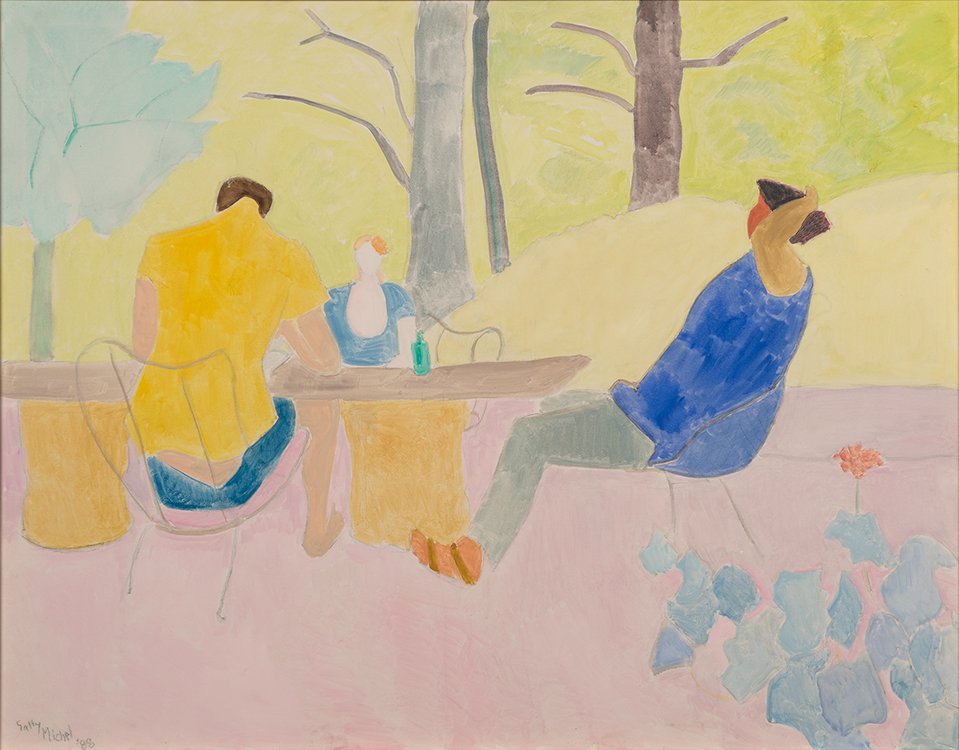
Some works may still be available, please contact the gallery at 212-581-1657.


Essay by Joe Houston

In the 1960s, a variety of artistic practices sought to engage the audience more wholly as participants in the aesthetic experience. Vanguard movements emerged to challenge the conventional, static relationship between object and viewer. Along with performance, installation, and conceptualism, which sometimes dispensed with the art object altogether, there arose an equally radical movement in perception-based art, which gave renewed vitality to the traditional medium of painting. Perceptual art, a term that best encapsulates various tendencies of optical, kinetic, and concrete art, challenged audience passivity through a profoundly visual experience, making the physiological and psychological process of vision a central subject of the art work.

Popularly characterized as Op Art, the work of the most publicized adherents of perceptual art, such as Victor Vasarely, Bridget Riley, and Richard Anuszkiewicz, can trace their lineage in Constructivist practices born in Europe in the early 20th century. The renewed exploration into abstraction and visual phenomena resonated with the idealism of a postwar generation of artists who shared a belief in the democratization of art and society, a worldwide evolution aided by advances in science and technology. The zeitgeist of perceptual art was indeed global, as evidenced in the simultaneous emergence of likeminded work in cultural capitals throughout Europe and the Americas. International publications and exhibitions enhanced the spread of ideas and images on a global scale, leading artists at a remove from the art capital of Manhattan to create progressive work.

Ohio, which had a history of support for geometric art, proved to be a particularly fertile ground for emerging perceptual artists. The educational institutions there formed a nexus for a number of experimental artists. Two leading exponents of perceptual art, Richard Anuszkiewicz and Julian Stanczak, met as students at the Cleveland Institute of Art in the early 1950s. After pursuing graduate study at Yale University in 1956, Anuszkiewicz remained on the East Coast, while Stanczak returned to Ohio, teaching in Cincinnati and later at his alma mater in Cleveland. Hailing from diverse backgrounds, Ernst Benkert, Francis Hewitt, and Edwin Mieczkowski formed the artist collaborative Anonima in Cleveland in 1960 and focused their activities in Ohio before moving their enterprise to New York four years later. Hewitt and Mieczkowski also maintained roots in Cleveland teaching and lecturing at local universities. Working at the margins of the art world had its benefits. “Decisions about what to do were easier at a distance.” Stanczak noted, “In Cleveland I could address myself more completely to my private, creative life.”1

Although Anonima, Anuszkiewicz, and Stanczak pursued separate paths, by the mid-1960s they were exhibiting in many of the same venues and were together included in seminal museum exhibitions of new abstraction. In 1965, each gained national attention from The Responsive Eye, the Museum of Modern Art’s popular and controversial exhibition of perceptual art. William Seitz’s prophetic exhibition gathered a wide variety of artists into one comprehensible perception-based movement, which the press quickly dubbed Op Art. While defining their achievements somewhat narrowly at the time, The Responsive Eye gave Anonima, Anuszkiewicz, and Stanczak considerable exposure and acknowledged each as pioneers of an experiential abstraction. Even reproduced in garish half-tones in the pages of Life magazine, their paintings of reverberating lines, intertwining patterns, and electric color contrasts communicated a systematic logic and visual excitement. Theirs was clearly an art that eschewed tradition, befitting a new technological era. Their emphasis on structures, systems, seriality, research, and communal practice has more in common with the concurrent trends in Minimalism and Conceptualism than has been previously acknowledged. Beyond its specific historical and cultural context, perceptual art remains a testament to the viability of painting and the visual splendor it can achieve. The work of Anonima, Anuszkiewicz, and Stanczak prove the potential for a viewer-centered experience that transcends the material object of art.

Anonima

The Anonima Group accounts for one of the more fascinating chapters in the chronicle of the 1960s art world. Founded in Cleveland as an artist collective by three abstract painters, Ernst Benkert, Francis “Frank” Hewitt, and Edwin “Ed” Mieczkowski, Anonima systematically investigated formal principles in painting and the complex visual phenomena they elicit. Through a structured regimen of research, writing, and studio practice that lasted roughly a decade, the three artists produced a body of closely related work that advanced the notion of the viewer’s own perceptual process as the central subject of the aesthetic experience.

Ed Mieczkowski and Frank Hewitt first encountered each other in 1957 while students at Carnegie Institute of Technology, whose program, influenced by the Bauhaus, emphasized technical and scientific concerns. Hewitt’s grasp of visual theory made a deep impression on Mieczkowski, who, seven years older, was more fully developed as a painter working in an Abstract Expressionist manner. Upon graduation Hewitt left Pittsburgh to pursue advanced study at Oberlin College in Ohio where he met Ernst Benkert, a fellow graduate student who had once studied with Oskar Kokoschka. The two debated the merits of the self-emotive gesture then paramount in painting and determined that prewar forms of geometric abstraction held more promise for them. On a visit back to Pittsburgh to view the 1958 Carnegie International exhibition, Hewitt introduced Benkert to Mieczkowski. The three young artists bonded over their mutual distaste for the informal art that dominated the exhibition, but found assurance in the De Stijl paintings of Mondrian concurrently on display at the museum. The following year, when Mieczkowski settled in Ohio to teach at the Cleveland Institute of Art, the three formed a mutually supportive circle. Their shared concerns about what Hewitt regarded as the “cult of the unconscious hand” in recent art gave impetus to new approaches in their individual painting, which now embraced the principles of European Constructivism that had lay dormant since World War II.

Anonima’s discussion of a more structured approach to art was grounded in Hewitt’s ongoing research in the psychology of perception. The theories of psychologists J.J. Gibson and Edwin Boring, in particular, provided an attractive connection between science and art for the group. Such ideas were beginning to expand the discourse of art history in general, as evidenced in the publication in 1960 of Ernst Gombrich’s Art and Illusion: A Study in the Psychology of Pictorial Representation, another major influence on the three young artists. Hewitt believed that the application of perceptual phenomena to painting could take abstraction beyond the formal experiments of the past. Such techniques — for instance, the appearance of spatial paradox — would not merely result in superficial illusionism, but could provoke a real psychological and physiological response in the viewer. In his essay “Reassessment of the Surface and Subsequent Implications for Contemporary Painting” Hewitt proposed that “the existence of the elements of visual perception…is as substantial and ‘physical’ as the experience of any external object.”2 Our reality, in other words, is that which we perceive.

When in 1960, Mieczkowski and Hewitt teamed together to design a course in Dimensional Drawing for the Cleveland Institute of Art, they codified these ideas into a curriculum of exercises that investigated the spatial possibilities of the 2-dimensional plane. Although Benkert had relocated to New York, the three artists discussed the idea of collaboration. In a meeting in Cleveland they formulated their group as Anonima, taking the name from the term Societa Anonima, Italian for “corporation.” The name suited the concept of a cooperative relationship, while paying homage to the old Société Anonyme for the advancement of modern art. Anonima also suggested anonymity among its members, to the extent that they relinquished individual egos—leaving their work unsigned, for instance—for the advancement of their ideas. Hewitt reasoned that the establishment of such a “program” was an alternative to the status quo, and offered “the framework for a set of criteria that a group of painters might bring to bear on existing work.”3 They would further define their goals to include the establishment of a gallery space, publication of artists’ writings, coordinated communication and cooperation between artists, and organized research, particularly in the psychology of visual perception.

The very concept of such group activity may have seemed heretical in American art in 1960, which was defined by singular voices of modern “masters.” However, at stake was a means for the three men to escape the aesthetic impasse they encountered in postwar painting. This hinged upon a reconsideration of painting not as autographical document, but as a dynamic catalyst for viewer experience. This shift from personal expression to group research resonated with the larger cultural belief in science and technology as a means towards social and economic progress then gaining momentum at home and abroad. While Anonima was unique in the United States, such collaboratives were springing up throughout Europe and Latin America at precisely the same moment. The German Zero Group, which formed in 1957, perhaps provided a model for groups that followed. Among the perception-centered groups to emerge at the time were Equipo 57, formed by Spanish expatriates in Paris in 1957; the Italian Gruppo N and Gruppo T, both formed in 1959; the French group Groupe de Recherche d’Art Visuel (GRAV), founded in 1960; and the Dutch NUL, founded in 1961. Such artist groups initially emerged in cities where socialist ideals were prevalent, and while their members contributed to common projects, each maintained their distinct voice within the group. The artists of newly formed Anonima were unaware that they were part of this growing international phenomenon.

Although Hewitt and Mieczkowski maintained their teaching positions in Cleveland while Benkert taught in New York, their work gained momentum in the summers of 1960 and 1961, when all three worked together at Benkert’s home in East Hampton. In their individual drawings and paintings they explored perceptual issues that Hewitt had elaborated in his writings, joining together daily to discuss their work. Hewitt’s wife Karen, a student of experimental psychology at Oberlin, contributed to the dialogue. The fruits of their labors were exhibited in Recent Development in Visual Design: Perception and Constructs in 1962 at a temporary gallery they established in Cleveland. Among the works exhibited were Benkert’s series of De Stijl-like works in black and white and primary colors that had been executed to order by a professional sign painter. Such experimental work underscored art as a conceptual process, rather than one of labored craft, while neatly echoing the notion of anonymity the group implied.

When Anonima gathered at the studio of Benkert’s father in Mill Spring, North Carolina the following summer, work continued with focused energy on a structured program of studio work, readings, lectures, discussions, and group activities.4 Their work schedule was attended by a more defined program of investigation, which culminated in the group’s first publication In-Out. In 1964, they held their first exhibition in New York in a rented space on West 56th Street. The group’s first exhibition there was their most ambitious and cohesive thus far and included kinetic work by Karen Hewitt. On opening night, the group held a panel discussion on “Geometry and Art,” which included museum director Charles Parkhurst, Constructivist Anthony Hill, and Donald Judd, whom Benkert had befriended in 1960 when they taught at the same school.5 After a favorable review in The New York Times, the show was extended to accommodate the increased number of visitors. The success of their initial outing in the center of the art world was confirmed when dealers Martha Jackson and Denise René engaged Anonima for exhibitions in New York and Paris, respectively.

Anonima’s partnership with Martha Jackson Gallery and their inclusion in Galerie Denise René’s seminal exhibition Mouvements II led to their inclusion in the first significant exhibition of the new perceptual art then being curated by William Seitz for the Museum of Modern Art. The group was among the more than 100 participating international artists and collaboratives selected for The Responsive Eye. Months before its debut in 1965 the exhibition became newsworthy, inspiring the newly coined term Op Art, a snappy retort to the recent trend of Pop Art. A colorful article appearing in Time magazine promoted the tantalizing new work of artists such as Richard Anuszkiewicz, Bridget Riley, Julian Stanczak, as well as the collaboratives Equipo 57, Gruppo N, and Anonima, who—unlike their European counterparts—were individually identified. The article “Op Art: Pictures that Attack the Eye,” noted that Anonima “believe that the rule and compass are proper artist’s tools. Like other op artists, they dislike artistic preciousness, the expression of prima donna personality on canvas, and the psychic plumbing into the meaning of art.”6 This was followed in short order by further exposure for the group in Life, Newsweek, Arts Magazine and elsewhere in the months leading up to the exhibition.

Anonima was represented in The Responsive Eye by primarily black and white works that in divergent ways explored the tension between contradictory visual cues. As Frank Hewitt noted in the Time article, “The quality and depth of the experience (of their work) depend on the willingness to perceive and persistence to overcome certain levels of frustration.”7 Such visual paradox is generated in Hewitt’s Abe’s Box, 1964, through delicate shifts of value and hue. Ed Mieczkowski’s Fuseli’s Box, 1964, creates similar levels of perceptual frustration within a prison-like structure that appears to collapse and expand simultaneously. Ernst Benkert’s Black and White Op-Tickler, completed in the wake of the Time article, satirized what was fast becoming an international fad. Despite its irreverent title, the painting provokes an undeniably palpable sensation of optical flicker, making it difficult for the eyes to rest on any one spot of the composition. It was just such spectral phenomena that made Op so fascinating to the public. Unlike anything that had been seen in America before, such works orchestrated visual events in the viewer, generously leaving room for what Hewitt called “the beholder’s share.”8

In the tumultuous wake of The Responsive Eye, Anonima continued their work with renewed urgency. They were soon included in exhibitions of the new abstraction throughout the U.S. and abroad at the Institute for Contemporary Arts in London, Galeria Foksal in Warsaw, and in the pivotal New Tendencies 3 in Zagreb. Despite commercial interest, the group remained ambivalent of—even antagonistic to—the art establishment. They severed ties with Martha Jackson and redoubled efforts to present and publish their own work outside the commercial system. Privately they relished the notion of exhibiting behind the Iron Curtain, where Constructivism had deep roots. On their travels abroad Benkert and Hewitt conversed with Constructivist masters George Vantongerloo and Henryk Stazewski and initiated personal contact with likeminded collaboratives including Gruppo MID from Milan and the Paris-based GRAV, with whom they promoted their hope for international collaboration.

At its inception Anonima demurred from associating itself too directly with political concerns. However, they had admired Mondrian’s wish for a New Society and held many beliefs in common with their neo-Constructivist counterparts overseas. As Hewitt would later admit, “To address oneself to perceptual issues in the early ’60s was to say that every person is a democrat, an everyman. We were saying that slight increases in perception, or direction in perception, would maybe recreate a new kind of sensibility in the world.”9 While the group maintained an analytic purity to their formal investigations, they became politically active around 1967 in response to the war in Vietnam. In their endeavors in and beyond the studio, they found support and friendship in Ad Reinhardt, who they admired for both his art and activism.10

The Anonima Group moved into a new space on West 28th Street where they alternated periods of studio practice with exhibitions—their own and guest artists—and a schedule of publications and public events. Their program reached full clarity with the initiation in 1966 of a four-year plan to systematically explore key methods of evoking dimensional space on a flat surface: overlap, relative size change, brightness ratio, and light and shade, each to be addressed in successive years. Mieczkowski and Hewitt relocated from Ohio to New York, in 1964 and 1967, respectively, to devote themselves more fully to the program. The first year’s work was exhibited in 1967 at the Anonima Gallery in an exhibition objectively titled Perceptual Inquiry 1: Overlap, followed the next year by Perceptual Inquiry 2: Relative Size Change, each accompanied by publications expounding the Anonima philosophy. Without commercial representation, their exposure continued in significant exhibitions through 1969, including New Tendencies 4 in Zagreb. Their work, which had for a time limited itself to black, white and gray, now embraced the full spectrum of color, which the three intuitively applied to their gridded structures, offering a further element of instability to purposefully ambiguous compositions. Their works conveyed increasingly divergent solutions to common problems. Benkert’s Overlap No.3 (Crimson and Blue), 1966 , complicates our reading of its interwoven lattice pattern with wildly vibrating hues, while Hewitt’s Overlap Series, 1966, employs more subtle system of hues within horizontal and vertical lines, making the color and value shifts difficult to discern. By contrast, Mieczkowski’s Blue Bloc, 1967 is comprised of a nearly digital array of interrupted dots that appear to fade in and out of focus, while simultaneously summoning uncanny effects of illumination within the canvas.

After completing the third year of their plan with the exhibition Brightness Ratio, the group began to lose its coherence due to increasing family obligations, antiwar protests, and a waning interest in the overall program. Work on the fourth year’s exercise Light and Shade was abandoned when Mieczkowski returned to his teaching positing in Ohio and the Hewitts relocated to Vermont, effectively ending the most productive chapter in the group’s history. With the final Anonima exhibition at the State University of New York at New Paltz in 1970 and retrospective the following year at the University of Vermont, the group had reached the status of a historical movement. Benkert, Hewitt, and Mieczkowski remained close friends, offering continued support for each other’s solo careers. Upon the dissolution of Anonima, each artist drew on the group’s experiments in future work: Benkert refocusing his attention to drawing; Hewitt to a more intuitive approach to painting up until his death in 1992; and Mieczkowski to ever more elaborate investigations in dimensional painting.

Richard Anuszkiewicz and Julian Stanczak

Although two very singular artists, Richard Anuszkiewicz and Julian Stanczak share a common background and parallel careers as preeminent colorists of perceptual abstraction. The two met in the early 1950s as undergraduate students in Cleveland, where they gained a typical academic training. In 1954 they enrolled in the progressive graduate program at Yale University, where they roomed together for a time. There they studied with Josef Albers and discovered the writings of gestalt psychologist Rudolph Arnheim, whose Art and Visual Perception: A Psychology of the Creative Eye—published the year they entered Yale— influenced their preoccupation with visual phenomena. Albers’ theories of color interaction and Arnheim’s explanation of visual phenomena were synthesized by the two young artists, who upon graduation quickly developed radical, and closely related, approaches to abstraction. After obtaining a further degree in teaching at Kent State University in Ohio, Anuszkiewicz returned to the East Coast, settling eventually in New Jersey. Stanczak, however, returned to Ohio to teach, first in Cincinnati and later at the Cleveland Institute of Art.

While Anuszkiewicz and Stanczak remained in contact, they each devoted themselves independently to the development of their own work, each exploring in different means the powerful effects of color on human perception. Anuszkiewicz applied his knowledge of color theory and principles of visual perception to measured, geometric compositions comprised of precise linear patterns, which often emanate outward from the center of his canvases. Gridded structures and square formats provided the firm footing for increasingly dynamic experiments with complementary colors. In color he found a subject that was ever contemporary, noting “The ideas I work with are essentially timeless… and if color or form is visually exciting in any profound sense, it will be that way ten or twenty years from now also.”11 Complementary Forces, executed in 1964, proves the point. In this diamond-like composition a dynamic network of turquoise lines throbs against a tomato–red ground, its arresting effect transcends historical or cultural specificity, remaining ever fresh to our eyes.

By the time his work appeared in The Responsive Eye, Anuszkiewicz had already been included in important museum exhibitions such as the Whitney Museum of American Art’s Geometric Abstraction in America, as well as in galleries in New York and Paris. His uncanny work gained him wider admiration as one of the “new wizards”12 of Op, as identified by Life magazine and found easy favor with the press and the culture at large.13 Having established his reputation early (MoMA bought their first painting by him in 1960), Anuszkiewicz transcended the category of Op with his participation in major exhibitions of contemporary art throughout the 1960s, including the Carnegie International, Whitney Biennial, Corcoran Biennial, and Documenta. His continued association with perceptual artists is evidenced in his curation of the exhibition The Square in Painting in 1968, which included the work of Anonima and Stanczak.

In contrast to Anuszkiewicz’s scientific approach, Julian Stanczak found inspiration for abstraction in nature. The undulating hills, rippling river, and bending grasses of the Ohio landscape found their parallel expression in his rhythmic paintings of wiggles and crosshatching lines. After gaining attention in museum exhibitions throughout Ohio, including a solo show at the Dayton Art Institute, Martha Jackson invited him to exhibit at her New York gallery, giving him his first significant exposure outside the Midwest. Julian Stanczak: Optical Paintings opened in 1964, prompting review by Donald Judd in Arts Magazine, who snidely characterized the work “op art,” the first occurrence of the term in print. Despite his dissatisfaction with the label, Stanczak quickly became a reluctant ambassador to the new movement, garnering attention in the popular press and earning his place in museum exhibitions on the new abstraction throughout the 1960s and beyond.

Stanczak’s paintings of the decade generate radiant energy and internal illumination through complex interactions of contrasting hues. Quintessence, painted in 1969 demonstrates his deft handling of color to create a palpitating visual field that seems to extend beyond the borders of the canvas. In this composition overlapping linear elements appear to dissolve, summoning phantom forms and colors that are not actually painted. The sequencing of highly ordered elements prefigured advances to come in the union of technology and art, as one critic of his 1965 show at Martha Jackson noted, “While quietly laughing at the notion of computer art Stanczak dazzles with a super-computer human virtuosity.”14 With a combination of technical rigor and creative intuition Stanczak’s paintings exemplify a belief in the centrality of the viewer in the experience of painting, which finds its completion not on the surface of the canvas, but in the mind’s eye. As he stated so eloquently, “I am not important—the viewer is.” (15)

1 Stanczak interview with Dave Hickey, Julian Stanczak. New York: Danese, 2008.

2 Hewitt, Francis, “Reassessment of the Surface and Subsequent Implications for Contemporary Painting.” Mimeograph typescript with notations by Hewitt. Collection of the author.

3 Hewitt, Francis, “A Program for Painting,” 1961 excerpted in Anonima Group Retrospective 1960-1971, Robert Hull Fleming Museum, The University of Vermont, Burlington, 1971.

4 In a letter to Benkert, he noted “I would like to have a schedule typed, even with dates, say. Mon. Wed. and Fri. or Sun eve. sessions, with preplanned and prepared talks.” Hewitt, Karen, editor, Francis R. Hewitt, p. 17, The Institute for Progressive Painting, 1994.

5 Benkert recalls Judd provocatively remarked that he admired Pollock “because he put the whole idea of painting to rest, once and for all.” [Phone conversation with the author, March 2010].

6 Borgzinner, John, “Op Art: Pictures that Attack the Eye, Time, October 23, 1964, p. 85.

7 ibid 3.

8 Gombrich, Ernst, Art and Illusion: A Study in the Psychology of Pictorial Representation. Princeton University Press, 1960.

9 As quoted in: Oren, Michel, “The Anonima Program for Perceptual Re-education,” 1960-70, Cleveland Studies in the History of Art, Vol. 5, 2000 pp. 49-50.

10 This culminated in 1969-1970 when the Anonima Group joined the Art Workers’ Coalition. At the same time, Hewitt, Benkert, Mieczkowski and their former student Gerry Herdman formed a splinter group called Minority A that, among other things, protested meetings of the Art Workers’ Coalition because of some of its members’ ties to commercial galleries and institutions.

11 As quoted in: Lunde, Karl, Anuszkiewicz, Harry N. Abrams, New York, 1977, p. 80.

12 “OP ART,” Life magazine, December 11, 1964, p.133.

13 A salient example of this occurred when collector and garment manufacturer Larry Aldrich used his work — along with Bridget Riley, Julian Stanczak, and Victor Vasarely — as patterns for dresses without his consent. Later Anuszkiewicz partnered with a furrier to produce hand painted coats of his own design.

14 Berrigan, Ted, “Exhibition at the Jackson Gallery,” Art News, October 19, 1965.

15 McClelland, Elizabeth, Julian Stanczak: A Retrospective, 1948-1998, Butler Institute of American Art, 1998, p.36.

Joe Houston is curator of the Hallmark Art Collection and author of OPTIC NERVE: Perceptual Art of the 1960s, published by Merrell in conjunction with the 2007 Columbus Museum of Art, Ohio exhibition.

© Joe Houston, 2010

Press Release

D. Wigmore is pleased to announce its exhibition with catalogue, Op Out of Ohio: Anonima Group, Richard Anuszkiewicz, and Julian Stanczak in the 1960s, beginning April 15, 2010. The exhibition will feature over 30 paintings from 1959 to 1970 by Richard Anuszkiewicz (b.1930), Julian Stanczak (b.1928), and the three artists of the Anonima Group: Ernst Benkert (b.1928), Francis Hewitt (1936-1992), and Ed Mieczkowski (b.1929). A highlight will be four paintings from the Museum of Modern Art’s groundbreaking 1965 exhibition The Responsive Eye, curated by William Seitz, which placed optical, kinetic, and concrete art into one perception-based movement which the press dubbed “Op Art.”

Each of the artists in the exhibition studied or taught at Ohio institutions. Richard Anuszkiewicz and Julian Stanczak met as undergraduates at the Cleveland Institute of Art in the early 1950s before both studied at Yale University with Josef Albers from 1954-1956. Stanczak returned to the Cleveland Institute in 1964 to teach painting, which he did until 1995. Francis Hewitt and Ernst Benkert met as graduate students at Oberlin College in 1959. After meeting as students at Carnegie Tech in the mid-1950s, Hewitt and Ed Mieczkowski both taught at the Cleveland Institute in the early 1960s. Mieczkowski continued to teach there until 1990.

The Anonima Group, all artists interested in the psychology of perception and the European Constructivists, did their first work together at Ernst Benkert’s Springs, Long Island studio the summer of 1960. The group was unique in the United States, but its formation paralleled such European groups as Gruppo N and Gruppo T in Italy; Zero in Germany; and Groupe de Recherche d’Art Visual (GRAV) in France. After several exhibitions in Cleveland, the Anonima Group had its first New York exhibition in 1964. In the winter of 1964-1965 they participated in major exhibitions of perceptual art: Vibrations 11 at Martha Jackson Gallery and Mouvement II at Galerie Denise René in Paris, as well as MoMA’s The Responsive Eye in February 1965. In 1966 the Anonima Group’s project Black/White and Gray 24” Square, with ten paintings by each artist, was exhibited in New York and at the Institute of Contemporary Arts, London and Galeria Foksal in Warsaw. Anonima participated in the New Tendencies exhibitions in Zagreb in 1965 and 1969.

The Anonima Group set up a loft on West 28th Street in 1966 which functioned as a shared studio for the three artists and an exhibition space for Anonima’s work, as well as for their students. The artists developed a four-year plan to examine the four perceptual cues that create the reading of spatial dimension on a two-dimensional surface: overlap, relative size change, brightness ratio, and light and shade. Over the course of a year for each project, the group painted alongside each other using the same limit while creating independent work. Each project was then exhibited in the Anonima Gallery. D. Wigmore’s exhibition includes six examples from the group’s first project Perceptual Inquiry I: Overlap, exhibited in April 1967.

Richard Anuszkiewicz and Julian Stanczak are considered the two students who most embraced Josef Albers’s theories on color interaction. Anuszkiewicz’s work applied the latest findings in color theory and visual perception to measured, geometric compositions of precise linear patterns within gridded or square formats, which often emanate outwards from the center of the canvas. Stanczak applied the same knowledge to nature-inspired compositions of wiggles and juxtapositions of curved and angular forms, which radiate energy and internal illumination. With two different approaches, Anuszkiewicz and Stanczak express the excitement of color and make an event of the act of seeing.

The Museum of Modern Art purchased a painting by Anuszkiewicz in 1960 from the artist’s first New York solo exhibition at The Contemporaries. The D. Wigmore exhibition includes one of Anuszkiewicz’s paintings exhibited in MoMA’s Americans 1963 (The Harpist and Nine Muses, 1963), as well as the artist’s All Things Do Live in the Three, 1963 exhibited in The Responsive Eye. Julian Stanczak had his first solo exhibition in New York in the fall of 1964 at Martha Jackson Gallery. The exhibition’s title Julian Stanczak: Optical Paintings played on the growing talk of the “optical” style; the exhibition led artist and critic Donald Judd to use the term “Op Art” for the first time in print in his review of the exhibition for Arts Magazine. Stanczak and his teacher Albers preferred the use of “perceptual art” to describe these paintings which engaged the viewer’s eye and mind, but critics preferred Op as a counter to “Pop Art.” The D. Wigmore exhibition will have a major 1970 painting by Stanczak titled Burning Through, #III. Two other examples from this series are in the JPMorgan Chase Art Collection and the Carnegie Museum of Art.

[ TOP ]
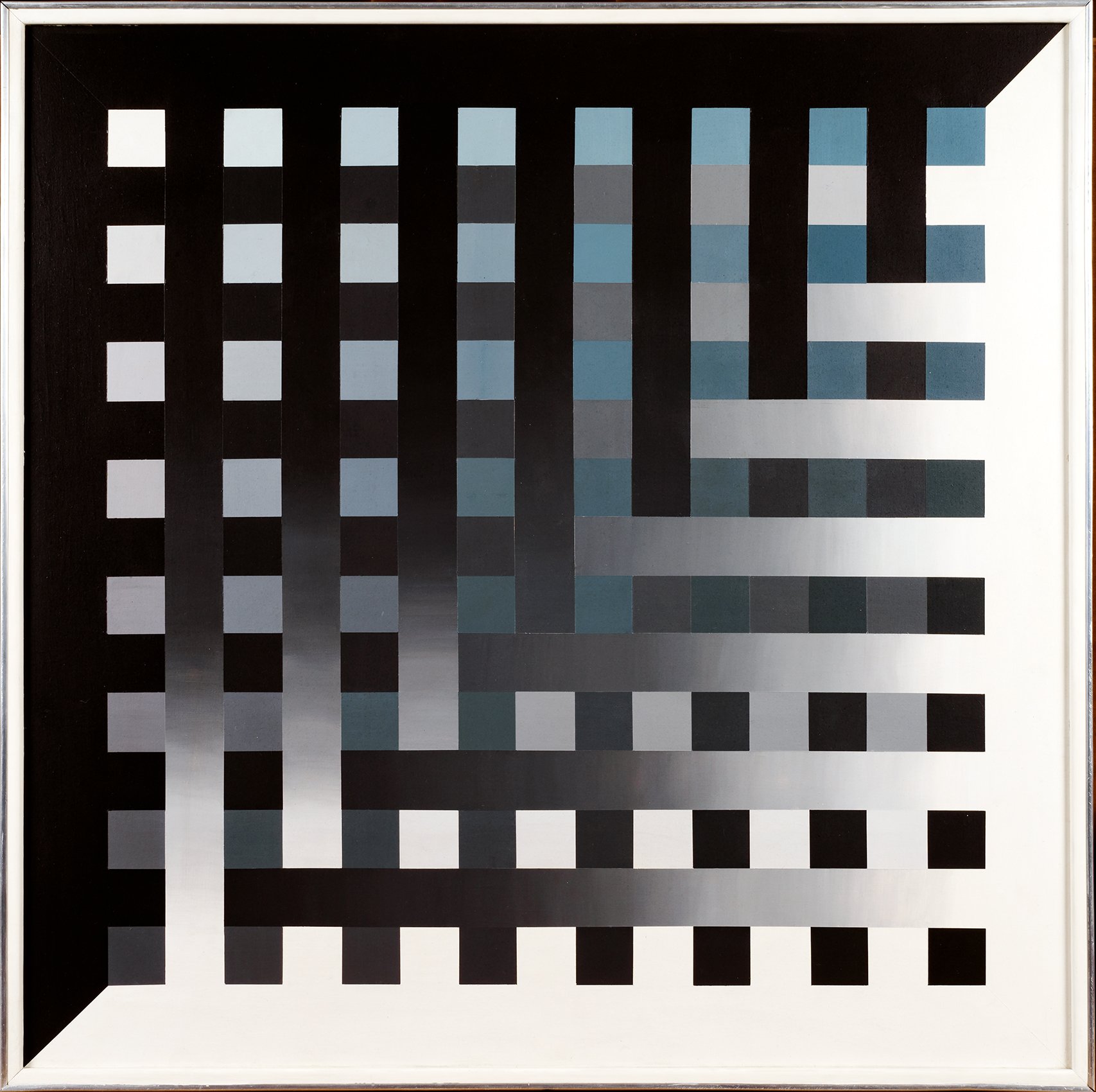
Modernism 1913-1950 | Realism of the 1930s and 1940s | Abstraction of the 1930s and 1940s | Post-War | Selected Biographies