WITOLD GORDON (1885-1968)
Available Work | Biography
Biography • Witold Gordon (1885-1968)
Witold Gordon was born in Poland, graduated from the Warsaw Academy of Fine Arts, and fled his homeland during the political upheaval of the Teens. His studies continued at the Ecole des Beaux Arts in Paris and in Italy. He came to the U.S. in 1914, settled in Manhattan and established his career as illustrator, designer, and muralist.
Gordon met Helena Rubenstein in Paris before coming to the United States, and for many years served as her design consultant on everything from cosmetics packages and advertising to the Countess Rubenstein Salons and her private art collection. It is likely that his association with Madame Rubenstein was responsible for a series of editorial illustrations in the April, July and August 1915 issues of Vanity Fair.
Gordon worked in a variety of media. He made costume designs for La Forza del Destino mounted by the Metropolitan Opera in 1918. These costumes were in use until 1944. He started designing theater posters. In 1929 he illustrated the Horace Liveright collector's edition of Manuel Komroff's Adventures of Marco Polo. In the 1930s, Gordon worked with Donald Deskey on interiors for parts of Rockefeller Center. He made two murals for Radio City Music Hall: History of Cosmetics in the lower level Ladies’ Lounge, and A Map of the World in the Gentlemen’s Smoking Room on the first mezzanine. Both murals remain in place.
An important advertising commission of the period was the design of promotional pieces and posters for the 1932 Olympics Winter Games at Lake Placid. Gordon created the cover for the Marshall Field 1941 Christmas catalogue, a parade of the stores, houses and churches of Main Street.
Vanity Fair published 15 small paintings of New York's store fronts in July 1934 under the title “New York Shops You Never See.” Gordon focused on the signs people paint, the bills they post, and how they build and decorate their homes and workplaces. The Museum of Modern Art had an exhibition of 35 gouaches titled American Scene by Witold Gordon in 1941.
Witold Gordon did many posters for Broadway productions from the 1920s-1940s, most notably Artcraft Lithograph and Printing Co. Inc and its predecessor, Golden Printing Service. Many of his theater posters are held at the Theater Collection of the Museum of the City of New York and the Harvard Theater Collection.
The New York World's Fair of 1939-40 was a great showplace for Witold Gordon. He executed a mural on the bright blue waved wall of Edward Stone's Food Pavilion II. The Distiller's Building had mosaic fountains, another mural and stylized grains motif displayed over the entry, all Gordon designed. He also did the murals in the Arkansas State Pavilion, New Zealand Pavilion and in one of the two House of Jewels.
The Rich family of Atlanta gave Gordon a commission to do murals for their store's main floor. To research the area, Witold and his wife Marie spent several months driving through the South with Gordon recording the buildings and signs he saw along the way. The New Yorker commissioned Gordon to paint eight covers, published from 1944 to 1948, with his observations of small businesses, such as a pillow shop in the Lower East Side, a pastry shop in Little Italy, and the sign for a chiropodist's office over the Corn Exchange Bank on Sheridan Square. The original art for the April 6, 1946 issue depicts marine supply shops along Front Street and is in the collection of the Museum of the City of New York.
In 1936 Gordon began designing Christmas cards for the American Artists Group. They published several hundred of his designs throughout Gordon’s lifetime. In 1952 Gordon participated in a fabric design project with Reeves Lewenthal at Associated American Artists. Theatrical posters continued to occupy some of his talent, but he began to devote almost full time to painting.
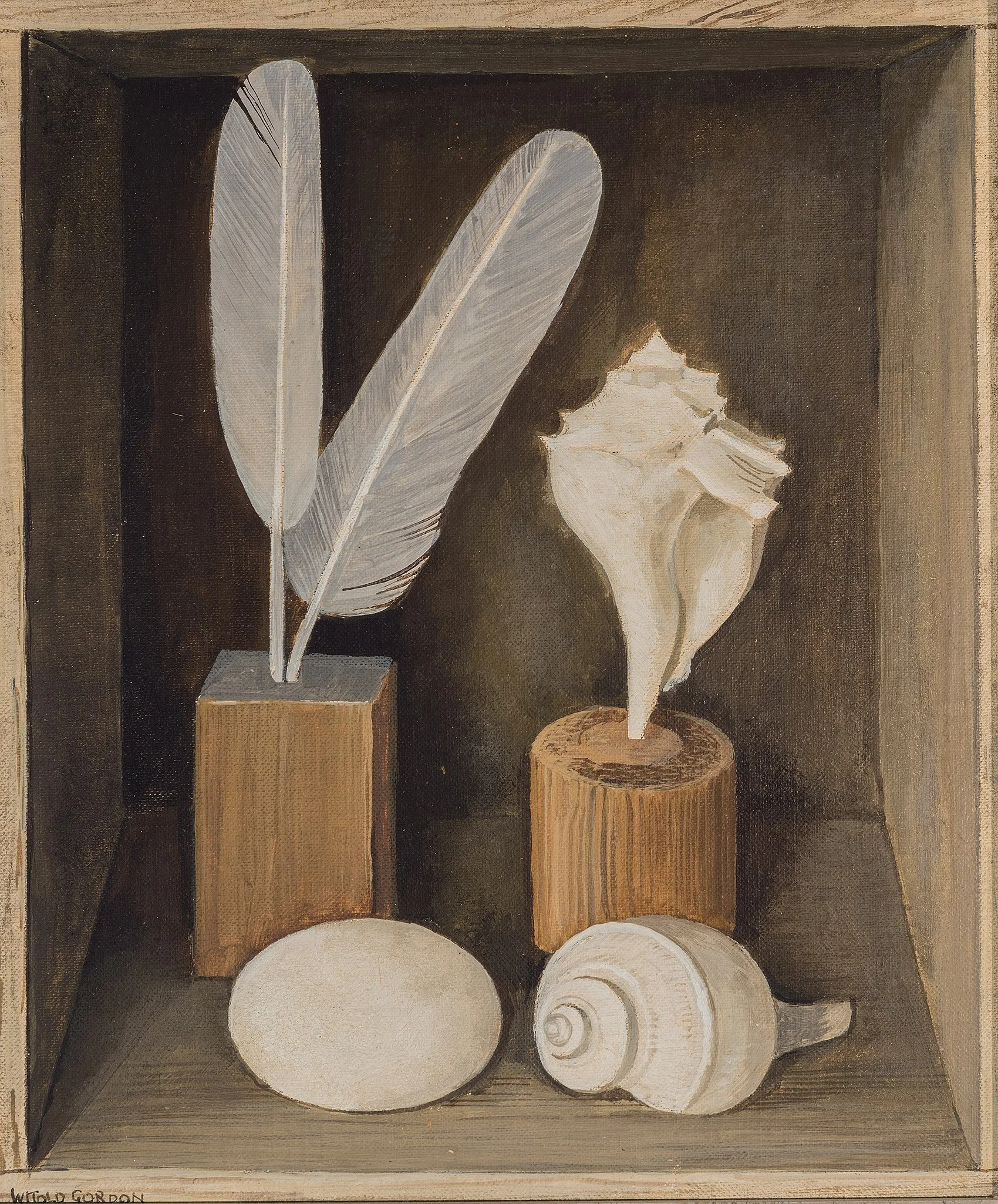
Gordon is represented in the collections of the Museum of the City of New York, Cooper Hewitt Museum, and the Whaling Museum of Sag Harbor. From the end of World War I, Gordon and his wife Marie spent long summers going to France each year until 1929 then spent several summers on Long Island's North Shore at Sea Cliff. During World War II they spent summers at Candlewood Lake sharing Alexander Calder's house boat with their friends Edgar and Louis Varese. As an illustrator in demand, Gordon used long summers, May to mid-October, to paint and sketch for his own pleasure.
After he developed heart problems in the early 1960s, Witold and his wife Marie moved from their Manhattan apartment and studio to a house in Sag Harbor. After a bout with cancer, Witold Gordon died in Southampton Hospital in 1968.