IRENE RICE PEREIRA (1902-1971)
Available Work | Biography
Biography • Irene Rice Pereira (1902-1971)
Irene Rice Pereira was the first child born to Emery and Hilda Vanderbilt Rice in Chelsea, Massachusetts in 1902. Her family moved to Pittsfield, Massachusetts in the Berkshires, before settling in Great Barrington, Massachusetts where her father ran a bakery and raised horses. The family relocated to Brooklyn by 1910. With the death of her father in 1917, Irene switched from an academic to a vocational track and began work as a secretary to support her mother and three younger siblings.
By 1927 Pereira was financially secure enough to pursue her study of art. Taking night classes at the Art Students League, she was greatly influenced by the teachings of Jan Matulka. In 1931 Irene Rice Pereira traveled to Paris and then throughout France, Italy and North Africa.
Irene Rice Pereira returned to New York in 1932 and began to produce Modernist-style oils using anchors, ventilators and machines as their focus. The subjects were directly influenced by the long hours Pereira spent sketching during her trans-Atlantic voyages. Works from this series were exhibited in her first solo exhibition at ACA Gallery in 1933. In her 1934 and 1935 ACA exhibitions Pereira showed paintings that incorporated semi-abstract figures into machinery settings. Pereira was included in the second Whitney Biennial in 1934 and the major exhibition Abstract Painting in America at the museum the following year.
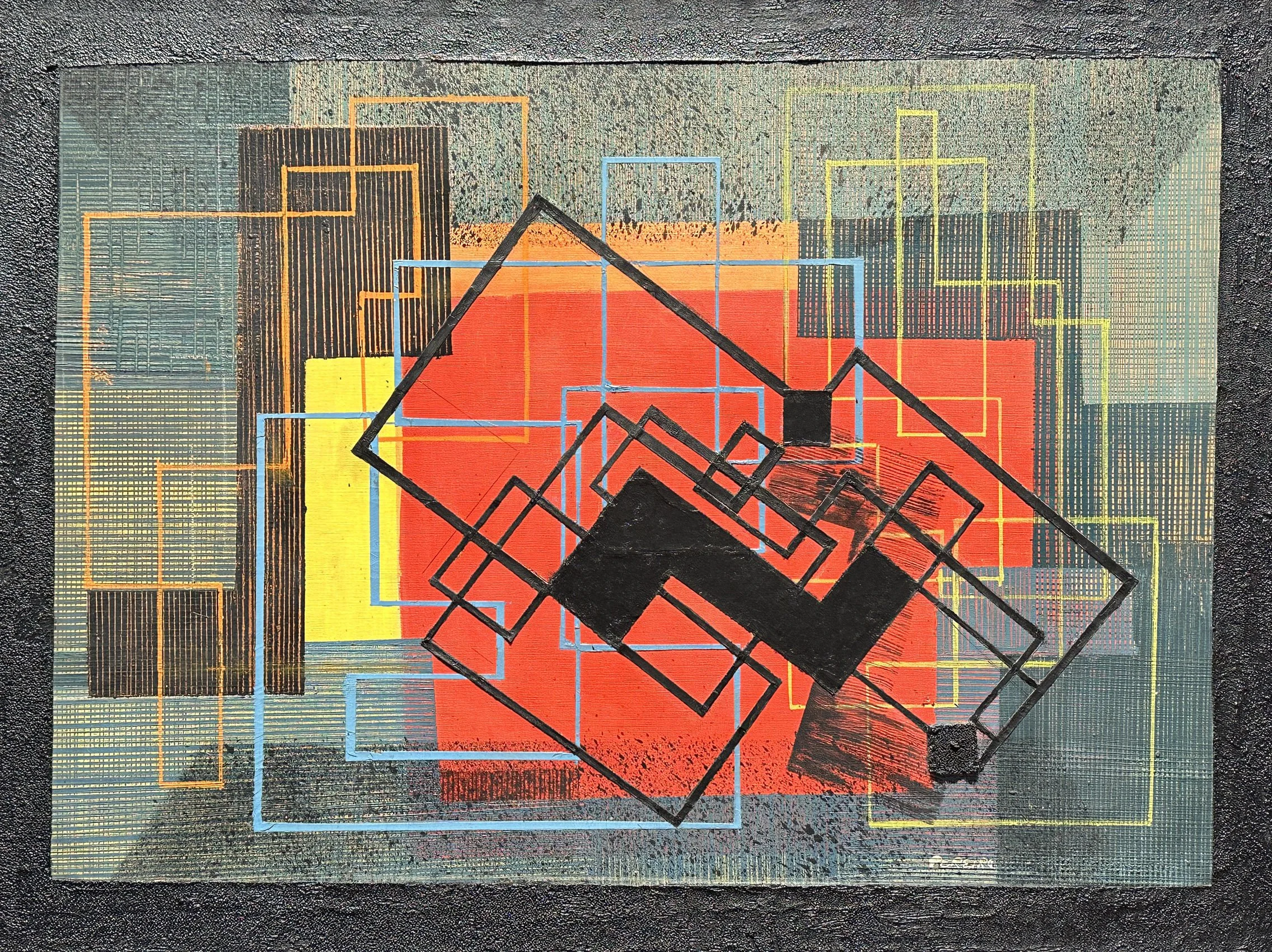
In 1937 Pereira painted her first purely abstract paintings, a result of her interest in the Bauhaus and Russian Constructivist movements. These works were exhibited at the East River Gallery. Pereira used the textures in her paintings to create light vibrations of changing speed and intensity, finding that pigment freed from its representational tasks could produce luminosity. Pereira received a solo exhibition at Howard University in Washington, DC in 1938.
When the WPA’s Federal Art Project created Design Laboratory, a cooperative school of industrial design, in 1937, Pereira was selected as the artist on faculty. Modeled after the Dessau Bauhaus, the Design Laboratory stressed experimentation with materials such as wood, metal, ceramics, glass, plastic, and textiles. Pereira helped develop the Design Laboratory art course and was a teacher there until 1939. Pereira also worked for the Easel Division under the WPA Project until 1939.
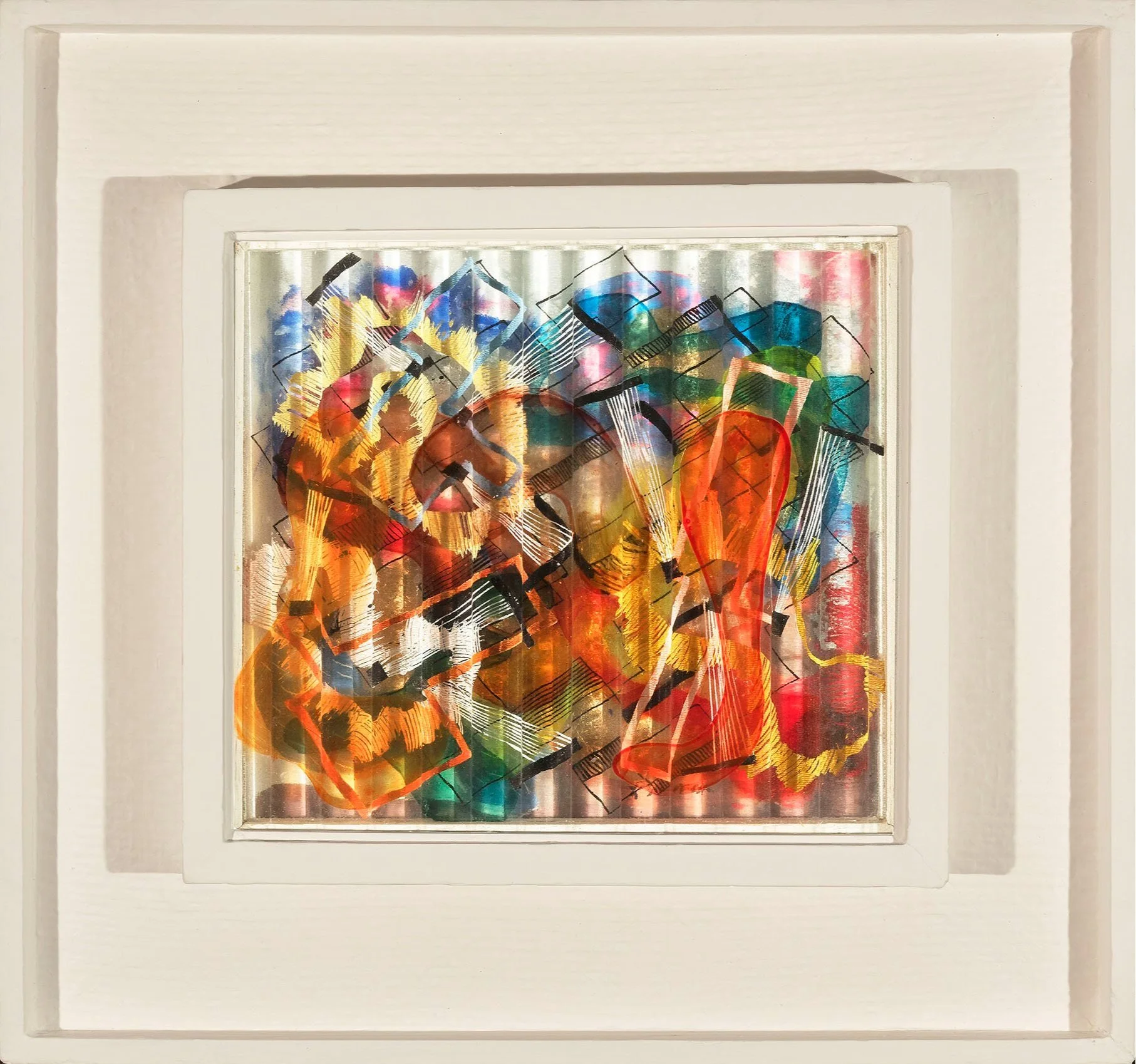
In 1939 Pereira first started painting on glass, plastic, and parchment to create three-dimensional depth in her works by using its transparent properties. Access to glass workers through the Design Laboratory may have facilitated this experimentation. Her first oil on glass painting, dated 1939, started off as a design for a window. Instead of individual segments connected with lead, Pereira painted her motif on the back of the glass and then encased it in a shadow box, thus creating a picture rather than a window. Such glass paintings had antecedents in Duchamp, Kandinsky, Albers, and Moholy-Nagy, but Pereira’s glass paintings were unique attempts to show both light and time, as the first physical representation of the fourth dimension. Pereira withdrew from the Easel Division of the Federal Art Project and the Design Laboratory in 1939. Pereira then aligned herself with New York abstract painters by joining the American Abstract Artists group and taking a job as an assistant to Hilla Rebay, director of the Museum of Non-Objective Painting, which she held until 1942.
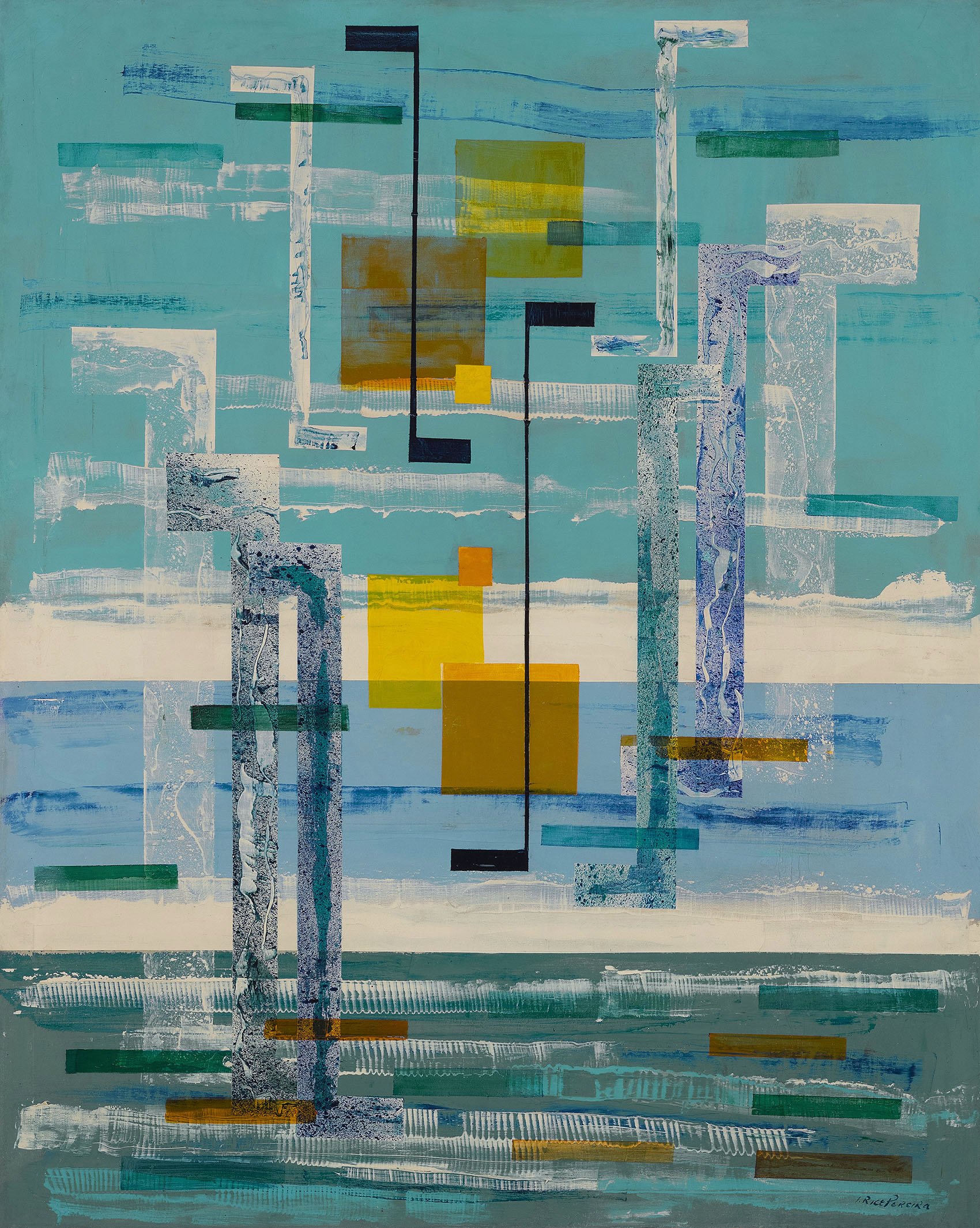
The 1940s saw further maturation of the artist’s work, recognized in 1940 by the Museum of Modern Art’s purchase of Pereira’s third oil on glass painting, Shadows on Painting, 1940. She was deeply stirred by new concepts of matter, energy and space, and in 1943 Pereira’s work began to exhibit a deeper sense of space and much more complex designs. Maze-like, or window-like, designs created depth on the flat surface of the canvas, while different colors juxtaposed in her compositions were used to indicate space, matter and time. These developments in Pereira’s repertoire attracted museum attention, and both the Newark Museum and the Metropolitan Museum purchased her work in 1944 and the Museum of Modern Art included her in their Fourteen Americans exhibition in 1946, which opened at MoMA in September then traveled across the country.
Irene Rice Pereira had a two-year affiliation with Peggy Guggenheim, first exhibiting at Guggenheim’s Art of This Century gallery in 1943 followed by a solo exhibition of 22 abstract paintings in 1944. Guggenheim arranged an exhibition of Pereira’s paintings on canvas, parchment, and glass at the Arts Club of Chicago in March of 1945. Pereira returned to ACA Gallery and had a solo exhibition there in February of 1946.
Through the late 1940s and into the early 1950s, Pereira continued to refine her skills as an artist and to create ever more complex paintings. In 1950 Pereira married the Irish poet George Reavey and the couple settled in Manchester, England. Although Pereira received recognition including exhibiting two paintings at the Institute of Contemporary Arts in London, the dreary skies of Manchester left Pereira wishing to return to New York. She was offered the position of artist-in-residence at Ball State University in 1951 and went to Indiana before returning to New York.
In the 1950s, Pereira became an accomplished poet and author, publishing ten books of poems and essays, including The Nature of Space: A Metaphysical and Aesthetic Inquiry, 1956. As abstraction came to dominate the artistic community of America in the 1950s, Pereira continued to enjoy much success as a painter. The Whitney Museum of American Art held a major exhibition on Irene Rice Pereira and Loren MacIver curated by John I.H. Baur in 1953. In the late 1950s, Pereira began to focus more on her writing and poetry, which led to the Lapis paintings executed in the 1960s until her death in 1971.
Irene Rice Pereira’s work is in numerous collections including Addison Gallery of American Art; Arkansas Museum of Fine Arts; Art Institute of Chicago; Blanton Museum of Art; Brooklyn Museum; Cleveland Museum of Art; Dallas Museum of Art; Guggenheim Museum; Lowe Art Museum; Metropolitan Museum of Art; Museum of Fine Arts, Boston; Museum of Modern Art, New York; Munson-Williams-Proctor Arts Institute; National Gallery of Art; North Carolina Museum of Art; Phillips Collection, DC; Rhode Island School of Design; Rose Art Museum; Skidmore College; Smithsonian American Art Museum; Syracuse Museum of Art; Toledo Museum of Art; University of Arizona Museum of Art; Wadsworth Atheneum; Walker Art Center; and Whitney Museum of American Art.