ESPHYR SLOBODKINA (1908-2002)
Available Work | Biography
Biography • Esphyr Slobodkina (1908-2002)
Esphyr Slobodkina was born in Siberia in 1908. In the wake of the Russian Revolution, her family fled to Vladivostok before settling in Harbin, Manchuria. In 1928 Slobodkina immigrated to New York City. She enrolled in the National Academy of Design the following year primarily to meet the requirements of her student visa. Through a fellow student at the Academy Slobodkina met her future husband Ilya Bolotowsky. A progressive thinker who had yet to experiment with abstraction in his own painting, Bolotowsky introduced Slobodkina to modern theories of art, particularly in relation to form, color and composition. Associations with Balcomb and Gertrude Greene, Byron Browne and Giorgio Cavallon further exposed Slobodkina to the ideas of these pioneer abstract artists and sparked a personal interest in the movement.
An invitation to the Yaddo artist colony brought Slobodkina and Bolotowsky to Saratoga Springs, New York in the early 1930s. It was during this visit that Slobodkina began tentative experimentation with abstraction, leading to her first Cubist-inspired work in 1934. Around this time Slobodkina’s family moved to New York City, which temporarily sidelined her artistic progression as she was under great financial pressure to help support them. With her mother, Slobodkina opened a dress shop where she both designed and made the clothing. She also worked textile design firms throughout these years.
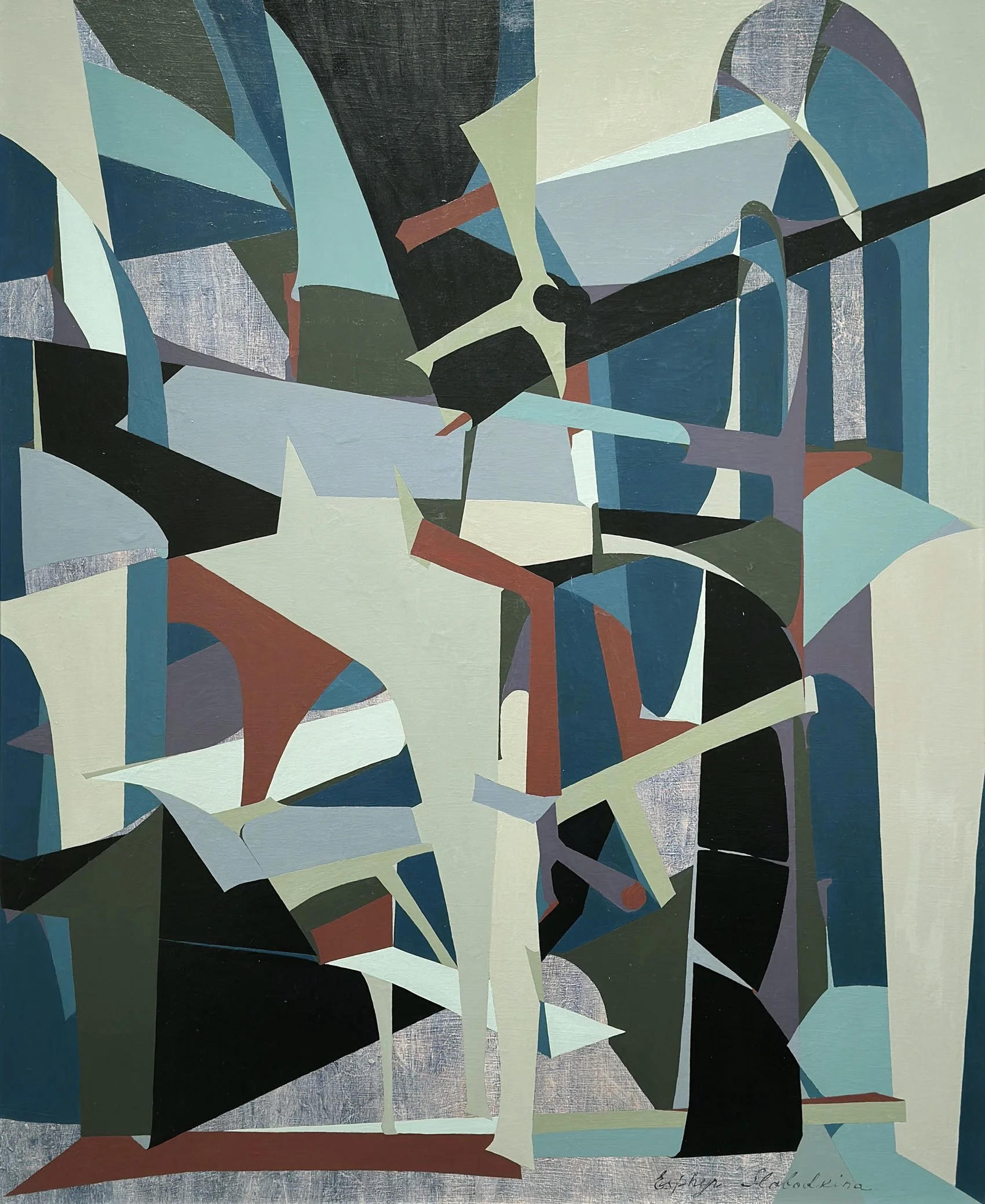
In 1935 Slobodkina separated from Ilya Bolotowsky and joined the Works Progress Administration. She also became very active in the Artists’ Union, designing posters for them in paper collage. It was through collage that she was able to develop her abstract style. By 1936 she had fully embraced abstraction as a means of artistic expression and her paintings reflected the influence of collage with their flat layered forms and carefully constructed arrangements. In the mid-1930s Slobodkina created several Surrealist-inspired sculptures made of wood, wire, and found objects. In 1937 she became a founding member of the American Abstract Artists and went on to be the group’s president in later years.
Upon meeting Margaret Wise Brown, the children’s books author, in 1937, Slobodkina was inspired to try her hand at book illustration. She provided the illustrations for Brown’s The Little Fireman before writing and illustrating her own books, most notably Caps for Sale, published in 1938. She continued to illustrate children’s books through the 1980s.
In the early 1940s Slobodkina found a patron in A. E. Gallatin who purchased two of her works for his Museum of Living Art. Slobodkina was included in the important exhibition Eight by Eight: Abstract Painting Since 1940 at the Philadelphia Museum of Art in 1945 which also featured Charles Green Shaw, George L.K. Morris, A.E. Gallatin, Suzy Frelinghuysen, Ilya Bolotowsky, Alice Trumbull Mason, and Ad Reinhardt. She exhibited in the Whitney Museum of American Art’s annuals through the 1950s. In 1957 Slobodkina was invited back to Yaddo and in 1958 she took two trips to the MacDowell Colony in New Hampshire. Her recent work was then included in an exhibition at the New School for Social Research in New York in 1958.
Her paintings and sculptures are part of the collections of The Metropolitan Museum; the Smithsonian American Art Museum; the Philadelphia Museum of Art; the Heckscher Museum of Art; Hillwood Art Museum; and the Whitney Museum of American Art.